
The British School of Existential Analysis is the term used for the descriptive, phenomenologically grounded strand of existential therapy that developed in the United Kingdom from the late 1980s onward, organized around the Society for Existential Analysis and the writings of Emmy van Deurzen and Ernesto Spinelli 16. For practicing clinicians, its distinguishing feature is not a technique package but a stance: meeting the client’s lived experience directly, mapping it across the dimensions of existence, and working with the paradoxes of being alive rather than reducing them to symptoms 23.
Type & Discipline
This is a modality within the family of existential therapy, sitting at the intersection of counseling psychology, psychotherapy, and applied philosophy 16. Van Deurzen is explicit that the approach is fundamentally philosophical rather than medical, drawing on roughly three thousand years of philosophy and especially on phenomenology, to ask “what it means to be alive” rather than to fit clients into predetermined diagnostic frameworks 2. In practice this means it is delivered as talking therapy by counsellors, psychotherapists, and psychologists, but its conceptual machinery comes from phenomenology and existential philosophy rather than from a medical or behavioral model 27. Clinicians coming from a CBT or psychodynamic background should expect a deliberate shift away from formulation-as-explanation toward description and clarification of experience LLM.
Creators & Lineage
The institutional anchor is the Society for Existential Analysis (SEA), established in 1988 to advance public education in Existential Psychotherapy and to foster and disseminate research into existential thought and psychotherapy 1. The SEA accredits existential psychotherapy training and registers qualified graduates with the UK Council for Psychotherapy, and it brings together students, counsellors, psychotherapists, psychologists, academics, and philosophers from the UK and abroad 1.
The central figure is Emmy van Deurzen, born in The Hague in 1951, who trained in both philosophy (with a thesis supervised by the phenomenologist Michel Henry) and clinical psychology before moving to Britain 6. Her early clinical formation included work with R.D. Laing and colleagues at the Philadelphia Association and the Arbours Association, situating the British school in the lineage of the anti-psychiatry and phenomenological psychiatry traditions 6. She founded the SEA in 1988, the School of Psychotherapy and Counselling at Regent’s College in 1990, the New School of Psychotherapy and Counselling in 1996, and the Existential Academy in 2010 6. Ernesto Spinelli is the other principal figure associated with the British school’s development 6. The broader intellectual lineage runs through existential psychotherapy, phenomenology (Husserl, Heidegger, Binswanger), and humanistic psychology, with logotherapy’s emphasis on meaning a recognizable cousin 26.
Core Principles
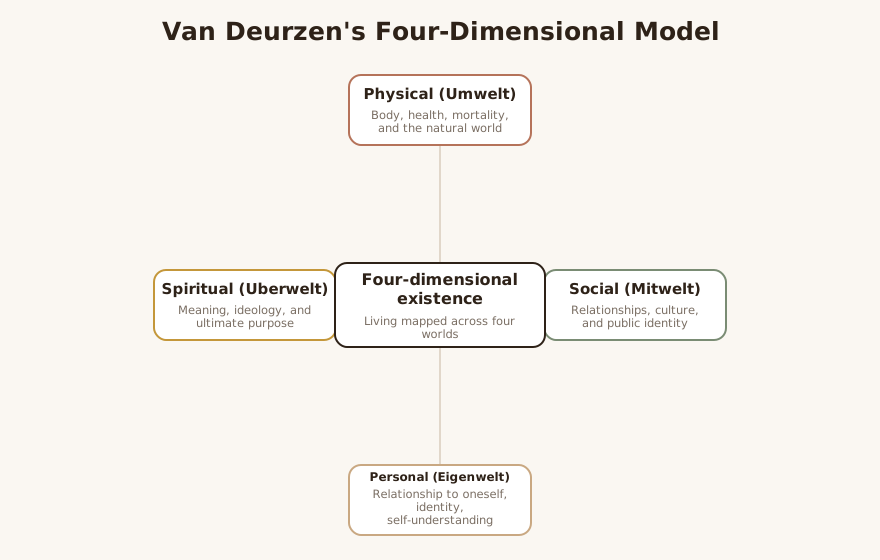
The organizing idea is that human existence is lived across four dimensions, sometimes called the four-dimensional force field or four worlds 25. The physical dimension (Umwelt) is our relationship to the natural world—body, health, mortality, possessions, and the givens of the environment—where the central tension is between dominating nature and accepting natural limits 2. The social dimension (Mitwelt) covers relationships, culture, and public identity, with polarities of acceptance versus rejection and cooperation versus competition, and the eventual confrontation with failure and aloneness 2. The personal dimension (Eigenwelt), sometimes called the psychological dimension, concerns our relationship to ourselves, identity, and self-understanding, with tension between self-affirmation and surrender 2. The spiritual dimension (Überwelt) is the realm of meaning, ideology, and ultimate purpose, bridging purpose and absurdity as people construct values and search for significance beyond mortality 2.
Several principles cut across the dimensions. First, disturbance is expected, even welcome: well-being is not the absence of problems but the capacity to face both the good and bad of existence, so the clinical question is not how to avoid disturbance but how to approach it with determination 2. Second, existential anxiety is energy, not pathology—a source of vitality that prepares a person for authentic living, such that accepting it becomes transformative 2. Third, the work centers on paradox and contradiction—finite and infinite, freedom and necessity, life and death—which are held rather than resolved 2. Fourth, the self is not fixed but continually created through relationships and choices, so authenticity means becoming true to one’s innermost possibilities while acknowledging human limits 2. Many difficulties are understood as conflicts or incongruities across the four dimensions, and therapy works toward integration 5.
Interventions & Techniques
The method is phenomenological before it is technical. Following Husserl, the therapist practices bracketing—setting aside prejudices and theory to meet experience freshly—and favors description over explanation, understanding phenomena directly rather than analyzing them through a preexisting model 2. Hermeneutic interpretation stays close to how the client subjectively experiences a situation rather than fitting it to theory 2.
Concrete moves van Deurzen describes include cultivating a naive attitude of genuine openness while continually questioning one’s own prejudices; identifying themes by recognizing implicit patterns in the client’s discourse and bringing them to awareness; exposing assumptions by making unexamined beliefs explicit; recognizing vicious circles, the self-fulfilling negative prophecies a client unknowingly maintains; questioning meaning beneath surface language; and clarifying values, helping the client articulate what makes life worth living 2. Confrontation may be used to point out contradictions, but never to impose moral views 2. The structured version of this work, Structural Existential Analysis (SEA), is van Deurzen’s phenomenological method for systematically mapping a client’s situation across the four dimensions 3.
The therapeutic relationship is described as non-directive but not directionless: a dialogue rather than a prescription, in which the therapist offers space, time, and understanding rather than trying to change the client, and acts as a fellow explorer of the client’s lived experience 25. The approach adopts a Socratic stance of curiosity and questioning rather than instruction 5. Van Deurzen frames it as relatively short-term—roughly three months to two years—and notes that change is initiated in sessions but accomplished in living between them, with the criterion for ending being the client’s readiness to manage on their own 2.
LLM-generated illustrative example (not a guideline): A 54-year-old client returning to work after cancer treatment says, “I should just be grateful and move on.” A clinician using this approach might bracket the impulse to reassure, instead describing the felt experience—“there is gratitude, and also something that won’t let you move on”—and over sessions surface a sedimented assumption that grief is ingratitude (Überwelt and Eigenwelt in tension), without prescribing a conclusion LLM.
Evidence Base
The maturity of this approach is best described as established as a theory and a recognized practice tradition, but limited in controlled outcome evidence. It is a formally organized modality with a professional society dating to 1988, accredited training, and UKCP registration, which signals institutional establishment within the UK psychotherapy field 1. Its conceptual literature is mature and extensive, anchored by van Deurzen’s textbook Existential Counselling and Psychotherapy in Practice, now in its third edition 46. However, the British school’s own self-description is explicitly philosophical and phenomenological rather than protocol-driven, and the provided sources document the model, methods, and lineage rather than randomized controlled trials or effect sizes 23. Clinicians should therefore present it honestly: a coherent, widely taught, practice-based existential framework with strong theoretical grounding, but without the manualized RCT evidence base of, for example, CBT LLM. Where stronger empirical support is needed for a given presentation, it can be integrated within an evidence-based modality rather than offered as a freestanding intervention LLM.
Populations & Indications
The approach is oriented to adults navigating the universal givens of existence rather than to a narrow diagnostic group 27. It is particularly suited to people facing life transitions, people with explicitly existential concerns, those living with terminal or chronic illness, bereaved individuals, and general counseling clients seeking meaning or grappling with authenticity and conflicts between life dimensions 57. Because it treats anxiety and disturbance as part of being alive rather than as defects to be removed, it fits well with clients who experience their distress as meaningful or who resist being pathologized 2. It is well matched to clients who are psychologically curious and verbally reflective, and who can tolerate open-ended inquiry into mortality, freedom, isolation, and meaninglessness 25.
Problems-for-Work
The framework lends itself to presentations where the difficulty is bound up with meaning, limits, and choice rather than with a discrete behavioral target LLM. Existential anxiety is the prototypical indication—reframed as energy for authentic living and explored across the Überwelt and Eigenwelt 2. Grief and bereavement are approached as encounters with mortality and with the limits of the physical dimension, where the task is to face loss rather than to extinguish it 27. Loss of meaning and demoralization map directly onto the spiritual dimension’s tension between purpose and absurdity, inviting clarification of values 2. Identity crisis sits in the personal dimension, working the tension between self-affirmation and surrender as a not-yet-fixed self is renegotiated 2. Adjustment disorder and life dissatisfaction during transitions are treated as cross-dimensional incongruities to be integrated rather than as failures to cope 5. Relationship conflict is explored in the social dimension through polarities of acceptance and rejection, cooperation and competition 2. For major depressive disorder and generalized anxiety disorder, the existential lens can address the meaning and stance dimensions, though for these the clinician should be alert to symptom severity and the case for evidence-based concurrent care 2LLM.
LLM-generated illustrative example (not a guideline): A client with GAD describes relentless worry about “doing life wrong.” Rather than only challenging cognitive distortions, the clinician might explore the worldview underneath—an assumption that a correct, anxiety-free life is achievable (a denial of existential anxiety as a given)—while still using structured anxiety-management tools from an evidence-based modality LLM.
Contraindications, Cautions & Cultural Humility
This is an open-ended, insight-oriented, verbally demanding approach, so it is a poor primary fit during acute crisis, active psychosis, severe cognitive impairment, or when a client needs containment and stabilization rather than open inquiry into mortality and meaning LLM. Its reframing of anxiety and disturbance as welcome should never be used to minimize risk; suicidality, severe depression, and safety concerns require standard risk assessment and, where indicated, evidence-based and pharmacological care alongside or before existential work LLM. The confrontation of contradictions must remain in the service of the client’s own thinking and never become moralizing—van Deurzen is explicit that confrontation is to point out contradiction, not to impose the therapist’s values 2.
On cultural humility, the British school’s parent society names pluralism as an essential feature of existential practice and explicitly rejects racism, which is consonant with the phenomenological commitment to bracketing the therapist’s assumptions and meeting each client’s world on its own terms 12. In practice this means the four dimensions are a map, not a value system: what counts as meaning, an acceptable relationship to the body, family obligation, or the spiritual dimension is culturally shaped, and the clinician should hold the model lightly and let the client define the terrain 1LLM.
Treatment-Plan Suggestions & SMART Objectives
| Goal | SMART objective (example) | Mechanism |
|---|---|---|
| Reduce avoidance of existential anxiety | Within 8 sessions, client will name 3 situations that trigger existential dread and describe the underlying assumption in each, rated weekly | Reframing anxiety as energy; exposing assumptions 2 |
| Clarify personal values | By session 6, client will articulate a written hierarchy of 3-5 core values guiding a current decision | Clarifying values; questioning meaning 2 |
| Integrate conflicting life dimensions | Over 10 sessions, client will identify one cross-dimensional conflict (e.g., work vs. relationships) and describe a chosen stance toward it | Mapping the four dimensions; working with paradox 25 |
| Process grief without suppression | Within 6 sessions, client will describe the loss in session without self-correction (“I should move on”) on at least 3 occasions | Description over explanation; facing mortality 27 |
| Renegotiate identity in transition | By week 12, client will articulate a revised self-description that holds both strength and limitation | Working Eigenwelt tension of self-affirmation vs. surrender 2 |
| Interrupt self-fulfilling relational patterns | Over 8 sessions, client will identify one “vicious circle” in a relationship and test one alternative response | Recognizing vicious circles; social dimension polarities 2 |
| Restore a sense of meaning/purpose | Within 12 sessions, client will name one purpose-giving commitment and one weekly action toward it | Spiritual dimension; bridging purpose and absurdity 2 |
Common Misconceptions
A frequent misreading is that existential therapy is directionless or unstructured; van Deurzen is explicit that it is non-directive but not directionless, with the four dimensions and SEA providing a real structure for inquiry 23. A second misconception is that it is anti-emotional or coldly philosophical—in fact it foregrounds emotional honesty and facing distress rather than eliminating it, and treats defenses as evasions that diminish authenticity 5. A third is that the approach treats anxiety as a problem to be removed; it is instead reframed as a source of energy for authentic living 2. A fourth is that it is purely abstract and impractical; van Deurzen frames it as relatively short-term and oriented to negotiating concrete crises and decisions in everyday life 2. Finally, clinicians sometimes assume it is incompatible with diagnosis or with other modalities; while it avoids reductive labeling, its principles can be integrated into structured, evidence-based care 2LLM.
Training & Certification
In the UK, training is anchored by the Society for Existential Analysis, which organizes events, seminars, conferences, and training programs, offers grants and scholarships, accredits existential psychotherapy training, and registers qualified graduates with the UKCP 1. Van Deurzen founded a sequence of training institutions—the School of Psychotherapy and Counselling (1990), the New School of Psychotherapy and Counselling (1996), and the Existential Academy (2010)—through which much of the British school’s clinical training has been delivered 6. Her textbook Existential Counselling and Psychotherapy in Practice serves as a core training text 4. There is no single US licensure for this approach; clinicians practice it within their existing license and scope, and the SEA and associated schools provide the recognized routes to formal existential training and accreditation 1LLM.
Key Terms
- Four dimensions / four worlds: the physical (Umwelt), social (Mitwelt), personal (Eigenwelt), and spiritual (Überwelt) realms across which existence is lived 25.
- Structural Existential Analysis (SEA): van Deurzen’s phenomenological method for mapping a client’s situation across the four dimensions 3.
- Bracketing: setting aside prejudices and theory to meet the client’s experience freshly 2.
- Description over explanation: understanding and describing phenomena directly rather than analyzing through a preexisting theory 2.
- Existential anxiety: anxiety treated as an inevitable given and a source of energy for authentic living rather than as pathology 2.
- Vicious circle: a self-fulfilling negative prophecy the client unknowingly maintains 2.
- Authenticity: becoming true to one’s innermost possibilities while acknowledging human limits; the self as continually created 2.
- Non-directive but not directionless: the therapeutic stance of dialogue and shared exploration with a clear orientation 2.
Resources & Further Reading
▶ Watch — a video introduction to this concept:
- About the SEA — The Society for Existential Analysis 1
- Existential Psychotherapy — Emmy van Deurzen (official site) 2
- Structural Existential Analysis (SEA): A Phenomenological Method for Therapeutic Work 3
- Existential Counselling & Psychotherapy in Practice (van Deurzen; SAGE, 3rd ed.) 4
- Emmy van Deurzen: Existential Psychotherapy Across Four Dimensions 5
- Emmy van Deurzen — Wikipedia 6
- Existential Psychotherapy in a Nutshell — Prof Emmy van Deurzen (video) 7
Reflective / Supervision Questions
- When this client describes their distress, am I bracketing my own theory and meeting their experience, or am I quietly explaining them into a familiar framework? 2
- Across which of the four dimensions does this client’s difficulty most live, and where is the incongruity between dimensions? 25
- Am I treating the client’s anxiety as a problem to remove, or as a given to be faced and worked with? 2
- Where am I being directive when I should be non-directive—and where am I drifting into directionlessness? 2
- When I confront a contradiction, is it in service of the client’s own thinking, or am I importing my values? 2
- Is this open-ended existential inquiry appropriate for this client’s current level of risk and stability, or is containment and evidence-based care the priority right now? LLM
- How might this client’s culture shape what counts as meaning, an acceptable relationship to the body, or the spiritual dimension—and am I holding the model as a map rather than a value system? 1LLM