
Type & Discipline
Emotionally Focused Therapy (EFT) is a short-term, structured, experiential psychotherapy grounded in attachment science, developed primarily within clinical psychology and couple and family therapy 7. Its signature application is couple therapy (often labeled EFCT or EFT-C), where it is recognized within the empirically supported treatments tradition curated by the Society of Clinical Psychology, APA Division 12 1. The model has since been formalized into adaptations for individuals (Emotionally Focused Individual Therapy, EFIT) and families (Emotionally Focused Family Therapy, EFFT), so that the same attachment-and-emotion change process is applied across relational and intrapsychic contexts 7. LLM
Methodologically, EFT sits at the intersection of three traditions: humanistic-experiential therapy (working in the present moment with felt emotion), systemic family therapy (working with interactional patterns and cycles), and attachment theory (organizing distress around the need for secure connection) 7. This hybrid identity matters clinically—EFT is neither purely insight-oriented nor purely skills-based, but works by deepening and restructuring emotional experience in vivo. LLM
Creators & Lineage
EFT was created in the 1980s by Susan (“Sue”) Johnson and Leslie (“Les”) Greenberg, who developed the approach inductively by analyzing videotaped couple-therapy sessions to identify the in-session moments that actually produced change 7. Greenberg’s subsequent trajectory emphasized intrapsychic emotional processing and gave rise to the closely related Emotion-Focused Therapy for individuals; Johnson’s trajectory emphasized attachment and the relational bond, becoming the dominant voice of EFT for couples 7. LLM
The intellectual lineage is explicit and worth holding in mind when you formulate a case. From John Bowlby’s attachment theory EFT takes the premise that adults, like children, have a wired-in need for a felt sense of secure connection to a few irreplaceable others, and that distress is fundamentally about the security of that bond 4. From Carl Rogers and the experiential/humanistic tradition it takes empathic attunement, moment-to-moment tracking of emotion, and a non-pathologizing stance 7. From systems theory it takes attention to repeating interactional cycles—the patterned “dance” partners fall into 7. From emotion theory it takes the working assumption that emotion is adaptive information and the primary organizer of attachment behavior, not merely a symptom to be managed 7. LLM
Core Principles
The organizing claim of EFT is that relationship distress is best understood as attachment distress: behind criticism, withdrawal, and conflict lie unmet attachment needs and the fears that accompany them 4. Partners are not seen as having a “communication problem” so much as a bonding problem expressed through communication. LLM
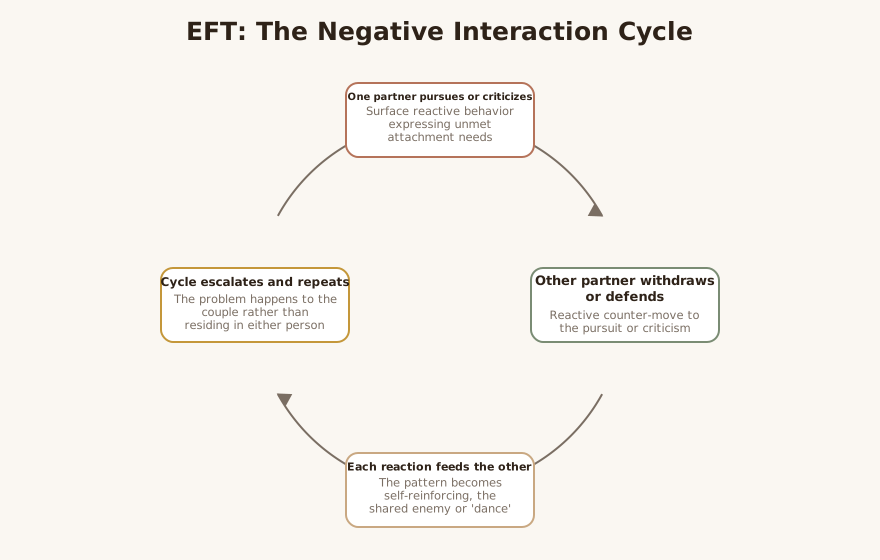
A second core principle is the negative interaction cycle. Distressed couples become trapped in a self-reinforcing pattern—classically pursue/withdraw or criticize/defend—that each partner’s reactive behavior keeps feeding 7. EFT externalizes this cycle as the shared enemy (“the dance”), which de-blames both partners and reframes the problem as something happening to the couple rather than a flaw in either person 7. LLM
A third principle is the distinction between secondary (reactive) and primary (underlying) emotions. The anger, criticism, or stonewalling visible on the surface are typically secondary reactions; underneath sit primary attachment emotions—fear of abandonment, shame, loneliness, the longing to matter 7. EFT works by accessing and deepening these primary emotions, because expressing vulnerable primary emotion is what evokes a partner’s compassion and pulls for a new, bond-affirming response 7. LLM
Finally, EFT holds that emotional experience itself—not insight, homework, or negotiated agreements—is the primary agent of change. New emotional experiences in session reorganize how partners perceive themselves and each other, which is why the therapist works to slow down, intensify, and process emotion rather than move quickly to problem-solving 7. LLM
Interventions & Techniques
EFT for couples is delivered in three stages spanning roughly nine steps 7.
Stage 1 — De-escalation (Cycle De-escalation). The therapist builds the alliance, identifies the core conflict issues, maps the negative interaction cycle, and reframes the presenting problem in terms of the cycle and the underlying attachment fears it conceals 7. The goal of Stage 1 is not change in content but a shift in how the couple sees their distress—they begin to see the cycle, not each other, as the problem 7. LLM
Stage 2 — Restructuring the Bond (Changing Interaction Positions). Here partners are helped to access and voice their deeper needs and primary emotions, and to receive and respond to those of the other with acceptance and compassion 7. The pivotal events of Stage 2 are the withdrawer re-engagement and the blamer softening, in which a previously defensive or critical partner can risk asking for connection from a place of vulnerability—the enactments most associated with creating secure bonding 7. LLM
Stage 3 — Consolidation. The couple practices new patterns of communication, revisits old problem areas from their new emotional stance, and consolidates the changes into a coherent narrative of their relationship 7. LLM
Within these stages, EFT clinicians draw on five recognizable families of technique: empathic/reflective exploration of experience, building and tending the alliance, evoking and heightening emotional experiencing, reprocessing and restructuring emotional and interactional responses, and action-oriented work such as enactments and chair work 7. In practice the most characteristic micro-skills are reflection, evocative questioning, heightening (slowing down and amplifying a felt emotion), empathic conjecture, reframing in attachment terms, and choreographing in-session enactments between partners 7. Worksheets and structured tools (emotion-awareness, emotion-regulation, and conflict-mapping exercises) can scaffold the work but are adjuncts to the experiential process, not the engine of change 7. LLM
LLM-generated illustrative example (not a guideline): A husband who “shuts down” during conflict is helped to slow down and notice the panic underneath his silence; with heightening, he can finally say, “When you get that edge in your voice, I freeze because some part of me is sure I’m about to lose you.” His wife, who had read his silence as not caring, softens. This enactment—vulnerable primary emotion met with compassion—is the kind of in-session event EFT is built to create LLM.
Evidence Base
EFT for couples is one of the better-validated couple therapies, and the maturity of its evidence base is fairly characterized as established for distressed couples 1. A comprehensive meta-analysis of EFT efficacy reported medium-to-large effects for relationship outcomes—for example, on the order of d ≈ .93 from pre- to post-treatment and d ≈ .44 favoring EFT over other active couple interventions—with gains broadly sustained at follow-up out to roughly two years, and with stronger outcomes associated with therapist fidelity to the model 3. The same body of work indicates that a substantial majority of treated couples move out of distress by the end of therapy 3. (Exact effect-size decimals should be read as approximate; the consistent and defensible conclusion is that EFCT produces durable, medium-to-large improvements that exceed no-treatment and compare favorably with other active approaches.) LLM
Mechanism research adds biological plausibility to the attachment model. In a neuroimaging study, women in moderately distressed marriages were scanned under threat of mild electric shock before and after a course of EFT; after therapy, threat-related neural activity (including in the dorsal anterior cingulate cortex and prefrontal regions) was reduced during spousal hand-holding, with partner contact producing stronger regulatory effects than a stranger’s hand 4. The authors interpreted this as evidence that a more secure bond lets a partner serve as a “load-sharing” resource that lowers threat perception itself, consistent with attachment theory’s safe-haven and secure-base functions 4. LLM
The honest caveats: the strongest evidence is for the couple format with relationally distressed (but otherwise lower-risk) couples 3. The individual (EFIT) and family (EFFT) adaptations, and applications to comorbid clinical conditions, rest on a thinner and more emerging evidence base, and much of the couples research has been conducted by groups close to the model—so fidelity-linked, possibly allegiance-inflated effects warrant clinical humility 3. LLM
Populations & Indications
EFT is indicated across couples, families, and individuals, with couples the primary and best-supported population 7. Within couples work it is well suited to distressed partners caught in escalating conflict or emotional disconnection, and it has a developed protocol for attachment injuries—specific incidents of abandonment or betrayal at moments of acute need (a partner absent during a miscarriage, a major breach of trust) that become unhealed wounds blocking reconnection 7. EFT is frequently applied to infidelity recovery, treating the affair as an attachment injury to be processed rather than only a behavior to be contracted around 7. LLM
EFT has also been studied and applied where relational distress co-occurs with individual symptoms such as depression and anxiety, on the rationale that strengthening the bond improves the relational context that maintains those symptoms 7. People with trauma histories that affect their relationships are an important indicated population: trauma frequently heightens attachment alarm, and EFT’s slow, safety-first emotional processing is designed to work with that hyperaroused threat system 4. The modality is suitable across the lifespan and adaptable to diverse couple constellations, including same-sex couples 7. LLM
Problems-for-Work
- Pursue/withdraw and conflict escalation. The core target: map the cycle, de-escalate, and replace it with bids for connection that get met. LLM
- Emotional disconnection / “we’ve grown apart.” Access the longing and fear beneath the flatness and use enactments to rebuild engagement 7. LLM
- Attachment injuries. Use the structured injury-resolution process to let the injured partner voice the wound and the other respond with attuned remorse and care 7. LLM
- Infidelity recovery. Frame the affair as a bonding rupture; process the injury before rebuilding trust and renegotiating the relationship 7. LLM
- Depression and anxiety in a relational context. Strengthen the partner as a secure base so the relationship buffers rather than amplifies symptoms 7. LLM
- Communication problems. Reframe “bad communication” as the visible surface of unmet attachment needs and reactive secondary emotion 7. LLM
LLM-generated illustrative example (not a guideline): A couple presents after an affair. Rather than starting with rules and accountability spreadsheets, the EFT therapist first helps the betrayed partner give voice to the terror and aloneness the discovery triggered, and helps the involved partner stay present and let that pain land. Only once that injury can be approached without re-escalation does the work turn to rebuilding a secure, trustworthy bond LLM.
Contraindications, Cautions & Cultural Humility
EFT is not appropriate as a conjoint couple treatment where there is ongoing intimate partner violence, and it is not designed for couples who have already separated or where one partner has firmly decided to leave 7. Active, unaddressed abuse makes the vulnerability EFT asks for unsafe; emotional exposure in front of an abusive partner can be harmful, and safety assessment must precede any conjoint work 7. LLM
Other clinical cautions follow from the model’s reliance on emotional deepening: where there is untreated severe substance dependence, acute psychosis, or active high suicide risk, those crises generally need stabilization or concurrent treatment before bond-restructuring work can proceed LLM. With significant trauma, the therapist must titrate emotional intensity carefully, because EFT deliberately activates the attachment-threat system that trauma has already sensitized 4. LLM
Cultural humility is essential because EFT’s assumptions about emotional expressiveness, vulnerability, and the centrality of the dyadic romantic bond are culturally situated. Norms around displaying emotion, the role of extended family and community, gendered expectations about pursuing versus withdrawing, and what “secure connection” looks like vary widely across cultures, and the clinician should hold the attachment frame as a lens rather than a universal prescription LLM. The work should be adapted to the couple’s own meaning system rather than imported wholesale LLM.
Treatment-Plan Suggestions & SMART Objectives
| Goal | SMART objective (example) | Mechanism |
|---|---|---|
| De-escalate the negative cycle | Within 6 sessions, the couple will jointly name their cycle and report at least two instances of catching it in real time before escalation | Externalizing the cycle de-blames partners and interrupts reactive secondary emotion 7 |
| Access primary (vulnerable) emotion | Within 8 sessions, each partner will identify and verbalize one underlying attachment fear in session on at least two occasions | Deepening primary emotion shifts experience and pulls for a compassionate response 7 |
| Withdrawer re-engagement | By session 12, the withdrawing partner will initiate one direct bid for connection in session rather than disengaging | Re-engagement is a pivotal Stage 2 change event that reshapes interaction positions 7 |
| Blamer softening | By session 14, the critical partner will express a need from vulnerability rather than criticism in at least one enactment | Softening creates bonding events that build felt security 7 |
| Resolve an attachment injury | Within the episode of care, the injured partner will voice the injury and report feeling heard and comforted by the other | Structured injury resolution heals the wound blocking reconnection 7 |
| Build a secure base that buffers symptoms | Over treatment, the partner reporting depressive/anxious symptoms will identify two ways the relationship now soothes rather than amplifies distress | A secure bond functions as a load-sharing, threat-reducing resource 4 |
| Consolidate new patterns | In the final 2–3 sessions, the couple will revisit a prior conflict topic and resolve it using new bonding-based responses | Consolidation integrates change into a durable relational narrative 7 |
Common Misconceptions
- “EFT is just venting feelings.” EFT is structured and goal-directed; emotion is accessed deliberately and then restructured into bonding interactions, not discharged for its own sake 7. LLM
- “EFT is communication-skills training.” Teaching communication skills is not the mechanism; the mechanism is new emotional experience that reorganizes the bond, after which better communication tends to follow 7. LLM
- “It works for any couple.” It is contraindicated in ongoing abuse and not designed for couples already separated or decided on divorce 7. LLM
- “EFT and Greenberg’s Emotion-Focused Therapy are the same thing.” They share roots and a co-founder but diverged; Johnson’s couples EFT is attachment-centered, while Greenberg’s individual EFT centers intrapsychic emotion processing 7. LLM
- “The therapist stays neutral and lets the couple talk.” The EFT therapist is highly active—directing, heightening, choreographing enactments, and keeping the process within a safe emotional window 7. LLM
Training & Certification
EFT has a defined professional training pathway, classically beginning with an Externship (an introductory experiential training), followed by Core Skills training and supervised practice, leading toward certification as an EFT therapist and, at advanced levels, supervisor and trainer roles 7. Because outcomes are linked to fidelity to the model, supervised practice and adherence are emphasized rather than treated as optional polish 3. Clinicians integrating EFT-derived techniques without full certification should be transparent—internally and in documentation—about the difference between practicing certified EFT and drawing on EFT-informed methods LLM.
Key Terms
- Negative interaction cycle (“the dance”): the self-reinforcing pattern (e.g., pursue/withdraw) that maintains distress and is framed as the couple’s shared problem 7.
- Primary vs. secondary emotion: primary = underlying attachment emotions (fear, shame, longing); secondary = reactive surface emotions (anger, defensiveness) that obscure them 7.
- Attachment injury: a specific betrayal or abandonment at a moment of need that becomes an unhealed wound blocking reconnection 7.
- Withdrawer re-engagement / blamer softening: the two pivotal Stage 2 change events that shift partners into new, bond-affirming positions 7.
- Enactment: a therapist-choreographed in-session interaction in which partners speak new emotional messages directly to each other 7.
- Heightening: slowing down and intensifying a felt emotion so it becomes available for processing and expression 7.
- Safe haven / secure base: attachment functions whereby a trusted partner soothes threat and supports exploration; neuroimaging links these to reduced threat response 4.
Resources & Further Reading
▶ Watch — a video introduction to this concept:
- Emotionally Focused Couples Therapy — Society of Clinical Psychology (APA Division 12) 1
- Spengler et al. (2022), A Comprehensive Meta-Analysis on the Efficacy of Emotionally Focused Couple Therapy (record) 3
- Soothing the Threatened Brain: Leveraging Contact Comfort with Emotionally Focused Therapy (PMC) 4
- Emotionally Focused Therapy: 17 Tools for Your EFT Sessions — PositivePsychology.com 7
Reflective / Supervision Questions
- When a couple escalates, can I name the cycle out loud and make it the problem—or do I find myself subtly siding with one partner? LLM
- Am I tracking primary attachment emotion, or am I getting pulled into the content of secondary, reactive emotion? LLM
- Have I assessed for ongoing violence and for whether both partners are actually invested in the relationship before asking either to be vulnerable? LLM
- How do my own attachment patterns and cultural assumptions about emotional expression shape what I treat as “secure” or “healthy” connection? LLM
- When I claim EFT efficacy to a client or referrer, am I representing the couples evidence accurately—and being honest that the individual and family adaptations are less established? 3 LLM
1: Society of Clinical Psychology (APA Division 12), Emotionally Focused Couples Therapy — Diagnoses & Treatments database. https://div12.org/treatment/emotionally-focused-couples-therapy/ 3: Spengler, P. M., Lee, N. A., Wiebe, S. A., & Wittenborn, A. K. (2022). A comprehensive meta-analysis on the efficacy of emotionally focused couple therapy. Couple and Family Psychology: Research and Practice, 13(2), 81–99. https://www.researchgate.net/publication/363783246_A_comprehensive_meta-analysis_on_the_efficacy_of_emotionally_focused_couple_therapy 4: Johnson, S. M., et al. (2013). Soothing the threatened brain: Leveraging contact comfort with Emotionally Focused Therapy. PMC3835900. https://www.ncbi.nlm.nih.gov/pmc/articles/PMC3835900/ 7: PositivePsychology.com. Emotionally Focused Therapy: 17 Tools for Your EFT Sessions. https://positivepsychology.com/emotionally-focused-therapy/