
Type & Discipline
The Adverse Childhood Experiences (ACE) Study is an epidemiological framework, not a treatment modality, situated at the intersection of public health, preventive medicine, and developmental psychology 1. Its core deliverable is not a protocol but an empirical relationship: that the quantity of adverse experiences accumulated before age 18 predicts, in a graded fashion, a wide range of adult health, behavioral, and social outcomes 1. It belongs to the family of developmental and cumulative-trauma models, and it supplies the population-level evidence that underwrites much contemporary trauma-informed care 4.
For clinicians, the practical meaning of “framework” is that ACEs function as a conceptual lens and a screening construct rather than a therapy you administer LLM. The framework reframes many adult presentations — chronic disease, addiction, depression, suicidality — as potential downstream consequences of early adversity rather than as freestanding diagnoses 2. The actual therapeutic work is delivered through established modalities; the ACE construct informs why and what you treat, not the technique by which you treat it LLM.
Creators & Lineage
The study was led by Vincent Felitti, then head of Kaiser Permanente’s Department of Preventive Medicine in San Diego, in collaboration with Robert Anda of the Centers for Disease Control and Prevention 1. Felitti has described the origin as serendipitous: in the mid-1980s, his obesity program had a high dropout rate, yet many of those dropping out were successfully losing weight 2. Detailed interviews with roughly 200 dropouts revealed that childhood abuse was strikingly common and had often preceded the onset of obesity — and that, for some, the weight served a protective function rather than being simply a problem to solve 2.
That clinical observation became a formal epidemiological study, a collaboration between Kaiser Permanente and the CDC, with Anda bringing the population-health and biostatistical rigor 1. The lineage of the ACE framework runs through the broader twentieth-century recognition of childhood trauma’s importance, but its distinctive contribution was methodological: taking a large, insured, largely middle-class adult population and demonstrating that the sum of different adversities — not just any single event — tracked linearly with adult disease and death 1. The work has since seeded an entire field of toxic-stress and trauma-informed practice, popularized for clinical and public audiences by figures such as pediatrician Nadine Burke Harris 5.
Core Principles
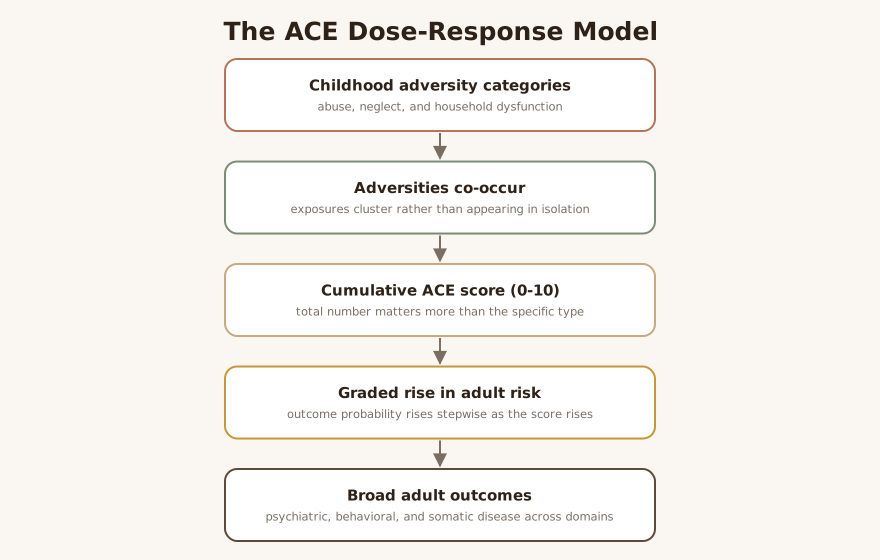
The first principle is cumulative burden. The ACE Study’s central insight is that adversities co-occur and that their total number — operationalized as an ACE score from 0 to 10 — is more predictive than the specific type of any single exposure 1. The original study asked about seven, later expanded to ten, categories grouped as abuse (physical, emotional, sexual), neglect (physical, emotional), and household dysfunction (substance abuse, mental illness, domestic violence, parental separation/divorce, incarcerated household member) 6.
The second principle is the dose-response (graded) relationship: as the ACE score rises, the probability of adverse adult outcomes rises in a stepwise, monotonic fashion 1. This is the study’s signature finding and what gives it epidemiological weight — the pattern looks like a true exposure-disease gradient rather than a threshold effect 1.
The third principle is breadth of outcome. The same childhood exposures predict outcomes across radically different domains — psychiatric (depression, suicidality), behavioral (smoking, substance use, sexual risk), and somatic (ischemic heart disease, chronic obstructive pulmonary disease, cancer) 1. This breadth implies a shared upstream mechanism rather than many separate causal pathways 2.
The fourth principle is biological embedding via toxic stress: chronic, unbuffered activation of the stress response in childhood is theorized to alter the developing brain, immune system, and neuroendocrine stress-response systems, providing a plausible mechanism linking early adversity to later disease 4. The fifth, and clinically humane, principle is reframing maladaptive behavior as coping: Felitti argued that behaviors like smoking, overeating, and drug use may begin as effective short-term solutions to the distress of early adversity, which helps explain why they are so resistant to simple cessation advice 2.
Interventions & Techniques
The ACE framework is not itself an intervention; it generates a small set of clinical practices that sit on top of whatever modality a clinician already uses LLM. The most concrete is ACE screening or history-taking — systematically asking about childhood adversity, whether through the formal ACE questionnaire or through trauma-informed interviewing woven into intake 4. Felitti’s own model integrated routine adversity inquiry into adult preventive-medicine visits, treating the disclosure itself as therapeutically meaningful 2.
A second practice is reframing the presenting problem. Rather than treating a patient’s morbid obesity, hypertension, depression, and diabetes as four disconnected conditions, the ACE lens prompts the clinician to ask whether a shared developmental root is driving the cluster, and to make that root a focus of formulation 2. This is a formulation technique, not a treatment in itself LLM.
A third is psychoeducation about toxic stress — helping clients understand the biological plausibility of the connection between their early experiences and their current health, which can reduce shame and increase engagement 4. The framework then routes the actual therapeutic work toward trauma-focused and relational modalities — the affect-regulation, attachment, and somatic approaches that address developmental trauma — and toward prevention efforts aimed at building safe, stable, nurturing relationships 4.
LLM-generated illustrative example (not a guideline): A 52-year-old presents with treatment-resistant depression, obesity, and a long smoking history. Instead of layering a fourth antidepressant trial, the clinician gently asks about childhood, learning of chronic emotional abuse and a parent with alcohol-use disorder. Naming the link between those experiences and the present cluster — and validating the smoking and eating as early survival strategies — shifts the work from symptom-chasing toward trauma-focused treatment LLM.
Evidence Base
The evidence base for the ACE framework is established at the population level 1. The original 1998 study sampled over 17,000 adult Kaiser members and demonstrated a clear, graded relationship between the number of childhood exposures and adult risk factors and diseases 1. Compared with an ACE score of zero, a score of four or more was associated with markedly elevated risk across domains — for example, Felitti’s reflection cites large increases in depression, attempted suicide, and substance use at the highest scores, with attempted suicide showing roughly a 30-fold elevation in the highest exposure group 26. These findings have been replicated in many subsequent samples, and the CDC now treats ACEs as a major, preventable public-health problem 4.
The 2017 Hughes et al. systematic review and meta-analysis pooled data across many studies and confirmed the associations while clarifying their magnitude: individuals with four or more ACEs showed substantially elevated odds of poor outcomes, with the strongest associations for behavioral and mental-health outcomes (such as problematic drug use, interpersonal and self-directed violence, and depression) and more modest — though still significant — associations for physical diseases such as heart disease and cancer 36. The gradient and the breadth of the relationship are, by now, among the more robust findings in social epidemiology 3.
Honesty about the limits is essential. The robust evidence is associational and population-level; the ACE score was designed as an epidemiological measure, not a clinical diagnostic or prognostic instrument for individuals 6. Critics note the lack of randomized trials showing that ACE screening improves health outcomes, the reliance on retrospective recall, the loss of information in binary 0/1 scoring that ignores severity, frequency, and timing, and the framework’s relative underemphasis on protective factors and resilience 6. Early death and poor outcomes are not inevitable consequences of a high ACE score, and resilience can substantially buffer risk 6. Clinicians should therefore treat a high score as a flag for further conversation, not as a verdict LLM.
Populations & Indications
The framework is most directly relevant to adults with chronic medical illness whose presentations have psychosocial roots, the population in which the study originated 2. It is highly indicated for survivors of childhood abuse and neglect, for whom it provides a validating, mechanistic account of their adult health 1. Adults with substance use disorders are a central population, given Felitti’s reframing of addictive behavior as adaptive coping with early distress 2.
People with depression and suicidality are strongly indicated, since these show some of the steepest dose-response gradients in the data 2. The framework is increasingly applied in pediatric and adolescent populations as a prevention and early-identification tool — CDC data indicate that roughly three in four high-school students report at least one ACE and about one in five report four or more 4. Caregivers and parents are a key population for prevention, given concern about the intergenerational transmission of adversity, and communities affected by structural adversity are central to the public-health application, since ACEs cluster with poverty, racism, and instability 4.
Problems-for-Work
The ACE framework organizes clinical attention around complex and developmental trauma as the upstream problem from which many presentations descend 1. It directly informs work on substance use and addiction, reframing them as coping strategies with developmental origins rather than as moral failures or purely pharmacological dependencies 2.
For depression and suicidality, the framework supplies both a risk-stratification rationale and a formulation that connects current mood to early adversity 2. For chronic medical illness with psychosocial roots — obesity, cardiopulmonary disease, autoimmune conditions — it prompts integrated, whole-person treatment planning rather than siloed disease management 2. It speaks to affect dysregulation and high-risk health behaviors as the behavioral expression of toxic stress, and to the intergenerational transmission of adversity, where supporting a struggling parent becomes a means of preventing the next generation’s exposures 4.
LLM-generated illustrative example (not a guideline): A clinician working with a young mother in early recovery from opioid use disorder uses the ACE lens to connect her substance use, her difficulty regulating anger toward her toddler, and her own history of household dysfunction. The shared formulation lets the work address all three as facets of one developmental-trauma picture, with explicit attention to interrupting transmission to her child LLM.
Contraindications, Cautions & Cultural Humility
The framework carries no contraindications as a way of thinking, but several cautions govern its use LLM. The most important is that an ACE score is a population-epidemiology measure, not an individual diagnostic or destiny; presenting a high score to a client as if it predicts their personal future is both clinically wrong and potentially harmful 6. Routine screening should never be done without the capacity to respond — asking about abuse and then having no pathway to support can re-traumatize LLM. The binary 0/1 scoring also flattens severity, chronicity, and timing, so two clients with identical scores may have very different clinical pictures 6.
The framework’s relative silence on protective factors and resilience is a real limitation to correct in practice: clinicians should pair any adversity inquiry with assessment of buffering relationships and strengths, since these meaningfully alter outcomes 6. Cultural humility is essential because the original cohort was a largely insured, middle-class, predominantly white Kaiser population, and the ten categories were defined within a particular cultural frame 1. Forms of adversity salient in other communities — community violence, racism, discrimination, immigration trauma, historical and intergenerational trauma — are not captured by the original instrument and must not be treated as absent simply because the standard ACE items miss them LLM. Finally, the framework should not be used to assign blame to families or to obscure the structural drivers — poverty, housing instability, racism — that produce much childhood adversity in the first place 4.
Treatment-Plan Suggestions & SMART Objectives
| Goal | SMART objective (example) | Mechanism |
|---|---|---|
| Identify trauma history safely | Within the first 3 sessions, complete a trauma-informed adversity history and collaboratively map links to current concerns | Systematic adversity inquiry reframes presenting cluster 4 |
| Reduce trauma-driven coping behavior | Over 12 weeks, client reduces a high-risk coping behavior (e.g., binge eating, smoking) by an agreed measure on 4 of 7 days/week | Replacing adaptive-but-costly coping with regulation skills 2 |
| Build affect-regulation capacity | Within 8 weeks, client identifies early stress cues and applies one grounding skill in 4 of 5 sessions | Counteracting toxic-stress dysregulation 4 |
| Increase protective/buffering supports | Within 60 days, client identifies and strengthens 2 supportive relationships, tracked weekly | Resilience and buffering offset cumulative risk 6 |
| Reduce depressive symptoms | Over 12 weeks, client lowers PHQ-9 score by ≥5 points while linking mood to developmental roots | Treating depression as a trauma sequela, not isolated 2 |
| Interrupt intergenerational transmission (parent work) | Over 10 weeks, parent responds to child distress with a regulated, soothing strategy in 3 of 4 observed interactions | Building safe, stable, nurturing relationships 4 |
| Reduce shame about health behaviors | Within 6 weeks, client articulates a non-blaming, trauma-informed account of their behaviors in session | Psychoeducation on toxic stress reduces shame 4 |
Common Misconceptions
A primary misconception is that the ACE score is a diagnostic or predictive test for individuals; it was built and validated as a population-epidemiology measure, and a high score indicates elevated group-level risk, not an individual’s fate 6. A related error is treating a high ACE score as a sentence of inevitable poor health, which ignores the substantial buffering role of resilience and protective relationships 6.
A third misconception is that ACEs cause adult disease through purely psychological pathways; the framework explicitly posits biological embedding through toxic stress affecting neurodevelopment, immune, and neuroendocrine systems 4. A fourth is that the ten categories are exhaustive — they omit major adversities such as community violence, racism, and poverty that are highly salient in many populations 1. A fifth is reading the addiction findings as excusing or endorsing harmful behavior; Felitti’s point is mechanistic and compassionate — that these behaviors often began as effective coping — which informs treatment rather than removing accountability 2. Finally, “trauma-informed care” is sometimes equated with simply administering the ACE questionnaire, when the construct is meant to reshape formulation and the therapeutic stance, not function as a checkbox LLM.
Training & Certification
There is no certification in the ACE Study itself, consistent with its status as an epidemiological framework rather than a treatment LLM. Clinicians typically learn it through primary reading — the 1998 American Journal of Preventive Medicine paper and Felitti’s later reflective account of the study’s origins — supplemented by the CDC’s public-health resources on ACEs and prevention 124. Nadine Burke Harris’s widely viewed TED talk is a common accessible entry point for clinicians and the public 5.
Applied competence comes from training in trauma-informed care more broadly and in the specific modalities that treat developmental trauma — trauma-focused cognitive behavioral therapy, attachment-based and somatic approaches, and affect-regulation work — within which the ACE construct is operationalized LLM. Many health systems and child-serving agencies now offer institutional ACE and trauma-informed-care trainings, but these certify familiarity with the framework and screening, not mastery of a discrete therapy 4.
Key Terms
- ACE score: A 0-10 count of the number of distinct categories of childhood adversity a person reports, used as a cumulative-exposure measure 1.
- Dose-response (graded) relationship: The finding that adult risk rises stepwise as the ACE score rises, the study’s signature pattern 1.
- Household dysfunction: Adversity categories beyond abuse and neglect — substance abuse, mental illness, domestic violence, parental separation, incarceration in the home 6.
- Toxic stress: Prolonged, unbuffered activation of the stress response in childhood, theorized to alter brain, immune, and neuroendocrine development 4.
- Biological embedding: The process by which early experience becomes encoded in physiology, linking adversity to later disease 4.
- Adaptive coping reframe: Felitti’s interpretation of high-risk behaviors as initially effective solutions to the distress of early adversity 2.
- Resilience / protective factors: Buffering relationships and strengths that meaningfully reduce the risk associated with a given ACE score 6.
Resources & Further Reading
▶ Watch — a video introduction to this concept:
- Felitti, Anda, et al. (1998). The Adverse Childhood Experiences (ACE) Study (American Journal of Preventive Medicine)
- Felitti, V.J. — Origins of the ACE Study / Turning Gold into Lead (PMC)
- Hughes et al. — Adverse childhood experiences and associated health outcomes: systematic review and meta-analysis (ScienceDirect)
- About Adverse Childhood Experiences (CDC)
- Nadine Burke Harris — How childhood trauma affects health across a lifetime (TED)
- Adverse childhood experiences (Wikipedia)
Reflective / Supervision Questions
- When I ask a client about childhood adversity, do I have a clear, supportive pathway ready for whatever they disclose, or am I screening without the capacity to respond? LLM
- Am I using the ACE construct to enrich my formulation, or am I treating a score as a diagnosis or a prediction of the client’s future? 6
- How systematically do I assess protective factors and resilience alongside adversity, rather than focusing only on harm? 6
- Which forms of adversity salient to this client’s community — racism, community violence, immigration trauma — fall outside the standard ten categories, and how am I capturing them? 1
- When a client presents with multiple “separate” conditions, do I pause to ask whether a shared developmental root is driving the cluster? 2
- Am I holding high-risk behaviors with the compassionate, mechanistic stance the framework invites, or am I quietly framing them as failures of will? 2