
Type & Discipline
Reflective Functioning (RF) is not a therapy and not a school of thought; it is a construct — and, crucially, a measure — that sits at the intersection of clinical and developmental psychology LLM. RF is the operationalized, scorable expression of mentalizing: the capacity to understand one’s own and others’ behavior in terms of underlying mental states such as feelings, beliefs, wishes, and intentions 4. Where “mentalizing” names the broad mental activity, RF names the degree to which a person demonstrates that activity in a structured assessment, most rigorously when narrating attachment experiences 1. This distinction matters clinically: mentalizing is the process you try to cultivate in the room, and RF is one of the few ways the field has found to put a number on it LLM.
Because RF was developed to be coded from interview transcripts, it carries a methodological precision unusual for a psychodynamic construct LLM. It was designed as an empirical bridge between the rich but slippery language of object relations and attachment, and the demands of outcome research that require reliable, replicable measurement 1. That bridging ambition explains why RF appears in studies spanning developmental psychopathology, personality disorder, parenting, and process research on what actually happens during sessions 3.
Creators & Lineage
RF emerged from the work of Peter Fonagy, Mary Target, and their colleagues at University College London and the Anna Freud Centre in the 1990s 4. The first formal scoring instrument — the Reflective-Functioning Manual, Version 5.0, for Application to Adult Attachment Interviews — was authored by Fonagy, Target, Howard Steele, and Miriam Steele, and remains the canonical reference for how RF is operationalized 1. The Steeles, who carried the Adult Attachment Interview (AAI) tradition forward, are central to the construct’s lineage and to its empirical grounding in attachment narratives 6.
The intellectual debts are clear and worth naming for orientation LLM. From attachment theory RF inherits the conviction that the capacity to mentalize is forged in early caregiving relationships, where a sensitive caregiver who treats the infant as a being with a mind helps the infant discover its own 4. From the developmental literature on theory of mind it inherits the focus on representing mental states as causes of behavior, while extending that idea from a binary “passed/failed” milestone into a graded, lifelong, affectively loaded capacity LLM. From object relations theory — the Kleinian and Independent traditions of internalized self-and-other representations — it inherits the clinical vocabulary of internal worlds that RF was, in part, built to measure LLM. Downstream, RF became the core construct around which Mentalization-Based Treatment (MBT) was organized, giving that therapy a defined target and a way to track change 4. A useful shorthand: attachment theory and theory of mind are the parents, object relations is the grandparent, and MBT is the clinical child LLM.
Core Principles
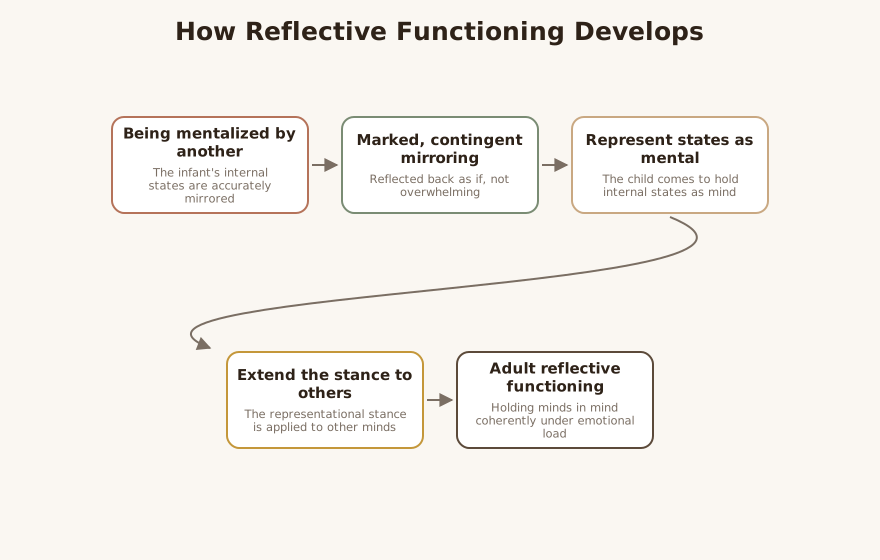
The foundational principle is that mentalizing is acquired, not innate, and that it develops within the attachment relationship through being mentalized by another 4. The infant whose internal states are accurately mirrored — marked, contingent, and “as if” rather than overwhelming — comes to represent those states as mental, and gradually to extend that representational stance to others 4. RF is the adult residue of this developmental achievement, observable in how coherently and flexibly a person can hold minds in mind under emotional load 1.
A second principle is that RF is relationship- and state-dependent, not a fixed trait LLM. The same person may mentalize well in calm, low-stakes moments and collapse into non-mentalizing modes when attachment systems are activated and arousal is high 6. This is why RF is scored specifically from attachment-laden material: the AAI deliberately “surprises the unconscious” by probing loss, rejection, and early relationships, stressing the system enough to reveal a person’s true mentalizing ceiling under pressure rather than their best performance when relaxed 6.
A third principle is the tight coupling of RF with affect regulation LLM. The capacity to label, tolerate, and reflect on emotional states — rather than be flooded or driven by them — is both an ingredient and a product of mentalizing, which is why deficits show up clinically as emotion dysregulation and affect intolerance 4. More recently, the model has folded RF into the broader concept of epistemic trust: the willingness to treat another person as a reliable source of social knowledge, which secure mentalizing relationships open up and which insecure or traumatic histories close down 4.
Interventions & Techniques
RF is, first, an assessment technology, and its primary “intervention” is measurement that informs treatment LLM. The gold-standard method is RF coding of the Adult Attachment Interview, in which trained, reliability-certified raters assign a scale score (conventionally from −1, anti-reflective, through 5, marked, to 9, exceptional) based on demonstrated mentalizing across the transcript 1. Scoring rewards markers such as awareness of the nature of mental states, explicit effort to tease out the mental states underlying behavior, recognition of developmental and intergenerational influences on mind, and awareness of the interviewer’s separate mind 1.
Because full AAI-based RF coding is labor-intensive and requires formal training, the team developed a self-report alternative: the Reflective Functioning Questionnaire (RFQ), an eight-item measure yielding subscales for certainty and uncertainty about mental states, intended to capture the extremes of hypo- and hyper-mentalizing in a feasible, scalable format 2. The RFQ trades depth for accessibility and is best understood as a screening and research tool rather than a replacement for narrative coding 2.
A further methodological advance moved RF measurement into the session itself LLM. Process-oriented work has examined how mentalizing and attachment show up in the patient–therapist exchange — “mentalizing in the presence of another” — capturing in vivo what the AAI captures retrospectively, and offering a window on how reflective stance fluctuates moment to moment in treatment 3. Clinically, the through-line across these methods is the same: identify when mentalizing is present, notice when it collapses, and use that information to calibrate intervention LLM.
LLM-generated illustrative example (not a guideline): A clinician notices that a client narrates a painful breakup almost entirely in terms of facts and accusations — “he texted at 2 a.m., that proves he’s selfish” — with no reference to what either person might have been feeling or fearing. Rather than challenging the conclusion, the clinician slows down and wonders aloud, “What do you imagine was going on for him in that moment? And for you, before you read the text?” — an attempt to restart mentalizing where it had gone offline. LLM
Evidence Base
The maturity of RF is best described as established as a construct and as a measure, with a strong validation record and a less fully settled picture of mechanism LLM. The AAI-based RF scale has decades of use as a reliable, trainable coding system and is the reference standard against which other measures are compared 1. The RFQ underwent formal development and validation across multiple samples, demonstrating acceptable psychometric properties and the ability to discriminate clinical from non-clinical groups, which substantially lowered the barrier to studying RF at scale 2.
RF reliably differentiates clinical populations from controls and tracks with attachment security, lending it strong construct validity 6. In personality pathology, low RF is a well-replicated correlate, consistent with the theory that impaired mentalizing under attachment stress is central to borderline phenomenology 4. RF has also been examined in other diagnostic groups; preliminary comparative work in obsessive–compulsive disorder, for example, explored whether and how reflective capacity differs in OCD relative to other groups, illustrating both the construct’s reach and the still-developing state of disorder-specific findings 7.
Honesty about limits is warranted LLM. Full RF coding is resource-intensive and rater-dependent, which constrains how widely the gold-standard method is used 1. Self-report measures like the RFQ are more feasible but capture a narrower slice of the construct and are vulnerable to the paradox that poor mentalizers may not accurately report their own mentalizing 2. And while RF predicts and correlates with clinically important outcomes, demonstrating that raising RF is the active ingredient driving symptom change — rather than a parallel marker of improvement — remains an area of ongoing process research rather than settled fact 3.
Populations & Indications
RF is most informative where mentalizing is theorized to be central to the clinical problem LLM. Adults with insecure attachment are a core indication, since RF was developed precisely to score attachment narratives and to distinguish secure-autonomous from dismissing and preoccupied states of mind 1. People with personality disorders, particularly borderline presentations marked by emotion dysregulation, identity disturbance, and unstable relationships, are a primary population because mentalizing collapse under relational stress maps closely onto their presenting difficulties 4.
Parents and caregivers are a distinct and important application: parental reflective functioning — a caregiver’s capacity to hold the child’s mind in mind — bears on caregiving sensitivity and the intergenerational transmission of attachment, making RF relevant to assessment and intervention in parent–child relational problems 4. Trauma survivors, including those with PTSD and complex trauma, are a population in whom mentalizing is frequently disrupted by hyperarousal and by histories that punished curiosity about minds; RF assessment can clarify where reflective capacity is intact and where it is overwhelmed 6. Children and adolescents are studied within the developmental framework that the construct grew out of, where mentalizing is still consolidating 4. Finally, individuals in psychodynamic and mentalization-informed therapy are an obvious indication, since RF gives those treatments a coherent target and an outcome marker 3.
Problems-for-Work
Emotion dysregulation and affect intolerance. When clients cannot label or tolerate feelings, RF assessment can locate the breakdown — whether they lack a vocabulary for inner states or lose access to it specifically when attachment is activated — and target the rebuilding of an affect-labeling, reflective stance 4.
Borderline personality disorder and identity disturbance. Low RF under relational stress is a defining feature; framing the work as restoring mentalizing where it goes offline gives both clinician and client a shared, non-pejorative account of why relationships and self-sense feel so volatile 4.
Insecure attachment and interpersonal difficulties. Because RF is scored from how people narrate attachment relationships, it is well suited to clients whose recurring relational ruptures reflect dismissing or preoccupied stances toward minds 1.
PTSD and complex trauma. Here mentalizing is often intact in safe moments but collapses under trauma-linked arousal; RF helps distinguish a genuine capacity deficit from a state-dependent collapse, which changes the intervention 6.
Parent–child relational problems. Assessing parental reflective functioning can reveal whether a parent can represent the child as a separate mind with their own intentions, guiding interventions that strengthen that capacity 4.
LLM-generated illustrative example (not a guideline): A parent describes a toddler’s tantrums purely as defiance — “she does it to control me” — with no curiosity about fear, fatigue, or frustration behind the behavior. Work might gently expand the parent’s reflective range: “If we imagine she’s a small person who’s just lost a word she wanted, what might the screaming be telling us?” — building the mentalizing that supports attuned caregiving. LLM
Contraindications, Cautions & Cultural Humility
RF is a measurement and conceptual tool, so the cautions are mostly about how it is used rather than whether it is “indicated” LLM. The most important caveat is that RF scoring is a specialized skill: valid AAI-based coding requires formal training and certified reliability, and informal “eyeballing” of a client’s reflectiveness should not be dressed up as a scored result 1. Self-report measures such as the RFQ are feasible but should not be over-interpreted, given that the very deficit being measured can distort self-assessment 2.
Clinicians should resist treating RF as a global verdict on a person’s worth or intelligence; it is a context- and arousal-dependent capacity, and a low score under attachment stress does not mean a person cannot mentalize in calmer domains of life 6. There are also legitimate cautions about cultural and linguistic generalizability LLM. RF coding was developed within particular linguistic and cultural conventions of narrating emotional experience, and what counts as elaborated reflection on mental states can vary across cultures that value indirectness, collective framing, or somatic idioms of distress LLM. Applying the construct across language, culture, and neurodivergence calls for humility: a difference in style of talking about minds is not automatically a deficit in the capacity to hold them, and clinicians should guard against pathologizing culturally normative ways of speaking LLM.
Treatment-Plan Suggestions & SMART Objectives
| Goal | SMART objective (example) | Mechanism |
|---|---|---|
| Increase awareness of one’s own mental states | Within 8 weeks, client will name and rate one emotion in 4 of 5 sessions before describing the triggering event | Strengthens self-directed mentalizing and affect labeling 4 |
| Improve other-directed mentalizing | Within 10 weeks, client will generate at least two alternative explanations for a partner’s behavior during one conflict review per session | Counters certainty/hypermentalizing and rigid attributions 2 |
| Recover mentalizing under attachment stress | Over 12 weeks, client will use one grounding-and-reflect step when arousal rises, in 3 of 4 reported conflicts | Targets state-dependent mentalizing collapse 6 |
| Reduce emotion dysregulation | Within 8 weeks, client will report tolerating a distressing feeling without acting on it in 60% of logged episodes | Links reflective stance to affect regulation 4 |
| Strengthen parental reflective functioning | Within 10 weeks, caregiver will describe a child’s behavior in mental-state terms in 4 of 5 recorded incidents | Supports caregiving sensitivity and secure attachment 4 |
| Build epistemic trust in the therapeutic relationship | Over 12 weeks, client will bring one disconfirming or corrective observation about the therapist’s understanding to 4 sessions | Reopens learning from social experience 4 |
| Establish a shared, non-pejorative formulation | By session 6, client will articulate in their own words how mentalizing “goes offline” for them under stress | Provides a coherent model that reduces shame 3 |
Common Misconceptions
“Reflective functioning is the same as intelligence or insight.” RF is specifically about representing mental states as causes of behavior under emotional load, not general cognitive ability; highly intelligent, articulate clients can show strikingly low RF when attachment is activated 6. Equating the two leads to missing the deficit in exactly the clients who most need it addressed LLM.
“RF and mentalizing are interchangeable words.” Mentalizing is the broad capacity and process; RF is its operationalized, scorable form, and conflating them obscures that RF makes specific measurement claims grounded in a coding manual 1.
“You can read someone’s RF off a clinical impression.” Valid RF scores come from a trained, reliability-tested coding procedure applied to specific interview material; a clinician’s gut sense of how “reflective” a client seems is useful but is not a scored RF result 1.
“A high RF score means a person is psychologically healthy in every domain.” RF is one capacity among many and is state-dependent; it predicts important outcomes but does not certify global wellbeing, and it can vary across relationships and arousal states within the same person 6.
“The RFQ is just a shorter version of the AAI coding.” The self-report questionnaire captures a narrower, certainty/uncertainty slice of the construct and is subject to the limits of insight-into-one’s-own-mentalizing; it complements rather than replaces narrative coding 2.
Training & Certification
Becoming a certified RF coder is a structured, gatekept process rather than something absorbed informally LLM. It typically requires prior training in the Adult Attachment Interview and its administration, followed by dedicated training in the Reflective-Functioning Manual and demonstration of inter-rater reliability against established coders before one’s scores are considered valid 1. Training resources and overviews of the construct are offered by groups oriented to parental development and reflective functioning, reflecting how central RF has become to parent–infant and developmental work 5.
For clinicians whose interest is therapeutic rather than research-coding, the more relevant pathway is training in mentalization-informed treatment, where understanding RF underpins the stance and techniques without requiring formal coding certification LLM. Accessible explainer material — including interviews with figures like Howard Steele on RF and attachment — can orient clinicians to the construct before they commit to formal training 6.
Key Terms
Mentalizing — the broad capacity to understand behavior in terms of underlying mental states (thoughts, feelings, intentions) in oneself and others 4.
Reflective functioning (RF) — the operationalized, measurable expression of mentalizing, scored most rigorously from attachment narratives 1.
Adult Attachment Interview (AAI) — a structured interview probing early attachment experiences, used as the substrate for gold-standard RF coding because it stresses the attachment system 6.
Reflective Functioning Questionnaire (RFQ) — a brief self-report measure of mentalizing yielding certainty and uncertainty subscales, designed for feasibility and scalability 2.
Parental reflective functioning — a caregiver’s capacity to hold the child’s mind in mind, linked to sensitivity and intergenerational attachment transmission 4.
Epistemic trust — the willingness to treat another person as a reliable source of social knowledge, opened by secure mentalizing relationships 4.
Hypomentalizing / hypermentalizing — under- versus over-attribution of mental states (excessive uncertainty versus excessive certainty), the two failure modes the RFQ subscales aim to capture 2.
Resources & Further Reading
▶ Watch — a video introduction to this concept:
- Reflective-Functioning Manual, Version 5.0, for Application to Adult Attachment Interviews (Fonagy, Target, Steele & Steele)
- Development and Validation of the Reflective Functioning Questionnaire (Fonagy et al., 2016, PLOS ONE)
- Mentalizing in the Presence of Another: Measuring Reflective Functioning and Attachment in the Therapy Process (PMC)
- Mentalizing and Epistemic Trust — Mentalizing in Development (Oxford University Press)
- Reflective Functioning overview (PDI Training Institute)
- Reflective Functioning and Attachment Insights with Dr. Howard Steele (Psychiatry & Psychotherapy Podcast)
- Reflective functioning in patients with obsessive–compulsive disorder (OCD) — preliminary comparison
Reflective / Supervision Questions
- When in my last few sessions did the client’s mentalizing visibly go offline, and what was happening in the room — in their arousal, and in mine — at that moment? LLM
- Am I distinguishing a genuine capacity deficit in a client from a state-dependent collapse of mentalizing under attachment stress, and does my intervention match which one it is? LLM
- When I form an impression that a client is “not very reflective,” am I being careful not to confuse a cultural or linguistic style of speaking about minds with a true deficit? LLM
- How does my own reflective functioning hold up when a particular client activates my attachment system — and where might I be losing the capacity to hold their mind in mind? LLM
- If I am using a self-report screen like the RFQ, am I treating it as a conversation-starter rather than a verdict, given that poor mentalizers may misjudge their own mentalizing? LLM