
Type & Discipline
Disorganized attachment is a developmental construct, not a treatment, diagnosis, or billable modality LLM. It originated within attachment theory as a fourth classification of infant attachment behavior, added to the three “organized” patterns that Mary Ainsworth had derived from the Strange Situation procedure 5. Where the secure, avoidant, and resistant (ambivalent) patterns each represent a coherent, organized strategy for managing the attachment relationship under stress, disorganized attachment names the apparent absence or breakdown of any single coherent strategy on reunion with the caregiver 1. It is best understood as a category describing observable infant behavior in a controlled separation-reunion paradigm, and secondarily as a research lineage examining how that behavior arises and what it predicts 3. Because it is a construct rather than a therapy, it informs assessment, case formulation, and treatment selection rather than being something a clinician “delivers” LLM.
Creators & Lineage
The classification grew directly out of John Bowlby’s attachment theory and Mary Ainsworth’s empirical method 5. Ainsworth’s Strange Situation, developed in the 1960s and 1970s, used a structured sequence of separations and reunions to reveal how an infant uses the caregiver as a secure base and what the infant does when the attachment system is activated by mild stress 5. Within that paradigm, a subset of infants did not fit any of the three organized categories, and Mary Main and Judith Solomon introduced the “disorganized/disoriented” (D) classification to capture them, formalizing it through close analysis of behaviors that had previously been treated as unclassifiable 1.
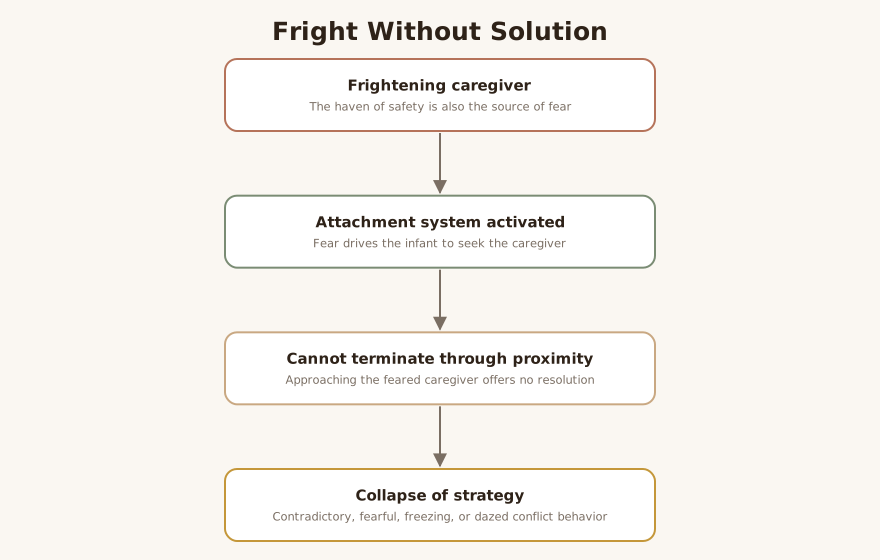
The construct’s central explanatory model is associated with Mary Main and Erik Hesse, who proposed that disorganization reflects “fright without solution” 1. In their account, the disorganized infant faces an irresolvable paradox: the caregiver is simultaneously the source of alarm and the only available haven of safety, so the biologically prepared impulse to flee to the attachment figure collides with the impulse to flee from her 1. Hesse and Main linked this state to a particular kind of caregiving and traced parallel collapses in attentional and behavioral strategies across infancy, childhood, and adulthood 1. Judith Solomon, working with Carol George, extended the lineage into the study of caregiving itself, examining the parent’s side of the disorganized dyad and the representational and behavioral disturbances in caregiving that accompany it 4. A further thread, the intergenerational transmission of trauma, connects the parent’s own unresolved loss or trauma to the infant’s disorganization, a link that became central to later empirical work 2.
Core Principles
The first principle is that disorganized attachment is defined by the breakdown of an organized strategy, not by a specific behavior 1. The classifying observer looks for contradictory, fearful, or apprehensive behavior toward the caregiver on reunion, including approaching with the head averted, freezing or stilling, dazed or trance-like expressions, undirected or misdirected movements, and sequential or simultaneous displays of contradictory behavior such as moving toward the parent and then sharply away 1. These index a momentary collapse of the behavioral and attentional organization that the infant otherwise maintains 1.
The second principle is the “fright without solution” model: when the haven of safety is also the source of fear, the attachment system is activated and cannot be terminated through proximity, producing the conflict behaviors that the D category captures 1. The third principle locates the proximal cause in caregiving rather than in the infant’s temperament, specifically in frightening, frightened, or otherwise anomalous parental behavior that places the infant in this paradox 2. The fourth principle is intergenerational: parents with unresolved states of mind regarding loss or trauma, as assessed on the Adult Attachment Interview, are more likely to display frightening or frightened behavior, which in turn predicts infant disorganization, suggesting a pathway by which trauma is transmitted without requiring direct maltreatment 2. A recurring caution within the field is conceptual: scholars have argued that “disorganization,” “fear,” and the various behavioral indices have at times been conflated, and that precision about what is being measured matters for both research and clinical inference 3.
Interventions & Techniques
Because disorganized attachment is a construct rather than a therapy, there are no “disorganized-attachment techniques” in the way there are cognitive-behavioral techniques LLM. Its clinical utility lies upstream, in assessment and formulation, and downstream, in selecting and shaping interventions delivered through recognized modalities LLM. On the assessment side, the underlying method is observational and structured: the Strange Situation and related separation-reunion procedures generate the behavioral data from which classification is made, and later work has pursued briefer observational procedures and coding of parental frightened/frightening subtypes 6. Clinically, the relevant skill is recognizing the markers of dysregulated, contradictory, or fear-driven relating in the room and formulating them in light of caregiving history rather than as willful or oppositional behavior LLM.
The intervention logic that follows from the construct centers on the caregiving relationship, because that relationship is the proposed mechanism 4. Work that reduces frightening or frightened parental behavior, that increases the parent’s capacity to serve as a reliable haven and secure base, and that addresses the parent’s own unresolved loss or trauma targets the pathway the model identifies 2. The mentalization-based tradition, a related lineage, frames a complementary aim: strengthening the caregiver’s and later the client’s capacity to hold mind in mind, so that fear-driven, non-mentalizing collapses become less frequent and the relationship becomes more predictable LLM.
LLM-generated illustrative example (not a guideline): In a dyadic parent-infant session, a clinician notices the toddler approach the mother on reunion and then freeze mid-step with a blank expression; rather than labeling the child as “difficult,” the clinician gently names the pattern and explores what the mother felt, learning she had braced and stiffened as the child neared, so the work becomes helping the mother notice and soften that frightening micro-response and meet the child’s approach with a steady, welcoming presence LLM.
Evidence Base
The honest appraisal is that disorganized attachment is an established, well-replicated construct in developmental psychology, not a contested fringe idea and not a treatment with its own outcome trials LLM. The D classification has been integrated into mainstream attachment research for decades, and its core descriptive features and the fright-without-solution model are widely cited foundations of the field 1. The proposed mechanism has empirical support: frightening maternal behavior has been shown to link parental unresolved loss to infant disorganization, providing a measured pathway rather than a purely theoretical one 2. Subsequent work has refined this by examining specific frightened versus frightening subtypes and testing whether they predict disorganization within briefer observational procedures, extending the original findings 6.
At the same time, the literature is candid about unresolved problems LLM. Scholarly reviews have argued that the construct’s terminology and boundaries need clarification, that “disorganization” and “fear” have sometimes been used loosely, and that not every disorganized infant has experienced frightening caregiving, so the mechanism is a strong association rather than a one-to-one cause 3. Clinically, the most important caution is that a disorganized classification in infancy is a risk indicator, associated with later difficulties, but is not a diagnosis and not destiny; many disorganized infants do not go on to develop disorder 3. The defensible stance is to treat the construct as a robust, mechanistically supported risk marker that informs prevention and formulation, while resisting deterministic or label-driven claims about individual children or adults LLM.
Populations & Indications
The construct’s primary population is infants and toddlers observed in separation-reunion paradigms, where the classification was developed and is most directly valid 1. It is highly relevant to maltreated children, among whom rates of disorganization are elevated, consistent with a caregiving environment that is frightening or unpredictable 3. It is especially pertinent to children of parents with unresolved trauma or loss, the population in which the intergenerational pathway was demonstrated 2. Caregivers themselves are an indicated focus, because the construct’s mechanism is located in caregiving behavior and representation, making the parent a primary target for preventive and dyadic work 4.
Beyond infancy, the lineage extends the idea to adults with childhood trauma, where parallel collapses in discourse and attentional strategy were proposed as the adult analogue of infant disorganization 1. Foster and adoptive children are a clinically important population, as early disruptions and prior frightening care raise the likelihood of disorganized relating that new caregivers may encounter and struggle to interpret LLM. Across these groups, the construct indicates where attachment-focused assessment and caregiving-centered intervention are likely to be most useful LLM.
Problems-for-Work
The construct maps onto a recognizable cluster of clinical problems, with attachment difficulties at the center, where contradictory approach-avoidance, fear of the very people sought for comfort, and breakdowns in using others as a secure base present directly 1. Emotional dysregulation and affect-regulation deficits are closely linked, because the unsolvable activation of the attachment system without a route to soothing leaves the child, and later the adult, without an internalized strategy for down-regulating fear LLM. Developmental trauma and PTSD sit within the lineage, since frightening caregiving and unresolved parental trauma are part of the same causal field, and the adult analogue was framed around unresolved loss and trauma 2.
Dissociation is a particularly important problem-for-work, as the trance-like, freezing, and dazed behaviors that mark infant disorganization have been theorized as early correlates of later dissociative tendencies under the collapse-of-strategy model 1. Borderline personality disorder and broader interpersonal difficulties are also frequently connected to disorganized histories in the clinical literature, given the shared themes of fear within close relationships and unstable strategies for managing closeness and distance LLM.
LLM-generated illustrative example (not a guideline): An adult client in individual therapy describes “going blank” and feeling far away whenever a partner gets close and warm; formulated through this construct, the clinician hypothesizes that closeness itself activates an old, unresolved alarm and that the blankness is a learned collapse rather than disinterest, so treatment delivered within a trauma-informed evidence-based modality focuses on building tolerance for safe closeness and a felt sense of the therapist as a steady, non-frightening presence LLM.
Contraindications, Cautions & Cultural Humility
The foremost caution is against using “disorganized attachment” as a diagnosis or a fixed trait label; it is a research classification and a risk marker, and applying it loosely to clients or, worse, to parents as an indictment is both inaccurate and harmful 3. Clinicians should also avoid inferring maltreatment from a disorganized presentation, because the association between frightening caregiving and disorganization is probabilistic, not deterministic, and not all disorganized infants have been maltreated 3. Reliable classification depends on validated observational procedures and trained coders, so informal “diagnosis” of attachment style from ordinary clinical observation overreaches the construct’s evidence base 6.
A specific ethical caution concerns the wider “attachment therapy” field: coercive, regressive, or holding-based “rebirthing” practices marketed for attachment problems are not supported by attachment theory and have caused serious harm, and they should never be conflated with the legitimate, caregiving-supportive interventions the science implies LLM. Cultural humility is essential because the Strange Situation and its norms were developed within particular cultural contexts, and culturally normative caregiving practices, separation patterns, and proximity expectations vary, so behavior must be interpreted against the family’s own cultural frame rather than a single Western standard 5. The clinician should hold the construct as a sensitive lens for risk and formulation, applied with care to context, history, and the family’s values, not as a verdict LLM.
Treatment-Plan Suggestions & SMART Objectives
| Goal | SMART objective (example) | Mechanism |
|---|---|---|
| Reduce frightening/frightened caregiving behavior | Over 12 weeks of dyadic sessions, caregiver will identify 3 of their own fear or threat cues and replace them with a soothing, predictable response, observed in 2 consecutive sessions | Targets the proposed proximal cause of disorganization 2 |
| Strengthen caregiver as reliable haven and secure base | Within 10 sessions, caregiver will demonstrate consistent comforting on reunion in 3 structured play episodes | Restores an organized, non-paradoxical attachment signal 1 |
| Address caregiver’s unresolved loss/trauma | Within 16 sessions, caregiver will process 1 identified loss/trauma narrative with reduced disorganized affect and report fewer intrusive reactions during caregiving | Interrupts intergenerational transmission 2 |
| Build affect-regulation capacity in the child | Over 8 weeks, child will use 2 co-regulation strategies with caregiver support when distressed, observed weekly | Supplies the soothing route the disorganized system lacks LLM |
| Increase tolerance of safe closeness (adult client) | Within 12 sessions, client will remain present (no dissociative “blanking”) during 3 structured closeness exercises and report grounding strategies used | Counters fear-within-closeness and collapse 1 |
| Strengthen mentalizing/reflective function | Over 10 sessions, client or caregiver will accurately name the mental state behind 2 confusing interactions per week | Reduces non-mentalizing, fear-driven collapses LLM |
| Reduce dissociative responses to relational triggers | Within 12 sessions, client will identify 3 relational triggers and apply a grounding skill at onset in 80% of logged instances | Targets the dissociative correlate of disorganization 1 |
Common Misconceptions
A frequent error is treating disorganized attachment as a personality type or a stable adult “attachment style” that a brief quiz can identify; it originated as a coded infant classification within a validated procedure, and its adult analogue rests on specialized interview-based assessment, not self-report labels 1. A second misconception is that disorganization is a specific behavior, when it is precisely the breakdown of any single organized strategy, expressed through contradictory, fearful, freezing, or dazed responses 1. A third is assuming the cause is the infant’s temperament or “difficult” nature; the model and its evidence locate the proximal cause in frightening or frightened caregiving, not in the child 2.
A fourth misconception equates a disorganized classification with inevitable pathology, when the literature treats it as a risk indicator whose links to later difficulty are probabilistic rather than deterministic 3. A fifth is that disorganization always means abuse; while maltreatment elevates rates, the pathway can run through subtle frightening or frightened behavior tied to a parent’s own unresolved loss, without overt maltreatment 2. Finally, scholars themselves caution against the loose, interchangeable use of “disorganization” and “fear,” a reminder that the construct is more precise, and more contested at its edges, than popular usage suggests 3.
Training & Certification
There is no license or credential in “disorganized attachment”; it is a research construct used by trained clinicians and developmental researchers within their existing scope LLM. The classification itself requires formal training, because reliable coding of the Strange Situation and of parental frightened/frightening behavior depends on established procedures and inter-rater reliability rather than casual observation 6. The adult analogue similarly depends on specialized interview-based assessment associated with the Main and Hesse tradition 1.
For clinical application, the relevant training lives in recognized attachment-focused and trauma-focused therapies: dyadic parent-child and infant mental health models, caregiving-focused interventions reflecting the Solomon and George line of work, and mentalization-based treatment as a related lineage 4. Generalist therapists can legitimately use the construct for formulation provided they represent their competence honestly and refer for, or pursue, specialized training where structured attachment assessment or dyadic treatment is needed LLM. Clinicians should be especially careful to distinguish evidence-aligned training from the discredited “attachment therapy” practices that misuse the name LLM.
Key Terms
Disorganized/disoriented attachment (D) – the fourth infant classification, marking the breakdown of an organized strategy on reunion, introduced by Main and Solomon 1. Strange Situation – Ainsworth’s structured separation-reunion procedure from which attachment classifications are coded 5. Secure base / haven of safety – the caregiver’s dual function as a base for exploration and a refuge in distress, which disorganization disrupts 5. Fright without solution – Main and Hesse’s model in which the caregiver is both source of and solution to fear, leaving the attachment system activated with no resolution 1. Frightening/frightened caregiving – anomalous parental behavior that places the infant in the disorganizing paradox and links unresolved loss to infant disorganization 2. Unresolved loss/trauma – a parental state of mind, assessed on the Adult Attachment Interview, associated with frightening behavior and intergenerational transmission 2. Collapse of behavioral/attentional strategies – the proposed common thread linking infant, child, and adult disorganization 1. Intergenerational transmission of trauma – the pathway from parental unresolved trauma to infant disorganization via caregiving behavior 2. Mentalization – the capacity to understand behavior in terms of mental states, a related target whose failure accompanies fear-driven collapse LLM.
Resources & Further Reading
▶ Watch — a video introduction to this concept:
- Disorganized Infant, Child, and Adult Attachment: Collapse in Behavioral and Attentional Strategies (Hesse & Main, 2000)
- Frightening maternal behavior linking unresolved loss and disorganized infant attachment (Schuengel, Bakermans-Kranenburg & van IJzendoorn, 1999)
- Disorganization, Fear and Attachment: Working Towards Clarification (Duschinsky, 2018)
- Disorganized Attachment and Caregiving (Solomon & George, sample chapter)
- Attachment Theory (Bowlby & Ainsworth) – Simply Psychology
- Examining the role of parental frightened/frightening subtypes in predicting disorganized attachment (Development and Psychopathology)
Reflective / Supervision Questions
- When I notice contradictory or fear-driven relating in a client, am I formulating it as a learned response to a once-frightening relationship, or am I quietly reading it as resistance or pathology LLM?
- With caregiving dyads, how do I address frightening or frightened parental behavior without shaming the parent, holding their own unresolved loss with the same compassion I extend to the child 2?
- Am I treating a disorganized presentation as a probabilistic risk marker, or am I drifting toward a deterministic, label-driven narrative the evidence does not support 3?
- How do I distinguish culturally normative caregiving and proximity patterns from genuinely disorganizing behavior before I reach any formulation 5?
- Where am I operating beyond my training – for instance, implying formal attachment classification from informal observation – and when should I refer for specialized assessment or dyadic treatment 6?