
Type & Discipline
Mentalization is a psychological construct rather than a discrete treatment, and reflective functioning (RF) is its operationalized, measurable form 6. The construct sits at the intersection of developmental psychoanalysis, attachment research, and cognitive science, drawing explicitly on the philosophical and developmental literature on theory of mind 6. In clinical usage, mentalization refers to the capacity to interpret one’s own and others’ behavior as flowing from underlying mental states such as feelings, beliefs, intentions, and desires 3. Reflective functioning is the term used when this capacity is assessed and scored as a graded variable, most often from interview or session material 3. A clinician should treat mentalization as a transdiagnostic capacity that varies by context and arousal rather than as a fixed trait or a diagnosis 2. This framing matters because it reframes many presenting problems as failures of mentalizing under stress rather than as deliberate or characterological misbehavior LLM.
Creators & Lineage
The modern construct was developed primarily by Peter Fonagy and Mary Target, with key collaborators György Gergely and Elliot Jurist, much of it through work at the Anna Freud Centre in London 5. Their foundational 1991 paper introduced the reflective-self concept and demonstrated that a parent’s capacity to understand mental states predicted the security of the child’s attachment 1. The 2002 volume Affect Regulation, Mentalization, and the Development of the Self consolidated the theory, integrating attachment theory, psychoanalysis, and developmental psychology into a single developmental account 6. The lineage is therefore explicitly hybrid: it inherits Bowlby and Ainsworth’s attachment tradition, the psychoanalytic interest in internal representation, and the cognitive-developmental literature on theory of mind 6. The Adult Attachment Interview tradition, associated with researchers such as Howard Steele, supplied the methodological substrate for measuring reflective functioning 7. The construct was later extended by Fonagy and colleagues into the broader concept of epistemic trust, linking mentalizing to how individuals come to accept and learn from social information 5.
Core Principles
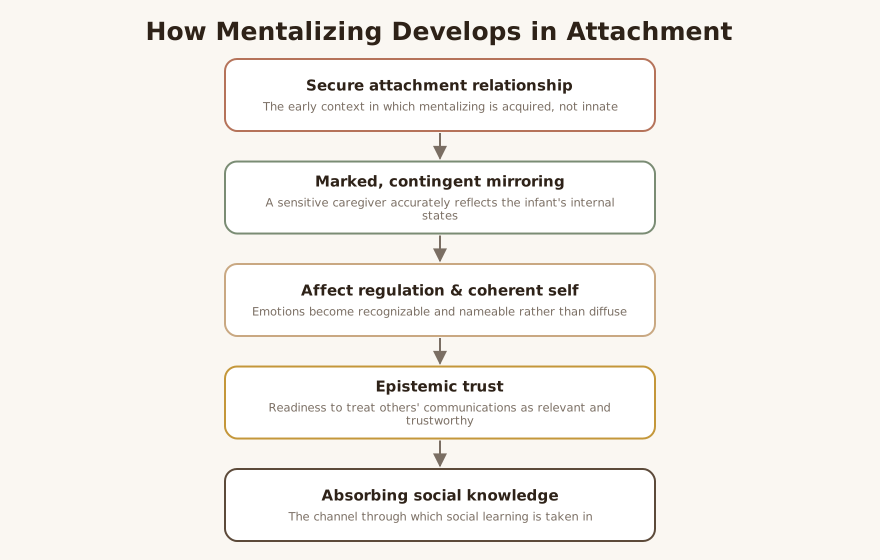
The central developmental claim is that mentalizing is not innate but acquired within early attachment relationships 6. A sensitive caregiver who accurately reflects the infant’s internal states—through what the theory calls marked, contingent mirroring—helps the child build a second-order representation of its own feelings 6. Through this process, the child develops affect regulation and a coherent sense of self, because emotions become recognizable and nameable rather than diffuse bodily states 6. Secure attachment thus does double duty: it soothes distress and it transmits the very capacity to think about minds 1. Fonagy’s later work adds that this relational learning opens epistemic trust—a readiness to treat communications from others as relevant and trustworthy—which is the channel through which social knowledge is absorbed 5. Mentalizing is also understood as multidimensional, spanning self versus other, cognitive versus affective, automatic versus controlled, and internally versus externally focused poles 2. Clinically, the key principle is that the capacity is state-dependent: it collapses under high attachment-related arousal and recovers as arousal falls 2.
Interventions & Techniques
Because mentalization is a construct, the techniques that target it live within Mentalization-Based Treatment (MBT), the structured psychotherapy developed to apply the theory 8. The therapeutic stance is one of curiosity and “not-knowing,” in which the clinician models active inquiry into mental states rather than supplying authoritative interpretations 8. Interventions are calibrated to the patient’s current arousal: when mentalizing is intact the therapist can explore complex states, but when it collapses the work shifts to support, empathy, and re-establishing a basic sense of being understood 2. The 2018 process study frames good in-session mentalizing as the patient’s capacity for “autonomous reflection,” “affective sharing,” and “self-assertion” while remaining open to the therapist’s perspective 3. That same study describes secure functioning as “the capacity to be alone in the presence of another,” supporting collaborative meaning-making in the room 3.
LLM-generated illustrative example (not a guideline): A patient says, “You cancelled last week because you can’t stand me.” Rather than reassure or interpret, the therapist pauses and wonders aloud: “I’m curious what was happening for you in the moment you concluded that—what was the feeling first?” LLM
This stance deliberately works with the rupture to restore mentalizing rather than resolving the factual dispute LLM.
Evidence Base
The honest summary is that the evidence base is established but uneven, strongest where the construct was first applied clinically LLM. The most mature evidence concerns MBT for borderline personality disorder, where the approach was developed and tested as a treatment for that population 2. Choi-Kain and Gunderson’s review situated mentalization as a measurable capacity with direct relevance to BPD’s assessment and treatment, consolidating the clinical rationale 2. Reflective functioning itself has decades of measurement validation, originating in the 1991 demonstration that parental RF predicts infant attachment security 1. Process research continues to refine how mentalizing is observed: the 2018 multi-site study of 160 outpatients across three countries showed that patients with higher pre-treatment RF demonstrated more autonomous reflection and affective sharing in early sessions, independent of therapist contribution 3. By contrast, applications to parenting interventions, child and adolescent treatment, and trauma are comparatively more emergent, with dedicated child-focused protocols only more recently formalized 4. Clinicians should therefore cite the BPD evidence with confidence and frame other applications as promising but less consolidated LLM.
Populations & Indications
The construct was clinically anchored in people with borderline personality disorder, for whom mentalizing failures map onto emotion dysregulation, impulsivity, and identity disturbance 2. Parents and caregivers are a second core population, since parental reflective functioning shapes the security of the child’s attachment and is itself a target of intervention 1. Children and adolescents are an expanding indication, with time-limited mentalization-based protocols developed specifically for younger patients 4. People with insecure attachment patterns are broadly indicated, given that the construct was built on attachment-classification research 7. People with trauma histories are increasingly addressed, because trauma can disrupt both mentalizing and the epistemic trust needed to learn from others 5. Across these groups the shared indication is difficulty representing mental states—one’s own or others’—under relational stress LLM.
Problems-for-Work
Mentalizing offers a unifying lens for several clinical problems that otherwise look unrelated LLM. Emotion dysregulation can be reframed as the collapse of affect mentalizing under arousal, so that feelings become overwhelming rather than thinkable 6. Interpersonal difficulties and relationship conflict often reflect rigid, inaccurate assumptions about others’ intentions that the patient holds as certainties 2. Impulsivity and self-harm can be understood as actions that substitute for unthinkable mental states when reflection is unavailable 2. Identity disturbance connects to a fragile or incoherent self-representation that never fully consolidated in early relationships 6. Insecure attachment is both a vulnerability and an active treatment focus, since the therapeutic relationship itself becomes the arena for new learning 7.
LLM-generated illustrative example (not a guideline): A couple repeatedly escalates because one partner reads silence as contempt; the therapist slows the exchange and asks each partner to voice their own state before guessing the other’s, rebuilding accurate other-mentalizing LLM.
LLM-generated illustrative example (not a guideline): An adolescent who cuts after arguments learns to label the unbearable feeling as shame rather than acting on it, restoring affect mentalizing in the gap between trigger and act LLM.
Contraindications, Cautions & Cultural Humility
Mentalizing work is not a substitute for crisis stabilization, and acute risk should be managed before exploratory mentalizing is attempted LLM. A core caution is iatrogenic: probing mental states while a patient is in a high-arousal, non-mentalizing state can intensify distress rather than help, so clinicians must titrate to current capacity 2. The “not-knowing” stance can be misapplied as detachment or as a refusal to provide needed structure, which undermines the epistemic trust the approach depends on 5. Cultural humility is essential because beliefs about minds, emotional expression, and acceptable self-disclosure vary across cultures, and what reads as “low reflective functioning” may reflect a different idiom of distress or communication norm LLM. The reflective-functioning rating scale was developed within particular research populations, so clinicians should avoid treating numeric RF as a universal or culture-free verdict on a person’s mind 3. The clinician’s own mentalizing can also fail under pressure, and supervision is the standard safeguard against confidently misreading a patient LLM.
Treatment-Plan Suggestions & SMART Objectives
| Goal | SMART objective (example) | Mechanism |
|---|---|---|
| Improve affect mentalizing | Within 8 weeks, client will name the specific emotion preceding two dysregulation episodes per week in session review | Builds second-order representation of affect, supporting regulation 6 |
| Reduce certainty about others’ intentions | Within 12 weeks, client will generate at least two alternative explanations for a partner’s behavior in 3 of 4 sessions | Loosens psychic-equivalence assumptions and strengthens other-mentalizing 2 |
| Increase pause before impulsive action | Over 6 weeks, client will use a “stop-and-wonder” step before self-harm urges, logging 80% of urges without acting | Inserts reflection between mental state and action 2 |
| Strengthen self-coherence | Within 16 weeks, client will articulate a consistent self-narrative across 3 consecutive sessions | Consolidates self-representation rooted in mentalized affect 6 |
| Repair attachment-related ruptures | In each session where a rupture occurs, client and therapist will jointly review the misunderstanding within the same session | Uses the relationship to restore mentalizing and epistemic trust 5 |
| Raise parental reflective functioning | Within 10 weeks, caregiver will describe the child’s likely internal state before responding in 4 of 5 reported interactions | Improves contingent mirroring that supports child attachment security 1 |
| Sustain mentalizing in the room | By session 20, client will demonstrate autonomous reflection and affective sharing while remaining open to the therapist’s view | Operationalizes in-session mentalizing as a process marker 3 |
Common Misconceptions
A frequent error is equating mentalization with empathy or insight; mentalizing includes thinking accurately about one’s own states, not only attuning to others 2. Another is treating reflective functioning as a stable trait, when it is explicitly state-dependent and degrades under attachment-related arousal 2. Some clinicians assume “more mentalizing is always better,” but hyper-mentalizing—elaborate, ungrounded inferences about others’ minds—is itself a form of impairment, not a strength 2. The construct is sometimes confused with mindfulness; mentalizing centers on the content of mental states and their causal links to behavior, not on nonjudgmental present-moment awareness LLM. Finally, MBT is often misread as a niche BPD-only technique, when the underlying construct is transdiagnostic and the BPD work is simply where the evidence is most developed 8.
Training & Certification
Mentalization-Based Treatment has formalized training, historically coordinated through the Anna Freud Centre and associated bodies, and MBT is the route through which clinicians become credentialed to deliver mentalizing-focused work 8. Training typically proceeds from a basic introductory course to a practitioner level, with supervision and adherence rating as components of competence 8. Dedicated tracks exist for specific applications, including time-limited mentalization-based treatment for children, which has its own published clinical manual 4. Reliable use of the Reflective Functioning Scale, particularly when scored from the Adult Attachment Interview, requires separate rater training to achieve consistency 3. Clinicians integrating only the mentalizing stance into existing practice do not need full certification, but formal MBT training is advisable before claiming to deliver the model LLM.
Key Terms
Mentalization — the capacity to interpret behavior, one’s own and others’, as arising from underlying mental states 3. Reflective functioning (RF) — the measurable, scored expression of mentalizing, rated on a graded scale in interview or session material 3. Marked mirroring — the caregiver’s contingent, slightly exaggerated reflection of the infant’s affect that builds the child’s representation of its own feelings 6. Epistemic trust — a person’s readiness to treat communicated information as relevant and trustworthy, opened by secure attachment and targeted in treatment 5. Psychic equivalence — a non-mentalizing mode in which internal experience is felt to be literally true of external reality, so thoughts and feelings carry the force of facts LLM. Adult Attachment Interview (AAI) — the semi-structured interview from which reflective functioning is frequently coded 7.
Resources & Further Reading
▶ Watch — a video introduction to this concept:
- Fonagy et al. (1991). The capacity for understanding mental states: the reflective self in parent and child
- Choi-Kain & Gunderson (2008). Mentalization: ontogeny, assessment, and application in BPD
- Talia et al. (2018). Mentalizing in the presence of another (open access)
- Mentalization-Based Treatment for Children (APA)
- Mentalizing and Epistemic Trust: the work of Fonagy and colleagues (Oxford Academic)
- Fonagy, Gergely, Jurist & Target (2002). Affect Regulation, Mentalization, and the Development of the Self
- Reflective Functioning and Attachment with Dr. Howard Steele (podcast)
- Mentalization-based treatment (Wikipedia)
Reflective / Supervision Questions
- When a session feels stuck or escalating, can I identify whether my own mentalizing has collapsed alongside the patient’s LLM?
- Am I distinguishing between a patient who genuinely cannot mentalize in the moment and one who is mentalizing differently because of cultural or relational norms I have not asked about LLM?
- Where am I tempted to supply interpretations rather than hold a “not-knowing” stance, and what does that tendency tell me about my own discomfort with uncertainty 8?
- When I describe a patient as “low RF,” what specific in-session behavior am I observing, and could I be confusing low reflective functioning with avoidance or fear 3?
- Finally, am I claiming the BPD evidence base to justify applications—such as trauma or parenting work—where the support is genuinely more emergent LLM?