
Type & Discipline
The Strange Situation is an observational assessment procedure in developmental psychology, not a treatment, a diagnosis, or a billable modality 1. It is a structured laboratory paradigm that exposes an infant to a standardized sequence of mildly stressful events — encounters with an unfamiliar room and stranger, brief separations from the caregiver, and reunions — and codes the infant’s behavior to derive an attachment classification 1. The procedure belongs to John Bowlby and Mary Ainsworth’s attachment theory, the framework that treats the infant–caregiver bond as a biologically rooted behavioral system organized around proximity, protection, and the use of the caregiver as a secure base 3. Its output is not a clinical label a therapist delivers but a research-validated description of how a particular infant organizes attachment behavior under stress, which in turn informs assessment, case formulation, and the selection of caregiving-focused intervention LLM. For practicing clinicians, the value of the paradigm is conceptual and assessment-adjacent: it supplies the empirical backbone for thinking about early relational security, attunement, and risk, even when no formal classification is being performed in the room LLM.
Creators & Lineage
The procedure was created by Mary Ainsworth in the 1960s and 1970s, building directly on John Bowlby’s attachment theory, with which she collaborated 3. Ainsworth’s early naturalistic observations of mother–infant interaction in Uganda and later in Baltimore convinced her that infants differed systematically in how they used the caregiver as a base for exploration and a haven in distress, and the Strange Situation was designed to elicit and measure those differences under controlled conditions 3. The film record of her work, including the Davidson Films documentary on attachment and the growth of love, helped establish the paradigm as a canonical method for the field 4. From these foundations Ainsworth derived three “organized” classifications — secure, insecure-avoidant, and insecure-resistant (ambivalent) — each representing a coherent strategy for managing the attachment relationship 1.
The lineage did not end with Ainsworth’s three categories 1. A subset of infants did not fit any organized pattern, and Mary Main, working with Judith Solomon, introduced the fourth “disorganized/disoriented” (D) classification around 1990 to capture them, with Erik Hesse later central to its theoretical development 2. Main also extended attachment assessment into adulthood through interview-based methods, opening the line of work — the Adult Attachment Interview and the study of internal working models — that connects an adult’s state of mind regarding attachment to their own caregiving and to their child’s classification LLM. The mentalization-based tradition is a further descendant, framing attachment security partly as the product of a caregiver’s capacity to hold the infant’s mind in mind LLM.
Core Principles
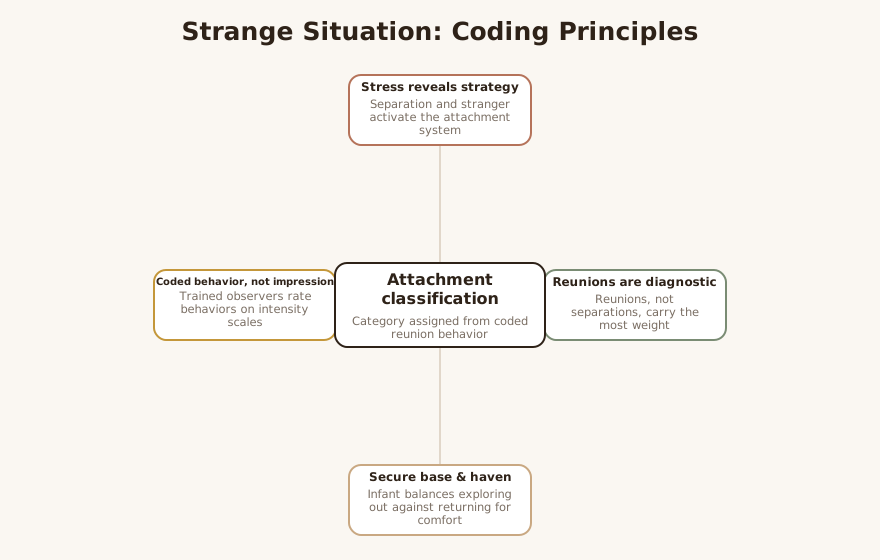
The first principle is that attachment behavior is best revealed under mild stress, not under calm 1. A contented, unstressed infant may explore happily regardless of attachment quality, so the procedure deliberately activates the attachment system through separation and the presence of a stranger, making the infant’s underlying strategy observable on reunion 1. The reunion episodes, not the separations, carry the most diagnostic weight, because they show how the infant uses — or fails to use — the caregiver to recover equilibrium LLM.
The second principle is the secure base and haven of safety: a well-functioning attachment relationship lets the infant venture out to explore and return for comfort, balancing exploration against the need for proximity 1. The third principle is that classification rests on coded behavior, not impression 1. Trained observers rate behaviors such as proximity and contact seeking, contact maintaining, avoidance of proximity and contact, and resistance to contact and comfort, typically on intensity scales sampled at fixed intervals across the episodes 1. The pattern across these behaviors, especially at reunion, yields the category 1. The fourth principle, central to Ainsworth’s interpretation, is the maternal sensitivity hypothesis: that secure attachment grows from a caregiver who responds promptly, consistently, and appropriately to the infant’s signals, while insecure patterns reflect less attuned caregiving 1. This last principle is also the one the evidence has most qualified, a point taken up below LLM.
Interventions & Techniques
Because the Strange Situation is an assessment method rather than a therapy, there are no “Strange Situation techniques” a clinician delivers in session LLM. The procedure itself is a standardized eight-episode sequence lasting roughly twenty minutes: caregiver and infant enter; the infant explores while the caregiver is available but uninvolved; a stranger enters and engages; the caregiver leaves; the caregiver returns and the stranger departs; the caregiver leaves again so the infant is briefly alone; the stranger returns; and the caregiver returns for a final reunion 12. Episodes are kept brief, around three minutes each, and are curtailed early if the infant becomes excessively distressed 1. Coding is then performed by trained raters using the behavioral scales, and the resulting classification is the technique’s product 1.
For the practicing therapist, the clinically usable translation is not to run the laboratory procedure but to recognize its logic in everyday interaction and to direct intervention at the caregiving relationship the model implicates LLM. The attachment-derived intervention aim is to increase caregiver sensitivity and reliable availability so that the infant can use the caregiver as a secure base and a haven, which is the proposed engine of security 1. Observation of separation and reunion moments — at drop-off, after a parent’s brief absence, during a frightening event — can be used informally to notice whether a child seeks, accepts, avoids, or resists comfort, and to formulate the caregiving pattern around it LLM.
LLM-generated illustrative example (not a guideline): In a parent–toddler session a clinician arranges a brief, naturalistic separation by having the parent step out to the waiting room and return; on reunion the toddler arches away while reaching, neither settling nor turning fully away. Rather than coding a formal classification, the clinician uses the moment to explore with the parent what made comforting hard in that instant and to coach a warmer, more predictable reunion, treating the observation as formulation rather than diagnosis LLM.
Evidence Base
The honest appraisal is that the Strange Situation is an established, extensively replicated assessment paradigm — arguably the most influential observational measure in developmental attachment research — not a fringe method and not a treatment with its own outcome trials 1. Its classifications have been reproduced across many samples, and large meta-analytic work has documented a broadly stable global distribution, with secure infants the majority and the two organized insecure patterns each a minority, though exact proportions vary by sample and culture 2. The original Baltimore findings approximated a secure majority of around seventy percent, with avoidant and resistant patterns each near fifteen percent, and later cross-national aggregation found comparable, if not identical, balances 12. Continuous-scoring approaches developed to address the limits of discrete categories have been shown to recover the secure-versus-insecure distinction in roughly nine of ten cases, supporting the measure’s underlying validity while signaling that rigid categories oversimplify a more dimensional reality 2.
At the same time the literature is candid about limits LLM. The maternal sensitivity hypothesis, while supported, is weaker than Ainsworth’s framing implied: meta-analytic estimates put the association between parental sensitivity and attachment classification at a modest correlation around 0.24, indicating that sensitivity matters but is far from the whole story 1. The procedure has been criticized for limited ecological validity, since it observes only about twenty minutes of artificial, laboratory-bound behavior and may not represent the relationship as it lives in the home 12. It assesses attachment to one caregiver at a time, not the child’s wider network of relationships 1. And its categorical structure has been challenged as obscuring continuous, multidimensional variation 1. The defensible stance is to treat the Strange Situation as a robust, well-validated measure of a real and meaningful phenomenon, while resisting the inference that a twenty-minute classification is a fixed verdict on a child or a parent LLM.
Populations & Indications
The paradigm’s primary and best-validated population is infants and toddlers, roughly nine to eighteen months and somewhat beyond, observed in the separation–reunion procedure for which it was designed 1. Within that range it is most informative where early relational security is the clinical question — for new parents and caregivers worried about bonding, for families in dyadic or infant mental health treatment, and for parent–child relational problems where the quality of comfort-seeking and comfort-giving is at issue LLM. Foster and adoptive families are a clinically important group, because early disruptions, multiple placements, and prior frightening or unpredictable care raise the likelihood of insecure or disorganized relating that new caregivers must learn to interpret and meet LLM.
The construct’s reach extends conceptually beyond infancy through its lineage LLM. The disorganized classification and the adult interview tradition connect the infant paradigm to populations with early relational trauma and to caregivers whose own unresolved histories shape their attunement, which is where attachment-informed assessment most often guides treatment selection LLM. Across these groups the indication is not that every family should undergo the formal procedure — which requires specialized training — but that attention to separation, reunion, and the use of the caregiver as a secure base is a useful organizing lens for early relational risk LLM.
Problems-for-Work
The paradigm maps onto a recognizable cluster of clinical problems with attachment insecurity at the center 1. Insecure-avoidant patterns present clinically as a child who minimizes distress and turns away from comfort, and the work is helping the caregiver read suppressed need behind apparent self-sufficiency and offer warmth the child can accept 1. Insecure-resistant or ambivalent patterns present as a child who is hard to settle and remains distressed or angry even when comforted, and the work is helping the caregiver provide predictable, consistent responsiveness that lets the child trust soothing will come 1. Disorganized presentations — contradictory, fearful, freezing, or dissociative behavior on reunion — signal the most concern, since they index a breakdown of any organized strategy and are linked to frightening or frightened caregiving and to early relational trauma 2.
Separation anxiety, emotion dysregulation, and caregiver attunement difficulties sit naturally within this frame LLM. Separation distress that is extreme or that fails to resolve on reunion is exactly what the procedure was built to surface, and formulating it through attachment rather than as mere “clinginess” points the work toward the reunion experience LLM. Emotion dysregulation in young children is often the visible face of a relationship that has not yet supplied reliable co-regulation, so the intervention targets the caregiver’s capacity to serve as a soothing presence LLM. Reactive attachment disorder and similar severe presentations belong to the same clinical territory, though they are formal diagnoses distinct from the research classifications and require their own assessment LLM.
LLM-generated illustrative example (not a guideline): A clinician sees a four-year-old in foster care who, when the foster parent returns after any absence, stiffens and stares blankly before resuming play as if nothing happened. Formulating through the attachment lens, the clinician hypothesizes that reunion itself has historically been unsafe rather than soothing, and the dyadic work focuses on small, repeated, low-key reunions in which the foster parent stays calm and welcoming until the child’s nervous system can begin to register return as relief LLM.
Contraindications, Cautions & Cultural Humility
The foremost caution is against treating a Strange Situation classification — or, worse, an informal impression of one — as a fixed trait, a diagnosis, or an indictment of a parent 1. It is a research category derived from about twenty minutes of behavior with a single caregiver, and overreading it as destiny or as proof of bad parenting is both inaccurate and harmful 1. Reliable classification depends on the standardized procedure and trained coders, so “diagnosing” a child’s attachment style from ordinary clinical observation, or a parent’s from a self-report quiz, overreaches the method’s evidence base 1.
Cultural humility is essential, because the procedure and its norms were developed within particular Western contexts and rest on the assumption that brief separations mean the same thing everywhere — an assumption that does not hold across cultures 2. In Japanese samples, where infants are rarely separated from mothers, the separations were unusually distressing and inflated apparent resistant classifications, while North German samples, which value early independence, produced more avoidant classifications than global norms; in both cases culturally normative caregiving risked being misread as insecurity 12. Later research using developmentally and culturally adapted systems brought some of these distributions back toward global norms, underscoring that the behavior must be interpreted against the family’s own caregiving culture rather than a single standard 2. A further ethical caution belongs to the wider field: the mild stress the procedure induces is defensible only because episodes are curtailed when distress is excessive, and clinicians should sharply distinguish evidence-aligned, caregiving-supportive attachment work from coercive or regressive “attachment therapies” that misuse the name and have caused harm 1LLM.
Treatment-Plan Suggestions & SMART Objectives
| Goal | SMART objective (example) | Mechanism |
|---|---|---|
| Increase caregiver sensitivity and prompt responsiveness | Over 12 weeks of dyadic sessions, caregiver will accurately read and respond to 3 of the child’s distress signals within structured play, observed in 2 consecutive sessions | Targets the proposed engine of secure attachment 1 |
| Strengthen caregiver as a secure base for exploration | Within 10 sessions, caregiver will support the child’s independent exploration while remaining available, demonstrated in 3 structured episodes | Restores the explore-and-return balance of secure attachment 1 |
| Make reunions soothing rather than dysregulating | Over 8 weeks, child will accept comfort and settle within 2 minutes on reunion in 3 of 4 observed instances | Repairs the reunion experience that classification weights most heavily 1 |
| Build co-regulation for emotion dysregulation | Over 8 weeks, child will use 2 caregiver-supported co-regulation strategies when distressed, observed weekly | Supplies the reliable soothing an insecure pattern lacks LLM |
| Reduce extreme separation distress | Within 12 sessions, child will tolerate a brief planned separation and recover on reunion with caregiver support in 80% of logged instances | Addresses separation anxiety through predictable, safe reunion LLM |
| Address disorganized/fearful reunion behavior | Within 16 sessions, caregiver will identify and soften 2 of their own threat or fear cues so reunions become consistently calm and welcoming | Targets caregiving behavior linked to disorganized relating 2 |
| Support attunement in foster/adoptive placements | Over 12 weeks, caregiver will narrate the child’s likely inner experience during 2 confusing interactions per week | Builds reflective attunement that scaffolds new security LLM |
Common Misconceptions
A frequent error is treating the resulting “attachment style” as a stable personality type that a brief online quiz can reveal; the classifications originated as coded infant behavior within a validated laboratory procedure, and their adult counterparts rest on specialized interview assessment, not self-report labels 1. A second misconception is that the separations are the point; the diagnostic weight lies in the reunion, in how the infant uses the caregiver to recover, not in how much the infant cries when alone 1. A third is that the procedure measures the child’s temperament or general anxiety; it is designed to capture the organization of the attachment relationship with a specific caregiver, which is why the same child can show different patterns with different caregivers 1.
A fourth misconception treats Ainsworth’s maternal sensitivity hypothesis as fully established and deterministic, when the measured association between sensitivity and security is modest and leaves substantial room for other influences 1. A fifth assumes the classifications are universal in their meaning, ignoring the cross-cultural findings showing that culturally normative caregiving can shift distributions and be misread as insecurity 2. Finally, many assume a classification is a permanent verdict; it is a snapshot of one relationship at one developmental moment, and attachment patterns can change as caregiving and circumstances change LLM.
Training & Certification
There is no clinical license or credential in “the Strange Situation”; it is a research and assessment method used within existing professional scope, and using attachment concepts for formulation does not require certification LLM. Administering and coding the procedure itself, however, does require formal training, because reliable classification depends on the standardized protocol and on inter-rater reliability rather than casual observation 1. The disorganized classification in particular requires specialized coding, and the adult interview tradition that grew from this lineage depends on its own training 2.
For clinical application, the relevant training lives in recognized attachment-focused and infant mental health approaches: dyadic and parent–child psychotherapy models, caregiver-sensitivity interventions, and mentalization-based treatment as a related lineage LLM. Generalist therapists can legitimately use attachment classifications as a formulation lens, provided they represent their competence honestly and refer for, or pursue, specialized training when structured attachment assessment or dyadic treatment is indicated LLM. Clinicians should be especially careful to separate evidence-aligned training from the discredited “attachment therapy” practices that misuse attachment language LLM.
Key Terms
Strange Situation — Ainsworth’s structured eight-episode separation–reunion procedure from which infant attachment classifications are coded 1. Secure base / haven of safety — the caregiver’s dual function as a base for exploration and a refuge in distress, central to secure attachment 1. Secure (Type B) — the pattern in which the infant explores using the caregiver as a base, shows distress at separation, and is comforted and settles on reunion 1. Insecure-avoidant (Type A) — the pattern of minimized distress and turning away from comfort on reunion 1. Insecure-resistant/ambivalent (Type C) — the pattern of heightened distress and difficulty being soothed, with angry or passive resistance to comfort on reunion 1. Disorganized/disoriented (Type D) — the fourth classification, added by Main and Solomon, marking the breakdown of any organized strategy, with contradictory, fearful, freezing, or dissociative behavior 2. Maternal sensitivity hypothesis — Ainsworth’s proposal that prompt, consistent, appropriate caregiver responsiveness fosters secure attachment, supported but at a modest effect size 1. Internal working models — the mental representations of self and others formed from early attachment experience, the bridge from infant classification to later relating LLM.
Resources & Further Reading
▶ Watch — a video introduction to this concept:
- Mary Ainsworth & The Strange Situation Experiment — Simply Psychology
- Strange Situation — Wikipedia
- Mary Ainsworth: Attachment Theory and the Strange Situation — The Attachment Project
- Mary Ainsworth’s Strange Situation: Attachment and the Growth of Love (Davidson Films preview)
- Mary Ainsworth Strange Situation Experiment — Attachment Theory (Early Years TV)
Reflective / Supervision Questions
- When I read a child’s reunion behavior, am I attending to how the child uses the caregiver to recover, or am I overweighting how much the child cried during separation 1?
- How do I hold an attachment formulation as a snapshot of one relationship at one moment, rather than letting it harden into a fixed verdict about a child or a parent 1?
- Before I interpret a child’s behavior as insecure, how am I checking it against the family’s own cultural and caregiving norms around separation and proximity 2?
- With caregivers, how do I address attunement difficulties without shaming the parent, recognizing that sensitivity is only a modest part of what shapes security 1?
- Where am I operating beyond my training — for instance, implying a formal classification from informal observation — and when should I refer for specialized attachment assessment or dyadic treatment LLM?
- How do I keep my attachment-informed work clearly distinct from coercive or regressive practices that misuse the language of attachment LLM?