
Type & Discipline
Mentalization-Based Treatment (MBT) is a manualized, time-limited psychotherapy situated within the psychodynamic tradition but heavily informed by attachment theory and developmental research 3. It is best understood as a transdiagnostic family of treatments built around a single capacity — mentalizing — rather than as a school-bound technique 4. Its native discipline is clinical psychology and psychoanalysis, and it is most often delivered in secondary and tertiary mental health services by clinicians from mixed professional backgrounds 3. Unlike interpretation-heavy classical psychoanalysis, MBT deliberately keeps its theoretical demands low and its therapeutic stance simple enough to be learned with limited additional training and moderate supervision 3. This pragmatism was a design choice: the model was built to be deliverable within ordinary generic services rather than confined to specialist analytic centres 3.
Creators & Lineage
MBT was developed by Anthony Bateman, a psychiatrist and psychotherapist, and Peter Fonagy, a clinical psychologist and psychoanalyst, beginning in the late 1990s 1. Its intellectual lineage runs directly through attachment theory and the developmental study of how infants come to read minds 3. Fonagy’s research program reframed Bowlby’s attachment work in cognitive-developmental terms, proposing that the capacity to understand mental states is itself an achievement of secure early attachment relationships 3. The model also draws on the psychoanalytic concern with internal representations and transference, though it reworks these into a more collaborative, less interpretive form 3. Conceptually, MBT shares territory with Dialectical Behavior Therapy — both target the affective and interpersonal storms of borderline personality disorder — but MBT locates the core problem in a collapse of mentalizing under attachment stress rather than in skills deficits per se LLM. The Anna Freud Centre in London has been a principal hub for the dissemination, training, and continued development of MBT 4.
Core Principles
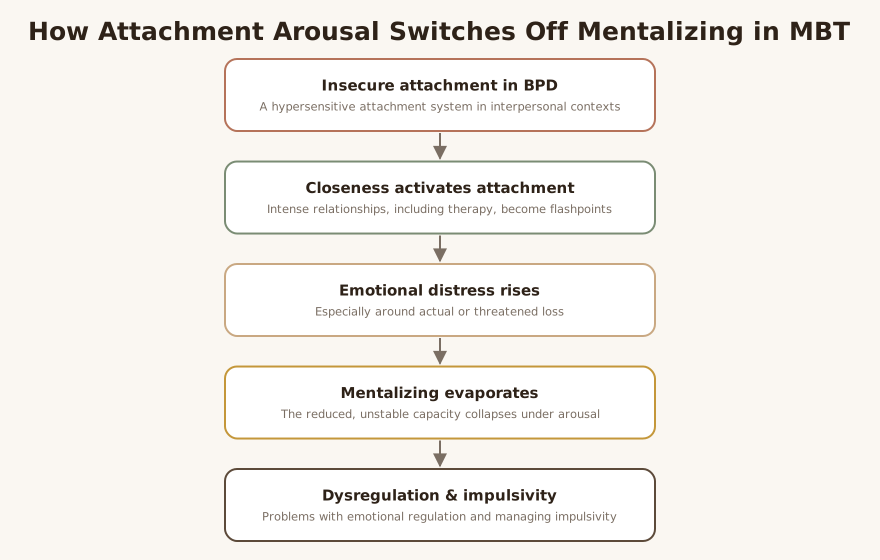
Mentalizing is “the process by which we make sense of each other and ourselves, implicitly and explicitly, in terms of subjective states and mental processes” 3. It is the capacity to attend to mental states — beliefs, wishes, feelings, intentions — in oneself and others, and to grasp how those states drive behavior 4. MBT’s central clinical claim is that people with borderline personality disorder have a reduced and unstable capacity to mentalize, which produces problems with emotional regulation and difficulty managing impulsivity 3. Crucially, the deficit is not fixed but stress-sensitive: at moments of emotional distress, especially around actual or threatened loss, the capacity for mentalization is most likely to apparently evaporate 3. BPD is strongly associated with insecure attachment, with only a small minority of patients coded as securely attached, and the disorder involves a hypersensitive attachment system in interpersonal contexts 3. The therapeutic logic follows directly: closeness and attachment activation can paradoxically switch mentalizing off, which is why intense relationships — including the therapeutic one — become flashpoints 3.
When mentalizing fails, the mind reverts to developmentally earlier, non-mentalizing modes of experience LLM. In psychic equivalence, inner experience and outer reality are fused, so a thought feels as real and unarguable as a physical fact LLM. In the teleological mode, mental states are only believed when expressed in physical action or observable outcomes, which helps explain why reassurance in words can fail while self-harm or demands for action feel compelling LLM. In pretend mode, thoughts and feelings are decoupled from reality, producing talk that is fluent but emotionally empty or dissociated LLM. Restoring flexible, accurate mentalizing across these modes is the organizing aim of every MBT session LLM.
Interventions & Techniques
The therapist’s stance is the primary intervention, and it is deliberately one of humility from a “not-knowing” position 3. Rather than presenting as the expert on the patient’s mind, the clinician models curiosity, patiently identifies where their perspective and the patient’s differ, and asks “what” questions in preference to “why” questions 3. Asking what was happening just before an outburst keeps attention on observable mental states, whereas “why” prematurely demands an explanation the patient may not yet be able to give LLM. The therapist actively monitors their own mentalizing failures and treats occasional enactments as expected and workable rather than as errors to be hidden 3.
Technique is sequenced to the patient’s arousal: MBT first works to stabilize emotional expression, and only then turns toward exploring internal representations 3. A signature procedure is mentalizing the transference, a stepwise process emphasizing validation of the patient’s experience, joint exploration, explicit acknowledgment of the therapist’s own contribution and enactments, collaboration, and the careful presentation of alternative perspectives 3. This is explicitly distinguished from traditional insight-focused transference interpretation; the goal is to use the live relationship to practice mentalizing, not to deliver a genetic explanation 3. The standard format combines weekly individual therapy with a weekly mentalizing group, so the patient rehearses the same capacity in both dyadic and group attachment contexts LLM.
LLM-generated illustrative example (not a guideline): A patient arrives convinced their therapist “obviously wants to get rid of them” after a session was rescheduled. Rather than reassuring or interpreting, the MBT therapist slows down, validates the fear, and says, “Let’s rewind — what went through your mind the moment you got my message?” — working to re-open mentalizing where psychic equivalence had collapsed thought into fact LLM.
Evidence Base
The maturity of MBT’s evidence base is best described as established for borderline personality disorder, with the strongest trials coming from the originating group 6. The first randomized controlled trial, in 1999, tested MBT delivered within a partial hospitalization program against treatment as usual and found statistically significant improvement across measures, including reduced depressive symptoms, fewer suicidal and self-mutilatory acts, fewer inpatient days, and better social and interpersonal functioning, with gains emerging after about six months and continuing to the 18-month endpoint 1. Long-term follow-up of that original partial-hospitalization cohort versus treatment as usual was striking: at eight years, only 14% of MBT-treated patients still met diagnostic criteria for BPD compared with 87% of the comparison group 3. A second, larger trial in 2009 tested 18 months of outpatient MBT against structured clinical management, a robust comparator 2.
Honesty about that 2009 trial is important: substantial improvements were observed in both conditions across all outcome variables, with the MBT group showing a steeper decline in self-reported problems, suicide attempts, and hospitalization 3. In other words, a well-structured, attentive comparator also helped patients considerably, and MBT’s advantage was one of degree LLM. This pattern matters for interpretation, because the most robust positive trials originate from the developers, and the extent and consistency of independent replication outside the originator group remains an active question rather than a settled one LLM. A 2024 state-of-the-science review formally appraised the field and mapped future directions, signaling that the modality continues to mature rather than rest 6.
Populations & Indications
MBT was initially developed for the treatment of borderline personality disorder and has been shown to be highly effective for it, which remains its primary indication 4. From that base it has been adapted for a widening range of presentations, and the Anna Freud Centre describes its use for antisocial personality disorder, families, and adolescents, among others 4. The clinical rationale for these extensions is consistent: wherever mentalizing collapses under interpersonal and affective stress, the model’s stance and structure are potentially relevant LLM. Adolescent adaptations (MBT-A) target self-harming young people, where developmental immaturity of mentalizing intersects with attachment turmoil LLM. Application to eating disorders and to populations with significant trauma histories has also been explored, on the reasoning that disrupted mentalizing and insecure attachment are common across these groups, though the supporting trial literature here is thinner than for BPD LLM. Within a BPD presentation, the typical indications include emotion dysregulation, impulsivity, recurrent self-harm and suicidality, affective instability, identity disturbance, and chronic interpersonal difficulty LLM.
Problems-for-Work
MBT translates symptom-level problems into a single working question: where and when does this patient stop mentalizing, and what mode takes over LLM?
- Non-suicidal self-injury and suicidal ideation. These are read as actions that surface when words feel unconvincing — a teleological solution to unbearable, unmentalized affect — so work focuses on rebuilding the felt link between internal state and self-care LLM.
- Emotion dysregulation and affective instability. Sessions first stabilize arousal, because mentalizing is unavailable at high affect, then slowly reconstruct an accurate narrative of what the feeling was about 3.
- Interpersonal difficulties. The live therapy relationship, including ruptures, is used as practice ground via mentalizing the transference rather than as material to interpret 3.
- Identity disturbance. A coherent sense of self is treated as an emergent product of stable mentalizing of one’s own states over time, so the work is cumulative rather than insight-driven LLM.
LLM-generated illustrative example (not a guideline): A young adult who cuts after every argument with a partner is helped, over weeks, to notice the specific moment of “going blank” before the urge — naming the unmentalized panic — so that an internal experience, rather than an action on the body, becomes the place the feeling can be held LLM.
Contraindications, Cautions & Cultural Humility
MBT is not a crisis intervention, and acute risk that exceeds the holding capacity of an outpatient frame may require a higher level of care before or alongside it LLM. Because closeness can switch mentalizing off, an overly intense or interpretation-heavy stance can iatrogenically destabilize a patient — restraint and the not-knowing position are protective, not merely stylistic 3. Clinicians should be cautious about applying BPD-derived evidence to populations where the trial base is limited, such as eating disorders or trauma-specific presentations, and should hold those applications as reasoned extensions rather than established treatments LLM. Cultural humility maps unusually well onto the model’s own logic: the not-knowing stance presumes the clinician cannot read another person’s mind, and that presumption should extend to cultural, linguistic, and contextual meanings the therapist does not share LLM. What looks like a “mentalizing failure” may instead be a legitimate difference in idiom, family structure, or relational norms, and labeling it as pathology is itself a failure of the therapist’s mentalizing LLM. Co-occurring active psychosis or substance intoxication can also temporarily make explicit mentalizing work impractical until those states are addressed LLM.
Treatment-Plan Suggestions & SMART Objectives
| Goal | SMART objective (example) | Mechanism |
|---|---|---|
| Stabilize affect before exploration | Within 8 weeks, patient will identify early-warning bodily/affect cues in 3 of 4 sessions before escalation | Lowers arousal so mentalizing capacity stays online LLM |
| Reduce self-harm as a teleological solution | Over 12 weeks, reduce NSSI episodes by 50% by naming the precipitating mental state instead of acting | Re-links internal state to symbolic processing rather than action LLM |
| Strengthen self-mentalizing | By session 16, patient will articulate a feeling and its likely trigger in own words in 75% of sessions | Builds stable representation of own mind LLM |
| Improve other-mentalizing | Within 12 weeks, patient generates at least one alternative perspective on a conflict partner per relevant session | Counters psychic equivalence in relationships LLM |
| Repair relational ruptures in vivo | Across treatment, patient and therapist explicitly name and work through 80% of identified ruptures | Uses transference as live mentalizing practice 3 |
| Reduce crisis service use | Over 6 months, reduce ED visits/hospital days vs prior 6-month baseline | Replicates the functional gains seen in MBT trials 1 |
| Build a coherent identity narrative | By treatment end, patient describes self across 3 domains without all-or-nothing shifts | Emergent product of sustained accurate mentalizing LLM |
Common Misconceptions
A frequent error is treating MBT as a synonym for “talking about feelings”; the work is about restoring the capacity to think about mental states, not about catharsis or insight delivery 3. Another is conflating it with classical psychoanalytic transference interpretation — MBT explicitly distinguishes mentalizing the transference from interpretation aimed at insight, and the therapist’s posture is collaborative and not-knowing rather than authoritative 3. A third misconception is that more intensity equals more progress; because attachment activation can suppress mentalizing, pushing closeness or affect too hard can be counterproductive 3. Clinicians sometimes assume MBT is only for BPD, when in fact it was developed for BPD but has been extended to antisocial personality disorder, adolescents, and families 4. Finally, the evidence is sometimes overstated as uniformly superior to all comparators, when in reality strong structured comparators have also produced substantial improvement and MBT’s documented advantage has been one of degree 3.
Training & Certification
MBT was deliberately designed to be teachable to generic mental health clinicians with limited additional training and moderate supervision, which is part of its appeal for ordinary services 3. Formal training pathways are offered by the Anna Freud Centre, which provides structured MBT training programmes spanning adult, adolescent, and other adaptations 4. A practical clinical manual by Bateman and Fonagy serves as the canonical implementation guide and supports fidelity to the model 5. In practice, competent delivery typically progresses from foundational training in the model’s stance and structure, through supervised clinical work, toward recognized practitioner and supervisor status within the MBT training framework LLM. Ongoing supervision is treated as integral rather than optional, both for fidelity and because the therapist’s own mentalizing is itself a clinical instrument 3.
Key Terms
- Mentalizing. Making sense of self and others in terms of subjective states and mental processes, implicitly and explicitly 3.
- Psychic equivalence. A non-mentalizing mode in which inner experience is felt to be identical to external reality, so a thought feels indisputably real LLM.
- Teleological mode. A non-mentalizing mode in which mental states are only credited when shown in physical action or observable outcomes LLM.
- Pretend mode. A non-mentalizing mode in which thoughts and feelings are decoupled from reality, producing fluent but emotionally hollow talk LLM.
- Not-knowing stance. The therapist’s posture of curious humility about the patient’s mind, asking “what” rather than “why” 3.
- Mentalizing the transference. A stepwise use of the live therapy relationship to practice mentalizing, distinct from insight-oriented interpretation 3.
- Hypersensitive attachment system. The proposed mechanism by which interpersonal closeness destabilizes mentalizing in BPD 3.
Resources & Further Reading
▶ Watch — a video introduction to this concept:
- Bateman & Fonagy (1999), partial hospitalization RCT, Am J Psychiatry
- Bateman & Fonagy (2009), outpatient MBT vs structured clinical management RCT, Am J Psychiatry
- Bateman & Fonagy (2010), MBT for BPD overview, World Psychiatry (PMC)
- Anna Freud Centre — What Is MBT? Mentalization-Based Treatment Explained
- Bateman & Fonagy — MBT for BPD: A Practical Guide (Oxford Academic)
- Jorgensen et al. (2024), MBT for BPD: State-of-the-Science and Future Directions (Wiley)
Reflective / Supervision Questions
- Where in this patient’s history does my own capacity to mentalize tend to fail, and what mode do I slip into when it does LLM?
- Am I asking “what” or quietly demanding “why,” and is the patient’s arousal low enough for either to land LLM?
- When I felt an urge to reassure, interpret, or fix, what attachment pressure in the room was driving it LLM?
- How am I distinguishing a genuine mentalizing failure from a cultural or contextual difference I simply do not share LLM?
- If the patient is improving, can I tell whether it is the model’s specific technique or the nonspecific structure and attention that a strong comparator would also provide LLM?
- Where am I extending BPD-derived methods to a population with a thinner evidence base, and am I holding that honestly with the patient LLM?