
Type & Discipline
Decolonizing and Indigenous healing frameworks are not a single manualized therapy but a family of epistemologies, critiques, and culturally grounded practices situated at the intersection of Indigenous studies, community psychology, and counselling psychology 5. They begin from a critique rather than a protocol: that mainstream psychology was built on Western, Educated, Industrialized, Rich, and Democratic (WEIRD) populations and treats Western norms as universal, producing a narrow and culturally biased account of mental health that marginalizes Indigenous and non-Western worldviews 5. The discipline of psychology is described as having colonial foundations, having historically participated in pathologizing Indigenous ceremonies, spirituality, and cultural knowledge and in forced assimilation 6. For the practicing therapist, the most accurate framing is that this is a worldview and an ethical stance layered onto clinical work, not a replacement for assessment and indicated treatment LLM. Its central reframe is that distress is relational, historical, and collective as much as individual, and that healing is correspondingly relational, land-connected, and ceremonial rather than purely intrapsychic 46.
Creators & Lineage
This is a distributed, community-rooted tradition rather than the invention of any one founder, and much of its authority sits with Indigenous knowledge keepers and communities rather than with named academics LLM. Within the scholarly literature, Linda Tuhiwai Smith’s Decolonizing Methodologies is foundational, arguing that for Indigenous peoples research itself was “inextricably bound up with memories of exploitation” and calling for methodologies that center Indigenous ways of knowing and intellectual self-determination 1. Eduardo Duran is widely credited in this lineage for clinical concepts such as the “soul wound” and for articulating historical and intergenerational trauma in Native communities, though those specific contributions are attributed here from field knowledge rather than from the cited sources LLM. Contemporary scholarship continues to extend the work: Henninger and Marion theorize “decolonizing embodiment” as a route to liberation and collective healing rooted in decolonial theory and Indigenous knowledge systems 4, and reviews such as Gomez-Bailon’s situate Indigenous psychology as a necessary response to the dominance of “whiteness” in the field 5.
The intellectual lineage braids together Indigenous epistemologies, decolonial psychology, community psychology, and narrative and spiritual or ceremonial healing traditions 56. It overlaps substantially with liberation psychology, anti-oppressive practice, and conscientization, sharing their insistence that distress be located in systems of power rather than only in the individual LLM. A distinctive integrative concept from this literature is Etuaptmumk, or “two-eyed seeing,” which frames Western and Indigenous knowledge as distinct systems each holding value, to be used together rather than collapsed into one another 6.
Core Principles
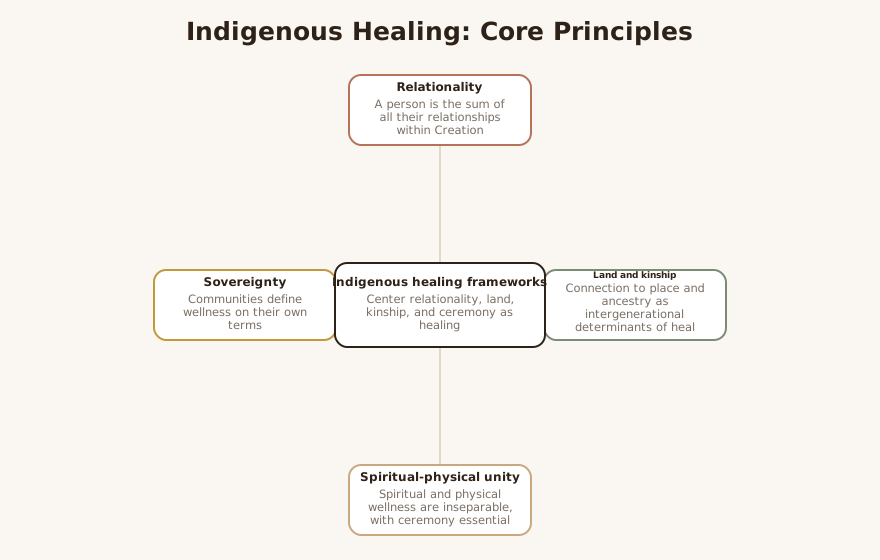
The first principle is relationality: in Indigenous epistemologies a person is understood as “the sum of all their relationships within Creation,” interconnected with community, ancestors, land, and the natural world, in sharp contrast to Western psychology’s individualistic self 6. Wellness on this view depends on maintaining and repairing those relationships across generations, not on optimizing an isolated individual 2. Land and kinship are treated as determinants of health in their own right: connection to place and to ancestral environments is intergenerational and protective, and documented land dispossession produced measurable harm to health 2.
A second principle is the inseparability of spiritual and physical wellness. Indigenous knowledge systems embed the spiritual and the physical as one, and ceremony and spiritual practice are described as essential to wellness rather than optional adjuncts 2. Knowledge itself is understood as carrying ancestral experience across generations, transmitted through story and language 6. A third principle is sovereignty and self-determination: Indigenous nations and communities define wellness on their own terms and build health systems that reflect their own worldviews, a stance that predates colonial contact 2. Language and cultural identity are framed as resilience factors, with reconnection to culture and identity functioning as protective, including in suicide prevention 2. A fourth principle, drawn from the embodiment literature, centers cultural resurgence, the acknowledgment of intergenerational trauma, land-based healing, and the cultivation of collective rather than purely individual agency 4. For clinicians trained in symptom-focused models, the practical takeaway is that spirituality, kinship, land, and collective identity are frequently central to the case rather than peripheral to it LLM.
Interventions & Techniques
Because this is a framework rather than a protocol, its “techniques” are better understood as orientations and as practices that belong to communities and knowledge keepers, not as portable tools a clinician simply adds to a kit LLM. The foundational clinical move is to shift the unit of analysis from the isolated individual toward the web of relationships, history, and land in which the person is embedded, and to treat that re-relating as itself therapeutic 62. A second move is two-eyed seeing: holding Western and Indigenous frameworks side by side so that biomedical assessment and culturally grounded healing each contribute their strengths without one subordinating the other 6.
Concrete culturally centered practices documented in this literature include reconnection to traditional knowledge systems, holistic and collectivist models of well-being, and culturally rooted healing practices 5. Land-based programs that engage youth in ancestral practices, such as the Healing of the Canoe initiative, have been used for substance-misuse prevention and cultural reconnection 2. Language revitalization, cultural reconnection, and intergenerational interaction are used as protective and suicide-preventive strategies 2. Somatic and embodiment-oriented approaches that reclaim Indigenous ways of being in the body are theorized as routes to liberation and collective healing 4. Crucially, ceremony and spiritual practice are community-held and require proper standing and relationship; the clinician’s role is typically to support, refer to, and collaborate with traditional healers rather than to deliver these practices directly 2LLM.
LLM-generated illustrative example (not a guideline): A non-Indigenous clinician working with a Native client experiencing grief and disconnection does not attempt to run a ceremony. Instead, using a two-eyed-seeing stance, the clinician offers narrative and emotion-focused work in session while actively helping the client re-establish contact with a community knowledge keeper and a land-based program, treating that reconnection as central to the plan rather than as an afterthought LLM.
Evidence Base
The honest assessment is that this is an emerging evidence base whose strength lies in critique, cultural safety, and community practice wisdom more than in head-to-head efficacy data LLM. The literature is largely conceptual, participatory, and qualitative: it advances a well-developed critique of medicalization and Eurocentrism in mental health and documents community-based programs, but it does not yet offer a deep body of randomized controlled trials demonstrating that decolonized or Indigenous-centered treatment packages outperform standard care 56. Specific community initiatives, such as land-based youth programs for substance-misuse prevention and culture-based suicide-prevention strategies, are reported as promising, but much of the supporting evidence is community-defined, contextual, and not designed around conventional trial metrics 2.
There is also a principled tension worth naming: these frameworks argue that imposing Western research methodology and outcome standards is itself a colonial act, since research was historically “inextricably bound up with memories of exploitation,” so the absence of large RCTs is partly a methodological stance rather than simply a gap 1. Reviews in this area frame Indigenous psychology as a necessary corrective to a WEIRD-dominated field rather than as a finished, validated treatment system 5. For clinicians, the responsible posture is to treat these frameworks as a rich, ethically important, and culturally responsive lens with strong face validity and growing but still-emerging empirical support, integrated alongside evidence-based care rather than substituted for it LLM.
Populations & Indications
The primary populations are Indigenous and First Nations peoples, Aboriginal communities, and Native American and Alaska Native populations, including the many federally and non-federally recognized tribal nations with diverse histories and distinct relationships to government 2. The frameworks also speak to communities affected by colonization more broadly, to people experiencing cultural disconnection, and to survivors of intergenerational and historical trauma 45. They are indicated whenever the cultural, spiritual, communal, or land-based dimensions of a client’s life are clinically relevant, which for these populations is often most of the time rather than only in explicitly “cultural” complaints 2. They are especially apt where a standard biomedical formulation would pathologize culturally normative behavior or would miss spirituality, extended kinship, language, and connection to land as protective resources 62. The frameworks are also indicated at the community and systems level, informing how services are designed, governed, and evaluated, not only how an individual session is conducted 2.
Problems-for-Work
Intergenerational and historical trauma. The frameworks locate present distress in the documented history of colonization, dispossession, and forced assimilation, validating it as legitimate clinical material rather than individual deficit 46. Application: a clinician helps a client connect current grief and anger to a multigenerational history, then mobilizes cultural reconnection as part of repair 4.
Substance use disorders. Culturally rooted, land-based, and community-engaged approaches are used for prevention and healing, as in youth ancestral-practice programs 25. Application: supporting a client’s participation in a community land-based program alongside indicated treatment, rather than relying on an individual relapse-prevention model alone LLM.
Cultural identity loss and community disconnection. Language revitalization, reconnection to culture and identity, and restoration of kinship ties are framed as protective and restorative 2. Application: helping a client re-engage language, ceremony access, and community relationships as a core treatment aim 2.
Suicidality and collective grief. Reconnection with culture and identity and intergenerational interaction are described as suicide-preventive, situating risk in disconnection rather than solely in individual pathology 2. Application: building cultural connectedness and community belonging into a safety and support plan, while still using standard risk assessment and crisis care 2LLM.
Spiritual distress and depression. Because Indigenous knowledge systems treat spiritual and physical wellness as inseparable, spiritual distress is engaged as central rather than peripheral, often by supporting access to community and ceremonial resources 26. Application: exploring spiritual disconnection respectfully and facilitating culturally appropriate connection rather than medicalizing the distress away 6.
Contraindications, Cautions & Cultural Humility
There are no medical “contraindications” to a worldview, but the cautions here are significant and specific LLM. Ceremony, smudging, sweat lodge, and other spiritual and land-based practices are community-held and require proper standing, relationship, and training; a non-Indigenous clinician performing or facilitating them without that standing is appropriation and can itself be harmful, and even well-intentioned imitation can violate protocol 2LLM. The appropriate stance is to refer to and collaborate with traditional healers and knowledge keepers, using two-eyed seeing as the integration frame so that biomedical care and Indigenous healing each keep their integrity 62. These frameworks must not be applied monolithically: Indigenous individuals and nations differ enormously in identity, religiosity, language, and relationship to tradition, and assuming any one client wants a ceremonial or culturally centered orientation is itself an imposition LLM.
Cultural humility also means recognizing that the clinician’s own discipline carries a colonial history and that research and assessment instruments may encode WEIRD assumptions, so they should be used reflectively rather than as neutral universals 56. Because suicidality and substance use disorders appear among the relevant problems, it must be stated plainly that ceremonial, spiritual, and reconnection work is not a substitute for indicated treatment of acute risk or serious psychiatric illness; standard risk assessment, crisis planning, and evidence-based care remain in force and are best delivered in collaboration with, not instead of, community resources LLM. Finally, the principle of sovereignty implies that communities, not outside clinicians, hold authority over how their healing knowledge is used and shared 2.
Treatment-Plan Suggestions & SMART Objectives
| Goal | SMART objective (example) | Mechanism |
|---|---|---|
| Address historical/intergenerational trauma | Within 12 sessions, client will narrate a personal-and-collective trauma timeline and report a measurable reduction in trauma-related distress on a standardized measure | Locating distress in colonial history and mobilizing cultural reconnection 4 |
| Restore cultural identity and belonging | Over 12 weeks, client will re-engage at least 2 cultural or language practices and report increased cultural connectedness | Language and identity as resilience factors 2 |
| Reconnect to community and kinship | Within 8 weeks, client will re-establish contact with 2 supportive community or kin relationships and log regular contact | Relationality and collective support 6 |
| Support recovery from substance use | Over treatment, client will participate in 1 community or land-based cultural program alongside indicated care and track engagement weekly | Land-based, culturally rooted prevention and healing 2 |
| Strengthen protective factors against suicidality | Within 6 weeks, client will identify and use 3 cultural-connectedness supports and complete collaborative safety planning | Cultural connectedness as a protective, suicide-preventive factor 2 |
| Engage spiritual distress respectfully | Over treatment, client will access 1 self-chosen spiritual or ceremonial resource through appropriate community channels | Inseparability of spiritual and physical wellness 26 |
| Build collective agency | Within 10 sessions, client will take 1 valued action connected to community or cultural resurgence and reflect on its meaning | Collective agency and cultural resurgence 4 |
Common Misconceptions
A frequent error is treating these frameworks as a toolkit of exotic techniques a clinician can simply adopt; in reality much of the healing knowledge is community-held and relational, and ceremony in particular requires standing the clinician usually does not have 2LLM. Another misconception is that decolonizing psychology is anti-scientific; it is better understood as a methodological and epistemological critique arguing that mainstream science encoded WEIRD assumptions as universals, while still valuing knowledge and evidence on Indigenous terms 51. Some assume two-eyed seeing means blending until the distinction disappears, when the concept actually insists on keeping Western and Indigenous systems distinct and using both 6. It is also wrongly assumed that these frameworks reject biomedical care outright; the literature describes Indigenous-led partnerships that incorporate traditional practices and improve well-being, implying integration rather than rejection 6. Finally, the frameworks are not uniform across “Indigenous peoples,” who comprise hundreds of distinct nations with different languages, ceremonies, and histories, so any pan-Indigenous generalization is itself a distortion 2.
Training & Certification
There is no single credential for this work, and the deeper point is that competence here is relational and community-conferred rather than certified by an institution LLM. Genuine grounding involves studying foundational texts such as Smith’s Decolonizing Methodologies and the embodiment and review literature, and, more importantly, building accountable relationships with the specific communities, traditional healers, and knowledge keepers a clinician serves 145. Decolonizing one’s practice also implies institutional work — supporting Indigenous scholars and integrating Indigenous knowledge systems into training and research rather than treating them as add-ons 6. For non-Indigenous clinicians, the expected posture is ongoing cultural humility, supervision and consultation, and readiness to collaborate with or refer to traditional healing resources and culturally matched providers 26.
Key Terms
- Decolonization: A transformation of knowledge, methodology, and practice that recognizes research and psychology as historically bound up with colonial exploitation and reclaims Indigenous ways of knowing and being 1.
- Indigenous knowledge systems (IKS): Systems of knowledge and epistemologies arising from Indigenous cultures that emphasize relational connection to the natural world and community and carry ancestral experience across generations 6.
- Relationality: The understanding that a person is the sum of all their relationships within Creation, interconnected with community, ancestors, and land 6.
- Two-eyed seeing (Etuaptmumk): A framework for using Western and Indigenous knowledge together as distinct systems, each holding value 6.
- Indigenous Social Determinants of Health (IsDOH): Constructs including sovereignty and governance, language and identity, land and kinship, and Indigenous knowledge and practices that shape Indigenous wellness 2.
- Land-based healing: Healing grounded in connection to ancestral place and environment, treated as intergenerational and protective 24.
- Decolonizing embodiment: Reclaiming Indigenous ways of being in the body, centered on cultural resurgence, intergenerational trauma, land-based healing, and collective agency 4.
- Cultural resurgence: The active revitalization of Indigenous language, practice, and identity as a source of healing and resilience 4.
Resources & Further Reading
▶ Watch — a video introduction to this concept:
- Smith, L. T. — Decolonizing Methodologies: Research and Indigenous Peoples (1999/2021) 1
- Developing Indigenous-Centered Healing, Health, and Wellness Frameworks (PMC) 2
- Decolonizing Healing Through Indigenous Ways of Knowing (Springer) 3
- Henninger & Marion — Decolonizing Embodiment (Counselling Psychology Quarterly) 4
- Gomez-Bailon — A Review of Decolonizing Frameworks and Culturally Centered Treatments in Indigenous Psychology (eScholarship) 5
- Decolonizing Psychology Through Incorporating Indigenous Knowledge Systems (BCcampus Pressbooks) 6
Reflective / Supervision Questions
- Whose worldview is implicit in the formulation I default to, and does it pathologize anything that is culturally normative or adaptive for this Indigenous client? 6
- Am I offering an Indigenous-centered lens as an invitation, or imposing it on a client whose relationship to tradition I have not actually asked about? LLM
- Where am I tempted to perform or facilitate ceremony myself, and how do I instead build referral and collaborative relationships with traditional healers and knowledge keepers? 2
- How am I holding two-eyed seeing in this case — keeping biomedical care and Indigenous healing each intact rather than collapsing one into the other? 6
- Am I treating land, language, kinship, and spirituality as central protective resources, or as background to the “real” clinical work? 2
- For a client with acute risk, how am I ensuring cultural connection supplements rather than replaces standard risk assessment and crisis care? LLM
- What accountable relationships, supervision, or consultation do I need with the specific community I serve in order to practice this work competently and humbly? 2