
Type & Discipline
Two-Eyed Seeing, in Mi’kmaw Etuaptmumk, is best understood not as a discrete therapy but as a guiding philosophy and epistemological stance for integrating Indigenous and Western knowledge systems 3. Albert Marshall, the Mi’kmaw Elder most associated with the phrase, frames it as “a fundamental principle for how we go through life” rather than a technique to be deployed in a single session 4. It sits within the broader discipline of Indigenous knowledge integration and is closely allied with cultural humility, decolonizing approaches, and integrative medicine 3. For clinicians, this matters because the framework governs how you hold and combine knowledge sources more than it prescribes what specific intervention you perform LLM. The distinction keeps practitioners from reducing a relational, ethical worldview to a checklist of imported techniques LLM. Throughout this article I treat Two-Eyed Seeing as a meta-framework that can wrap around established modalities rather than replace them LLM.
Creators & Lineage
Two-Eyed Seeing originated with Mi’kmaw Elders Albert D. Marshall and Murdena Marshall of Eskasoni First Nation, working alongside biologist Cheryl Bartlett at Cape Breton University in the 1990s 3. The concept grew out of a grassroots effort to understand why Mi’kmaq enrollment in university science programs was low, and to build curricula that honored both knowledge traditions 3. Murdena Marshall’s pointed reply to that question — that the Mi’kmaq had lived on the land for thousands of years and had surely “learned something about plants and animals” — captures the assertion of Indigenous knowledge as legitimate science rather than folklore 3. From these beginnings the principle spread into education, environmental management, and health research, including its formal adoption in Canadian health and research policy 3. Albert Marshall has continued to articulate the framework publicly, including in documentary and interview settings that describe it as “a quest for wisdom” mixing Indigenous knowledge and Western science 6. Its lineage thus draws on Indigenous healing traditions, cultural humility, decolonizing scholarship, and the integrative-medicine impulse to braid complementary systems 3.
Core Principles
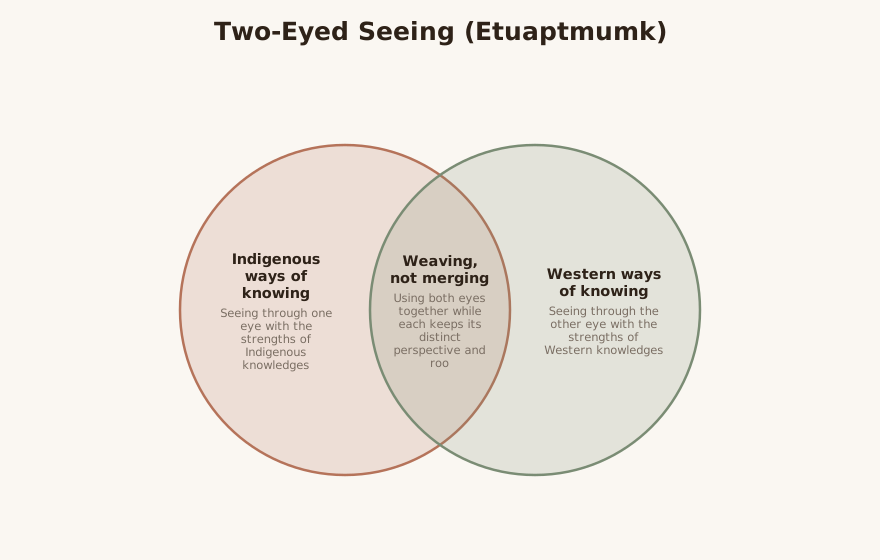
The central image is ocular: to see “from one eye with the strengths of Indigenous ways of knowing, and to see from the other eye with the strengths of Western ways of knowing, and to use both of these eyes together” 3. Critically, the two eyes are not merged into a single blended view; each retains its distinct perspective while the practitioner learns to switch between and combine them 3. The Mi’kmaw symbol of “Trees Holding Hands” expresses this — interconnection that nonetheless preserves the individual identity and roots of each system 3. A second principle is co-learning and weaving rather than assimilation, in which neither knowledge tradition is collapsed into or subordinated to the other 3. A third is teleological: the purpose of seeing with both eyes is to act so that “the present and the future will be better off because of the actions that we have taken,” extending the benefit beyond the individual to community and ecology 4. Applied frameworks built on these principles emphasize co-production of knowledge and the reciprocal benefit of bringing systems together rather than extracting from one to serve the other 1. For therapists, the operative shift is from “which model is correct?” to “what does each way of knowing reveal that the other cannot?” LLM.
Interventions & Techniques
Because Two-Eyed Seeing is a stance rather than a protocol, its “techniques” are mostly relational and structural choices the clinician makes around whatever modality is in use LLM. The first is positioning: the clinician treats Indigenous knowledge — including the client’s own cultural healing practices, Elders, ceremony, and land-based connection — as co-equal expertise alongside Western clinical assessment, rather than as adjunctive or quaint 3. The second is weaving: deliberately holding both perspectives in dialogue so that a Western formulation (for example, a trauma model) and an Indigenous understanding (for example, historical trauma and disrupted relationship to land and community) inform the work without one overwriting the other 1. The third is co-production, in which goals, meanings, and success criteria are defined jointly with the client and, where appropriate, community, rather than imposed 1. In wellness-service research, operationalizing Etuaptmumk has meant involving community in the design and interpretation of the work and reflecting critically on the researcher’s own positioning — a discipline that translates directly to clinical formulation and treatment planning 2.
LLM-generated illustrative example (not a guideline): A clinician working with a First Nations client who experiences recurrent depression formulates the presentation through a Western lens (sleep, anhedonia, cognitive patterns) with one eye, and through the client’s own framing of disconnection from community and ceremony with the other. Rather than choosing between cognitive-behavioral activation and reconnection to cultural practice, the clinician and client weave both into a single plan, treating the client’s relationship with an Elder as a legitimate therapeutic resource alongside structured behavioral goals. LLM
Evidence Base
Two-Eyed Seeing is established as a cultural and philosophical framework with broad uptake across education, environmental governance, and health-research policy 3. Its applied evidence in mental health, however, is best characterized as emerging and largely qualitative rather than built on randomized controlled trials LLM. The strongest documented applications are conceptual and methodological: frameworks for transforming research and management by weaving knowledge systems, and reflective accounts of using Etuaptmumk to shape studies of Indigenous wellness services 12. These contributions demonstrate feasibility, community acceptability, and improved alignment between services and Indigenous worldviews, but they do not constitute controlled efficacy data for any specific clinical outcome LLM. Honesty with clients and supervisors requires distinguishing the framework’s strong philosophical and ethical standing from a comparatively thin controlled-trial base LLM. Clinicians should therefore present Two-Eyed Seeing as a well-grounded approach to integration and engagement — which itself plausibly improves retention and cultural safety — rather than as an evidence-based standalone treatment for depression, substance use, or trauma LLM. The implication for practice is to pair the stance with modalities that do carry their own evidence base, using Two-Eyed Seeing to govern how those modalities are offered and adapted LLM.
Populations & Indications
The framework was developed by and for Indigenous communities, and its most natural indication is work with Indigenous peoples, First Nations communities, and Native American clients for whom Western-only models risk being culturally incongruent 3. It is particularly indicated for communities affected by colonization, where presenting problems are entangled with intergenerational and historical trauma and cannot be fully understood through individual psychopathology alone 2. More broadly, the principle informs work with any culturally diverse population whose healing traditions and explanatory models differ from those embedded in mainstream clinical training 4. It is also, importantly, a development framework for mental health practitioners themselves: it asks clinicians to cultivate the capacity to see with both eyes as a professional competency, not only to apply it to clients 4. Indications are strongest where engagement, trust, and cultural safety are the rate-limiting factors in care, and where prior Western-only services have produced disengagement or harm LLM. It is not population-restricted in principle, but its authority and meaning derive from Indigenous authorship, which clinicians must keep in view when extending it LLM.
Problems-for-Work
The framework is well-suited to problems that are simultaneously individual and collective, where a purely intrapsychic formulation misses the historical and relational context LLM.
- Intergenerational and historical trauma — seeing with both eyes lets the clinician hold a Western trauma physiology model alongside a community-level understanding of colonization’s transmitted harms, so that neither the body nor the history is erased 2.
- Cultural disconnection and identity issues — the work can frame reconnection to language, ceremony, and land as a therapeutic target rather than a private hobby, weaving it with Western identity-development concepts 4.
- Substance use disorders — Indigenous understandings of substance use as a response to disconnection and trauma can be braided with Western relapse-prevention skills, treating cultural reconnection as part of recovery LLM.
- Depression and grief — community, land, and ceremony are positioned as legitimate sources of meaning and behavioral activation alongside Western symptom-focused strategies LLM.
- Health disparities — at the service level, co-production and community involvement are used to make care more acceptable and accessible, narrowing the gap that Western-only delivery often widens 2.
LLM-generated illustrative example (not a guideline): For a client in early recovery from alcohol use, the clinician maps high-risk situations and coping skills with one eye, while with the other supporting the client’s plan to attend a sweat ceremony and reconnect with kin. Cravings are discussed both as conditioned responses and as signals of disconnection, and the two readings are treated as complementary rather than competing. LLM
Contraindications, Cautions & Cultural Humility
The principal caution is appropriation: Two-Eyed Seeing is an Indigenous, specifically Mi’kmaw, framework, and using it as a branding veneer over unchanged Western practice contradicts its core insistence that Indigenous knowledge be co-equal rather than decorative 3. A second caution concerns blending: because the framework deliberately keeps each eye distinct, clinicians should resist collapsing Indigenous practices into Western theory or vice versa, which would dissolve the very strength the principle protects 3. Implementation faces real obstacles — philosophical differences in how each system interprets knowledge, resource limitations, and uneven practitioner preparation — and pretending these away undermines authenticity 3. Clinicians without genuine relationship to the relevant community risk extractive integration, taking practices out of context to serve a clinical agenda rather than co-producing with the community 1. Cultural humility here is not optional politeness but a structural requirement: the framework asks practitioners to examine their own positioning and to share authority over meaning and method 2. Where a clinician cannot honor co-equal status — for example, in a setting that will only reimburse or recognize Western framings — it is more honest to name that limit than to claim a Two-Eyed practice that the context cannot support LLM. Finally, clinicians should defer to local protocols, Elders, and community guidance on which practices are appropriate to bring into clinical space at all LLM.
Treatment-Plan Suggestions & SMART Objectives
| Goal | SMART objective (example) | Mechanism |
|---|---|---|
| Build a dual-perspective formulation | Within 3 sessions, co-create with the client a written formulation that names both a Western clinical frame and the client’s own cultural/historical frame for the presenting problem | Weaving distinct knowledge systems without subordinating either 3 |
| Establish cultural safety and engagement | Over 4 weeks, client reports increased comfort and attends 80% of scheduled sessions, with at least one culturally grounded resource named in the plan | Co-equal positioning of Indigenous knowledge improves acceptability 2 |
| Support cultural reconnection | Within 6 weeks, client identifies and takes one concrete step toward reconnection (language, ceremony, land, or kin) and reviews its impact in session | Reconnection as a therapeutic target addressing cultural disconnection 4 |
| Integrate community resources | Within 8 weeks, client, with consent, links the work to at least one community or Elder resource as a co-resource in care | Co-production of knowledge and meaning with community 1 |
| Address historical/intergenerational trauma | Across treatment, client can articulate the presenting problem in both individual and historical terms and notice the difference this makes to self-blame | Holding physiological and historical understandings together 2 |
| Strengthen recovery in substance use | Over 90 days, client maintains a relapse-prevention plan that explicitly includes both Western coping skills and cultural-reconnection activities | Braiding skills training with reconnection as recovery LLM |
| Build clinician dual-seeing competency | Within the episode of care, clinician documents reflective notes on their own positioning and where each “eye” shaped the plan | Practitioner cultivation of seeing with both eyes 4 |
Common Misconceptions
A frequent misconception is that Two-Eyed Seeing means blending Indigenous and Western knowledge into one hybrid system; in fact the framework keeps each eye distinct and uses them together, which is a different operation 3. A second is that it is merely a metaphor or slogan rather than a substantive guiding principle for action; Albert Marshall describes it as a fundamental principle for how one lives, with concrete implications for ecological and social responsibility 4. A third is that it is a Western-invented model of cultural sensitivity; it is an Indigenous, Mi’kmaw-authored framework with named originators and a specific community of origin 3. A fourth is that it applies only to environmental or scientific domains because of its prominence in fisheries and ecological work; the same principles have been deliberately carried into health and wellness-services research 12. Finally, some assume that adopting the language is sufficient; the framework’s integrity depends on actually sharing authority and co-producing with Indigenous knowledge holders, not on terminology 1.
Training & Certification
There is no single credentialing body or certification that licenses a clinician as a “Two-Eyed Seeing practitioner,” consistent with its status as a guiding philosophy rather than a manualized therapy LLM. The framework has been institutionalized primarily through education and research settings — most notably the Integrative Science program at Cape Breton University — rather than through a clinical certification pipeline 3. Learning therefore comes through relationship and apprenticeship: engaging with Elders, community, and the primary teachings of the Marshalls and their collaborators rather than through a course completion certificate 4. Albert Marshall’s own recorded talks and documentary appearances are widely used teaching resources for understanding the principle in his words 56. For clinicians, responsible “training” means building genuine community relationships, supervised reflection on positioning, and grounding in Indigenous healing traditions alongside one’s existing licensure, rather than seeking a standalone credential LLM.
Key Terms
Etuaptmumk — the Mi’kmaw word rendered as “Two-Eyed Seeing,” denoting the practice of seeing with the strengths of both Indigenous and Western ways of knowing 3. Two eyes — the metaphor for two distinct, co-equal knowledge systems used together rather than merged 3. Weaving / co-learning — bringing knowledge systems into dialogue while preserving each, as opposed to assimilation or blending 3. Trees Holding Hands — the Mi’kmaw symbol of interconnection that preserves each tree’s distinct roots and identity 3. Co-production of knowledge — jointly generating understanding and goals with Indigenous knowledge holders rather than extracting from them 1. Positioning / reflexivity — the practitioner’s critical examination of their own standpoint as a precondition for ethical integration 2. Benefit of all — the teleological aim that combined seeing should leave the present and future better off for community and ecology 4.
Resources & Further Reading
▶ Watch — a video introduction to this concept:
- Reid et al. (2021), ‘Two-Eyed Seeing’: An Indigenous framework to transform fisheries research and management — Fish and Fisheries 1
- Reflecting on the use of Etuaptmumk/Two-Eyed Seeing in a study of Indigenous wellness services — Taylor & Francis 2
- Two-Eyed Seeing — Wikipedia 3
- Two-Eyed Seeing — The Garrison Institute 4
- Etuaptmumk: Two-Eyed Seeing with Albert Marshall — YouTube 5
- ‘A quest for wisdom’: How two-eyed seeing mixes Indigenous knowledge and Western science in N.S. — CBC News 6
Reflective / Supervision Questions
- When formulating a case, which understandings are you seeing with the “Western eye,” and which with the “Indigenous eye,” and are you treating them as co-equal? LLM
- Where in your current plan might you be unconsciously blending the two systems in a way that dissolves the distinct strength of either? 3
- Whose authority defines success in this case, and have you genuinely co-produced the goals with the client and, where relevant, their community? 1
- What is your own positioning relative to this client’s community, and how might it shape what you can and cannot ethically bring into the work? 2
- If the present and future are to be “better off” because of this episode of care, what would that look like beyond symptom reduction for this individual? 4
- Where are you at risk of using Two-Eyed Seeing as language without the substance of shared authority, and how would you know? LLM