
Type & Discipline
Critical pedagogy is a philosophy of education rather than a clinical treatment, situated within the broader tradition of critical theory of education.3 At its core sits conscientization (Portuguese conscientização), the process of developing a critical consciousness through which people learn to perceive and act against the social, political, and economic contradictions that shape their lives.1 The framework holds that education is never politically neutral: it either functions to domesticate learners into accepting an unjust status quo, or it serves as a “practice of freedom” through which people become active subjects in remaking their world.2 For clinicians, the relevance is that conscientization names a transferable process, one that maps onto how liberation-oriented, narrative, and feminist therapies help clients externalize and re-author socially produced distress, even though critical pedagogy itself was never designed as a psychotherapy.LLM
The discipline boundary matters for honest practice. Critical pedagogy belongs to educational and political philosophy, and its empirical literature is overwhelmingly about teaching, literacy, and community organizing rather than symptom reduction.3 When we import it into the consulting room, we are borrowing a conceptual lens and a set of dialogic stances, not a manualized protocol with controlled outcome data.LLM
Creators & Lineage
The framework is overwhelmingly identified with the Brazilian educator Paulo Freire, whose 1968 book Pedagogy of the Oppressed (published in English in 1970) is its foundational text.2 Freire developed his approach through adult literacy work with rural and impoverished Brazilian populations, where he found that teaching reading alongside critical reflection on learners’ lived conditions produced both literacy and political awakening.4 His earlier formulation of critical consciousness evolved directly into the more developed pedagogy of the oppressed, a trajectory traced in scholarship on his intellectual development.5
Freire described stages of consciousness, contrasting “magical” or “naive” consciousness, in which people accept their conditions as fate or natural law, with critical consciousness, in which people grasp the historical and social causation behind those conditions.1 He argued that the oppressed often internalize the image and values of the oppressor, so that liberation requires not merely changing external conditions but transforming how people understand themselves.2 This insight, that oppression installs itself inside the psyche, is the precise hinge on which the clinical relevance turns.LLM
The lineage that clinicians will recognize runs from Freire into liberation psychology, which adapted conscientization to mental health and community work; into narrative therapy, whose externalizing conversations and re-authoring echo Freire’s move from object to subject; into feminist therapy, which similarly locates distress in social context through consciousness-raising; and into Critical Race Theory, which shares the analysis of structural power.LLM As a teaching and organizing tradition, the work continues to be disseminated through educator resources and popular explainers that keep Pedagogy of the Oppressed in active circulation.67
Core Principles
Dialogue over banking. Freire’s most cited contrast is between the “banking model” of education, in which the teacher deposits information into passive students, and “problem-posing” education, in which teacher and learner investigate reality together as co-investigators.2 Dialogue is not a technique laid over content; it is the relational form through which knowledge is jointly constructed and through which both parties are changed.7 In clinical terms this maps onto a collaborative, non-expert stance in which the clinician resists positioning the client as a passive recipient of interpretation.LLM
Praxis: reflection plus action. Conscientization is not contemplation alone; Freire insisted on praxis, the cyclical unity of reflection and action upon the world in order to transform it.2 Critical awareness that does not issue in action risks becoming mere verbalism, while action without reflection becomes blind activism.4
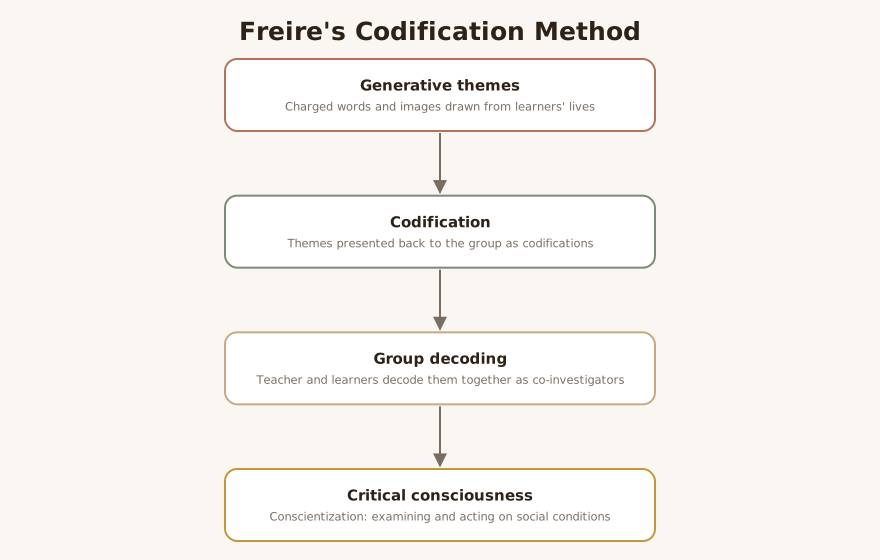
Generative themes and codification. In Freire’s literacy method, educators identified “generative themes,” charged words and images drawn from learners’ lives, and presented them as “codifications” that the group then decoded together, surfacing the social contradictions embedded in everyday experience.4 The pedagogical movement is from naming the world, to reflecting on it critically, to acting to change it.1
Humanization as the central project. Freire framed both oppression and liberation in terms of humanization: dehumanization distorts both the oppressed and the oppressor, and the vocation of the oppressed is to recover their full humanity in a way that liberates everyone.2 This reframes the goal of consciousness-raising as restoring agency and dignity, not assigning blame.LLM
Interventions & Techniques
Critical pedagogy supplies stances and processes rather than discrete clinical procedures, so the “techniques” below are adaptations clinicians have drawn from its principles.LLM
- Problem-posing dialogue. The clinician poses the client’s situation as a shared problem to be examined rather than a deficit to be corrected, asking questions that open up the social context of a presenting concern.2
- Decoding lived experience. Using a generative theme from the client’s own language, the clinician and client “decode” it together, examining the historical and structural forces that produced it.4
- Externalizing the internalized oppressor. Drawing on Freire’s observation that the oppressed harbor an internalized image of the oppressor, the clinician helps the client distinguish their own voice from the critical, devaluing voice absorbed from an oppressive environment.2
- Linking reflection to action (praxis). The dialogue is oriented toward small, feasible acts of agency, so that insight is consolidated through changed behavior in the client’s real conditions.2
- Moving from fatalism to causality. Interventions track the shift from a “magical” framing (“this is just how things are for people like me”) toward a critical one that perceives social causation and the possibility of change.1
LLM-generated illustrative example (not a guideline): A clinician working with an immigrant client who says “I’m just not smart enough for office work here” might treat that sentence as a generative theme. Rather than disputing the cognition in isolation, they explore together how credential barriers, language gatekeeping, and discriminatory hiring practices contributed to the belief, then identify one concrete action the client is willing to take. The aim is to relocate the problem from a fixed personal defect to a contestable social condition. LLM
Evidence Base
Honesty about maturity is essential here. Critical pedagogy is established as an educational and social philosophy with decades of influence on adult education, literacy work, and curriculum theory, and Freire’s framework has been described and analyzed across academic and reference literature for over fifty years.43 In that sense its standing is secure: it is a canonical, widely taught body of thought.6
However, “established philosophy” is not the same as “validated psychotherapy.”LLM The framework was not constructed as a clinical intervention, and the provided literature documents its educational lineage and conceptual structure rather than randomized or controlled mental-health outcomes.45 Clinicians should therefore present conscientization to clients and supervisors as a values-aligned, theory-rich lens that informs how recognized therapies are delivered, not as an evidence-based treatment in its own right with a body of efficacy trials.LLM Where it has been adapted clinically, it has typically traveled inside liberation psychology, narrative therapy, and feminist therapy, and any claims of effectiveness should be attributed to those modalities and their respective evidence, not to critical pedagogy as such.LLM
Populations & Indications
The framework was developed with, and is most clearly indicated for, marginalized communities and survivors of oppression, where distress is meaningfully entangled with social subordination.2 Freire’s original work centered impoverished and rural adult learners, and the analysis generalizes to racial and ethnic minorities and immigrants navigating structural exclusion.4 The dialogic, co-investigative form lends itself naturally to group therapy participants, where collective decoding of shared themes parallels Freire’s “culture circles.”4
With adolescents, the emphasis on agency, voice, and questioning received authority can be developmentally resonant, supporting identity formation through critical examination of the social messages a young person has absorbed.LLM The framework is most apt when a client’s suffering is bound up with experiences of injustice, exclusion, or devaluation, and least apt when presenting problems are primarily biomedical or acute-crisis in nature and require stabilization first.LLM
Problems-for-Work
Critical pedagogy is best suited to problems in which social conditions have been internalized as personal pathology, and where restoring a sense of agency is therapeutic.LLM
- Internalized oppression and disempowerment. The Freirean concept of harboring the oppressor “within” gives a direct frame for clients who have absorbed devaluing messages about their worth or group.2 Work centers on distinguishing the internalized voice from the self.LLM
- Learned helplessness and demoralization. The movement from fatalistic “magical” consciousness toward perceived causation and possibility addresses the conviction that nothing one does can change one’s situation.1
- Low self-esteem and identity disturbance. Examining how social conditions shaped self-concept can loosen globally negative self-views and support a more integrated identity.LLM
- Discrimination-related distress. Naming discrimination as a structural reality, rather than a private failing, can relieve the self-blame that often accompanies it.2
- Depression. Where low mood is interwoven with disempowerment and demoralization, restoring agency through praxis can be a complementary lever alongside standard depression treatment.LLM
LLM-generated illustrative example (not a guideline): In a group of adolescents from a marginalized neighborhood, the clinician invites the group to bring a phrase they often hear about their community. Decoding “nobody here makes it out” together, members articulate the structural barriers behind it and also locate counter-examples and points of leverage, shifting the affect from resignation toward cautious agency. LLM
Contraindications, Cautions & Cultural Humility
The most important caution is that critical pedagogy is a political philosophy, and importing it carelessly risks imposing the clinician’s worldview rather than following the client’s, which would invert Freire’s own anti-banking principle.2 The clinician must hold the framework with cultural humility, treating the client as the authority on their own experience and resisting the temptation to recruit therapy into a predetermined ideological narrative.LLM
Several practical cautions follow. First, raising consciousness about oppression can increase distress in the short term and is contraindicated as a primary focus during acute crisis, active suicidality, or untreated trauma symptoms that require stabilization and safety first.LLM Second, praxis (action) should be calibrated to the client’s real-world safety: encouraging confrontation of an oppressive system without attention to consequences can expose vulnerable clients to retaliation.LLM Third, because the framework is not itself a validated treatment, it should not displace evidence-based care for diagnosable conditions but should inform how that care is delivered.LLM
Finally, cultural humility requires recognizing that not every client from a marginalized group experiences their distress through a lens of oppression, and assuming so is its own form of imposition.LLM The dialogic stance is the safeguard: it asks rather than tells.7
Treatment-Plan Suggestions & SMART Objectives
| Goal | SMART objective (example) | Mechanism |
|---|---|---|
| Distinguish internalized critical voice from self | Within 6 sessions, client will identify and name 3 absorbed “oppressor” messages and articulate an alternative self-statement for each | Externalizing the internalized oppressor2 |
| Reduce fatalism / increase perceived agency | Over 8 weeks, client will move from “nothing I do matters” to completing 2 small self-chosen agentic actions and reflecting on outcomes | Praxis: reflection plus action2 |
| Reframe self-blame for discrimination | By session 5, client will reattribute at least 2 self-blaming beliefs to identifiable structural factors | Decoding lived experience4 |
| Build critical understanding of presenting problem | Within 4 sessions, client will articulate the social/historical context of one generative theme drawn from their own words | Problem-posing dialogue2 |
| Strengthen collective support (group) | Over 6 group sessions, member will contribute to decoding a shared theme and name one source of collective leverage | Culture-circle dialogue4 |
| Restore sense of agency and dignity | By treatment midpoint, client will report (via brief self-rating) increased sense of voice and choice in 2 life domains | Humanization as central project2 |
| Consolidate insight through behavior | Each week for 4 weeks, client will enact one reflection-informed action and review it in session | Reflection-action cycle4 |
Common Misconceptions
“It’s a therapy model.” Critical pedagogy is a philosophy of education and social change, not a clinical treatment protocol; treating it as a standalone therapy overstates what the framework was built to do.3 “Conscientization just means raising awareness.” It is specifically the unity of critical reflection and action (praxis), and reflection without action is, in Freire’s terms, incomplete.2 “The banking critique means content doesn’t matter.” Freire did not dismiss knowledge; he objected to its transmission as deposit into passive recipients, favoring co-construction instead.7 “It’s about making clients angry at society.” The stated aim is humanization and the recovery of agency for both oppressed and oppressor, not the cultivation of grievance.2 “Naive and critical consciousness are fixed traits.” They describe stages in a developmental process that education and dialogue can move people through.1
Training & Certification
There is no clinical credential or certifying body for “critical pedagogy” as a therapy, consistent with its status as an educational philosophy rather than a licensed treatment.3 Foundational competence comes from primary engagement with Freire’s Pedagogy of the Oppressed and the surrounding scholarship on his development of critical consciousness.25 Educator-oriented resources offer accessible entry points and study materials for the source text.67 For clinicians, the practical pathway to applying these ideas runs through training in the modalities that have operationalized them, narrative therapy, feminist therapy, and liberation-psychology-informed practice, where supervision and the relevant ethical frameworks apply.LLM
Key Terms
- Conscientization (conscientização): Developing critical consciousness through which one perceives and acts against social, political, and economic contradictions.1
- Critical consciousness: Awareness of the historical and structural causes of one’s social conditions, contrasted with naive or magical consciousness.1
- Banking model: Education conceived as depositing information into passive students; the target of Freire’s critique.2
- Problem-posing education: Dialogic, co-investigative education in which teacher and learner jointly examine reality.2
- Praxis: The unity of reflection and action upon the world in order to transform it.2
- Generative theme / codification: Charged words or images from learners’ lives, presented for collective decoding of embedded social contradictions.4
- Humanization: The recovery of full personhood for both oppressed and oppressor as the goal of liberatory education.2
Resources & Further Reading
▶ Watch — a video introduction to this concept:
- Pedagogy of the Oppressed (Paulo Freire) — overview2
- Critical consciousness — reference entry1
- Critical pedagogy — reference entry3
- Lloyd (1972), Freire, Conscientization, and Adult Education4
- Paulo Freire: From Critical Consciousness to the Pedagogy of the Oppressed5
- Pedagogy of the Oppressed — Zinn Education Project teaching resource6
- Paulo Freire’s ‘Pedagogy of the Oppressed’: a manifesto on education and social change7
Reflective / Supervision Questions
- When I introduce a social or structural framing of a client’s distress, am I following the client’s lived experience, or importing my own political worldview into the work?LLM
- Where, in my current caseload, might a presenting “deficit” actually be an internalized response to an oppressive condition, and how would naming that change the formulation?LLM
- Am I positioning myself as a banking “expert” who deposits interpretations, or as a co-investigator in genuine dialogue?2
- For a given client, is consciousness-raising clinically timely, or does safety and stabilization need to come first?LLM
- When conscientization surfaces the impulse to act, how am I helping the client calibrate action to their real-world safety and capacity?LLM
- How would I explain to a supervisor or payer that this work is being delivered within a recognized, billable modality rather than as a treatment in its own right?LLM
1: Wikipedia. “Critical consciousness.” https://en.wikipedia.org/wiki/Critical_consciousness 2: Wikipedia. “Pedagogy of the Oppressed” (Paulo Freire). https://en.wikipedia.org/wiki/Pedagogy_of_the_Oppressed 3: Wikipedia. “Critical pedagogy.” https://en.wikipedia.org/wiki/Critical_pedagogy 4: Lloyd, A. S. (1972). Freire, Conscientization, and Adult Education. https://journals.sagepub.com/doi/10.1177/074171367202300101 5: Paulo Freire: From Critical Consciousness to the Pedagogy of the Oppressed (ResearchGate, 2024). https://www.researchgate.net/publication/379543770_Paulo_Freire_From_Critical_Consciousness_to_the_Pedagogy_of_the_Oppressed 6: Zinn Education Project. “Pedagogy of the Oppressed” (teaching resource). https://www.zinnedproject.org/materials/pedagogy-of-the-oppressed/ 7: Paulo Freire’s ‘Pedagogy of the Oppressed’: a manifesto on education and social change. Medium (Bits and Behavior). https://medium.com/bits-and-behavior/paulo-freires-pedagogy-of-the-oppressed-a-manifesto-on-education-and-social-change-dbd63cd9fc17