
Type & Discipline
Shamanic healing is an anthropological and transpersonal healing practice rather than a psychotherapy in the contemporary clinical sense 2. Britannica defines shamanism as “a religious phenomenon centered on the shaman, a person believed to achieve various powers through trance or ecstatic religious experience,” and the word derives from a Manchu-Tungus term meaning “one who knows” 2. The shaman functions as an intermediary between human and spiritual realms, combining the roles of healer, religious leader, and counselor 2. The variant most relevant to Western practitioners is “core shamanism,” a deliberately culture-free system distilling the cross-cultural commonalities of shamanic practice worldwide 4. Soul retrieval is one specific intervention within this larger framework, aimed at recovering “lost parts of the soul” understood to have departed during trauma 5. For the purposes of this article, the family is best described as neo-shamanic or core-shamanic practice, distinct from any single indigenous tradition 4. LLM
Creators & Lineage
The dominant Western lineage runs through Michael James Harner (1929–2018), an American anthropologist who conducted fieldwork with the Jivaro (Shuar) of Ecuador and the Conibo of Peru beginning in the late 1950s and early 1960s 1. His 1980 book The Way of the Shaman presented techniques such as monotonous drumming and journey work in a form accessible to Western practitioners 1. Harner founded the Center for Shamanic Studies in 1979, renamed the Foundation for Shamanic Studies in 1983, and left academia in 1987 to direct it full-time 1. He coined “core shamanism” to name the universal and near-universal features of shamanism, together with journeys to other worlds, distilled from cross-cultural research 3 4. The Foundation, whose mission is “the preservation, study, and teaching of shamanic knowledge,” credits both Mircea Eliade and Harner as the foremost twentieth-century authors on the subject 3 4. Eliade’s 1951 Shamanism: Archaic Techniques of Ecstasy established the academic framing — that the shaman’s trance journey (“ecstasy”) was the consistent cross-cultural feature, and that shamanism was a methodology rather than a religion 4.
Sandra Ingerman is widely associated with popularizing soul retrieval as a distinct technique, and Harner credits her account of its application to trauma 4. The clinically relevant intellectual lineage also includes the broader Western currents these practices now travel within — transpersonal psychology, Jungian depth psychology, and parts-based models such as Internal Family Systems — all sharing a vocabulary of inner multiplicity, fragmentation, and reintegration LLM. These are convergences of theme, not historical descent; core shamanism’s own stated derivation is from indigenous healing traditions filtered through comparative anthropology 4. LLM
Core Principles
Core shamanism rests on a small set of explicit assumptions. The first is that there are two realities whose perception depends on one’s state of consciousness: an ordinary state perceives “ordinary reality,” while the “shamanic state of consciousness” (SSC) allows perception of “nonordinary reality” (NOR) 4. The practitioner’s distinguishing skill is the disciplined ability to move between these realities at will in order to heal and help others 4. A corollary is that the beings encountered in nonordinary reality — termed “spirits” — are treated as empirically real because the practitioner interacts with them directly through all the senses 4. The University of Minnesota’s integrative-health summary similarly characterizes shamans as “community-assigned magico-religious professionals” who deliberately alter consciousness to access spirit realms and create changes intended to manifest in the physical world 5.
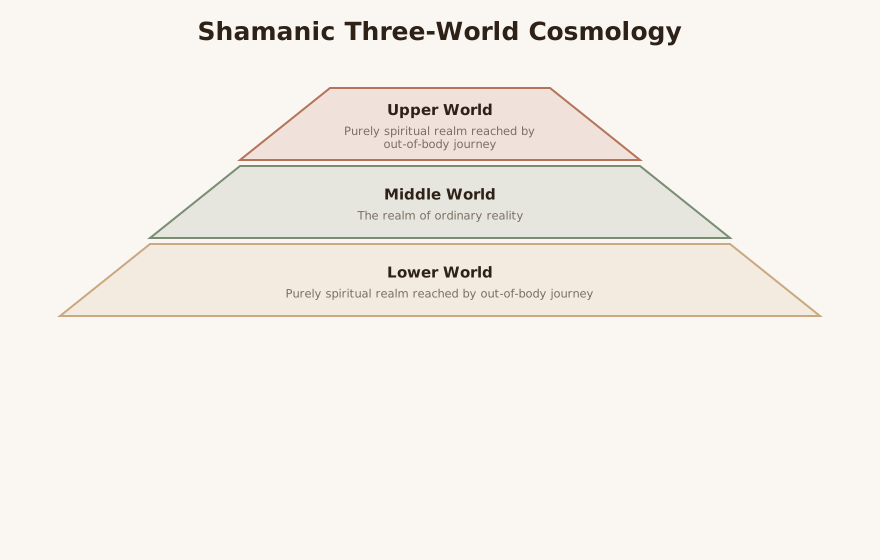
A second principle is a three-world cosmology: the Universe is divisible into Upper, Middle, and Lower Worlds, with the practitioner making “out-of-body” journeys to the purely spiritual Upper and Lower Worlds to seek assistance 4 6. The shaman depends on “tutelary” or helping spirits — including power animals understood as guiding spirits — discovered through direct experience rather than received doctrine 4 6. A third principle concerns etiology: poor health is attributed to spiritual factors of two types — the loss of a beneficial spirit (soul loss or guardian-spirit/power loss) and the acquisition of a detrimental one (spirit intrusion or involuntary possession) 4. Soul loss in particular is framed as a near-universal response to trauma, in which a portion of the soul departs to escape the experience, leaving the person “not all there” — a state the University of Minnesota describes as the sense that “something is missing” or “I haven’t been the same since” 4 5.
Interventions & Techniques
The centerpiece technique is the shamanic journey, induced through “sonic driving” — rhythmic drumming or rattling, typically around four to seven cycles per second, a frequency corresponding roughly to the theta EEG range 4. EntheoNation describes the practical rhythm as three to four beats per second sustained to induce trance 6. The practitioner usually lies or sits in a relaxed position to leave bodily awareness behind while traveling in nonordinary reality 4. Core practitioners generally do not use psychoactive substances, though Harner was aware of their use in some indigenous contexts 4.
Diagnosis proceeds by “divination,” either by consulting helping spirits or by shamanically “seeing” the spiritual cause of an illness, identifying soul loss, guardian-spirit loss, intrusion, or possession 4. Four core treatment techniques follow. Soul retrieval journeys to recover and return lost soul portions; Harner notes it restores parts of the personality (for example, “the happy child”) that vanished at the time of trauma but does not recover memories of the trauma itself — a point he stresses to distinguish it from memory-recovery practices 4. EntheoNation describes the practitioner journeying “to the spirit realm to look for the missing piece,” sometimes returning it by “blowing the returned essence back into the body” 6. Guardian-spirit (power-animal) retrieval restores spiritual power to resist illness and is often paired with soul retrieval 4. Spirit-intrusion extraction is described as a noninvasive removal of the spiritual aspect of localized pain, performed by the hands or by sucking, without penetrating the skin 4. Depossession addresses involuntary possession and is described as useful in addiction and in mental-emotional illness, with the patient required to be committed and free of sedating medication 4. Notably, Harner himself frames soul retrieval as a primary approach that “normally should be immediately followed by psychotherapy,” giving the psychotherapist the opportunity to treat the whole person 4.
Evidence Base
The honest summary is that shamanism is established as an ancient, cross-cultural anthropological practice — Harner cites scholarly estimates placing it at least 30,000 years old and calls it the most time-tested system for spiritual healing — but it is not established as an evidence-based clinical treatment 4. None of the available sources here is a randomized controlled trial or systematic review; the literature consists of anthropological reference works, an advocacy-organization account, an integrative-health summary, and a clinician-oriented description by the method’s own founders 1 2 3 4 5 6. Harner is candid that the most important teaching is experiential and ineffable, largely outside published literature, and concedes that shamanism’s claims about the reality of spirits “have long been unacceptable in Western science” 4.
For a clinician, the defensible position is that any benefit plausibly operates through recognized common factors rather than the postulated spiritual mechanism: ritual structure, expectancy and hope, the therapeutic relationship, somatic relaxation via rhythmic entrainment, and the meaning-making of an externalized narrative for trauma and loss LLM. These overlap substantially with mechanisms in parts-work, grief processing, guided imagery, and hypnotic/trance-based interventions, which is why core-shamanic elements can be mapped onto established modalities even though the practice itself carries no trial-level efficacy evidence LLM. The University of Minnesota positions shamanic healing as “fully compatible with both conventional medicine and other integrative treatments,” explicitly as a complement rather than a replacement 5. LLM
Populations & Indications
Within its own framework, shamanic healing is offered to trauma survivors, people experiencing grief, those in existential or spiritual crisis, and people who feel fragmented or chronically numb 4 5. Harner identifies mental and emotional trauma — including the consequences of incest and other childhood abuse — as a primary indication for soul retrieval, and chronic “dispiritedness” and depression as indications for guardian-spirit retrieval 4. The University of Minnesota lists depression, anxiety, attention disorders, autism, and addictions among the conditions a shamanic worldview regards as “more likely to have a spiritual component” 5. The concept is also indigenous in origin and remains embedded in living communities; Latin American cultures, for instance, carry the explicit concept of soul loss under the term susto (“fright”) 4.
From a clinical standpoint, the populations most likely to seek and to tolerate this framing are spiritually oriented clients, those drawn to indigenous or earth-based traditions, and clients for whom dissociation and “soul loss” are experientially resonant descriptions of their distress LLM. The crucial caveat for therapists is that “indication within the shamanic model” is not the same as “clinical indication,” and several of the conditions named above (psychosis, active addiction, severe dissociation) demand standard evidence-based care as the primary intervention LLM.
Problems-for-Work
The model’s vocabulary maps onto several presentations clinicians see regularly, and the mapping can be clinically useful even for therapists who hold the metaphysics lightly LLM. Trauma and identity fragmentation are the paradigm case: the “soul loss” frame names the felt sense that part of the self left at the moment of overwhelm, which parallels structural-dissociation and parts language 4. Grief and loss of meaning map onto journey and ritual work that gives form to mourning 4. Dissociation and chronic emotional numbness correspond to the “not all there” description of soul loss 4 5. Existential and spiritual crisis is addressed through restoring a sense of connection and power 5.
LLM-generated illustrative example (not a guideline): A client who survived a childhood house fire describes feeling “like the kid who could play just never came back.” Working within a trauma-focused therapy, a clinician borrows the soul-loss metaphor as an externalizing frame — naming the playful part as something temporarily absent rather than destroyed — to reduce shame and open a path toward reintegration, while delivering an evidence-based trauma protocol as the actual treatment. LLM
LLM-generated illustrative example (not a guideline): A bereaved client who finds standard grief work too abstract responds to a structured, ritualized “letting-go” exercise — a deliberately bounded imaginal practice with a clear beginning and end — that lends ceremonial shape to the loss. The clinician documents this as guided imagery within a recognized psychotherapy, not as a shamanic journey. LLM
Contraindications, Cautions & Cultural Humility
The single most important caution is cultural: the appropriation critique attached to core shamanism is substantial and documented. Wikipedia notes that critics observe Harner’s practices “do not resemble the religious practices or beliefs of any of these cultures,” that indigenous communities objected to his broad application of the term “shaman” and to the commercialization of their spiritual traditions, and that this gave rise to discussions of “plastic shamanism” as cultural appropriation 1. A clinician offering anything shamanically derived must therefore foreground cultural humility, name the lineage and its contested status honestly, and avoid presenting decontextualized rituals as authentically indigenous 1. LLM
Clinically, trance-induction and dissociation-adjacent techniques carry real risk for clients with psychosis, dissociative disorders, or unstable trauma activation, where altered states can destabilize rather than integrate LLM. Harner’s own text concedes the need for medical and psychotherapeutic primacy: in acute physical trauma, emergency non-spiritual treatment takes priority; depossession should not proceed during a psychotic episode until normal emergency procedures have been applied; and soul retrieval should be followed by psychotherapy 4. He also notes that shamanic practitioners “cannot be certified nor licensed” as healers, warns against anyone who self-declares as a shaman, and holds that treatment should be undertaken only at the patient’s request 4. For licensed therapists, none of this substitutes for scope-of-practice limits, informed consent, and the obligation to provide evidence-based care for serious mental illness LLM.
Treatment-Plan Suggestions & SMART Objectives
The objectives below translate the elements a clinician might borrow (externalized parts language, ritualized grief processing, relaxation/imagery) into documentable goals delivered inside a recognized psychotherapy — not into shamanic healing offered as a standalone service LLM.
| Goal | SMART objective (example) | Mechanism |
|---|---|---|
| Reduce trauma-related fragmentation | Client will identify and describe one “absent” part of self in 3 of 4 sessions over 8 weeks, rated on a self-report scale | Externalization / parts-work reduces shame and supports reintegration 4 |
| Process unresolved grief | Client will complete one structured, time-bounded letting-go imagery exercise and report change in distress (SUDS) within 6 weeks | Ritualized closure and meaning-making 4 |
| Decrease dissociation / numbness | Client will report 2 grounding-and-presence experiences per week (“feeling all there”) logged in a journal over 4 weeks | Counters “soul loss”–type detachment via embodied attention 4 5 |
| Restore sense of agency / “power” | Client will name and rehearse one internal-resource image and use it in 3 distressing situations over 8 weeks | Resource installation / guided imagery 4 |
| Re-establish meaning after existential crisis | Client will articulate 2 personally held sources of meaning and one committed action within 6 weeks | Meaning-making and values work 5 |
| Lower physiological arousal | Client will practice rhythmic, paced relaxation 4x/week and report reduced baseline tension over 4 weeks | Somatic down-regulation analogous to sonic-driving relaxation 4 6 |
| Strengthen spiritual coping (if client-led) | Client will integrate one personally meaningful ritual into a weekly self-care plan over 8 weeks | Expectancy, ritual structure, and common-factor support 5 |
Common Misconceptions
“Soul retrieval recovers traumatic memories.” Harner explicitly distinguishes it from memory-recovery work, stating it brings back lost parts of the personality but “does not bring back the memories of the trauma itself” 4. “Core shamanism is an authentic indigenous tradition.” It is, by its founders’ own description, a deliberately culture-free distillation that “by not imitating any specific cultural tradition” suits Western adoption — and it has been criticized precisely for not resembling the source cultures’ actual practices 1 4. “Shamanic healing replaces medical or psychiatric care.” Both the founders and the integrative-health literature frame it as complementary, with non-spiritual treatment taking priority in emergencies 4 5. “It is an evidence-based therapy.” There is no trial-level efficacy evidence in these sources; the practice is established as an anthropological tradition, not as a validated clinical treatment 4. LLM “Anyone can credibly call themselves a shaman.” The tradition itself holds that the status is conferred by others, not self-declared, and warns against self-designated practitioners 4.
Training & Certification
Within core shamanism there is no professional licensure or certification of healing ability; Harner states plainly that practitioners “cannot be certified nor licensed” because their helping spirits can withdraw at any time 4. The Foundation for Shamanic Studies teaches primarily through experiential workshops rather than written materials, with advanced courses running as long as three years and screening of applicants, but awards no degrees 3 4. The Foundation does offer a certification in shamanic counseling, which Harner is careful to note “is not healing work” 4. Estimated competence for Western practitioners is described as four to eight years of experiential training, with the founders adding that even an advanced practitioner is “perpetually in training” 4. For a licensed clinician, the relevant point is that no shamanic credential confers clinical scope; the credentials that govern practice remain the therapist’s licensure and the evidence-based modalities they are trained in LLM.
Key Terms
- Shamanic state of consciousness (SSC): the disciplined trance state in which the practitioner perceives nonordinary reality 4.
- Nonordinary reality (NOR): the spiritual reality, including the Upper and Lower Worlds, accessed in the SSC 4.
- The three worlds: Upper, Middle, and Lower; the Middle World is the lived world, the others purely spiritual 4 6.
- Soul loss: the departure of a portion of the soul in response to trauma, manifesting as feeling “not all there” 4 5.
- Soul retrieval: the journey to recover and return lost soul portions 4 6.
- Power animal / guardian-spirit retrieval: restoration of protective spiritual power, often paired with soul retrieval 4 6.
- Extraction: noninvasive removal of a localized spiritual “intrusion” 4.
- Sonic driving: rhythmic drumming/rattling (~4–7 Hz) used to induce the SSC 4.
- Susto: the Latin American folk concept of trauma-induced soul loss (“fright”) 4.
- Plastic shamanism: the critical term for commercialized, decontextualized appropriation of indigenous shamanic practice 1.
Resources & Further Reading
▶ Watch — a video introduction to this concept:
- Michael Harner — Wikipedia
- Shamanism — Encyclopaedia Britannica
- Michael Harner — The Foundation for Shamanic Studies
- Harner & Harner — Core Practices in the Shamanic Treatment of Illness (PDF)
- Shamanism — University of Minnesota, Taking Charge of Your Wellbeing
- Core Shamanism: Ancestral Rituals in Modern Times — EntheoNation
Reflective / Supervision Questions
- When a client’s distress is best described to them as “soul loss,” how do I use that metaphor therapeutically without endorsing a metaphysical claim or drifting outside my scope and evidence base? LLM
- Given the documented appropriation critique of core shamanism, how do I name the lineage honestly and avoid presenting decontextualized ritual as authentically indigenous? 1 LLM
- For which clients would trance-induction or dissociation-adjacent techniques be contraindicated, and how would I screen for that before introducing any imagery or ritual element? LLM
- Where is the line, in my documentation and informed consent, between delivering a recognized billable psychotherapy that borrows an element and offering “shamanic healing” as a service I am not licensed to provide? 4 LLM
- If a client is already seeing a shamanic practitioner, how do I coordinate respectfully while ensuring evidence-based care remains primary for any serious condition? 5 LLM