
Type & Discipline
The sweat lodge ceremony is a technique within the broader discipline of North American Indigenous ritual healing, belonging to the family of Indigenous purification ceremonies 6. It is not a Western psychotherapy and was never designed as one; it is a sacred ceremony whose primary purpose is spiritual purification, renewal, and reconnection rather than symptom reduction 4. The ceremony takes place in a low-profile, dome-shaped or oblong lodge built of natural materials, in which heated stones are brought to a central pit and water is poured over them to produce intense steam and heat 6. The induction of sweating is understood as spiritual cleansing, not merely physical perspiration, and the experience is structured around prayer, song, and communal participation 6.
For clinicians, the most useful framing is that the sweat lodge is a culturally embedded healing practice that the field encounters as an adjunct to, or container for, conventional treatment — most often in Indigenous-serving addiction and mental health programs, and in some correctional settings 4. Counseling and treatment programs that incorporate traditional healing such as the sweat lodge have been described in the literature as more successful than those that do not, particularly for Indigenous clients 4. The ceremony has been compared to group therapy process, though such comparisons tend to minimize its central spiritual dimension 4.
Creators & Lineage
The sweat lodge has no single author; it is a traditional ceremony practiced across many North American Indigenous nations for as long as oral tradition has been alive, with regional variation in construction, language, and ritual detail 4. In the Lakota tradition the ceremony is called Inípi, a term meaning “to live again,” and it serves as preparation and spiritual rebirth before significant undertakings such as the vision quest 1. The lodge itself is traditionally a dome of sixteen young willow trees set in a circle and covered so that no light penetrates, with an outer fire pit holding the heated stones 1. Different nations practice distinct traditions, and pan-Indigenous spread has carried sweat lodge practices to communities that historically did not perform them 6.
The contemporary lineage relevant to clinicians runs through the revival of traditional healing after a long colonial history of suppression, and through its formal recognition by Indigenous health bodies as a legitimate and protected practice 4. The intellectual lineage sits within Indigenous healing traditions, ceremony-based healing, and cultural and community psychology, and is often discussed alongside the anthropological idea of symbolic efficacy — the notion that ritual produces real change through meaning, narrative, and collective participation LLM. Key contemporary contributors to the clinical and research conversation include Jeannette Wagemakers Schiff and Kerrie Moore, who conducted an early quantitative pilot study of the ceremony’s impact on well-being 4, and Teresa Naseba Marsh and colleagues, who studied the ceremony as a healing intervention for intergenerational trauma and substance use 5. Authority to lead the ceremony itself is not academic; according to Lakota leader Arvol Looking Horse, legitimate ceremonial leaders must complete years of training, speak their Indigenous language, understand safe conduct, and be recognized by community Elders 6.
Core Principles
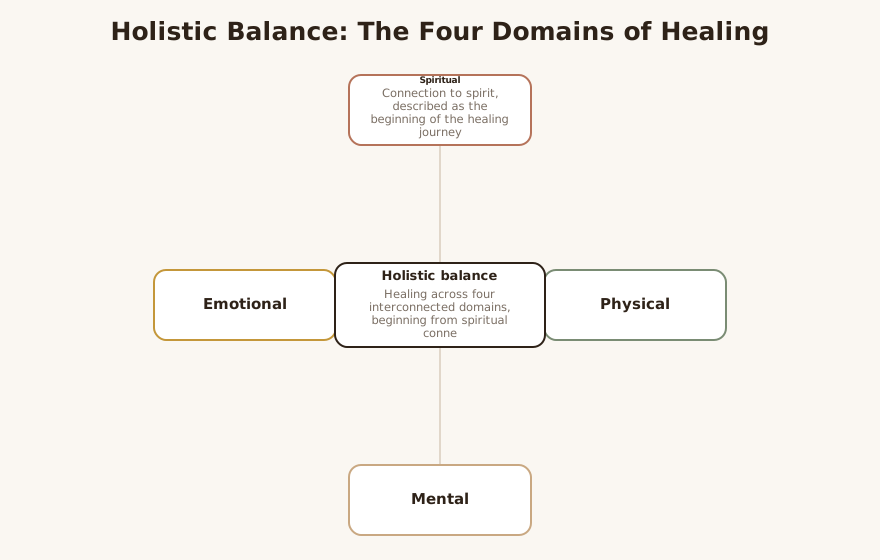
The organizing principle is holistic balance across four interconnected domains — physical, mental, emotional, and spiritual — with healing understood to begin from spiritual connection rather than from symptom-level intervention 4. Within an Indigenous paradigm, change in spirituality is itself a fundamental component of healing, and “connection to spirit” is described as the beginning of the healing journey 4. This stands in deliberate contrast to the deficit-based, individual-focused orientation of much Western practice; the ceremony embodies a strength-based, relational epistemology in which the person is understood through their connectedness to others, the land, and creation 4.
A second core principle is symbolism. The lodge is widely understood as representing the womb of the universe or the Earth, from which participants emerge renewed — moving from dark to light across the ceremony’s rounds 1. Prayers offered there are said to draw on the powers of Earth, Water, Fire, and Air 1. A third principle is community: the ceremony is collective, and socialization, mutual care, friendship, and even shared laughter are described by participants as healing properties 4. On leaving, participants are reminded to say “all my relations,” affirming the relationship and responsibility that humans share with all of creation 4. For clinical purposes, these principles map onto recognizable mechanisms — meaning-making, collective belonging, identity affirmation, and embodied ritual — without reducing the ceremony to them LLM.
Interventions & Techniques
The ceremony combines several elements that clinicians should understand at a respectful distance: an enclosed lodge of natural materials, heated stones brought from a sacred fire, water poured to create steam, and a structure of prayer, song, and sometimes drumming, often progressing through multiple rounds 61. In some traditions the door opens four times, each opening carrying cosmological meaning, with participants emerging at the end as a movement from darkness into light 1. Specific internal events of the ceremony are sacred and are deliberately not documented for outside audiences; researchers studying the ceremony have agreed to collect no information about ceremonial events and to keep all data collection outside the sacred circle 4.
For the clinician, the relevant “technique” is integration rather than facilitation. In practice the sweat lodge appears as one component within integrative programs that also offer Western assessment, education, counseling, and aftercare 3. A documented example is the explicit blending of the ceremony with a structured Western model: Marsh and colleagues incorporated the sweat lodge into Seeking Safety, with the integrated approach associated with reductions in intergenerational trauma symptoms and substance use 5. The reusable clinical skills are therefore referral, collaboration with Elders and ceremonial leaders, cultural assessment, and warm coordination of care — not running heat-and-water ceremonies oneself LLM.
LLM-generated illustrative example (not a guideline): A clinician working with a First Nations client in early recovery learns the client attends sweat lodge ceremonies led by a recognized Elder. Rather than treating this as outside the treatment plan, the clinician asks how the ceremonies fit the client’s healing goals, schedules sessions to support pre- and post-ceremony reflection, and frames Western relapse-prevention work as one strand braided with the client’s own ceremonial practice LLM.
Evidence Base
Honesty about maturity requires holding two things at once. As a practice, the sweat lodge is established: it is long-standing, widely recognized across nations, formally affirmed by Indigenous health bodies, and increasingly incorporated into programs serving Indigenous people 4. As a body of formal efficacy research, the evidence is sparse and methodologically limited 4. A scoping study of cultural interventions in Indigenous addiction treatment found that sweat lodge ceremonies were the single most prevalent intervention, appearing in 68% of studies, and reported benefits across all areas of wellness, with substance use problems reduced or eliminated in 74% of studies 3. However, that same study found no true randomized controlled trials, with designs that were quasi-experimental (53%) or pre-experimental (32%); all programs (100%) were integrative, mixing Western and Indigenous components, which makes it impossible to isolate the contribution of the sweat lodge specifically 3. Sample sizes were small and outcome measurement varied widely 3.
The most-cited focused study, Schiff and Moore’s pilot, illustrates both the promise and the limits 4. Working in close collaboration with Elders, the team measured 39 participants before and after a single ceremony using the SF-36 and the Heroic Myth Index 4. They found no significant change on the SF-36 physical and mental health scores — partly because participants were already in good health — and statistically significant pre-post change on only three of twelve HMI scales (Innocent, Warrior, Sage), with two more approaching significance 4. The authors framed this as the first known quantitative demonstration that change in spiritual and emotional well-being from the ceremony can be measured, while explicitly calling it a pilot needing replication on a larger scale 4. Qualitative work points the same direction: Marsh and colleagues report participants describing increases in spiritual and emotional well-being directly attributable to the ceremony 5. The honest summary for clinicians is that convergent, mostly low-tier evidence suggests benefit, particularly on spiritual, emotional, and community dimensions, but controlled efficacy data are largely absent and may be epistemologically incongruent with the practice itself 34.
Populations & Indications
The clearest indication is for Indigenous and First Nations clients for whom the ceremony is a culturally meaningful and traditional practice, especially within addiction and mental health treatment 4. The strongest applied signal in the literature is substance use: cultural interventions including the sweat lodge are widely used in Indigenous addiction programs and are associated with reduced or eliminated substance use across most studies 3. The ceremony is also indicated, on the qualitative and theoretical evidence, for clients carrying intergenerational and historical trauma, where strengthening cultural identity, traditional healing, and community integration are proposed mechanisms of recovery 5.
Additional populations who appear in the literature include incarcerated people, where sweat lodges have been incorporated into correctional and jail-based programming 4, trauma survivors and people with co-occurring trauma and substance use 5, and communities experiencing collective grief, depression, identity disturbance, spiritual crisis, and social isolation, where the communal and connective dimensions of the ceremony are most salient 4. Programs that incorporate traditional healing have also been associated with greater success in suicide prevention among Indigenous people 4. For non-Indigenous clients, the picture is more cautious: participation by outsiders raises significant cultural and ethical questions and is not a generic intervention to be prescribed 6.
Problems-for-Work
Substance use disorder. The best-supported applied problem; the ceremony commonly anchors integrative Indigenous addiction treatment and is associated with reductions in substance use 3. Application: a client in a culturally grounded recovery program may attend ceremonies as part of a relapse-prevention and identity-restoration plan, with Western counseling braided alongside 3LLM.
Historical / intergenerational trauma. Addressed through cultural-identity strengthening, traditional healing, and community integration, with the ceremony blended into structured trauma models such as Seeking Safety 5. Application: a clinician supports a client’s ceremonial participation as part of decolonizing trauma work, treating reconnection to culture as therapeutic rather than incidental 5LLM.
Social isolation and disconnection. The communal nature of the ceremony — mutual care, friendship, shared laughter, the affirmation of “all my relations” — directly targets isolation 4. Application: for a withdrawn client in collective grief, ceremonial community offers belonging that individual therapy alone cannot supply 4LLM.
Spiritual crisis and identity disturbance. Because the ceremony works first through spiritual connection and identity, it is well matched to clients whose distress centers on loss of meaning or cultural self 4. Application: supporting a client’s return to ceremony can restore a coherent cultural identity that stabilizes mood and reduces substance use 45LLM.
Contraindications, Cautions & Cultural Humility
The load-bearing clinical reality is this: clinicians do not run sweat lodges — they refer to and collaborate with legitimate Indigenous Elders and recognized ceremonial leaders 6. Cultural appropriation is a serious harm, not an abstraction. Indigenous leaders have strongly opposed non-Native appropriation and commercialization of the ceremony, and authority to lead requires extended traditional training, language fluency, and Elder recognition that cannot be self-designated or sold 6. The dangers of ignoring this are concrete and fatal: in a 2009 commercialized, non-traditional “sweat” near Sedona run by a non-Native motivational speaker, an improperly constructed lodge crowded with roughly sixty people led to three deaths and many more becoming ill 6. Native experts described that event as a bastardization of the ceremony, noting that traditional groups are small, that charging for ceremonies is inappropriate, and that breathable construction and Elder guidance are essential 6.
Physical safety is a real medical caution even in legitimate ceremonies. Documented risks include overexposure to heat, dehydration, smoke inhalation, and problems from improper lodge construction, and even experienced participants with authorized leaders can be endangered by underlying health conditions 6. Clinically, this means clients with cardiovascular disease, uncontrolled hypertension, pregnancy, seizure disorders, or heat-sensitive conditions warrant medical screening and a frank conversation before intense-heat participation; this is clinical reasoning, not a directive about the ceremony itself LLM. Finally, cultural humility extends to research and documentation: the sacred internal events of the ceremony are not material for outsider study or charting, a boundary that respectful researchers have explicitly honored by collecting no data within the sacred circle 4. The clinician’s posture is one of support, coordination, and respectful not-knowing LLM.
Treatment-Plan Suggestions & SMART Objectives
| Goal | SMART objective (example) | Mechanism |
|---|---|---|
| Support cultural reconnection in recovery | Client will attend at least 2 Elder-led ceremonies over 8 weeks and reflect on each in session | Cultural identity restoration, spiritual connection 45 |
| Reduce substance use | Client will report reduced or no substance use at 4 and 12 weeks while engaged in ceremony plus counseling | Integrative cultural-plus-Western treatment 3 |
| Address intergenerational trauma | Client will participate in ceremony braided with a structured trauma model over 12 weeks, tracking trauma-symptom change | Decolonizing, identity- and community-based healing 5 |
| Decrease social isolation | Client will identify and engage 1 ceremonial community connection within 6 weeks | Communal belonging, mutual care, “all my relations” 4 |
| Strengthen emotional/spiritual well-being | Client will rate emotional and spiritual well-being pre/post participation across 3 sessions | Spiritual connection as the start of healing 45 |
| Coordinate culturally safe care | Clinician will, with client consent, align Western session schedule with the client’s ceremonial calendar within 2 weeks | Two-Eyed Seeing / respectful integration 5 |
| Build relapse-prevention supports | Client will develop a written plan naming ceremony, Elder contact, and 2 coping skills within 4 weeks | Strength-based, community-anchored relapse prevention 34 |
Common Misconceptions
A first misconception is that the sweat lodge is a “detox sauna” or a stress-reduction technique; while heat and water are involved, the practice is a sacred ceremony oriented to spiritual purification and renewal, and its meaning is not reducible to thermal physiology 46. A second is that any heated-tent experience qualifies — the commercialized Sedona “sweat” that killed three people was explicitly not a traditional ceremony, and treating such events as equivalent is both factually wrong and dangerous 6. A third is that clinicians can or should facilitate ceremonies; legitimate leadership requires years of traditional training and Elder recognition, and is not transferable through a workshop 6.
A fourth misconception is that strong qualitative and traditional endorsement equals a robust controlled evidence base; in fact there are essentially no randomized trials, and the ceremony is almost always studied as one part of integrative programs, so its independent effect is not isolated 3. A fifth is that the practice is a single uniform ritual; in reality it varies substantially across nations, traditions, and languages, so generalizing from one lodge to all is inaccurate 46. Finally, some assume non-Indigenous participation is straightforwardly available and benign; the ethics of appropriation make this far more fraught than a typical referral 6.
Training & Certification
There is no clinical “certification” in sweat lodge facilitation, and clinicians should be wary of any course that implies otherwise LLM. Authority to conduct the ceremony rests within Indigenous communities: recognized ceremonial leaders are described as having completed years of traditional training, including fluency in their Indigenous language, demonstrated understanding of safe ceremonial conduct, formal recognition by Elders, and full standing as community members — qualifications that cannot be self-conferred or commercialized 6. For clinicians, the relevant development is not learning to lead but learning to collaborate: building genuine relationships with local Elders and Indigenous-serving programs, and following community protocol 4.
Where clinicians have engaged the ceremony in research or program contexts, the model has been partnership in which Elders co-design, approve, and co-disseminate the work, and in which cultural competence is something to be accepted by Elders rather than asserted by the researcher 4. The transferable training, then, is in cultural humility, Indigenous-informed assessment, and integrative care models such as the documented blending of the ceremony with Seeking Safety 5. Clinicians seeking to support clients well should pursue Indigenous cultural-safety training appropriate to their region and scope LLM.
Key Terms
Inípi — the Lakota sweat lodge ceremony; the term means “to live again,” reflecting its purpose of purification and spiritual rebirth 1. Womb of the Earth / universe — the central symbol of the lodge, from which participants emerge renewed, moving from darkness to light 1. “All my relations” — the affirmation said on leaving the ceremony, expressing connectedness with and responsibility to all of creation 4. Connection to spirit — the spiritual reconnection that, within an Indigenous paradigm, marks the beginning of healing 4. Intergenerational / historical trauma — cumulative, transmitted trauma from colonization, a primary problem the ceremony is used to address 5. Integrative treatment — programs combining Indigenous traditional healing with Western assessment, counseling, and aftercare 3. Two-Eyed Seeing / blended care — bringing Indigenous and Western knowledge together, as in pairing the ceremony with Seeking Safety 5LLM.
Resources & Further Reading
▶ Watch — a video introduction to this concept:
- Inipi: The Rite of Purification — Aktá Lakota Museum & Cultural Center
- Cultural interventions to treat addictions in Indigenous populations: findings from a scoping study (PMC)
- The Impact of the Sweat Lodge Ceremony on Dimensions of Well-Being — Schiff & Moore (ERIC PDF)
- The Sweat Lodge Ceremony: A Healing Intervention for Intergenerational Trauma and Substance Use — Marsh et al.
- Sweat lodge — Wikipedia
Reflective / Supervision Questions
- When a client describes ceremonial participation, do I treat it as central to their healing plan or as something peripheral to “real” treatment — and what does that reveal about my own frame? LLM
- How do I hold the tension between an established traditional practice and a thin controlled-evidence base without either dismissing or overselling the ceremony? LLM
- What relationships do I actually have with local Elders and Indigenous-serving programs, and how would I make a respectful, culturally safe referral? LLM
- Where is the line between supporting a client’s ceremony and intruding on sacred space that is not mine to document or analyze? 4LLM
- If a non-Indigenous client asks me to help them join a sweat lodge, how do I respond in a way that takes appropriation and safety seriously? 6LLM
- Am I screening for the real medical risks of intense-heat participation while staying out of the ceremony’s spiritual content? 6LLM