
Anti-oppressive practice (AOP) and its close relative anti-racist practice are not therapies in the way that CBT or EMDR are therapies. They are critical paradigms — orientations to the whole of helping work — that ask the clinician to keep power and structural oppression in view at every stage of assessment, formulation, and intervention 2. For a practicing therapist, the practical upshot is this: the distress in front of you is rarely produced by the individual alone, and the helping relationship itself reproduces the same hierarchies you are trying to address unless you actively work against them 1. This article orients clinicians to the framework, its evidence, and how to operationalize it inside the modalities you already bill.
Type & Discipline
AOP is best understood as a value-driven, structural framework rather than a manualized clinical protocol 2. Its home discipline is social work, where it sits within the family of critical and structural social work that treats socioeconomic and identity-based oppression as a primary clinical concern rather than a contextual footnote 2. The framework is explicitly interdisciplinary, drawing on critical social theory, sociology, and political philosophy to read individual problems as expressions of broader power relations 2. Anti-racist practice is the application of this same analysis to racism specifically, naming and working against racism as it operates at individual, interpersonal, institutional, and structural levels 3. Because AOP is a paradigm rather than a discrete treatment, it can be layered onto established clinical modalities — it tells you how to hold the work, not which technique to deploy LLM.
Creators & Lineage
The foundational articulation of AOP belongs to Lena Dominelli, whose 2002 text Anti-Oppressive Social Work Theory and Practice defines the approach as a methodology that empowers service users by reducing the negative effects of hierarchy in the helping relationship 2. Dominelli framed oppression as multidimensional and context-dependent, arguing that social work can either perpetuate or challenge oppressive social relations and that practitioners must therefore work reflexively to recognize and disrupt them 7. Neil Thompson contributed the widely taught PCS model, which distinguishes the Personal, Cultural, and Structural levels at which oppression operates 2.
The intellectual lineage runs through critical social theory and empowerment/structural social work, which reframe personal troubles as public issues 2. Kimberlé Crenshaw’s concept of intersectionality is central, supplying the recognition that oppressions on the basis of race, gender, class, and other identities compound rather than add 2. Liberation psychology shares AOP’s commitment to consciousness-raising and to dismantling what AOP literature calls the “culture of silence” and learned helplessness 2. In the United States, the NASW has formalized much of this lineage into professional commitments through its anti-racism statements 34.
Core Principles
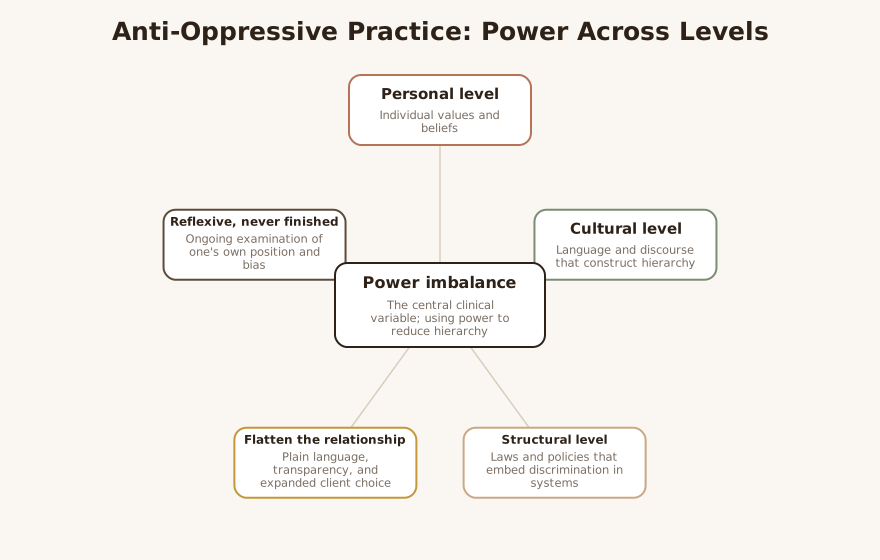
The organizing principle of AOP is that power imbalance is the central clinical variable 1. Dominelli’s definition turns on the deliberate, legitimate use of the practitioner’s power to reduce hierarchy rather than to reinforce it 2. Three interlocking principles follow LLM.
First, oppression is analyzed across levels: the personal (individual values and beliefs), the cultural (language and discourse that construct hierarchy, such as labeling some populations as “ethnic” and others as the norm), and the structural (laws and policies that embed discrimination in systems like immigration and welfare) 2. Second, the practitioner-client relationship is itself a site of power that must be actively flattened — through plain language, transparency, and expanded client choice — because those who benefit from any hierarchy are those who already hold the most power 2. Third, the work is reflexive and never finished: practitioners must continually examine their own racial history, position, and bias, treating anti-oppressive practice as ongoing labor rather than a credential to be earned once 5. NASW frames this as a duty to take “conscious and deliberate actions” both professionally and personally 3.
Interventions & Techniques
Because AOP is a stance rather than a protocol, its “techniques” are better understood as practice moves applied across micro, mezzo, and macro levels 5. At the micro (individual) level, the clinician engages in structured self-reflection on personal bias, minimizes professional jargon that reinforces hierarchy, names oppression explicitly in formulation, and works to increase the client’s dignity and choice within sessions 25. Counter-hegemonic reframing — helping a client understand distress as a reasonable response to unjust conditions rather than as individual pathology — is a core move 2.
At the mezzo (group/organizational) level, practitioners constructively name racism and inequity in workplace and community settings, participate in collective change of unjust organizational norms, and join reflective structures such as discussion groups or supervision focused on race 5. At the macro (systems) level, AOP expects advocacy: contacting legislators for equitable policy, supporting policy analysis, and challenging discriminatory laws 5. NASW operationalizes the macro level into specific commitments — reforming institutional practices, influencing external systems, and opposing discriminatory legislation 3.
LLM-generated illustrative example (not a guideline): A therapist treating a client’s panic symptoms after repeated stops by police might validate the physiology of the fear response while explicitly framing the hypervigilance as an adaptive response to a genuinely threatening environment, rather than coding it solely as a distortion to be restructured LLM.
Evidence Base
Honesty about evidence is essential here. AOP and anti-racist practice are established as professional and ethical frameworks — they are embedded in social-work curricula, accreditation expectations, and the formal commitments of the field’s largest professional body 34. They are not, however, established in the sense that a specific manualized treatment is established through randomized controlled trials LLM. The body of work is primarily theoretical, conceptual, and consensus-driven rather than outcome-trial driven 2.
The contemporary literature reflects an active, evolving landscape in which the profession is still working out definitions, scope, and the relationship between “anti-oppressive” and “antiracist” terminology 6. NASW itself frames the rationale on ethical and human-rights grounds — alignment with the profession’s core commitments to dignity and social justice — rather than on a claim of superior symptom-reduction efficacy 3. The practical implication for clinicians: adopt AOP because it improves the fit, safety, and ethics of care for marginalized clients and corrects for documented harms the profession has caused, not because it is a discrete intervention with its own effect size 4LLM.
Populations & Indications
AOP is indicated wherever oppression is plausibly a driver or amplifier of distress, which is to say across much of a generalist caseload but with particular salience for certain groups LLM. These include racialized and other marginalized communities; LGBTQ+ individuals clients; immigrants and refugees navigating systems explicitly named in AOP analysis, such as immigration and welfare bureaucracies; people of low socioeconomic status; people with disabilities; and survivors of structural violence 2. NASW specifically highlights populations harmed by systems in which social work has been complicit, including Black, Brown, and Indigenous families overrepresented in the child-welfare system and communities affected by medical racism and mass incarceration 4.
The framework’s value for these populations is that it prevents the clinician from misattributing externally produced suffering to internal deficit 2. For a refugee presenting with anxiety, an AOP-informed assessment will hold the asylum process and discrimination in view alongside intrapsychic factors LLM.
Problems-for-Work
AOP reframes a familiar list of presenting problems by situating them in their social context 2. With racial trauma and discrimination-related distress, the framework supports validating the injury as real and externally caused rather than pathologizing the client’s vigilance 4. With minority stress — the chronic strain of navigating a stigmatizing environment — AOP names the environment as the stressor and supports both coping and, where possible, environmental change LLM.
With internalized oppression, the work involves helping clients identify beliefs they have absorbed from a culture that devalues them, a process aligned with AOP’s challenge to the “culture of silence” 2. With disempowerment and learned helplessness, Dominelli’s core mechanism applies directly: deliberately redistributing power within the relationship to rebuild agency 2. For diagnosable conditions such as PTSD, depression, anxiety, and identity disturbance, AOP does not replace evidence-based treatment for those conditions; it shapes the formulation and the relational stance within which that treatment is delivered LLM.
LLM-generated illustrative example (not a guideline): A clinician using a depression protocol with a client facing housing discrimination would still deliver behavioral activation, while resisting framings that imply the client’s hopelessness is purely a cognitive error, since some of it tracks a genuinely constrained reality LLM.
Contraindications, Cautions & Cultural Humility
There are few formal contraindications to a values stance, but several cautions matter clinically LLM. First, AOP can be misapplied as the imposition of the clinician’s political analysis onto a client who has not requested it; the framework’s own commitment to client choice and reduced hierarchy forbids this 2. Naming oppression should follow the client’s experience, not override it LLM. Second, a clinician who frames all distress as externally caused may neglect treatable intrapsychic and biological contributors — AOP is meant to widen the formulation, not collapse it LLM.
Cultural humility is intrinsic rather than additive: AOP requires practitioners to examine their own power, position, and racial history continuously, which is especially pressing given that the social-work and broader therapy workforce is majority White 54. NASW explicitly calls White practitioners to confront their own racism through training, supervision, and reflective conversation 4. The honest caution is that anti-oppressive intent without ongoing reflexivity can slide into performative or tokenistic practice, which the literature warns is itself a harm 5.
Treatment-Plan Suggestions & SMART Objectives
| Goal | SMART objective (example) | Mechanism |
|---|---|---|
| Reduce discrimination-related distress | Client will identify 2 discriminatory stressors and rate associated distress weekly for 6 weeks, with a 30% reduction in peak rating | Externalizing attribution; validation of real injury 4 |
| Counter internalized oppression | Client will articulate 3 internalized negative beliefs and generate counter-statements in 4 of 6 sessions | Challenging the “culture of silence”; consciousness-raising 2 |
| Rebuild agency / reduce learned helplessness | Client will set and complete 1 self-chosen empowerment action per week for 8 weeks | Deliberate redistribution of power in the relationship 2 |
| Strengthen minority-stress coping | Client will practice 2 coping strategies and document use during 80% of identified stress events over 4 weeks | Coping skill-building within a named oppressive context 5 |
| Improve safety and voice in sessions | Clinician and client will co-create a session agenda and review power dynamics monthly | Flattening practitioner-client hierarchy; expanding choice 2 |
| Connect distress to systemic context | Client will complete a personal/cultural/structural mapping of their presenting problem by session 4 | Multilevel oppression analysis (PCS model) 2 |
| Mobilize protective resources | Client will engage 1 community or advocacy resource within 6 weeks | Macro-level linkage and empowerment 5 |
Common Misconceptions
The most common misconception is that AOP is a free-standing treatment with its own evidence base and procedure code; it is a paradigm layered onto other modalities 2LLM. A second is that anti-racist practice is a one-time training or certificate — the literature is emphatic that it is sustained, never-finished work 5. A third is that AOP means importing politics into the therapy room; in fact its discipline of reduced hierarchy and client choice constrains the clinician from doing exactly that 2. A fourth is that the framework denies individual agency or biology — it widens the formulation to include structural causes rather than denying internal ones LLM. Finally, some assume the profession has always practiced this way; NASW candidly documents social work’s own history of complicity in oppressive systems, which is part of why the commitment is framed as corrective 4.
Training & Certification
There is no single licensing credential that confers “AOP certification,” consistent with the framework’s status as a paradigm rather than a discrete modality LLM. The competencies are instead embedded in accredited social-work education and in continuing professional development 5. NASW provides a primary route, convening organizational anti-racism initiatives, professional development, and advocacy resources for members and chapters 35. Practical development pathways the literature endorses include reflective supervision focused on race and power, participation in anti-racism discussion groups, organizational convenings, and ongoing self-education — all framed as continuous rather than terminal 5. The contemporary scholarly conversation suggests the field is still actively building shared training standards and definitions in this area 6.
Key Terms
- Anti-oppressive practice (AOP): an interdisciplinary social-work approach targeting socioeconomic and identity-based oppression by examining power imbalances and building egalitarian, discrimination-free practice 2.
- PCS model: Thompson’s framework distinguishing the Personal, Cultural, and Structural levels at which oppression operates 2.
- Reflexivity: the practitioner’s continual examination of their own power, position, and bias as part of the work 5.
- Culture of silence / learned helplessness: the disempowered state AOP seeks to counter by redistributing relational power 2.
- Intersectionality: Crenshaw’s concept that multiple oppressions compound rather than simply add 2.
- Structural racism: racism embedded in laws, policies, and institutions, distinct from individual prejudice 3.
- Counter-hegemonic understanding: reframing difference and distress against dominant narratives that pathologize the marginalized 2.
Resources & Further Reading
▶ Watch — a video introduction to this concept:
- Dominelli, Anti-Oppressive Social Work Theory and Practice (2002) — the foundational text 1
- Dominelli, Anti-Oppressive Social Work Theory and Practice — Internet Archive copy — for table of contents and lending access 7
- Anti-oppressive practice — Wikipedia — concise overview of levels, key figures, and critiques 2
- NASW Anti-Racism Statement — professional definition and commitments 3
- NASW: Social Workers Must Help Dismantle Systems of Oppression — framing of structural oppression and the profession’s history 4
- Practicing Anti-Racism in Social Work: A Guide (2026 Edition) — practical micro/mezzo/macro practices 5
- The Changing Social Work Landscape: Addressing Race and Antiracism — academic discussion of the evolving evidence and terminology 6
Reflective / Supervision Questions
- Where in my current caseload am I attributing externally produced suffering to individual deficit, and how would the formulation change if I held the structural level in view 2LLM?
- How does the power differential between me and this client show up in our sessions, and what concrete move could reduce it this week 2?
- What is my own racial and social position, and how might it be shaping what I notice, validate, or pathologize 5?
- Am I naming oppression in response to the client’s experience, or imposing my analysis onto a client who has not raised it 2LLM?
- Where might my anti-oppressive intent have become performative rather than sustained, and what would genuine ongoing work look like 5?
- How is my own discipline implicated in the systems my client is navigating, and what does honest accountability require of me here 4?