
Type & Discipline
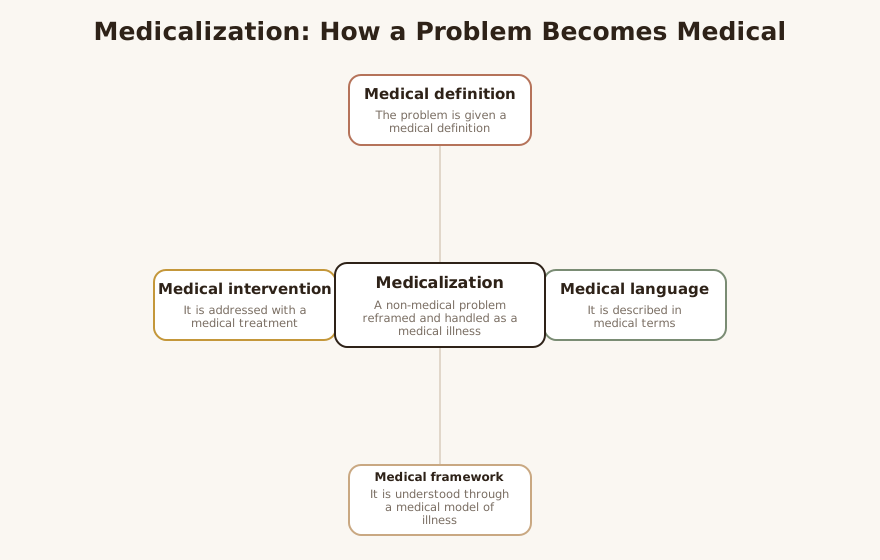
Medicalization is a theoretical concept from medical sociology, not a treatment, technique, or clinical modality 1. It names a social process: the way in which non-medical problems come to be defined and treated as medical illnesses, usually framed as disorders or syndromes requiring professional intervention 1. The concept belongs to the broader sociology of health and illness, the field that studies how societies decide what counts as sickness, who has the authority to make that decision, and what follows once a problem is brought under medical jurisdiction 4. For a practicing therapist, medicalization is best understood as an analytic lens rather than something one “does” in session; it sharpens awareness of how a given complaint became a diagnosis, and at what point ordinary human experience was reclassified as pathology LLM.
Because it is a sociological construct, medicalization makes no prescription about how to treat anyone, and its clinical value is interpretive LLM. It equips the clinician to hold the diagnostic process itself as an object of reflection, to notice the assumptions embedded in a referral question, and to weigh the benefits and costs of bringing a problem under a medical frame LLM. Everything that follows translates a descriptive social theory into questions a clinician can use, and that translation is the author’s clinical reasoning rather than a direct claim from the source literature LLM.
Creators & Lineage
The concept is most closely associated with the American sociologist Peter Conrad, whose decades of work made medicalization a central organizing idea in medical sociology 2. Conrad’s synthesis, “The Medicalization of Society: On the Transformation of Human Conditions into Treatable Disorders,” gathers the argument in book form and is the standard first-principles reference for the concept 1. His earlier work on the medicalization of deviance, including hyperactivity in children and the reframing of misbehavior as disorder, established the template for later analyses of how conduct becomes diagnosis 2.
Medicalization did not arise in isolation LLM. It draws on social constructionism, the view that categories such as “illness” are produced through social processes rather than simply read off nature, and it overlaps with the antipsychiatry and critical-psychiatry traditions that questioned the medical model of mental distress 5. A closely related strand is the disease-mongering critique, which examines how the boundaries of treatable illness are widened, sometimes by commercial actors, to expand markets for intervention 5. One of Conrad’s signature observations is that the principal engines of medicalization have shifted over time, moving away from the medical profession alone and toward biotechnology, the pharmaceutical industry, consumers and patient advocacy, and the financial structures of managed care 1. The contemporary picture is therefore less about doctors imposing labels and more about a diffuse set of forces, including patient demand, that pull human conditions into medical territory 1.
The concept has not stood still LLM. Since Conrad’s foundational statements it has been critically reassessed and refined within the sociology of health and illness, with scholars debating how broadly the term should be applied and whether its scope has become too elastic 3. That ongoing reappraisal is itself a sign of a mature, contested concept rather than a settled doctrine LLM.
Core Principles
The defining claim is jurisdictional: medicalization describes the expansion of medicine’s authority into domains previously understood in moral, legal, religious, or simply ordinary human terms 1. A problem becomes medicalized when it is given a medical definition, described in medical language, understood through a medical framework, or addressed with a medical intervention 4. Crucially, none of these steps requires that the underlying condition have a demonstrated biological cause; medicalization is about the framing of a problem, not proof of its pathophysiology 4.
A second principle is that medicalization operates by degree, not as an all-or-nothing switch LLM. Conditions can be more or less medicalized, the process can advance or recede over time, and the same behavior may be medicalized in one era and de-medicalized in another, as the history of homosexuality’s removal from the diagnostic nomenclature illustrates 5. A third principle is that medicalization is value-neutral as an analytic term: identifying that a problem has been medicalized does not by itself establish that the medicalization is good or bad 4. It can extend genuine help and reduce blame, and it can also pathologize the normal and create harm; the concept asks the clinician to evaluate which is occurring in a given case rather than to assume the answer LLM.
A fourth principle concerns mechanism: medicalization typically targets natural life processes, ordinary variation in mood and behavior, and forms of deviance, converting each into a treatable disorder 1. Childbirth, aging, sadness after loss, normal childhood activity levels, and the shy end of the temperament distribution are recurrent examples of human experiences drawn into medical management 5.
Interventions & Techniques
Medicalization supplies no interventions of its own, so what follows is the clinical application of the lens, and these recommendations are the author’s synthesis rather than directives from the source literature LLM. The most basic application is diagnostic conservatism, or diagnostic humility: pausing before assigning a label to ask whether the presentation reflects disorder or an expectable, context-appropriate human response LLM. This pairs with normalizing psychoeducation, explaining the range of normal reactions to stressors and loss so a client does not read an ordinary response as evidence of being broken LLM.
A second application is contextualization: before treating a complaint as a freestanding disorder, the clinician situates it in the client’s circumstances, relationships, work, finances, and culture, asking whether the distress signals something about the environment rather than a defect in the person LLM. A third is watchful waiting and stepped care, deferring escalation to higher-intensity or pharmacological intervention when a problem may be self-limiting, while keeping a clear threshold for acting if it does not resolve LLM. A fourth is attention to iatrogenic and identity effects: monitoring whether a diagnosis is helping the client make sense of their experience and access support, or whether it is becoming a fixed, limiting identity and a source of health anxiety LLM.
A fifth is collaborative meaning-making around the diagnosis itself, treating the label as a hypothesis and a flexible tool rather than an immutable fact about the client LLM. None of these is unique to medicalization; they are good general clinical practice that the lens foregrounds and justifies LLM.
LLM-generated illustrative example (not a guideline): A client three months after the death of a spouse arrives convinced they “have depression” because they still cry daily and cannot concentrate at work. Using the medicalization lens, the clinician first validates the depth of the grief, explains that intense, fluctuating distress is an expectable response to a major loss, and frames their reactions as grief rather than rushing to a depressive-disorder label, while explicitly tracking the markers (persistent hopelessness, worthlessness, suicidality, marked functional collapse beyond the expected) that would warrant reclassifying and treating it as a disorder LLM.
Evidence Base
The honest characterization is that medicalization is an established and influential sociological concept, not a treatment with an outcome-trial evidence base 2. Its maturity is the maturity of a theory: decades of scholarship anchored in Conrad’s body of work, an entry in standard reference works of the social and behavioral sciences, and continuous use across medical sociology, public health, and bioethics 2. There are no randomized controlled trials of “medicalization” because it is not an intervention, and it would be a category error to present it to a client as an evidence-based therapy LLM.
What the concept does have is strong descriptive and historical support: well-documented case studies of how specific conditions, from attention and activity problems in children to aspects of aging and reproduction, were drawn into medical management, and a coherent account of the social forces driving the process 1. The concept is also actively contested and reassessed within its own field, with scholars questioning whether it has been stretched too far and how broadly the term should be applied 3. It now sits alongside newer ideas such as biomedicalization and pharmaceuticalization LLM. For the clinician, the practical implication is to treat medicalization as a credible, well-developed interpretive framework that prompts useful questions, while not overclaiming it as a validated clinical method or as proof that any particular diagnosis is illegitimate LLM.
Populations & Indications
The lens is relevant across general clinical populations, because every diagnostic encounter involves a decision about whether and how to apply a medical frame LLM. It is especially salient for people presenting with subclinical or normative distress, where the central question is whether a complaint crosses the threshold into disorder or reflects an ordinary reaction that does not require treatment 5. It is particularly important in work with children and adolescents, given the long-running debates about the medicalization of childhood behavior and the consequences of early diagnostic labeling for a developing identity 2.
Older adults are a key population, because aging itself has been a recurrent site of medicalization, and ordinary features of later life can be reframed as conditions to be treated 5. Bereaved individuals warrant special attention in light of debates about whether and when grief should be classified as a disorder, a debate that is among the clearest contemporary examples of the medicalization question in mental health 5. Finally, patients in primary care are a frequent locus of medicalization, since brief, high-volume settings can favor a quick diagnostic-and-prescription pathway for problems that are partly social or situational in origin LLM.
Problems-for-Work
The lens speaks most directly to overdiagnosis and diagnostic inflation, the widening of diagnostic boundaries so that more people qualify for a label, which the clinician counters through careful threshold-setting and diagnostic conservatism 1. It addresses the pathologizing of normal experiences, such as shyness or grief, by helping the clinician and client distinguish expectable human responses from genuine disorder 5. It bears on overprescription and overtreatment, by prompting a deliberate weighing of whether a medical intervention is warranted or whether watchful waiting and psychosocial support are more appropriate 1.
LLM-generated illustrative example (not a guideline): A college student is referred with “social anxiety disorder” after a roommate told them their reluctance to attend parties was “a real condition.” On assessment, the clinician finds a temperamentally shy young person whose avoidance is mild, situation-specific, and not impairing their studies or close friendships; the work becomes psychoeducation that introversion and shyness exist on a normal spectrum, paired with optional skills for the specific situations the client wants to manage, rather than installing a disorder identity around an ordinary temperament LLM.
The lens is also a tool against stigma and labeling, since it makes visible how a diagnosis can become a master status that reorganizes how a person sees themselves 4. It applies squarely to medicalized grief, supporting the clinician in honoring mourning as a human process while remaining alert to genuine complicated or major depressive presentations 5. It directs attention to iatrogenic harm, the possibility that diagnosis and treatment themselves cause harm, and to the identity effects of diagnosis and to health anxiety, where preoccupation with being ill becomes its own clinical problem LLM.
Contraindications, Cautions & Cultural Humility
The central caution is that the lens must not tip from diagnostic humility into diagnostic nihilism LLM. Medicalization sits on an antipsychiatry and critical-psychiatry lineage that can read as anti-diagnosis, and a clinician who absorbs only that valence can do real harm by dismissing serious illness as “just a label,” minimizing suffering, or withholding effective treatment LLM. Under-medicalization is a genuine harm in its own right: failing to recognize depression, psychosis, an eating disorder, a substance use disorder, or a medical condition masquerading as psychological distress can be catastrophic, and the critique is never a license to skip thorough assessment LLM. The concept asks the clinician to evaluate, case by case, whether a medical frame helps or harms, not to default to skepticism 4.
A second caution is that diagnosis carries real benefits the lens should not obscure: a label can validate suffering, reduce self-blame, organize a treatment plan, and open the door to support and accommodations LLM. For some clients, especially those long told their distress was imaginary or a character flaw, a diagnosis is liberating rather than confining, and the clinician should not impose a de-medicalizing stance the client does not share LLM.
Cultural humility is essential, because what counts as illness, normal sadness, or a problem worth treating is itself culturally and historically variable 4. The thresholds embedded in any diagnostic system reflect particular cultural assumptions about the normal, and a presentation that looks like disorder through one cultural lens may be expectable within another LLM. The clinician should hold diagnostic categories as useful but situated tools, attend to how a client’s community understands their experience, and avoid both pathologizing culturally normative distress and dismissing real suffering as mere cultural difference LLM.
Treatment-Plan Suggestions & SMART Objectives
| Goal | SMART objective (example) | Mechanism |
|---|---|---|
| Distinguish normal reaction from disorder | Within 2 sessions, client will collaboratively review the criteria and context of their presenting concern and articulate, in their own words, which features are expectable and which warrant clinical attention | Diagnostic conservatism and threshold-setting 1 |
| Reduce self-pathologizing of a normal experience | Over 4 weeks, client will reframe 2 self-statements (e.g., “I’m broken”) into context-based descriptions of an ordinary response to stress or loss | Normalizing psychoeducation 5 |
| Process grief without premature disorder labeling | Within 6 sessions, client will identify 3 features of their grief that reflect mourning and name the specific markers that would indicate a clinical depression requiring treatment | Contextualizing grief; honest threshold-monitoring 5 |
| Limit overtreatment through stepped care | Over 8 weeks, client and clinician will trial a psychosocial-first approach and review at a set date whether escalation to higher-intensity care is warranted | Watchful waiting and stepped care 1 |
| Loosen a rigid diagnostic identity | Within 5 sessions, client will describe 2 areas of life and self not captured by their diagnosis | Countering identity effects and labeling 4 |
| Reduce health-anxiety preoccupation | Over 6 weeks, client will track and reduce checking or reassurance-seeking behaviors tied to fears of being ill | Attending to iatrogenic and health-anxiety effects LLM |
| Situate distress in its context | Within 3 sessions, client will map current stressors across work, relationships, finances, and culture and identify which the distress may be signaling | Contextualization of presenting problems LLM |
Common Misconceptions
A frequent error is to read medicalization as the claim that mental illness is not real or that diagnosis is inherently illegitimate; the concept makes no such claim, and treats medicalization as a process to be evaluated rather than condemned 4. A related misconception is that the term is pejorative; in its sociological usage it is analytically neutral, describing a process that can be beneficial, harmful, or both 4. Another is that medicalization is something doctors do to passive patients, when contemporary accounts emphasize that patients, consumers, advocacy movements, industry, and health-system financing are all active drivers, and demand for medical labels often comes from below 1.
Some clinicians assume medicalization requires that a condition be “fake” or have no biological basis; the concept is about how a problem is framed and governed, and it applies regardless of whether biological contributions exist 4. Finally, medicalization is sometimes confused with simply having too many diagnoses, but it is a broader structural process about the extension of medical jurisdiction over human life, of which diagnostic inflation is only one expression 1.
Training & Certification
There is no certification, credential, or licensing body in medicalization, and any clinician who claimed to be a “certified” practitioner of it would be misrepresenting a sociological concept as a credential LLM. The concept is encountered in the academic literature of medical sociology, where Conrad’s work is foundational, and in standard reference works of the social and behavioral sciences 2. Within clinical training, it typically appears in coursework on the sociology of health and illness, in medical and professional ethics, and in critical examinations of diagnostic systems and the limits of the medical model LLM. Clinicians who wish to deepen their understanding are best served by reading Conrad’s primary work and the sociological literature that has reassessed and extended it, and by integrating its questions into their everyday assessment practice rather than seeking a separate qualification 1.
Key Terms
Medicalization – the process by which non-medical problems come to be defined and treated as medical illnesses, typically as disorders requiring intervention 1. De-medicalization – the reverse process, in which a problem loses its medical definition, as when homosexuality was removed from the psychiatric nomenclature 5. Medicalization of deviance – the reframing of behavior once judged in moral or legal terms as a medical disorder, a central theme in Conrad’s early work 2. Engines of medicalization – Conrad’s term for the shifting drivers of the process, now including biotechnology, the pharmaceutical industry, consumers, and managed care rather than the profession alone 1. Disease mongering – the widening of the boundaries of treatable illness, often commercially motivated, to enlarge markets for intervention 5. Diagnostic inflation / overdiagnosis – the broadening of diagnostic criteria so that more people qualify for a label 1. Iatrogenic harm – harm caused by the diagnostic or treatment process itself rather than by the underlying condition LLM. Social construction of illness – the view that illness categories are produced through social processes rather than simply discovered in nature 5.
Resources & Further Reading
▶ Watch — a video introduction to this concept:
- Conrad, “The Medicalization of Society: On the Transformation of Human Conditions into Treatable Disorders” (Johns Hopkins University Press, 2007)
- Medicalization (Conrad) – Wiley International Encyclopedia of the Social & Behavioral Sciences
- Busfield, “The concept of medicalisation reassessed” (2017, Sociology of Health & Illness)
- Medicalization – ScienceDirect Topics (overview)
- Medicalization – Wikipedia
Reflective / Supervision Questions
- When I assign a diagnosis, am I able to articulate why this presentation crosses the threshold into disorder rather than reflecting an expectable response to the client’s circumstances LLM?
- Where in my caseload might I be over-medicalizing ordinary distress, and where might I be under-medicalizing genuine illness by minimizing it as “just a label” LLM?
- For a given client, does their diagnosis open up support and self-understanding, or has it hardened into a limiting identity, and how would I know the difference LLM?
- Whose interests are served by bringing this particular problem under a medical frame – the client’s, the system’s, the referrer’s, or the market’s LLM?
- How do my own cultural assumptions about what is “normal” shape where I set the line between health and pathology, and how would a client from a different background draw that line LLM?