
Most of what shapes a client’s health and mental health happens outside the consulting room — before the first session and between every one after. The social-determinants-of-health framework names that fact and gives it structure. LLM This article orients practicing therapists to the framework, its evidence, and how to use it in formulation, planning, and documentation without overreaching its scope. LLM
Type & Discipline
Social determinants of health (SDOH) is a framework — a conceptual and analytic model — rather than a treatment modality. LLM It sits within social epidemiology and public health, the disciplines that study how social position and the distribution of resources pattern disease across populations. LLM The World Health Organization defines social determinants as “the conditions in which people are born, grow, work, live, and age, and the wider set of forces and systems shaping the conditions of daily life.” 3 For clinicians, the practical consequence is that SDOH is a lens for understanding and contextualizing a presenting problem, not a set of techniques you deliver. LLM
The framework is explicitly “upstream”: it directs attention away from individual behavior and biology toward the structural conditions that constrain them. 6 Research summarized in the public-health literature holds that “more than half of a person’s health is determined by social determinants rather than clinical care and genetics,” which positions these factors as causes operating before any clinical encounter. 6 The WHO calls these the conditions “shaping the conditions of daily life” — sometimes described as the “causes of the causes” of poor health. 3
Creators & Lineage
The modern framework crystallized in the 2008 final report of the WHO Commission on Social Determinants of Health (CSDH), Closing the Gap in a Generation, chaired by epidemiologist Sir Michael Marmot. 4 The report drew global attention to “social factors leading to ill health and inequities” and called on the WHO and national governments to lead action on social determinants with the explicit aim of achieving health equity. 4 Its PubMed-indexed record marks the report’s entry into the formal scientific literature. 2
The lineage runs deeper than 2008. LLM The framework grew out of seminal British research, including the Whitehall Studies of civil servants — which documented a health hierarchy tracking employment grade — and the Black Report, which established that socioeconomic position powerfully predicts health outcomes. 6 Michael Marmot and Richard Wilkinson advanced the field through frameworks examining stress, inequality, and social position, work later distilled in the WHO Europe publication Social Determinants of Health: The Solid Facts. 6 At its 2008 launch, then–WHO Director-General Margaret Chan emphasized that while health care and lifestyles matter, it is “factors in the social environment that determine access to health services and influence lifestyle choices in the first place.” 4
Core Principles
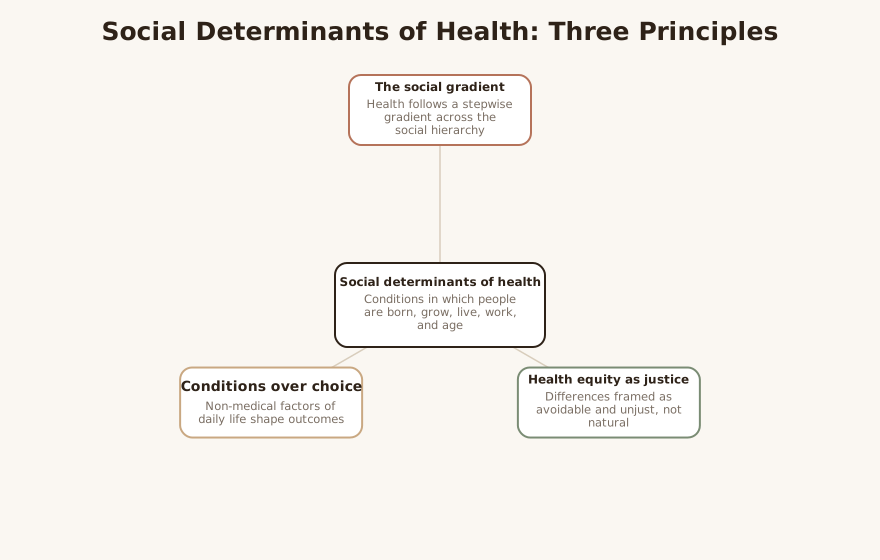
Three principles anchor the framework. LLM
First, the social gradient: health follows a stepwise gradient across the social hierarchy, not a simple poor-versus-rich split. 6 The CSDH documented that within and between nations there are “dramatic differences in health” that correlate directly with “degrees of social disadvantage,” with life expectancy ranging from more than 80 years in some countries to less than 45 in others. 1
Second, health equity as a justice issue: the Commission framed these differences as avoidable and unjust, stating that “differences of this magnitude, within and between countries, simply should never happen,” and argued that a society can be judged by “how fairly health is distributed across the social spectrum.” 1 The framework holds that health inequalities are not “natural phenomena” but result from “poor social policies, unfair economic arrangements, and bad politics.” 6
Third, conditions of daily life over individual choice: the CDC frames SDOH as “the non-medical factors that influence health outcomes” and notes they “create health inequities — types of health disparities that stem from unfair and unjust systems, policies, and practices.” 3
Interventions & Techniques
Because SDOH is a framework rather than a modality, its “techniques” are assessment, formulation, and connection — not in-session procedures. LLM
The CDC organizes determinants into recognizable domains a clinician can screen against: economic stability (income, employment, food security), education, healthcare access and quality, neighborhood and physical environment (housing, living conditions), and social and community context (social norms, discrimination, residential segregation, incarceration). 3 A sixth domain — race and gender, acknowledging structural discrimination — is commonly added in the broader literature. 6 Practically, this means a clinician can build a structured psychosocial inventory across these domains, ask routinely about housing, food, work, safety, and social support, and treat the answers as clinical data rather than background. LLM
The framework’s signature contribution is upstream formulation: locating a symptom’s drivers in the conditions of daily life rather than defaulting to intrapsychic or behavioral explanations. 3 At the system level, the CSDH translated this into three overarching recommendations — improve daily living conditions; tackle the inequitable distribution of power, money, and resources; and measure and understand the problem and assess the impact of action. 4 For an individual clinician, the actionable analogue of the first recommendation is warm-handoff referral and care coordination: connecting clients to housing, benefits, food, and legal resources as part of the treatment plan. LLM
Evidence Base
The evidence base is established, but it is essential to be precise about what is established. LLM The epidemiological claim — that social position predicts health and that a social gradient runs across populations — is robustly supported by decades of cohort research, including the Whitehall Studies, and is codified in major WHO and CDC frameworks. 6 As a public-health and policy framework, SDOH is mainstream and authoritative, endorsed by the WHO Commission and incorporated into national public-health guidance. 1 3
What is not established in the same way is SDOH as a clinical treatment. LLM There are no efficacy trials of “the social-determinants-of-health framework” as a psychotherapy, because it is not one; it is a lens and a set of policy aims, not a manualized intervention with controlled outcome data. LLM The Commission itself recognized this gap, making “measure and understand the problem and assess the impact of action” one of its three core recommendations — an explicit acknowledgment that the evidence for interventions on determinants needs building even where the descriptive epidemiology is settled. 4 For clinicians, the honest summary is: the framework’s diagnosis of the problem is strong; the evidence for any specific clinic-level intervention to modify determinants is more uneven and should be evaluated case by case. LLM
Populations & Indications
SDOH formulation is most clinically salient for populations whose presentations are entangled with disadvantage. LLM These include low-income and economically insecure clients, where the CDC names “poverty, unequal access to health care, lack of education, stigma, and racism” as underlying contributors to inequities. 3 Racial and ethnic minority and immigrant communities are central, given the framework’s explicit attention to discrimination and residential segregation. 3
Other high-yield groups include unemployed or precariously employed workers, the socially isolated (where social support is eroded), children exposed to early-life adversity, and clients in housing- or food-insecure circumstances. 3 The framework is broadly indicated as a formulation lens for nearly any client, because conditions of daily life shape everyone’s health; it becomes clinically decisive when those conditions are constraining the presenting problem or the client’s capacity to engage in care. LLM
LLM-generated illustrative example (not a guideline): A clinician treating a client for recurrent depression notices the episodes track job-contract endings and rent increases rather than internal cycles. Reframing the formulation around economic instability — rather than treating the low mood as purely endogenous — redirects part of the work toward benefits navigation and a vocational referral alongside the psychotherapy. LLM
Problems-for-Work
The framework reframes familiar clinical problems by surfacing their upstream drivers. LLM Common problems-for-work include:
- Depression linked to chronic financial strain and unemployment — formulating low mood and hopelessness partly as responses to material insecurity, consistent with the CDC’s linkage of income and employment to health outcomes. 3
- Anxiety driven by housing or food insecurity — locating hypervigilance and worry in real, ongoing threats to shelter and nutrition rather than treating them as cognitive distortion alone. 3
- Chronic stress and allostatic load from social disadvantage — recognizing, as the framework holds, that chronic stress is disproportionately experienced by disadvantaged populations and links directly to mental-health disorders. 6
- Treatment non-adherence as an access problem — reframing “noncompliance” as a downstream effect of healthcare-access barriers the CDC identifies as a core determinant. 3
- Isolation and loss of social support — treating eroded social and community context as a modifiable driver of distress. 3
- Internalized stigma and experiences of discrimination — naming social norms, discrimination, and racism as legitimate clinical targets, not background noise. 3
Contraindications, Cautions & Cultural Humility
There are no contraindications to thinking in determinants, but there are several ways the lens can be misapplied. LLM
First, scope drift: a therapist is not a caseworker, and an SDOH formulation can outrun the clinician’s competence and role if it converts every session into resource navigation at the expense of the therapeutic work the client came for. LLM Coordinate and refer; do not abandon the clinical task. LLM
Second, over-attribution in both directions: locating a problem entirely in social conditions can be as distorting as ignoring them, particularly when it inadvertently strips a client of agency or pathologizes an entire community. LLM The framework’s own emphasis that inequities stem from “unfair and unjust systems, policies, and practices” is a claim about structures, not a verdict on individuals. 3
Third, cultural humility is built into the framework, not optional: because the model foregrounds discrimination, segregation, and structural racism as determinants, applying it well requires the clinician to examine power and their own positionality rather than treating “social context” as a neutral checklist. 3 6 The CSDH framed the whole enterprise as a matter of fairness and justice, which obligates clinicians to hold these conversations with care and without assumption. 1
Finally, do not promise what the system cannot deliver: the Commission itself flagged that action on determinants is uneven and must be measured, so clinicians should be honest with clients about the limits of referral and the real constraints clients face. 4
Treatment-Plan Suggestions & SMART Objectives
| Goal | SMART objective (example) | Mechanism |
|---|---|---|
| Map the client’s social context | Within 2 sessions, complete a structured psychosocial inventory across the CDC’s five SDOH domains, documenting at least one stressor and one resource per domain | Domain-based assessment surfaces upstream drivers 3 |
| Reduce material-insecurity-driven distress | Within 30 days, complete one warm-handoff referral (benefits, housing, or food) and confirm contact at the next session | Care coordination targets daily-living conditions 4 |
| Reframe symptoms in context | Over 4 sessions, collaboratively reformulate the presenting problem to name at least one social determinant maintaining it | Upstream formulation reduces self-blame and clarifies targets 3 |
| Strengthen social support | Within 6 weeks, identify and re-engage two supportive contacts or one community group, tracked weekly | Rebuilding social/community context buffers chronic stress 6 |
| Improve healthcare access | Within 30 days, resolve one concrete access barrier (transportation, scheduling, cost) with a documented plan | Removing access barriers addresses a core determinant 3 |
| Address discrimination-related distress | Over 8 sessions, process at least two experiences of discrimination and their impact on mood and trust | Naming structural stressors validates and reduces internalized stigma 3 |
| Reduce allostatic load | Within 8 weeks, implement one stress-reduction routine and review perceived stress every 2 weeks | Lowering chronic-stress exposure targets a disadvantage-linked mechanism 6 |
Common Misconceptions
“SDOH is a kind of therapy.” It is not; it is a public-health framework and a formulation lens, with no manual and no efficacy trials as a treatment. LLM Conflating it with a modality leads clinicians to overstate what the evidence supports. LLM
“It just means poverty.” The framework spans economic stability, education, healthcare access, neighborhood environment, social and community context, and structural discrimination — a multidimensional model, not a synonym for low income. 3 The social gradient further shows effects across the whole hierarchy, not only at the bottom. 6
“Social determinants explain everything, so individual work is pointless.” The framework holds that more than half of health is socially determined — which leaves a substantial share for clinical care, behavior, and biology, and explicitly preserves a role for treatment alongside structural action. 6
“Naming context is enough.” The CSDH paired its analysis with action recommendations; description without coordination or referral leaves the determinant untouched. 4
Training & Certification
There is no certification in “the social determinants of health” as a clinical credential, consistent with its status as a framework rather than a modality. LLM Clinicians typically encounter it through public-health and social-epidemiology coursework, continuing education, and the primary documents themselves. LLM The foundational texts for self-directed learning are the CSDH final report Closing the Gap in a Generation and the CDC’s domain framework, both of which are freely available and define the core concepts and domains used in practice. 1 3 The Institute of Health Equity, which grew out of Marmot’s work, curates the Commission’s outputs and subsequent reviews for practitioners. 4
Key Terms
- Social gradient — the stepwise relationship between social position and health, observed across the entire hierarchy, not only between rich and poor. 6
- Health equity — the principle that avoidable, unjust health differences across social groups “simply should never happen.” 1
- Causes of the causes — the upstream conditions and “forces and systems shaping the conditions of daily life” that produce the proximate causes of disease. 3
- Health inequities — health disparities that “stem from unfair and unjust systems, policies, and practices.” 3
- SDOH domains — economic stability, education, healthcare access and quality, neighborhood and physical environment, and social/community context (with race/gender added in the broader literature). 3 6
- Upstream vs. downstream — structural determinants (upstream) versus individual behavior and clinical care (downstream). 6
Resources & Further Reading
▶ Watch — a video introduction to this concept:
- Closing the Gap in a Generation: CSDH Final Report (WHO, 2008)
- CSDH 2008 — PubMed record
- Social Determinants of Health — CDC (Health Equity)
- Action on the Social Determinants of Health — Institute of Health Equity
- Social determinants of health: the solid facts (Wilkinson & Marmot, WHO Europe)
- Social determinants of health — Wikipedia
Reflective / Supervision Questions
- For my current caseload, where am I defaulting to intrapsychic or behavioral explanations when the social gradient suggests an upstream driver is doing more of the work? LLM
- Which SDOH domains do I routinely assess, and which do I systematically skip — and what does that omission say about my assumptions? LLM
- When I formulate a client’s distress around their social conditions, am I preserving their agency or inadvertently removing it? LLM
- How does my own social position shape which determinants I notice in the room and which I am blind to? LLM
- Where does my role end and a caseworker’s begin, and do my referrals actually connect, or do they just document intent? LLM
- Am I honest with clients about the limits of what referral and coordination can change in their material circumstances? LLM