
Type & Discipline
Critical medical anthropology (CMA) is a theoretical and analytic framework, not a therapy modality or a billable intervention. LLM It sits within medical anthropology and the broader “political economy of health,” which examines how illness and suffering are distributed by social, economic, and political structures rather than by chance or individual choice alone. LLM Its central organizing construct is structural violence: the avoidable harm produced when social structures and institutions prevent people from meeting fundamental human needs. 1 6 For practicing clinicians, CMA functions as a lens for case conceptualization and contextual formulation — a way of asking “what social forces shaped this person’s exposure to risk and access to care?” — rather than a protocol to be delivered. LLM
The framework is explicitly normative as well as explanatory: it argues that recognizing structural causes carries ethical and clinical consequences, including a duty not to mistake the effects of inequality for individual pathology or cultural deficit. 2 5 In a behavioral-health context, this matters because the populations most affected by structural violence — refugees, immigrants, people in poverty, racial and ethnic minorities, survivors of political violence, and people managing chronic illness — are precisely those whose distress is most often misread as decontextualized symptoms. LLM
Creators & Lineage
The term structural violence was coined by the Norwegian peace researcher Johan Galtung in his 1969 paper “Violence, Peace, and Peace Research,” where he defined violence broadly as anything that causes an avoidable gap between what is and what could be — including harm with no identifiable individual perpetrator. 1 Galtung distinguished direct (or personal) violence, with a visible actor, from structural (or indirect) violence built into the social order itself, manifesting as unequal power and unequal life chances. 1 6 He categorized deprivation along lines such as poverty (denial of basic material needs), repression (denial of rights), and alienation (denial of higher needs like self-actualization). 6
The physician-anthropologist Paul Farmer brought the concept into medicine and global health, arguing that social forces — not merely individual behavior — largely determine who becomes ill and who receives care. 2 6 Farmer came to medical anthropology as an undergraduate and was shaped by mentors including Arthur Kleinman, learning to combine ethnographic listening with active clinical practice rather than detached observation. 4 His work, especially in Haiti, illustrated how global economic inequality channels disease toward the poor while care flows toward the wealthy. 4 His 2004 essay “An Anthropology of Structural Violence” is the field’s most-cited bridge between the concept and clinical reasoning. 2 Nancy Scheper-Hughes, another foundational figure in critical medical anthropology, advanced the field’s attention to how political-economic conditions are lived in the body and in everyday violence. LLM
CMA developed alongside and overlaps with several adjacent traditions clinicians may recognize: liberation psychology, with its focus on oppression and conscientization; Critical Race Theory; cultural psychiatry; and intersectionality, which models how overlapping systems of disadvantage compound. LLM
Core Principles
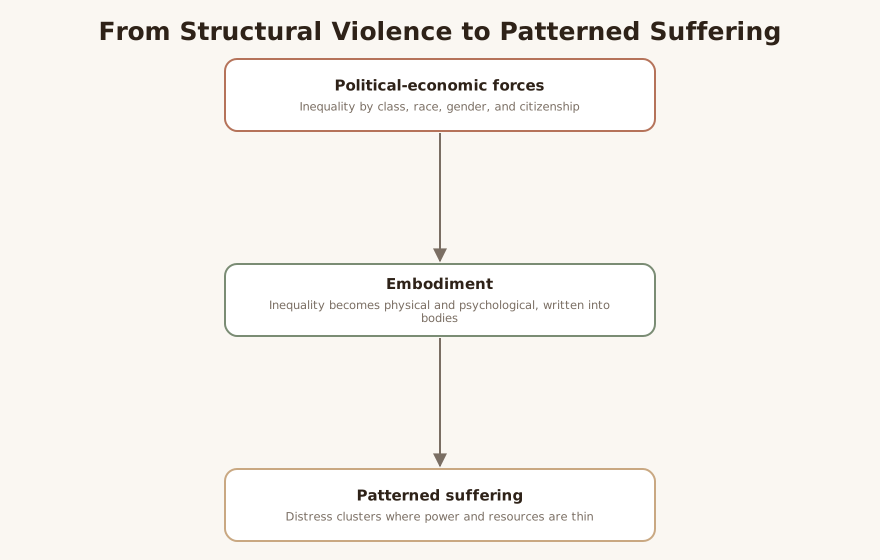
Suffering is patterned, not random. Farmer argued that structural forces account for much epidemic disease and that the distribution of suffering follows the contours of inequality — by class, race, gender, and citizenship. 6 2 Distress clusters where power and resources are thin. LLM
Embodiment. Inequality does not stay external; it becomes physical and psychological — written into bodies as disease, injury, chronic stress, and despair. 5 2 This is the clinical heart of CMA: the social becomes the somatic and the symptomatic. LLM
“Culture” can be an alibi. Farmer’s sharpest methodological warning is that cultural explanations, while valuable for understanding local meaning, can obscure power and history — “‘culture’ does not explain suffering; it may at worst furnish an alibi” for oppression. 5 Attributing a marginalized client’s distress to “their culture” risks naturalizing what is actually a product of exploitation or exclusion. 5
The same world, not separate worlds. CMA insists that affluence in one place and misery in another are connected within a single political-economic system, not parallel universes. 5 Clinically, this discourages exoticizing a refugee’s or immigrant’s circumstances as foreign and instead situates them in shared, traceable structures. LLM
Invisibility. Unlike direct violence, structural violence has no obvious perpetrator and is therefore easy to overlook or normalize, which is part of how it persists. 1 6
Interventions & Techniques
CMA is not a treatment, so it offers a stance and a set of analytic moves rather than session protocols. LLM In clinical practice these translate into:
- Structural case formulation. Add an explicit social-structural axis to the formulation: housing, immigration status, income, exposure to violence, discrimination, and access to care, alongside the usual biopsychosocial factors. 2 LLM
- Ethnographic listening. Borrowing Farmer’s practice, the clinician listens for the patient’s own account of how their life conditions produced their distress, rather than imposing a decontextualized diagnostic frame first. 4
- De-individualizing the narrative. Naming structural contributors (“this is a predictable response to sustained injustice, not a personal failing”) to counter internalized blame. 2 LLM
- Contextual, not culturalist, curiosity. Asking about meaning and practice while keeping power and history in view, so culture informs without becoming an alibi. 5
- “Structural healing” / pragmatic advocacy. Farmer’s profile describes a notion of structural healing — interventions aimed at the social conditions causing suffering — which in a therapy office takes the modest form of resource linkage, care coordination, and advocacy. 4 LLM
LLM-generated illustrative example (not a guideline): A clinician treating an asylum seeker with insomnia, hypervigilance, and intrusive memories documents both the trauma symptoms and the structural stressors — pending immigration case, work prohibition, housing precarity — and frames the symptoms as an understandable response to ongoing threat rather than a fixed disorder, while connecting the client to legal aid. LLM
Evidence Base
CMA’s maturity is best described as established as a theory — it is a widely taught, heavily cited explanatory and ethical framework with deep roots in peace studies and medical anthropology. 1 2 Galtung’s foundational paper and Farmer’s elaboration are canonical, and the concept of structural violence is standard vocabulary in global health and the social determinants literature. 1 2 7
It is important to be candid about what kind of evidence this is. LLM CMA is supported by extensive ethnographic, historical, and epidemiological argument linking inequality to disease and distress; it is not a manualized intervention with randomized controlled trials of “structural-violence-informed therapy,” and clinicians should not present it as one. LLM Its empirical strength lies in the well-replicated association between socioeconomic disadvantage, discrimination, and adverse mental-health outcomes — a body of evidence CMA helps interpret. 2 6 Its clinical value is in formulation and stance; its outcome claims are correspondingly modest and indirect. LLM
Populations & Indications
CMA is most clinically useful with populations whose presenting distress is heavily conditioned by structural disadvantage. LLM These include refugees and asylum seekers; immigrants navigating legal precarity and acculturation; people experiencing poverty; racial and ethnic minorities subject to discrimination; survivors of political violence, war, and torture; and people with chronic illness whose access to care is unequal. 4 6 For these groups, a formulation that ignores structure risks both inaccuracy and harm. 2
The framework is “indicated” not as a treatment but as an interpretive overlay on whatever evidence-based modality is appropriate — trauma-focused CBT, narrative therapy, interpersonal therapy, or supportive work — to ensure the social context is named and the client is not pathologized for a predictable response to adversity. LLM
Problems-for-Work
CMA informs work on a range of presentations where social conditions are causal or aggravating: LLM
- PTSD and Complex PTSD in survivors of political violence and forced migration, where the “trauma” is often ongoing and structural rather than a discrete past event. 4 LLM
- Depression and demoralization, where hopelessness tracks real, durable constraints; CMA helps distinguish demoralization (a response to genuine entrapment) from a primary mood disorder. 2 LLM
- Minority stress, acculturative stress, and discrimination-related distress, which CMA reframes as embodied effects of structural exclusion rather than individual maladjustment. 5 2
- Anxiety and adjustment disorder tied to precarity — immigration status, eviction risk, unsafe work. LLM
- Learned helplessness, reframed as a rational adaptation to environments that genuinely do not respond to effort. LLM
- Somatic symptom disorder, illuminated by the embodiment principle — distress that surfaces in the body when it cannot be safely voiced. 5 LLM
LLM-generated illustrative example (not a guideline): A clinician working with a client experiencing poverty who presents with chronic fatigue, low mood, and vague pain uses the embodiment lens to validate the somatic complaints as real while exploring how relentless economic stress is being carried in the body, pairing behavioral activation with concrete benefits navigation. LLM
Contraindications, Cautions & Cultural Humility
CMA is an analytic frame, so the cautions are about misuse, not physiological contraindication. LLM
- Do not let structure erase agency. Over-applying the lens can slide into a deterministic story in which the client has no efficacy; this can be demoralizing and clinically counterproductive. Hold structure and agency together. LLM
- Do not substitute analysis for treatment. Naming structural violence is not itself trauma processing, skills work, or symptom relief; it complements evidence-based care, it does not replace it. LLM
- Avoid the culturalist trap in reverse. Just as “culture” can be an alibi for ignoring power, “structure” can become a way to avoid the particular person in front of you; keep ethnographic attention to individual meaning. 5
- Mind your own position. Clinicians occupy structural positions too (often more privileged than their marginalized clients), and humility about that asymmetry is part of using the frame responsibly. 2 LLM
- Scope of practice. Advocacy and resource linkage are appropriate and consistent with “structural healing,” but clinicians should stay within ethical and professional bounds and not promise systemic change they cannot deliver. 4 LLM
Cultural humility here means holding curiosity about the client’s meaning system while keeping history and power in view, so that culture informs the formulation without supplying an excuse to overlook injustice. 5
Treatment-Plan Suggestions & SMART Objectives
| Goal | SMART objective (example) | Mechanism |
|---|---|---|
| Reduce self-blame for distress | Within 6 sessions, client will identify and verbalize at least 3 structural contributors to their distress and reframe one self-critical belief in structural terms, on 2 consecutive sessions | De-individualizing the narrative reduces internalized blame and demoralization 2 LLM |
| Lower symptom burden via context-informed trauma work | Over 12 sessions, client will reduce PTSD symptom score by a clinically meaningful margin using a trauma-focused modality contextualized to ongoing structural threat | Evidence-based trauma treatment delivered with accurate contextual formulation 4 LLM |
| Improve access to needed resources | Within 4 weeks, client will complete 2 concrete resource-linkage steps (e.g., legal aid, benefits, housing referral) with clinician support | “Structural healing” / pragmatic advocacy addresses material drivers of distress 4 LLM |
| Restore sense of agency within constraints | Within 8 sessions, client will identify 3 domains of realistic control and act on 1 weekly | Counteracts learned helplessness by separating genuine constraint from over-generalized helplessness LLM |
| Validate and reduce somatic distress | Over 8 sessions, client will link at least 2 somatic symptoms to identifiable stressors and use 1 regulation skill 3x/week | Embodiment framing validates somatic complaints while building coping 5 LLM |
| Strengthen coping with discrimination stress | Within 6 sessions, client will name discrimination-related stressors and rehearse 2 coping/response strategies | Reframes minority/discrimination stress as structural, supporting targeted coping 2 5 LLM |
| Reduce isolation | Within 8 weeks, client will engage with 1 community or peer support connected to shared structural experience | Collective context counters alienation, a core deprivation type 1 6 LLM |
Common Misconceptions
- “It’s a therapy you can deliver.” It is a theory and stance, not a manualized, outcome-tested intervention; treating it as a billable modality misrepresents it. LLM
- “Structural violence requires a perpetrator.” By definition it is harm built into the social order with no identifiable individual actor, which is what distinguishes it from direct violence. 1 6
- “It means individuals have no responsibility or agency.” The point is to correctly locate causes, not to deny agency; good use holds structure and agency together. LLM
- “Cultural sensitivity and structural analysis are the same thing.” Farmer’s argument is partly a critique of culturalism — culture can be an alibi that hides power, so the two frames can pull in opposite directions. 5
- “It’s just politics, not clinical.” The clinical payoff is concrete: more accurate formulation, less victim-blaming, and better engagement of marginalized clients. 2 LLM
Training & Certification
There is no certification in critical medical anthropology or in “structural-violence-informed therapy,” because it is an academic framework rather than a credentialed clinical modality. LLM Clinicians typically encounter it through graduate coursework in medical anthropology, public health, cultural psychiatry, and social-justice-oriented clinical training, and through primary readings — Galtung’s 1969 paper and Farmer’s writing being the standard entry points. 1 2 Continuing education on social determinants of health, structural competency, and cultural humility carries the framework into clinical settings; recorded scholarly symposia, such as the GHSM session on structural violence and health, are accessible introductions. 7 LLM
Key Terms
- Structural violence — avoidable harm produced by social structures that block fundamental human needs, with no single identifiable perpetrator. 1 6
- Direct (personal) violence — harm with a visible actor, contrasted with structural violence. 1 6
- Embodiment — the process by which inequality becomes physical and psychological reality in the body. 5
- Political economy of health — the study of how economic and political systems pattern the distribution of illness and care. LLM
- Culture-as-alibi — Farmer’s warning that cultural explanation can obscure power and excuse oppression. 5
- Structural healing — interventions aimed at the social conditions that cause suffering. 4
- Ethnographic listening — attending closely to the patient’s own account of how their conditions produced their distress. 4
Resources & Further Reading
▶ Watch — a video introduction to this concept:
- Violence, Peace, and Peace Research (Galtung, 1969) 1
- An Anthropology of Structural Violence (Farmer, 2004) 2
- Unclouded Judgment — Global Health and the Moral Clarity of Paul Farmer (NEJM) 3
- The Intersection of Anthropology and Medicine — Paul Farmer profile (PMC) 4
- Explaining Difference: “Culture,” “Structural Violence,” and Medical Anthropology (University of Washington) 5
- Structural violence (Wikipedia) 6
- GHSM 150th Symposium: Structural Violence & Health (video) 7
Reflective / Supervision Questions
- In my last formulation of a marginalized client, did I name the structural contributors to their distress, or did I default to decontextualized diagnosis? LLM
- Where might I be using “culture” as an alibi that obscures power, history, or injustice in a client’s story? 5
- Am I holding structure and agency together, or has the structural frame tipped into a deterministic narrative that leaves the client without efficacy? LLM
- What is my own structural position relative to this client, and how does that asymmetry shape the alliance? 2 LLM
- For this case, what would modest “structural healing” look like within my scope — and have I taken it? 4 LLM
- Am I letting structural analysis substitute for delivering the actual evidence-based treatment the client needs? LLM