
Type & Discipline
Structural competency is a clinician-training framework, not a discrete psychotherapy modality or a manualized intervention LLM. It originated in medicine and psychiatry education as a proposed paradigm shift in how health professionals are taught to address stigma and health inequality 1. It belongs to the broader family of health equity and social medicine, drawing on public health, social science, the medical humanities, and critical race studies 1. For a psychotherapist, it functions less as a technique applied to a client and more as an analytic lens and stance that reorganizes how you formulate a case, what you attribute symptoms to, and what counts as a legitimate target of intervention LLM.
The framework was first articulated in a 2014 paper in Social Science & Medicine and has since been elaborated into curricula and a case-based book spanning mental health and general medicine 12. Its central premise is that many phenomena clinicians call symptoms, attitudes, or diseases are in part the downstream effects of upstream structural decisions 1.
Creators & Lineage
Structural competency was coined and theorized by psychiatrists Jonathan Metzl, of Vanderbilt University, and Helena Hansen, then at New York University and the Nathan Kline Institute, in their 2014 article 1. Both are physicians with social-science training, and the framework reflects that hybrid lineage, deliberately importing methods from outside clinical medicine 1.
The framework’s most direct ancestor is cultural competency, the rubric that dominated U.S. medical education from roughly the 1980s onward for addressing cross-cultural clinical encounters 14. Metzl and Hansen position structural competency as a corrective extension of that tradition rather than a repudiation of it 1. Other intellectual roots include the social determinants of health literature, the concept of structural violence developed in social medicine, and critical race scholarship on institutional racism 14. The authors explicitly invoke civil-rights activist Stokely Carmichael’s 1968 argument that racism is embedded not in individual beliefs but in the functions of social structures and institutions such as zoning laws, schools, and courts 1. They also connect to the medical-education concept of “critical consciousness,” which places medicine in social, cultural, and historical context 1.
Core Principles
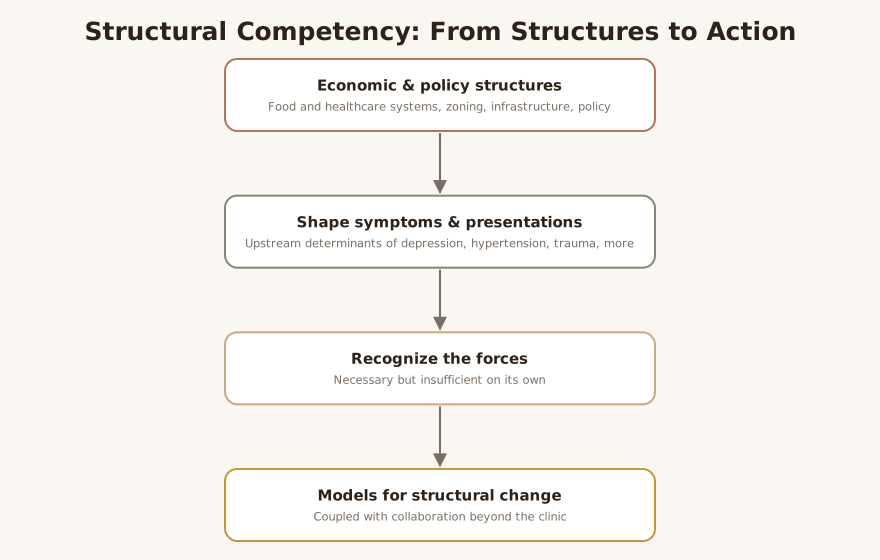
The organizing claim is that stigma and health inequality are not primarily produced inside the individual clinical encounter, even though they are enacted there 1. If that is true, then training that focuses only on the dyad — the doctor and the patient, the therapist and the client — will systematically miss the structural causes that generated the presentation in the first place 1. The principle reframes a host of clinically defined problems — depression, hypertension, obesity, trauma, psychosis, medication “non-compliance” — as having upstream determinants in food and healthcare delivery systems, zoning, infrastructure, and policy 1.
A second principle is that recognizing these forces is necessary but insufficient; recognition must be coupled with models for structural change and collaboration beyond the clinic 1. Metzl and Hansen note the bind in which clinicians find themselves: physicians have never known more about how social systems produce disease, yet many work in systems that invest little in correcting those inequities, and most feel unprepared to meet patients’ social needs 1. A third principle distinguishes the framework from cultural competency by asking why disparities exist at the institutional level rather than only how to navigate cultural difference sensitively 45.
Interventions & Techniques
Because this is a competency framework rather than a session protocol, its “techniques” are five trained skills the authors describe as core competencies 1.
-
Recognizing the structures that shape clinical interactions — learning to see how institutions, policies, neighborhoods, and economies produce the presentation in the room 14.
-
Developing an extra-clinical language of structure — acquiring vocabulary from public health, social science, and policy so that structural forces can be named and discussed rather than left invisible 14.
-
Rearticulating “cultural” formulations in structural terms — translating what might be coded as a cultural trait (for example, “mistrust” or “non-adherence”) into structural drivers such as food deserts, lack of transportation, or under-resourced clinics 14.
-
Observing and imagining structural interventions — identifying barriers and benchmarks over time and envisioning interventions, often collaborative and extra-clinical, that address structural health issues; the authors point to examples such as medical-legal partnerships and research-based health activism 12.
-
Developing structural humility — the trained ability to recognize the limits of the framework itself, to treat structural readings as the beginning of conversations rather than definitive interpretations, and to position the clinician as collaborator and listener, not master of complex social systems 1.
LLM-generated illustrative example (not a guideline): A clinician working with a client who repeatedly “no-shows” might, applying skill 3, reframe the pattern from “ambivalence about treatment” to a structural problem: the client’s shift work and unreliable bus route make a 2 p.m. appointment nearly impossible. The intervention shifts from confronting motivation to flexible scheduling and a warm referral to a transportation-assistance program. LLM
Evidence Base
The evidence base for structural competency is best described as emerging rather than established LLM. The framework is conceptual and pedagogical in origin; the 2014 paper is a theory and education proposal, not an outcome trial 1. Subsequent work has produced curricula for medical students, residents, and interprofessional teams, indicating uptake in training settings 6. A case-based book described as the first collection of case studies on structural competency demonstrates real-world implementation — including medical-legal partnerships at a children’s hospital and integrated degree programs — but represents implementation experience rather than controlled effectiveness data 2.
Honest framing for clinicians: there is broad face validity and growing curricular adoption, but the literature is dominated by conceptual articles, educational descriptions, and case studies rather than randomized or longitudinal patient-outcome studies 26. The framework’s own fifth competency, structural humility, anticipates this limitation by insisting on awareness of medical education’s realistic goals and endpoints 1. Practitioners should adopt it as a defensible orienting framework while recognizing that its causal claims about improving patient outcomes are not yet supported by a mature outcomes literature LLM.
Populations & Indications
Structural competency is most directly indicated for work with populations whose presentations are heavily shaped by structural disadvantage: marginalized communities, low-income populations, racial and ethnic minorities, and immigrants navigating unfamiliar systems 12. The framework’s examples center on patients living in food deserts, neighborhoods without gyms or sidewalks, and under-resourced care settings 1.
Critically, the framework also takes clinicians and trainees themselves as a target population, because its core intervention is the education of practitioners 16. It is relevant to any patient embedded in a healthcare system, since structural forces — insurance design, clinic resourcing, time pressure — shape encounters across the economic spectrum, including affluent patients 1. For psychotherapists, indications cluster around presentations where social and economic determinants are doing meaningful clinical work and a purely intrapsychic formulation would be incomplete LLM.
Problems-for-Work
The framework reorganizes how a clinician understands several common problems-for-work.
-
Health disparities and social determinants of mental health. Rather than treating disparities as patient-level traits, the clinician locates them in institutions and conditions that distribute health-related resources 1.
-
Barriers to care. Missed appointments, “non-adherence,” and disengagement are reframed as structural barriers — transportation, work schedules, cost — rather than character or motivation 1.
-
Mistrust of healthcare. The framework reads mistrust as a rational response to histories and ongoing realities of structural racism and institutional harm, not as an individual deficit 31.
-
Stigma. Metzl and Hansen argue stigma is enacted in encounters but produced by institutions, markets, and delivery systems 1.
-
Minority stress and chronic stress. The framework connects to research showing how high-stress, resource-poor environments produce lasting risk factors, supporting a structural reading of chronic stress burdens 1.
LLM-generated illustrative example (not a guideline): For a client whose persistent hypervigilance is framed in intake as “generalized anxiety,” a structurally competent formulation would also ask whether housing insecurity and exposure to neighborhood violence are sustaining the physiology — informing both the therapy plan and a referral to housing advocacy. LLM
Contraindications, Cautions & Cultural Humility
There are no medical contraindications to a framework, but there are important cautions in application LLM. The first is the risk of structural reductionism — swinging so far toward structural explanation that the clinician overlooks the client’s individual agency, internal world, or treatable intrapsychic and biological factors; the framework is meant to add to, not replace, attention to the individual encounter 1. The second caution is that “prescribing” food or services can paradoxically reinforce medical authority while requiring networks and skill sets clinicians rarely possess, and that medicalizing housing or urban planning can smuggle in classist notions of health 1.
Cultural humility is structurally encoded in the fifth competency: structural humility holds that the Other always lies beyond the comprehension of the self, that the clinician’s reading is not the definitive interpretation, and that structural analysis opens conversations rather than closing them 1. Applied honestly, this means inviting the client’s own account of the forces shaping their life rather than imposing a structural narrative on them LLM. Clinicians should also avoid using structural framing to abdicate clinical responsibility or to imply that nothing can be done within the dyad while structures remain unchanged LLM.
Treatment-Plan Suggestions & SMART Objectives
| Goal | SMART objective (example) | Mechanism |
|---|---|---|
| Reduce care-access barriers | Within 4 weeks, identify the top 2 structural barriers to attendance and implement one accommodation (flexible scheduling or telehealth), raising attendance to 80% over 8 weeks | Rearticulating “non-adherence” as structural barriers 1 |
| Build a structural formulation | By session 3, co-construct with the client a written formulation naming at least 2 structural determinants of the presenting problem | Recognizing structures shaping the encounter 1 |
| Strengthen extra-clinical resources | Within 6 weeks, complete one warm referral to a legal, housing, or food-assistance resource and confirm linkage | Observing/enacting structural interventions 12 |
| Address mistrust collaboratively | Over 8 weeks, client reports a 2-point increase on a working-alliance check-in after clinician validates structurally rooted mistrust | Reframing mistrust as rational response to structural harm 3 |
| Reduce chronic-stress load | Within 12 weeks, reduce one modifiable environmental stressor via resource linkage and track self-rated stress weekly | Linking chronic stress to resource-poor environments 1 |
| Practice structural humility | Each session, elicit and document the client’s own account of structural forces before offering the clinician’s reading | Developing structural humility 1 |
| Support self-advocacy | Within 8 weeks, client independently navigates one system task (benefits, scheduling) using skills rehearsed in session | Building agency alongside structural analysis LLM |
Common Misconceptions
A frequent misconception is that structural competency is simply a renamed or “upgraded” cultural competency; in fact, it shifts the unit of analysis from the individual encounter to the institutions, policies, and economies surrounding it 15. A related error is treating it as anti-cultural — Metzl and Hansen build on cultural competency’s gains and credit it with introducing diversity and stigma into clinical decision-making 1.
Another misconception is that the framework is a therapy modality with its own session structure; it is a competency set and analytic stance applied across modalities LLM. Some assume that adopting a structural lens means the clinician must personally fix structural problems; the framework instead emphasizes collaboration, coalition, and humility about the limits of clinical expertise 1. Finally, the claim that structural framing excuses individual responsibility misreads it: recognition of structure is meant to be coupled with action and with continued attention to the person in the room 1.
Training & Certification
There is no licensing body or formal certification in structural competency LLM. Training occurs primarily through medical and health-professions education, including published curricula designed for medical students, residents, and interprofessional teams 6. Programs commonly integrate coursework on social and economic conditions of health with community site visits and partnerships, as in the Vanderbilt medicine, health, and society model and medical-legal partnership programs 2. Self-directed entry points include the foundational 2014 paper and the case-based book, both of which lay out the five competencies and worked examples 12. For practicing therapists, development is largely a matter of incorporating the five skills into supervision, case formulation, and continuing education rather than pursuing a credential LLM.
Key Terms
- Structural competency — the trained ability to discern how phenomena defined clinically as symptoms, attitudes, or diseases also reflect upstream structural decisions 1.
- Structural humility — the trained recognition of the limits of structural analysis and of one’s own interpretation 1.
- Structural violence — systemic institutional stigmatization and marginalization operating above the level of individuals 1.
- Cultural competency — the trained ability to identify cross-cultural expressions of illness and counteract marginalization, the predecessor framework 1.
- Social determinants of health — the social, economic, and physical conditions that shape health before patients reach care 5.
- Extra-clinical language of structure — vocabulary drawn from public health and social science used to name structural forces 1.
- Structural racism — racism embedded in the functions of institutions and the structure of medical knowledge itself 3.
Resources & Further Reading
▶ Watch — a video introduction to this concept:
- Metzl & Hansen (2014), Structural competency: Theorizing a new medical engagement with stigma and inequality (Social Science & Medicine)
- Structural Competency in Mental Health and Medicine: A Case-Based Approach (PMC review)
- Structural Competency Meets Structural Racism (AMA Journal of Ethics)
- Structural competency (Wikipedia)
- Pushing Beyond ‘Cultural Competency’ to ‘Structural Competency’ in Medical Education (Princeton RRAPP)
- Structural Competency: Curriculum for Medical Students, Residents, and Interprofessional Teams (MedEdPORTAL)
Reflective / Supervision Questions
- When I formulate a “non-adherent” or “mistrustful” client, how much of that picture is structural, and would the client describe the forces in their life the same way I do? LLM
- Which of the five competencies is weakest in my current practice, and what is one concrete way to strengthen it this quarter? 1
- Where am I at risk of structural reductionism — losing sight of the individual’s agency, inner world, or treatable clinical factors — and where am I at risk of ignoring structure entirely? LLM
- What extra-clinical partnerships (legal, housing, food, transportation) exist in my catchment area, and do I know how to make a warm referral? 2
- How do I practice structural humility — treating my structural reading as the start of a conversation rather than the definitive interpretation of my client’s life? 1