
Type & Discipline
Behavioral Activation (BA) is a structured, time-limited psychotherapy for depression rooted in clinical psychology and the behavior-therapy tradition 1. It sits within the broader cognitive-behavioral family but is distinctive in that it works almost entirely at the level of overt behavior and its environmental consequences, rather than targeting maladaptive thoughts directly 3. The American Psychological Association’s Division 12 (Society of Clinical Psychology) lists BA as a research-supported treatment for depression with strong empirical support 1. In practice, BA can function either as a standalone treatment or as the activation component embedded within a fuller course of cognitive behavioral therapy 4.
The defining feature of the discipline is its functional-analytic stance: behavior is understood not by its form but by its function within a given context, and treatment proceeds by changing the relationship between what a client does and what follows from doing it 3. This places BA firmly in the lineage of operant conditioning and applied behavior analysis while keeping it accessible to generalist clinicians 4.
Creators & Lineage
The conceptual seed of BA predates its modern packaging. In the 1960s and 1970s, Charles Ferster and Peter Lewinsohn articulated a behavioral model of depression in which low mood follows from a reduction in response-contingent positive reinforcement, meaning that depressed people receive too little reward for the things they do, and so do progressively less 3. Lewinsohn’s early activity-scheduling work was the direct ancestor of contemporary BA 6.
The modern resurgence traces to Neil Jacobson and colleagues, whose component analysis of cognitive therapy in the 1990s found that the behavioral-activation component alone performed comparably to the full cognitive package, prompting a deliberate “return to contextual roots” 3. Jacobson, with Christopher Martell and Sona Dimidjian, developed this into a coherent, manualized contextual treatment that emphasizes function, avoidance, and idiographic activity rather than mood-dependent action 3. Martell, Dimidjian, and Ruth Herman-Dunn’s clinician’s guide is the standard contemporary reference for this version of the model 4. A parallel, more streamlined protocol — Brief Behavioral Activation Treatment for Depression (BATD), developed by Carl Lejuez and Derek Hopko — emerged around the same period and is widely used in brief and primary-care formats 5. These two strands share a behavioral spine while differing in length and structure 5.
Core Principles
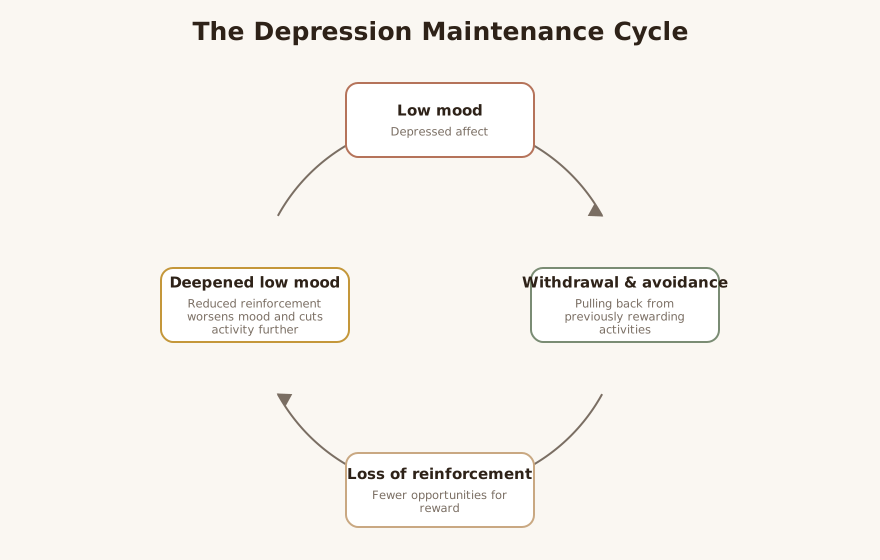
The central principle is that depression is maintained, not merely accompanied, by a self-reinforcing cycle of inactivity and avoidance 6. As mood drops, people withdraw from previously rewarding activities; withdrawal removes opportunities for reinforcement; loss of reinforcement deepens low mood, which further reduces activity 6. BA aims to break this loop from the outside in, by changing behavior first and allowing mood to follow 4.
A second principle is the primacy of function over form 3. The same observable behavior — lying in bed, for instance — may be adaptive rest for one client and reinforced avoidance for another, so the clinician analyzes the antecedents and consequences of behavior rather than judging the behavior itself 4. Closely related is the concept of avoidance, which BA construes broadly to include not only overt escape but also rumination, procrastination, and “shutting down,” all of which provide short-term relief while entrenching the depressive cycle 4.
A third principle is action precedes motivation 4. BA explicitly reverses the intuitive sequence in which clients wait to feel motivated before acting; instead, clients are coached to act according to a plan or to their values regardless of current mood, on the expectation that engagement, rather than feeling, will be the engine of change 4. This “outside-in” logic is one of the few things every BA protocol shares 6.
LLM-generated illustrative example (not a guideline): A client says she will resume seeing friends “once I feel up to it.” The BA clinician gently reframes this — the depression has made “feeling up to it” the very thing that will not arrive on its own, so the plan is to schedule one short, low-stakes contact and let the doing precede the wanting LLM.
Interventions & Techniques
The core procedural toolkit is small and learnable 7. Treatment typically opens with a clear behavioral rationale and psychoeducation about the activity-mood cycle, so the client understands why doing more, especially when unmotivated, is the intervention 7. Clinicians then introduce activity monitoring: the client records daily activities alongside ratings of mood, mastery, and pleasure, generating an idiographic map of which activities are depleting and which are reinforcing 4.
From this baseline, the clinician and client move to activity scheduling, planning specific, concrete, graded activities and assigning them as between-session tasks 4. Activities are selected to increase contact with positive reinforcement and to align with the client’s values and longer-term goals rather than to chase momentary pleasure 4. Tasks are graded from easier to harder so that early successes build behavioral momentum 7.
Functional analysis runs throughout: the clinician helps the client identify triggers, the behavior, and its consequences, often using a TRAP-to-TRAC heuristic in which a Trigger-Response-Avoidance Pattern is replaced by Trigger-Response-Alternative Coping 4. Skills training, problem-solving, and attention to routine regulation (sleep, meals, structure) are added as needed 4. Throughout, the clinician works to shift the client from mood-dependent behavior toward goal- and values-dependent behavior 4.
LLM-generated illustrative example (not a guideline): A client’s activity log shows that scrolling on the phone in bed reliably precedes the lowest mood ratings of the day. Rather than banning the phone, the clinician and client design a competing alternative — a ten-minute morning walk scheduled at the same trigger point — and track whether mood, mastery, and pleasure shift over the following week LLM.
Evidence Base
BA’s evidence base for adult depression is mature and among the strongest in the behavioral literature, which is why it is classified as an established, research-supported treatment 1. Its empirical credibility was bolstered by the component-analysis tradition, in which the activation component performed comparably to full cognitive therapy, and by subsequent randomized trials and reviews supporting its efficacy 3. Narrative and systematic reviews of the empirical literature describe BA as effective and durable for depression while noting heterogeneity in how protocols are defined and delivered 5.
Honest appraisal of maturity matters here. The evidence is strongest and most established for depression in adults, where BA is broadly comparable to other frontline psychotherapies 1. Evidence for transdiagnostic application is more recent and less settled: a meta-analysis examining outcomes beyond depression found benefits for depression with smaller, less mature effects on anxiety and on activation itself, indicating that anxiety and transdiagnostic use remain an emerging rather than established indication 2. Clinicians should therefore present BA to clients as a well-supported depression treatment, and as a promising but still-developing option for comorbid anxiety and other targets 2. A practical strength reinforcing its evidence base is that BA’s relative simplicity allows delivery by a wider range of providers, supporting feasibility in routine and lower-resource settings 5.
Populations & Indications
BA has been studied and applied across a wide range of populations 5. The primary indication is adult depression, including major depressive disorder and persistent depressive disorder 1. The model has been adapted for adolescents and for older adults, where its concrete, behavioral focus and lower cognitive load can be advantages 5. It has been delivered to people with chronic physical illness, where activity loss and demoralization frequently co-occur, and to veterans, a population in which BA has been disseminated within integrated care systems 5.
Because the procedures are relatively brief and teachable, BA is especially well suited to primary care and stepped-care settings, where it can be delivered by non-specialist or supervised providers within short formats such as BATD 5. This deliverability is part of why it is favored where access to specialist psychotherapy is limited 5.
Problems-for-Work
BA targets the behavioral machinery of depression directly, which makes it a strong fit for several presenting problems 4. Behavioral inactivity and low motivation are the prototypical targets: the activity-scheduling and graded-task procedures are designed precisely to restart engagement when amotivation has stalled it 4. Anhedonia is addressed by deliberately rebuilding contact with reinforcing, mastery- and pleasure-yielding activity rather than waiting for enjoyment to return spontaneously 6.
Avoidance behavior — whether overt withdrawal, procrastination, or rumination treated as a form of avoidance — is mapped through functional analysis and replaced with alternative coping 4. Social withdrawal is countered through scheduled, graded re-engagement with relationships and roles that supply social reinforcement 4. Depressive rumination is reframed not as a thought to be disputed but as an avoidant behavior to be interrupted with an incompatible activity 4. For comorbid anxiety, BA’s approach-oriented, anti-avoidance stance overlaps mechanistically with exposure, though clinicians should remember the supporting evidence here is less mature than for depression 2.
LLM-generated illustrative example (not a guideline): A client with depression and social anxiety has stopped answering calls from his sister. The clinician frames call-avoidance as both depressive withdrawal and anxious escape, and schedules a graded sequence — first a text, then a five-minute call — so that re-engagement doubles as informal exposure LLM.
Contraindications, Cautions & Cultural Humility
BA has few absolute contraindications, but several cautions warrant attention 4. The clinician must distinguish genuine reinforcement-poor inactivity from adaptive rest, from physical limitation, or from medical fatigue, so that “activation” never becomes pressure to override real constraints 4. With clients who have chronic illness or pain, activity scheduling must be calibrated to physical capacity in collaboration with the client 5. Acute risk — significant suicidality, psychosis, or severe agitation — calls for appropriate risk management and may require more intensive care before or alongside BA LLM.
Cultural humility is essential because what counts as rewarding, valued, or socially reinforcing is culturally and individually specific 4. Activity menus drawn from one cultural frame may be irrelevant or alienating to a given client, so values and reinforcers must be elicited from the client rather than assumed 4. The clinician should also attend to material and structural realities: a client whose inactivity reflects unsafe housing, discrimination, caregiving load, or poverty may have an environment that genuinely offers little reinforcement, and pushing “activation” without acknowledging context can be invalidating LLM. Functional analysis, done well, is itself a vehicle for cultural humility because it grounds the plan in the client’s own contingencies 3.
Treatment-Plan Suggestions & SMART Objectives
The following table offers example goals, SMART-formatted objectives, and the behavioral mechanism each one targets; all are illustrative and should be individualized LLM. The mechanisms reflect BA’s core model of reinforcement and avoidance 4.
| Goal | SMART objective (example) | Mechanism |
|---|---|---|
| Re-establish daily structure | Complete a daily activity log rating mood, mastery, and pleasure on at least 6 of 7 days for 2 weeks | Self-monitoring builds an idiographic map of reinforcing vs. depleting activity 4 |
| Increase rewarding activity | Schedule and complete 3 values-consistent activities per week for 4 weeks | Restores response-contingent positive reinforcement 3 |
| Reduce avoidance | Identify one recurring avoidance pattern and replace it with a planned alternative coping response 4 times per week | Interrupts the negative-reinforcement cycle (TRAP to TRAC) 4 |
| Rebuild social contact | Initiate one graded social contact per week, increasing duration over 6 weeks | Re-accesses social reinforcement and counters withdrawal 4 |
| Counter rumination | Use a pre-planned incompatible activity within 10 minutes of noticing rumination, logged daily | Treats rumination as avoidance and disrupts it behaviorally 4 |
| Act independent of mood | Complete 80% of scheduled activities regardless of mood rating across 3 weeks | Shifts from mood-dependent to goal-dependent behavior 4 |
| Reconnect with values | Define 2 life-area values and link each week’s activities to them for 4 weeks | Orients activation toward durable meaning, not momentary pleasure 4 |
Common Misconceptions
A frequent misconception is that BA is simply “keeping busy” or scheduling pleasant events for their own sake 6. In fact, the target is function — increasing contact with reinforcement and reducing avoidance — not activity volume, and a relaxing activity can be as therapeutic as an energetic one if it serves the right function 4. A second misconception is that BA is a watered-down or merely preparatory part of CBT; the component-analysis evidence indicates it can stand on its own 3.
A third error is treating BA as cognitive restructuring in disguise 3. BA deliberately does not require the client to challenge or change thoughts; it works on behavior and context, which is precisely what distinguishes it from cognitive therapy 3. Finally, clinicians sometimes assume BA tells clients to “wait until they feel motivated,” when the model insists on the opposite — action precedes motivation 4.
Training & Certification
BA is intentionally learnable, and a key practical claim of the approach is that its relative simplicity allows it to be delivered effectively by a broad range of providers, including supervised non-specialists, which is central to its dissemination in primary and stepped care 5. There is no single mandatory credential to practice BA LLM. Competence is typically built through the standard clinician’s guide and manual, structured workshops, and supervision 4.
Freely available introductory resources, such as the University of York’s introductory course and accessible explainers, lower the barrier to initial learning, though independent practice still benefits from supervised application and fidelity monitoring 7. For clinicians, the practical path is to read the Martell, Dimidjian, and Herman-Dunn guide, practice the core procedures under supervision, and use measurement to track activation and mood over the course of treatment 4.
Key Terms
- Response-contingent positive reinforcement — reward that follows directly from a person’s own behavior; its loss is the proposed driver of depression 3.
- Avoidance — broadly defined to include withdrawal, procrastination, and rumination, all of which relieve distress short-term but maintain depression 4.
- Functional analysis — examining the antecedents and consequences of a behavior to understand its function rather than its form 3.
- Activity monitoring — daily recording of activities with mood, mastery, and pleasure ratings 4.
- Activity scheduling — planning specific, graded, values-consistent activities as between-session tasks 4.
- TRAP / TRAC — a heuristic for replacing a Trigger-Response-Avoidance Pattern with Trigger-Response-Alternative Coping 4.
- Mood-dependent vs. goal-dependent behavior — acting on the basis of current feeling versus acting on a plan or value 4.
- BATD — Brief Behavioral Activation Treatment for Depression, a streamlined protocol 5.
Resources & Further Reading
▶ Watch — a video introduction to this concept:
- Behavioral Activation for Depression — APA Division 12 (Society of Clinical Psychology)
- Looking beyond depression: a meta-analysis of the effect of behavioral activation on depression, anxiety, and activation (Psychological Medicine)
- Behavioral Activation Treatment for Depression: Returning to Contextual Roots (Jacobson, Martell & Dimidjian, 2001)
- Behavioral Activation for Depression, Second Edition: A Clinician’s Guide (Martell, Dimidjian, Herman-Dunn)
- A Narrative Review of the Empirical Literature of Behavioral Activation Treatment for Depression (PMC)
- Explainer: what is behavioural activation for depression? (The Conversation)
- Introduction to behavioural activation for depression (University of York free course)
Reflective / Supervision Questions
- For a current client, can you articulate the function of their most prominent inactive or avoidant behavior, rather than just its form? LLM
- Where might you be implicitly endorsing “wait until you feel motivated,” and how would you reframe that toward action-precedes-motivation? LLM
- How have you elicited this client’s reinforcers and values, rather than offering a generic menu of pleasant activities? LLM
- When a client’s environment genuinely offers little reinforcement (poverty, discrimination, caregiving load), how do you keep activation from becoming invalidating? LLM
- Are you presenting BA’s evidence honestly — well established for depression, still emerging for comorbid anxiety and transdiagnostic targets? 2
- How are you measuring activation and mood over time to verify that the behavioral cycle is actually shifting? 4