
Type & Discipline
Critical Race Theory (CRT) is a theoretical framework rather than a treatment protocol, and it did not originate in psychology or counseling at all 2. It emerged from legal studies in the United States, where scholars used it to analyze how law and legal institutions produce and sustain racial hierarchy 1. Methodologically it belongs to the family of critical theory, sharing intellectual machinery with critical legal studies, feminist theory, and the broader tradition that interrogates how power, knowledge, and social structure interact 6. Over the past three decades CRT has crossed disciplinary boundaries into education, public health, and clinical and social work, where it now functions as an analytic lens for understanding race-related distress 5. For the practicing therapist, the most accurate framing is this: CRT is an established framework that informs case conceptualization and the therapeutic stance, but it is not itself a billable, manualized modality LLM. Its clinical value lies in helping clinicians see racism as a chronic, structural stressor rather than only an interpersonal aberration 4.
Creators & Lineage
CRT was formally organized in 1989 at the first Workshop on Critical Race Theory, though its intellectual roots reach into the critical legal studies movement of the 1960s and 1970s 1. The legal scholar Derrick Bell is widely regarded as a founding figure, and his concept of “interest convergence” — the idea that gains for marginalized groups occur mainly when they also serve dominant-group interests — remains one of the framework’s signature contributions 6. Kimberlé Crenshaw, who coined the term “intersectionality,” and Richard Delgado, a prolific architect of the field, are likewise central figures, alongside scholars such as Mari Matsuda and Patricia Williams 2. Unlike critical legal studies scholars, who tended to reject law itself, CRT theorists held that some laws and legal reforms had genuinely helped oppressed people, even while the system reproduced inequality 1. For clinicians, the relevant lineage runs through intersectionality, liberation psychology, feminist therapy, and multicultural counseling — traditions that share CRT’s attention to context, power, and the validity of marginalized voices 5.
Core Principles
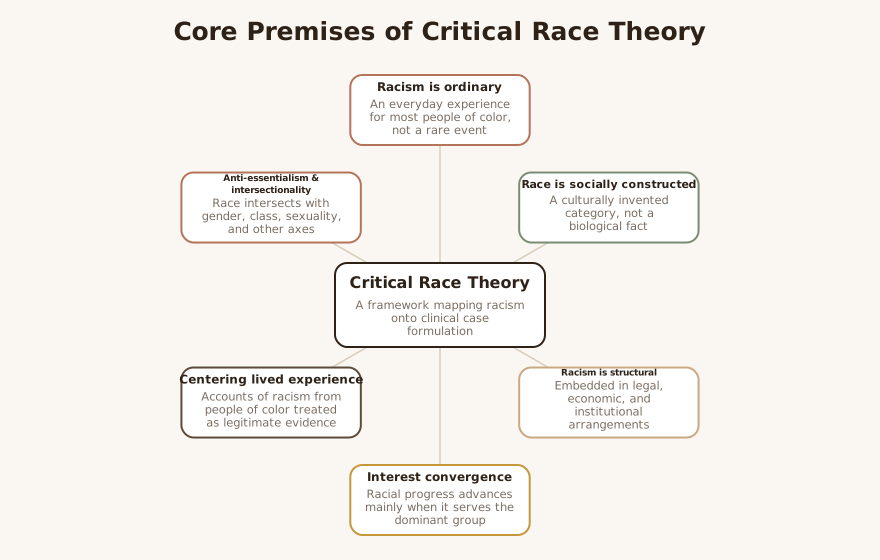
CRT rests on a small set of recurring premises that clinicians can map onto case formulation LLM. First, racism is “ordinary” — it is the everyday experience of most people of color rather than a rare, deviant event 2. Second, race is socially constructed: it is not a natural, biologically grounded feature but a culturally invented category that society creates and manipulates 1. Third, racism is structural and systemic, embedded in legal, economic, and institutional arrangements that create and maintain inequality between groups 1. Fourth, the framework advances “interest convergence,” holding that the dominant group tolerates or advances racial progress largely when it aligns with its own interests 6. Fifth, CRT centers the lived experience and knowledge of people of color, treating their accounts of racism as legitimate and analytically valuable evidence rather than anecdote 3. A sixth strand, anti-essentialism and intersectionality, insists that no person has a single, unitary identity and that race intersects with gender, class, sexuality, and other axes of experience 2. Together these principles shift the clinical question from “what is wrong with this person” toward “what has this person been navigating” LLM.
Interventions & Techniques
CRT does not prescribe session-by-session techniques the way a manualized therapy does, but it supplies a set of orienting practices that clinicians can integrate into established treatments LLM. The most directly transferable is counter-storytelling: the deliberate elicitation and validation of narratives that challenge the dominant or “majoritarian” account of how the world works 3. In a clinical context this looks like inviting a client to name, in their own words, experiences of racism that have been minimized or disbelieved, and treating those accounts as data rather than distortion 3. A second practice is naming structural attribution — helping a client distinguish self-blame from the influence of systemic conditions, which can reduce internalized oppression and demoralization 4. A third is intersectional formulation, in which the clinician maps how multiple identities jointly shape a presenting problem rather than reducing it to a single category 2. These practices are not therapy on their own; they are a stance and a set of inquiry habits delivered inside a recognized modality such as culturally responsive cognitive behavioral therapy or trauma-focused treatment LLM.
LLM-generated illustrative example (not a guideline): A Black adolescent presents with irritability and school refusal after repeated stops by campus security. A CRT-informed clinician validates the pattern as a real, repeated stressor rather than reframing it as oversensitivity, then uses counter-storytelling to help the client articulate the experience and structural cognitive work to separate “I am a problem” from “I am being treated as a problem.” LLM
Evidence Base
Honesty about maturity is essential here, and it cuts two ways LLM. As a framework, CRT is well established and influential: it has a defined founding history, a recognized body of foundational scholarship, and decades of application across law, education, and the social sciences 1. As a clinical treatment, however, CRT has no maturity at all, because it is not a treatment — there are no randomized controlled trials of “CRT therapy,” no outcome studies, and no efficacy data, because the framework was never designed to be operationalized as a standalone intervention LLM. What the clinical literature supports is the use of culturally responsive and antiracist principles, derived in part from CRT, as adjuncts to evidence-based modalities for race-related distress 4. Clinicians should therefore claim CRT as an informing lens, not as an evidence-based therapy, and should anchor measurable outcomes in the modality through which it is delivered LLM. It is also worth representing the framework neutrally: CRT has drawn substantive criticism, including the charge that it undervalues liberal ideals of neutrality and that it can interpret any racial inequity as proof of institutional racism 1. A clinician using CRT need not adjudicate those academic debates, but should hold its claims with appropriate epistemic humility LLM.
Populations & Indications
CRT-informed practice is most clearly indicated when a client’s distress is bound up with experiences of racism, marginalization, or systemic disadvantage 4. This includes racial and ethnic minorities broadly, and more specifically Black individuals, immigrants, and other people of color who present with race-related stressors 5. Adolescents of color are a particularly apt population, given that identity development and exposure to discrimination often intensify during this period LLM. Multiracial individuals may also benefit, because CRT’s anti-essentialist stance offers language for identities that resist single-category framing 2. The framework is indicated less by a specific diagnosis than by a clinical signal: the client’s suffering appears entangled with how the social world has positioned them by race LLM. It is not a substitute for diagnostic assessment, and a clinician should still evaluate for the full range of presenting conditions independent of the lens LLM.
Problems-for-Work
CRT is most useful for problems where the etiology or maintenance involves race-based social context LLM. Racial trauma and race-based traumatic stress are central indications: CRT’s premise that racism is ordinary and cumulative helps the clinician validate chronic, low-grade exposure as a genuine traumatic stressor rather than discounting it 2. Minority stress and discrimination-related distress map directly onto the framework’s structural-attribution work, which reframes ambient hostility as an environmental load rather than personal failing 4. Internalized oppression — the absorption of negative societal messages about one’s own group — is addressed through counter-storytelling that surfaces and contests the majoritarian narrative the client has internalized 3. Demoralization, the loss of hope and sense of agency, can lift when structural attribution restores a coherent account of why life has been hard LLM. CRT can also inform work with co-occurring PTSD, depression, anxiety, and identity disturbance, where racial context is a contributing factor, though the core treatment of these conditions should still follow established protocols LLM.
LLM-generated illustrative example (not a guideline): An immigrant client with depression repeatedly attributes workplace exclusion to personal inadequacy. The clinician integrates CRT-informed inquiry into behavioral activation, helping the client test the “I am not good enough” belief against a structural account of bias, which reduces self-blame and supports re-engagement at work. LLM
Contraindications, Cautions & Cultural Humility
There is no population for whom validating real experiences of racism is contraindicated, but there are clear cautions in how the lens is applied LLM. The first is imposition: a clinician should not assume that race is central to a given client’s distress or interpret a presentation through CRT against the client’s own framing, which would itself be a failure of cultural humility LLM. The second is over-attribution — explaining all suffering as structural risks obscuring treatable individual factors and can foster helplessness if not balanced with agency and coping LLM. The third is clinician positionality: CRT centers the lived knowledge of people of color, and a clinician should examine how their own racial identity, assumptions, and power shape the encounter 3. Cultural humility also means recognizing that CRT is one contested framework among several and presenting it without ideological pressure on the client 1. Finally, clinicians should be mindful that race intersects with other identities, so a single-axis application can flatten a person’s actual experience 2.
Treatment-Plan Suggestions & SMART Objectives
| Goal | SMART objective (example) | Mechanism |
|---|---|---|
| Reduce internalized oppression | Within 8 sessions, client will identify and reframe 3 internalized negative beliefs about their racial group, rated on a self-report log | Counter-storytelling contesting the majoritarian narrative 3 |
| Decrease self-blame for discrimination | Within 6 weeks, client will correctly attribute 2 recent discriminatory events to structural factors vs. personal failing in session | Structural attribution reduces internalized oppression 4 |
| Validate racial trauma | By session 4, client will narrate one previously minimized race-based experience and rate felt validation 7/10 or higher | Centering lived experience as legitimate evidence 2 |
| Reduce demoralization | Within 10 sessions, client will report a 30% improvement on a hope/agency measure | Coherent structural account restores meaning and agency LLM |
| Strengthen intersectional identity coherence | Within 12 weeks, client will articulate how 2+ identities shape their experience without single-category reduction | Anti-essentialist, intersectional formulation 2 |
| Build adaptive coping for minority stress | Client will practice and log 3 coping strategies for anticipated discrimination weekly for 4 weeks | Distinguishes environmental load from personal deficit 4 |
| Reduce discrimination-related anxiety symptoms | Within 8 sessions, client will lower GAD-7 score by 5 points while processing race-related stressors | CRT lens delivered within evidence-based CBT LLM |
Common Misconceptions
A frequent misconception is that CRT is a clinical therapy with its own techniques and evidence base; it is a legal and social-theory framework that clinicians adapt, not a manualized treatment 2. A second is that CRT claims race is biologically real and central; in fact it holds the opposite — that race is socially constructed rather than a natural biological category 1. A third is that CRT requires the clinician or client to adopt a fixed ideological position; the useful clinical move is to validate lived experience and structural context, not to enforce a worldview LLM. A fourth is the assumption that “interest convergence” or “systemic racism” are clinical diagnoses; they are analytic concepts that inform formulation, not assessment instruments 6. Finally, some clinicians assume CRT denies individual agency, when its structural attribution work is meant to be paired with restoring the client’s sense of coping and choice LLM.
Training & Certification
There is no licensing body, credential, or certification in “Critical Race Theory” for clinicians, because it is an academic framework rather than a regulated treatment LLM. Foundational competence comes from primary scholarship — most accessibly Delgado and Stefancic’s introductory text — and from CRT’s parent literatures in intersectionality and multicultural counseling 2. Practitioner-facing orientations, such as professional psychology association explainers, help translate the framework into clinical language 4. University library guides on antiracist praxis curate accessible readings and applications for those building competence 5. Because clinical delivery occurs through recognized modalities, the relevant certifications are in those therapies — for example, trauma-focused or culturally responsive CBT — supplemented by ongoing cultural-humility training and supervision LLM.
Key Terms
- Counter-story / counter-storytelling: A narrative that challenges the dominant account and centers the experiential knowledge of people of color as legitimate evidence 3.
- Majoritarian narrative: The taken-for-granted story of how the world works, told from the dominant group’s perspective, which counter-stories contest 3.
- Interest convergence: The principle that racial progress for marginalized groups occurs largely when it also benefits the dominant group 6.
- Social construction of race: The premise that race is a culturally invented category, not a natural biological fact 1.
- Systemic / structural racism: Racism embedded in laws and institutions that create and maintain inequality, beyond individual prejudice 1.
- Intersectionality: The idea, central to CRT, that identities such as race, gender, and class jointly shape experience and cannot be analyzed in isolation 2.
- Internalized oppression: A clinical target referring to the absorption of negative societal messages about one’s own group 4.
Resources & Further Reading
▶ Watch — a video introduction to this concept:
- Critical race theory | Tenets, History, Criticism (Britannica)
- Critical Race Theory: An Introduction (Delgado & Stefancic, NYU Press)
- Critical Race Methodology: Counter-Storytelling as an Analytical Framework (Solorzano & Yosso, 2002)
- What is Critical Race Theory? (Ohio Psychological Association)
- Critical Race Theory – Antiracist Praxis (American University Library guide)
- Critical race theory (Wikipedia)
- What Is Critical Race Theory (CRT)? (Britannica video)
Reflective / Supervision Questions
- How do I distinguish, in a given case, between distress driven by structural racial stressors and distress better explained by individual or familial factors? LLM
- When I apply a CRT lens, am I following the client’s own framing of their experience, or imposing an interpretation they have not endorsed? LLM
- How does my own racial identity and positionality shape what I notice, validate, or overlook in session? LLM
- Am I balancing structural attribution with the restoration of the client’s sense of agency and coping? LLM
- Within which billable, evidence-based modality am I delivering this lens, and are my documented objectives anchored there rather than in CRT as a procedure? LLM
- How do I hold CRT’s contested academic claims with appropriate humility while still validating my client’s lived experience? LLM