
Type & Discipline
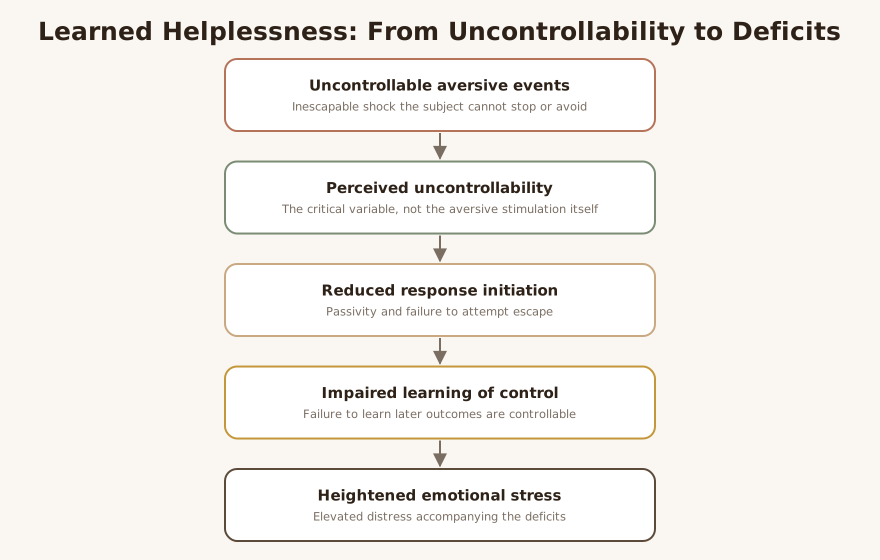
Learned helplessness is a theory in clinical and experimental psychology, not a treatment or a therapeutic technique LLM. It describes what happens when an organism is exposed to aversive events it cannot control: it stops trying to escape, learns new escape contingencies poorly, and shows heightened emotional distress, with these deficits carrying over into later, controllable situations 3. The model sits at the intersection of learning theory, the cognitive models of depression, and — in its most recent form — affective neuroscience, and it is one of the few constructs to span all three LLM. For clinicians, its value is less as a procedure you deliver than as a formulation lens: it gives a mechanistic vocabulary for the passivity, demoralization, and “why bother” stance that pervades depression, chronic trauma, and entrapping life circumstances LLM.
A feature that makes this theory unusual — and unusually instructive — is that its own originators eventually reversed its central claim LLM. The phenomenon was named for what animals were thought to learn (helplessness), but a half-century of neuroscience led Maier and Seligman to conclude that passivity is not learned at all; what is learned is the presence of control 1. That refinement, discussed throughout this article, is the theory’s most clinically important nuance, and a clinician who knows only the 1967 version is working from a model its authors have publicly corrected LLM.
Creators & Lineage
The phenomenon was discovered around 1967 by Martin E. P. Seligman, working at the University of Pennsylvania as an extension of his research on depression, together with Steven F. Maier and J. Bruce Overmier 4. Seligman and Maier observed it almost by accident while running Pavlovian conditioning studies on dogs and noticed that animals previously exposed to inescapable shock failed to escape later when escape was easy 2. The original publications framed the deficit as a learned expectation that outcomes are independent of responses 1.
The first major revision came in 1978, when Lyn Abramson, Martin Seligman, and John Teasdale reformulated the theory using attribution theory, shifting the explanatory weight from the objective uncontrollability of events to the causal explanations a person gives for them 42. This reformulated (attributional) version is the one most clinicians absorb in training, and it is the conceptual bridge from animal learning to human depression LLM. The lineage runs onward to the hopelessness theory of depression and, in a more applied direction, to Seligman’s later program of learned optimism, which treats explanatory style as something that can be retrained 2. The intellectual roots reach back into behaviorism and learning theory — the yoked-control experimental logic is pure operant-conditioning methodology — while the forward branches reach into cognitive behavioral therapy and positive psychology LLM.
The most recent and most consequential turn arrived in 2016, when Maier and Seligman published Learned Helplessness at Fifty: Insights from Neuroscience, integrating five decades of circuit-level findings and concluding that the original theory had the learning backwards 1.
Core Principles
The first principle, from the foundational work, is the triadic design and the uncontrollability effect 1. Three groups are compared: animals that can escape an aversive event (escapable), yoked controls that receive identical shock but cannot escape (inescapable), and a no-shock control; in the original studies about two-thirds of the inescapable group later failed to learn to escape, while roughly 90 percent of the escapable and no-shock groups learned easily 1. Because the escapable and no-shock groups performed equivalently, the critical variable was shown to be uncontrollability, not the aversive stimulation itself 1.
The second principle is the triad of deficits that uncontrollability produces: reduced initiation of responses, impaired learning that later outcomes are controllable, and heightened emotional stress 3. Hiroto’s human replications in the 1970s extended the effect beyond animals, showing that people exposed to uncontrollable noise subsequently performed worse than those who had control 34.
The third principle is the attributional reformulation 2. Whether and how widely helplessness generalizes depends on the causal explanation a person assigns to the bad event along three dimensions: internal versus external (is it me or the situation), stable versus unstable (will it last or pass), and global versus specific (does it touch everything or just this) 2. The most depressogenic pattern is the internal, stable, global attribution — “it’s me, it always will be, and it ruins everything” — which produces chronic, cross-situational helplessness and damaged self-esteem 32.
The fourth principle is the neuroscience reversal, and it is decisive 1. Maier and Seligman concluded that “passivity in response to shock is not learned” but is instead “the default, unlearned response to prolonged aversive events,” mediated by serotonergic activity in the dorsal raphe nucleus 1. What the organism actually learns, when events are controllable, is the presence of control: the medial prefrontal cortex detects controllability and inhibits the dorsal raphe, switching off the default passivity 1. In the authors’ framing, “there is nothing in the brain that is selectively turned on by a lack of control, only something that turns things off when there is the presence of control” 1. Learning control, once acquired, can even be carried forward as an expectation of control that buffers later uncontrollable stress 1.
Interventions & Techniques
The theory is not itself a procedure a therapist performs; it is a formulation and a rationale that several established interventions operationalize LLM. What it offers is a precise account of what to target — the perception of uncontrollability and the explanatory style that maintains it — and why certain techniques help LLM.
The most direct application is attributional retraining and cognitive restructuring within cognitive behavioral therapy 3. By identifying and challenging the internal, stable, global explanations a depressed client gives for setbacks, the clinician works to shift explanatory style toward the more contained external/unstable/specific attributions associated with resilience 32. This is the clinical embodiment of Seligman’s learned optimism: not forced positivity, but generating alternative explanations and disputing the automatic helpless interpretation 2.
A second application is behavioral activation and graded mastery experiences LLM. Because the original effect is produced by uncontrollability, arranging experiences in which the client’s actions do produce reliable, contingent outcomes directly contradicts the helpless expectation — and, in the neuroscience reading, exercises the prefrontal “control-detection” circuit that inhibits the default passivity 1. Even the modest, contingent successes of a structured activity schedule supply the “I acted, and it mattered” data the model says is curative LLM.
A third line, named in clinical accounts, includes trauma-focused approaches such as exposure therapy and EMDR for the trauma-linked variants, where uncontrollable aversive experience has installed durable passivity and avoidance 3. The unifying mechanism across all of these is the restoration of perceived and actual control LLM.
LLM-generated illustrative example (not a guideline): A client who has stopped applying for jobs after a layoff narrates each rejection as “I’m unemployable, I always fail, my whole life is a dead end” — an internal, stable, global attribution. The clinician pairs cognitive restructuring (generating the more specific, unstable explanation “this particular posting was a long shot in a bad market”) with a behavioral experiment (sending three tailored applications and tracking responses), so the client both reinterprets the past and gathers contingent evidence that action produces outcomes LLM.
Evidence Base
The maturity of this theory is established, and an honest account separates what is robust from what its own authors revised LLM. The core experimental phenomenon — that uncontrollability, not aversiveness per se, produces later passivity and learning deficits — has been replicated across species and demonstrated in humans, and it remains one of the more durable findings in experimental psychology 13. The attributional reformulation generated a large literature linking pessimistic explanatory style to depression and was operationalized in measurable, treatable constructs, giving it real clinical traction 2.
The contested part is not the existence of the phenomenon but its interpretation — and, as with LeDoux’s fear circuitry, the sharpest correction comes from the original authors 1. The 2016 review concluded that the 1967 theory misread the data: the brain’s default assumption is that control is absent, passivity is the unlearned response to prolonged adversity, and only the detection of control is genuinely learned 14. This is not a refutation of the clinical relevance of helplessness but a re-specification of mechanism, and it sharpens rather than weakens the treatment logic: interventions should aim to install or restore the experience of control rather than merely to “unlearn helplessness,” which was never separately learned in the first place 1. A fair clinician also notes the standing criticism that depression is more than learned helplessness — neurochemical, interpersonal, and developmental factors all contribute — and that some experimental participants verbally insisted effort mattered even while behaving helplessly, a gap between cognition and action the simple model does not fully explain 2.
Populations & Indications
The theory is most directly relevant to presentations organized around passivity, demoralization, and a collapsed sense of agency LLM. People with depression are the paradigm case, since the helplessness syndrome — lowered response initiation, anhedonia, and hopeless explanatory style — maps onto the diagnostic picture of major depressive disorder, and most of the helplessness features overlap with depressive symptoms 12. Trauma survivors and people with PTSD or complex trauma are a second core group, because trauma is, almost by definition, exposure to overwhelming uncontrollable aversive events, the exact condition the model says produces durable passivity and heightened fear 13.
Victims of domestic violence are an especially important population: the model has long been used to explain why people subjected to repeated, inescapable abuse stop seeking help or leaving, as they learn — accurately, within the relationship — that their actions do not change their circumstances 24. Children in adverse environments can develop helplessness when effort repeatedly fails to produce control, including the academic “I can’t do this” spiral 2. People with chronic illness, incarcerated individuals, and older adults in institutional care round out the indicated groups, all sharing the structural feature of constrained control over important outcomes 24. Across these populations, the indication is not a “helplessness therapy” but the use of the model to formulate the problem as eroded agency and to justify control-restoring intervention LLM.
Problems-for-Work
The model reframes a recognizable cluster of presenting problems as expressions of perceived uncontrollability LLM. Passivity and low motivation are the central case: the client has stopped initiating because past initiation did not pay off, and the work is to supply contingent, controllable experiences that re-link action to outcome 3. Hopelessness and demoralization are the cognitive-affective core, treated by shifting the stable, global explanatory style that makes the future look foreclosed 2.
Avoidance and low self-efficacy are the behavioral signature, where the client predicts effort is futile and so never gathers the disconfirming evidence; structured behavioral experiments interrupt this LLM. Learned passivity in abuse is the relational instantiation, in which the helplessness is a reasonable read of a genuinely uncontrollable situation, and the clinical task includes safety and actual control before cognitive work 2. Anhedonia and the passivity of major depressive disorder connect the model to the depressive syndrome it was built to explain 1.
LLM-generated illustrative example (not a guideline): A survivor of a long controlling relationship, now safe, still asks permission for ordinary decisions and freezes when given choices. Conceptualizing this as learned passivity — a default that made sense when control was genuinely absent — orients the clinician toward small, real, low-stakes choices that rebuild the experience of agency, rather than toward confronting the client for “not just deciding” LLM.
Contraindications, Cautions & Cultural Humility
A theory has no contraindications; the cautions concern how clinicians use it LLM. The foremost is to avoid telling a client that their helplessness is merely a faulty belief to be corrected, when in some contexts the lack of control is real LLM. For someone still inside an abusive relationship, a hostile institution, or genuine poverty, “you have more control than you think” is both inaccurate and potentially harmful; the model itself was demonstrated using situations that were actually uncontrollable 24. The clinical order of operations is to establish or expand real control where possible before reframing the client’s perception of it LLM.
A second caution follows from the neuroscience revision: framing the goal as “unlearning helplessness” misstates the mechanism, since helplessness was never separately learned — passivity is the default and control is what is acquired 1. The treatment implication is to build experiences of control, not to argue a client out of a learned habit that, neurally, does not exist as such 1.
Cultural humility is essential. What counts as controllable, how much agency is expected of an individual versus a family or community, and whether passivity reflects pathology or a rational adaptation to a constraining environment are all shaped by social and cultural context LLM. A behavior that reads as learned helplessness in one setting may be a sane response to structural powerlessness — discrimination, precarity, or oppression — that no amount of attributional retraining will fix, and locating the problem entirely “inside” the client risks pathologizing a reasonable response to genuine adversity LLM.
Treatment-Plan Suggestions & SMART Objectives
The model does not generate goals about a client’s brain chemistry; the appropriate goals concern restoring perceived and actual control, shifting explanatory style, and re-linking action to outcome, all delivered inside an established modality LLM.
| Goal | SMART objective (example) | Mechanism |
|---|---|---|
| Re-link action to outcome (reduce passivity) | Over 8 weeks, client completes a daily activity schedule for ≥5 days/week and logs ≥1 contingent success each day | Contingent, controllable experiences contradict the helpless expectation and engage control-detection 1 |
| Shift pessimistic explanatory style | Within 6 sessions, client identifies and reframes ≥2 internal-stable-global attributions per week into specific/unstable terms | Attributional retraining moves explanatory style toward the resilient pattern 2 |
| Reduce hopelessness | Over 10 weeks, client’s score on a standardized hopelessness measure decreases ≥30% from baseline | Disputing the stable-global view that the future is foreclosed reduces demoralization 2 |
| Rebuild self-efficacy through mastery | Within 8 weeks, client completes 3 graded behavioral experiments and rates predicted vs. actual control after each | Gathering disconfirming evidence that effort produces outcomes restores perceived control LLM |
| Restore real control in entrapping circumstances | Within 4 weeks, client identifies ≥3 domains of actual choice and exercises one weekly | The model requires genuine controllability, not only reframed perception, to reverse passivity 2 |
| Process uncontrollable trauma | Over 12 sessions of trauma-focused work, distress to the index memory declines ≥50% on a standardized measure | Re-experiencing the event in a controlled, safe context counters trauma-installed passivity 3 |
| Reduce avoidance | Over 6 weeks, client enters 2 previously avoided situations weekly without escape, logged | Sustained contact supplies the contingent feedback that avoidance prevents LLM |
Common Misconceptions
The most consequential misconception is that helplessness is learned — that the organism acquires a belief in its own powerlessness 1. The 2016 neuroscience review reversed exactly this: passivity is the unlearned default response to prolonged adversity, and what is actually learned is the presence of control 1. A clinician who tells a client “you’ve learned to be helpless” is repeating the framing the theory’s own authors corrected 1.
A second misconception is that learned helplessness is simply a distorted belief, implying the situation is really controllable and the client just fails to see it LLM. The phenomenon was demonstrated using genuinely uncontrollable events, and for clients in actually entrapping circumstances the perception is accurate, not distorted 24. A third error is treating learned helplessness as a complete account of depression; criticism has long held that neurochemical, developmental, and interpersonal factors contribute, and that the model alone does not explain why some helpless individuals still verbally insist effort matters 2. Finally, learned optimism is sometimes misread as positive thinking, when it is actually the disciplined practice of generating alternative, more accurate explanations rather than defaulting to self-blame 2.
Training & Certification
There is no certification in “learned helplessness,” because it is a body of scientific knowledge and a formulation framework rather than a credentialed therapy LLM. The clinically relevant competencies live in the modalities that operationalize it: cognitive behavioral therapy (including attributional retraining and behavioral activation), the learned-optimism and explanatory-style interventions developed within positive psychology, and trauma-focused treatments for the trauma-linked variants — each with its own established training pathways and supervised practice requirements 32.
For the practicing clinician, the realistic goal is twofold: enough grasp of the construct — the uncontrollability effect, the three attributional dimensions, and the 2016 control-detection revision — to formulate cases accurately, and enough familiarity with the neuroscience update to avoid the common over-claim that clients have “learned” their helplessness 12. That conceptual literacy is best paired with formal credentialing in the modalities within which the model is actually applied LLM.
Key Terms
Learned helplessness: the state, following exposure to uncontrollable aversive events, of believing oneself powerless to change a situation even when control later becomes possible, producing passivity, low motivation, and hopelessness 2.
Uncontrollability effect: the finding, established via the triadic yoked-control design, that the inability to control an aversive event — not the aversive event itself — produces later passivity and learning deficits 1.
Triad of deficits: the three downstream effects of uncontrollability — reduced response initiation, impaired learning of new controllable contingencies, and heightened emotional stress 3.
Attributional (explanatory) style: the characteristic way a person explains events along the internal/external, stable/unstable, and global/specific dimensions; the internal-stable-global pattern for negative events confers depression risk 2.
Reformulated learned helplessness: the 1978 revision by Abramson, Seligman, and Teasdale that made causal attribution, rather than objective uncontrollability, the determinant of how severe and generalized helplessness becomes 24.
Dorsal raphe nucleus: the serotonergic brainstem region whose activation mediates the default passivity and heightened fear produced by prolonged aversive events 1.
Control detection: the medial-prefrontal process that registers when events are controllable and inhibits the dorsal raphe, switching off the default passivity — in the 2016 model, the thing that is actually learned 1.
Learned optimism: Seligman’s later program of retraining explanatory style toward more accurate, contained explanations as a counter to helpless, pessimistic thinking 2.
Resources & Further Reading
▶ Watch — a video introduction to this concept:
- Maier, S.F. & Seligman, M.E.P. (2016). Learned Helplessness at Fifty: Insights from Neuroscience — Psychological Review
- Theory of Learned Helplessness — Seattle Anxiety Specialists
- Learned Helplessness: Seligman’s Theory of Depression — Simply Psychology
- Learned Helplessness (Martin E.P. Seligman) — UPenn Positive Psychology Center (PDF)
- Learned Helplessness — Sprouts (educational video)
- Learned helplessness — Wikipedia
Reflective / Supervision Questions
- For this client, have I established whether the situation is actually controllable before treating their helplessness as a perception to be reframed, or am I at risk of telling someone in a genuinely entrapping circumstance that the problem is in their head? 2
- Am I formulating the goal as restoring the experience of control — contingent successes, real choices — rather than as “unlearning helplessness,” which the 2016 revision says was never separately learned? 1
- Which attributional dimension is doing the most damage here — internality, stability, or globality — and is my intervention targeting the right one? 2
- Am I attending to the cultural and structural context that may make this client’s passivity a rational adaptation to genuine powerlessness rather than a distortion? LLM
- Have I integrated behavioral mastery experiences with cognitive work, given that some clients can verbally affirm control yet still behave helplessly? 2