
Type & Discipline
Peer support is a framework for organizing a workforce rather than a discrete psychotherapy: it formalizes roles in which people with lived experience of mental illness or addiction provide support, modeling, and navigation to others who are earlier in recovery 1. It belongs to the discipline of mental health services and the recovery-model tradition, and it operates inside systems of care—community mental health centers, crisis services, addiction treatment, peer-run organizations, and increasingly primary care—rather than as a stand-alone clinic 1. The defining ingredient is not a technique but a relationship: support delivered by someone whose own recovery is the credential, on a basis of shared experience rather than professional distance 1.
The role sits between two adjacent things it is often confused with LLM. Unlike informal mutual aid (an AA or NA meeting, a support group), peer support as discussed here is a paid, certified role with defined competencies, supervision, and scope—a person employed as a peer specialist on a treatment or crisis team 2. Unlike conventional clinical case management, the peer worker leads with disclosure of their own lived experience and a non-hierarchical, recovery-oriented stance rather than an expert-on-patient one 1. SAMHSA’s national framework treats the peer worker as a distinct member of the behavioral-health workforce with its own competency set, not as a junior clinician 1.
Creators & Lineage
Peer support has no single founder; it emerged from the convergence of several twentieth-century movements rather than from one theorist LLM. Its most direct ancestor is the mutual-aid and 12-step tradition, in which people with a shared problem help one another without professional mediation—the same participation-and-shared-experience mechanism that animates Alcoholics Anonymous and Narcotics Anonymous LLM. From the consumer/survivor/ex-patient movement and the broader recovery model it inherits the conviction that people with serious mental illness are experts in their own lives and that recovery—a meaningful life, not merely symptom remission—is the goal LLM.
A third strand is community mental health and case management, the deinstitutionalization-era infrastructure into which paid peer roles were eventually grafted LLM. Over the past two decades these movements have been formalized by government and advocacy bodies: SAMHSA articulated Core Competencies for peer workers, defining the role for behavioral-health systems 1, and later issued National Model Standards for Peer Support Certification to bring consistency across a patchwork of state programs 2. Advocacy organizations such as Mental Health America have promoted peer support as an applicable practice across diverse populations and have built the public-facing pathways into the role 67. The lineage, in short, runs from grassroots mutual aid through the recovery movement into a credentialed, system-embedded workforce LLM.
Core Principles
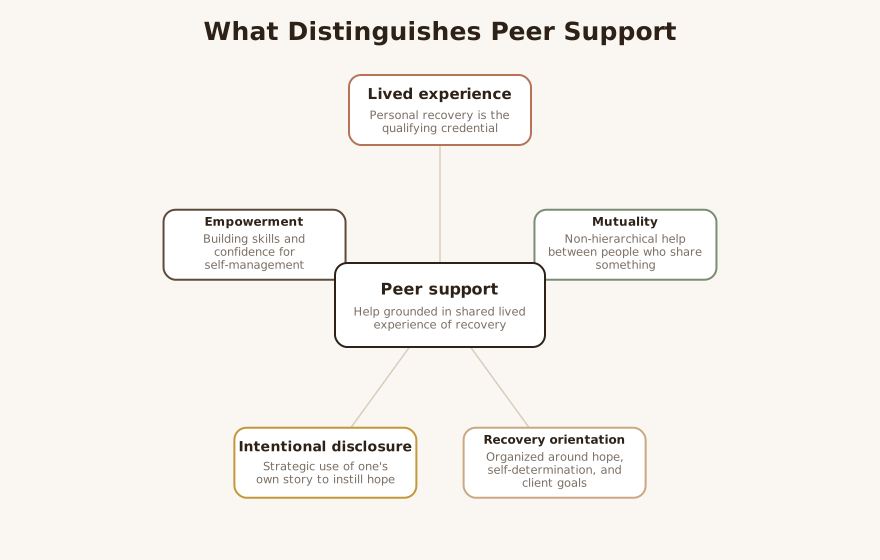
A small set of principles distinguishes peer support from other roles on a team LLM. The first is lived experience as the qualifying credential: the worker has personal experience of a mental health condition, substance use, or both, and demonstrated recovery, and this experience is the basis of the helping relationship rather than something to be hidden 7. The second is mutuality and a non-hierarchical relationship—help flows between two people who share something, rather than from an expert down to a patient 1.
The third is recovery orientation: the work is organized around hope, self-determination, and the client’s own goals, consistent with the recovery model from which peer support descends 1. The fourth is strategic, intentional self-disclosure: the peer worker uses their own story deliberately—to instill hope, normalize struggle, and model that recovery is possible—rather than for catharsis 1. The fifth is the orientation toward empowerment and self-management, helping people build the skills and confidence to make decisions aligned with their own goals and to navigate systems on their own behalf 6. SAMHSA frames these as teachable, assessable competencies—engaging and relating, supporting recovery and wellness, advocacy, mentoring, ethics—so that the role can be trained and supervised like any other 1.
Interventions & Techniques
Peer support is best understood as a container for several distinct activities rather than a single intervention LLM. The literature usefully sorts peer roles into three forms: peers added to conventional services to augment existing care, peers occupying roles that incumbents in those roles would otherwise fill, and peers delivering structured, manualized curricula such as illness-self-management programs 4. The day-to-day work spans emotional and social support, modeling and hope-instillation through disclosure of one’s own recovery, practical recovery navigation (helping clients find housing, benefits, transportation, and appointments), system advocacy, and skills coaching in self-management and wellness 1.
Specific techniques include intentional self-disclosure calibrated to the client’s situation, sharing of concrete coping strategies that worked in the worker’s own recovery, accompaniment to appointments and meetings, and warm linkage to mutual-aid groups and community resources 1. In crisis and post-discharge settings, peer workers often do transition and engagement work—reaching clients who have disengaged from formal care and bridging them back, on the strength of credibility that a non-peer professional may not have LLM. Structured peer-delivered curricula (for example, peer-led whole-health or self-management programs) add a manualized layer to the relational core 4.
LLM-generated illustrative example (not a guideline): A peer specialist meeting a client newly discharged after a psychotic episode might open not with an intake form but with, “I was hospitalized twice before things turned around for me,” then walk the client to their first community appointment, help them set up a pill organizer, and connect them to a local recovery group—three different supports delivered through one relationship built on shared experience LLM.
Evidence Base
Honest characterization of the evidence requires holding two facts together LLM. As an institutionalized practice, peer support is firmly established: it has national competency standards, national model certification standards, a credentialed workforce, and broad system adoption 12. As a treatment with demonstrated efficacy, however, the controlled-trial evidence is weak and low-certainty—the two findings are not in tension once the distinction is made LLM.
The Cochrane review of peer support for schizophrenia and other serious mental illnesses (13 trials, 2,479 participants) concluded there is no high-quality evidence to either support or refute the effectiveness of peer-support interventions, rated the evidence very low quality across outcomes, and found little or no clear impact on hospital admission or death when peer support was added to standard care 3. The Lloyd-Evans systematic review and meta-analysis (18 RCTs, 5,597 participants) reached a convergent conclusion: little evidence of effectiveness, with no significant benefit on hospitalization, near-zero effects on psychiatric symptoms, and only small positive effects on self-rated recovery and hope post-intervention; all outcomes received low or very-low GRADE ratings, heterogeneity was substantial, and all but two trials carried serious risk of bias 5. The earlier Psychiatric Services review similarly found the evidence base for peer support still maturing and uneven across the different forms the role takes 4.
Advocacy and policy sources present a more favorable picture, citing reduced re-hospitalization, increased outpatient engagement, improved quality of life, and greater empowerment 6. These claims are not baseless, but they draw on a mixed literature and on system-level and observational data more than on high-certainty trials, and clinicians should weight them accordingly LLM. The defensible summary: peer support is a valued, widely adopted, recovery-aligned service whose most consistent (though small) signals are on hope, empowerment, and self-rated recovery, while its effects on hard outcomes such as hospitalization and symptoms are not established by rigorous trials 35.
Populations & Indications
Peer support was developed primarily with and for people with serious mental illness—schizophrenia, schizoaffective disorder, bipolar disorder—and that remains its core population in the research literature 35. It is also widely applied in addiction recovery, where the peer (often a “recovery coach”) draws on the long mutual-aid tradition specific to substance use 7. Veterans are a major served population, with peer specialists embedded across veteran mental-health services 7.
Beyond these anchors, the practice is promoted across a broad range of groups—youth and college students, older adults, LGBTQ+ individuals communities, BIPOC communities, rural populations, and people with co-occurring disabilities—on the rationale that shared identity and experience deepen the helping relationship 6. It is particularly indicated for crisis-service users and people in care transitions (post-discharge, post-crisis), where engagement and re-engagement are the central challenge and a peer’s credibility is an asset LLM. The common thread across indications is not a diagnosis but a need: people who are isolated, disengaged from formal care, demoralized, or navigating recovery without a roadmap—situations in which “someone who has been there” addresses something a conventional clinician cannot LLM.
Problems-for-Work
Peer specialists take on a characteristic set of presenting problems, each addressed through the relationship and the worker’s lived experience LLM:
- Social isolation. Peer relationships and warm linkage to mutual-aid and community groups directly build a supportive network, one of the more consistently endorsed functions of the role 16.
- Stigma and self-stigma. A visibly recovered peer is living counter-evidence to the belief that the condition is a life sentence; disclosure and modeling target shame and hopelessness simultaneously 1.
- Hopelessness. Hope-instillation through the worker’s own story is a core mechanism, and self-rated hope is among the few outcomes showing a small positive effect in trials 5.
- Treatment engagement and adherence. Peers reach and re-engage clients who have dropped out of formal care, using credibility a non-peer may lack 4.
- Recovery navigation. Practical help with housing, benefits, transportation, and appointments turns abstract “recovery” into concrete next steps 1.
- Hospital readmission. Promoted as a target by advocacy sources, though rigorous trials have not demonstrated a clear effect—best framed as a hoped-for, not proven, outcome 36.
- Substance use disorders and relapse prevention. Recovery-coach peer roles support sobriety and relapse prevention by leveraging shared experience and mutual-aid linkage 7.
LLM-generated illustrative example (not a guideline): For a client whose “problem-for-work” is framed as self-stigma—the belief that having schizophrenia means they can never work or have relationships—a peer specialist who holds a job and discloses their own diagnosis offers a kind of disconfirming evidence that no amount of clinician reassurance can, and pairs it with practical steps toward the client’s stated goal of employment LLM.
Contraindications, Cautions & Cultural Humility
Peer support is a complement to, not a substitute for, clinical treatment; the principal caution is scope—peer workers are not clinicians, do not diagnose or prescribe, and should not be deployed to fill gaps that require licensed care 1. Because the evidence for hard outcomes is low-certainty, programs and referrers should be honest with clients about what the service can and cannot be expected to do, rather than overselling it as a proven treatment 35.
The role carries distinctive occupational hazards that supervision must address LLM. Strategic self-disclosure is a skill, and over-disclosure, boundary diffusion, or the worker’s own recovery being destabilized by the work are real risks; SAMHSA’s emphasis on ethics and defined competencies exists partly to manage them 1. There is also a systemic caution: peer roles can be tokenized or used as low-cost labor to substitute for adequate clinical staffing, which betrays the model’s intent LLM. Cultural humility is central because the helping mechanism is shared experience—matching on diagnosis is not the same as matching on culture, language, or identity, and a peer’s story is not universal; workers and supervisors must attend to where the client’s experience diverges from the peer’s, and to how histories of institutional mistreatment shape trust 6. The same lived experience that creates connection can, if assumed to be representative, become a blind spot LLM.
Treatment-Plan Suggestions & SMART Objectives
| Goal | SMART objective (example) | Mechanism |
|---|---|---|
| Reduce social isolation | Client will attend at least 2 peer-led or community recovery groups per week for 8 weeks, with the peer specialist accompanying the first session | Relationship-building and warm linkage to a supportive network 16 |
| Increase hope for recovery | Client will identify, with the peer specialist, 3 personally meaningful recovery goals within 4 weeks and review progress biweekly | Hope-instillation via modeling and intentional self-disclosure 5 |
| Strengthen treatment engagement | Client will attend at least 80% of scheduled clinical appointments over 3 months, with peer outreach after any missed visit | Peer credibility and re-engagement outreach 4 |
| Build self-management skills | Client will complete a peer-delivered wellness/self-management curriculum over 10 sessions and create a personal wellness plan | Structured, peer-delivered self-management program 4 |
| Reduce self-stigma | Client will rearticulate 2 stigmatizing self-beliefs into recovery-oriented statements within 6 weeks of peer work | Modeling and disclosure as disconfirming evidence 1 |
| Improve recovery navigation | Client will complete 2 concrete navigation tasks (e.g., benefits application, housing referral) with peer support within 60 days | Practical accompaniment and system navigation 1 |
| Support relapse prevention | Client will identify personal relapse warning signs and a peer-supported response plan, reviewing it weekly for 12 weeks | Shared-experience coaching and mutual-aid linkage 7 |
Common Misconceptions
- “Peer support and informal support groups are the same.” The certified peer-specialist role is a paid, supervised position with defined competencies and scope; it overlaps with but is distinct from informal mutual aid like an AA meeting 12.
- “Peer specialists are unqualified volunteers.” The credential is demonstrated lived experience plus standardized training, certification, and supervision; SAMHSA has issued national competencies and model certification standards precisely to professionalize the role 12.
- “Peer support is a proven clinical treatment for serious mental illness.” Rigorous trials and meta-analyses rate the evidence low to very-low certainty, with no clear effect on hospitalization or symptoms—it is an established practice without robust efficacy data 35.
- “It has no benefit at all.” The most consistent (if small) signals are on hope, empowerment, and self-rated recovery, and the practice is broadly valued and adopted; the honest position is uncertainty, not dismissal 56.
- “Any peer can help any client because they share a diagnosis.” Shared diagnosis is not shared culture, identity, or experience; effective peer work requires cultural humility about where stories diverge 6.
Training & Certification
Peer support is credentialed at the level of the individual worker, primarily through state certification programs—nearly all states and the District of Columbia operate training and certification pathways 7. Typical requirements include demonstrated lived experience with a mental health condition, substance use, or both; a period of demonstrated recovery (often one to two years); a high-school diploma or equivalent; a defined number of supervised training hours; and, in many states, a certification examination and supervised work experience 7.
The content of training is increasingly anchored to SAMHSA’s Core Competencies for peer workers, which define the knowledge, skills, and values the role requires across domains such as engaging and supporting recovery, mentoring, advocacy, and ethics 1. Because state programs historically varied widely, SAMHSA issued National Model Standards for Peer Support Certification to promote consistency and, ultimately, reciprocity across jurisdictions—addressing the long-standing problem that a credential earned in one state may not transfer to another 2. For clinicians and supervisors, the practical implication is that a “peer specialist” should be a certified one operating within defined competencies and supervision, not an ad hoc designation 12. Public-facing pathways into the role, including state certification directories and national peer-supporter associations, are mapped by advocacy organizations such as Mental Health America 7.
Key Terms
- Peer support specialist / peer worker: A person who uses their own lived experience of mental illness or addiction, plus training and certification, to support others in recovery 17.
- Lived experience: Personal experience of a mental health condition, substance use, or both, with demonstrated recovery—the qualifying credential for the role 7.
- Recovery model: The orientation, organizing peer support, in which a meaningful self-directed life rather than mere symptom remission is the goal 1.
- Intentional self-disclosure: The deliberate, calibrated sharing of one’s own recovery story to instill hope and model possibility 1.
- Recovery coach: A peer-support role specific to addiction recovery, drawing on the mutual-aid tradition 7.
- Core competencies: SAMHSA’s defined set of skills, knowledge, and values for peer workers in behavioral health 1.
- National Model Standards: SAMHSA’s framework for consistent peer-support certification across states, aimed at reciprocity 2.
Resources & Further Reading
▶ Watch — a video introduction to this concept:
- Core Competencies for Peer Workers in Behavioral Health Services — SAMHSA (BRSS TACS)
- SAMHSA’s National Model Standards for Peer Support Certification (PEP23-10-01-001)
- Peer support for people with schizophrenia or other serious mental illness — Cochrane Review (CD010880)
- Peer Support Services for Individuals With Serious Mental Illnesses: Assessing the Evidence — Psychiatric Services
- A systematic review and meta-analysis of RCTs of peer support for people with severe mental illness (Lloyd-Evans et al.)
- Peer Support: Research and Reports — Mental Health America
- How to Become a Peer Support Specialist — Mental Health America
Reflective / Supervision Questions
- For the clients I refer to peer support, am I clear with them about what the evidence does and does not show—that it is a valued, recovery-aligned service rather than a proven treatment for hospitalization or symptoms? 35 LLM
- How is the peer specialist on our team being supervised around self-disclosure, boundaries, and the protection of their own recovery? 1 LLM
- Are we deploying peer workers within a defined scope and competency set, or are we quietly using them to substitute for adequate clinical staffing? 1 LLM
- When a peer and client share a diagnosis but differ in culture, identity, or history, how do we make sure the peer’s story is offered as one experience and not assumed to be universal? 6 LLM
- For an isolated or disengaged client, what specifically can a peer relationship reach that my clinical relationship cannot, and how do we sequence the two? 4 LLM
- Is the peer specialist working with us certified and operating to recognized standards, and do we know what our state requires? 27 LLM