
Type & Discipline
Re-authoring conversations are a technique within narrative therapy, a postmodern approach housed in the broader discipline of family therapy 3. They are not a standalone modality but the engine of narrative work: the structured process by which a clinician and client co-create an alternative, preferred storyline of identity 3. The technique rests on a narrative metaphor — the assumption that people make sense of their lives by organising events into stories, and that the dominant, problem-saturated story a person carries is only one of many possible accounts of their experience 3. Because no single story can encapsulate the totality of a life, every client is understood to be “multi-storied,” and there are always neglected events from which a different account can be assembled 3.
The work is inseparable from its companion technique, externalizing conversations, which separate the person from the problem and typically form the backdrop against which re-authoring becomes possible 3. Where externalizing asks “what has the problem done to your life?”, re-authoring asks “what have you done, valued, or intended that the problem-story leaves out?” 3. LLM
Creators & Lineage
Michael White and David Epston introduced the narrative metaphor and the re-authoring metaphor to the therapeutic field, most influentially in their 1990 text Narrative Means to Therapeutic Ends 3. White later formalised the technique as the “re-authoring conversations map,” a guide to the kinds of questions that move a conversation toward a preferred story 3. The fullest mature statement of the method appears in White’s Maps of Narrative Practice (2007), which lays out the maps as scaffolding for therapeutic inquiry 2.
The intellectual lineage draws heavily on the cultural psychologist Jerome Bruner, whose observation that every story unfolds across a “landscape of action” and a “landscape of consciousness” supplies the two-territory structure of the re-authoring map 3. The wider roots lie in social constructionism and poststructuralism — the view that identity is socially constructed and shaped by relations of power, not lodged inside the individual as fixed traits 3. The approach grew within family-systems traditions and shares a forward-looking, exception-spotting sensibility with solution-focused brief therapy, though its theory of identity and its attention to power distinguish it LLM. The practitioner Q&A literature compiled by Maggie Carey and Shona Russell has been central to translating White’s maps into teachable steps 3.
Core Principles
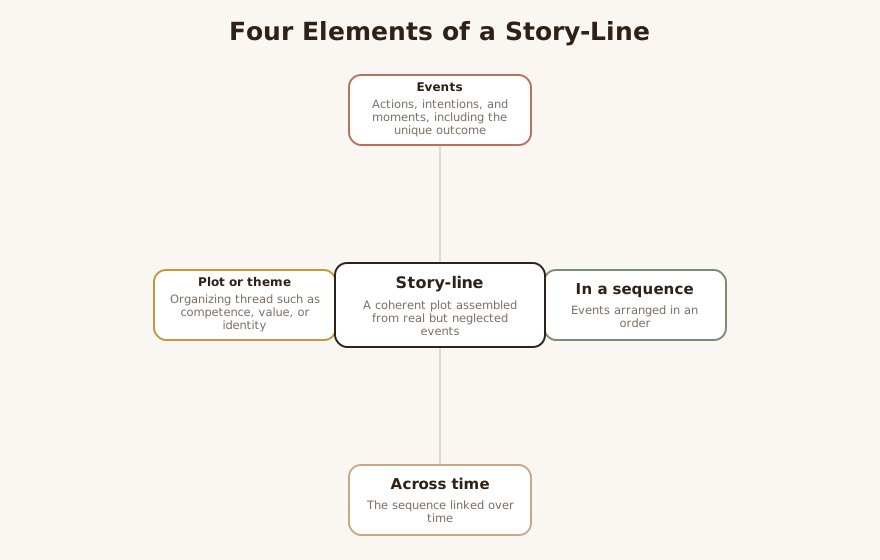
A story-line, in this framework, is built from four elements: events, in a sequence, across time, organised according to a plot or theme 3. If any element is missing, there is no story-line, so attention to all four is critical in re-authoring 3. The problem story is itself built this way — a string of past events linked under a theme such as “unworthiness” or “failure” — and the alternative story is built the same way, never invented from nothing but assembled from real but neglected events 3.
The pivotal raw material is the unique outcome, sometimes called a “sparkling moment”: an action, intention, or moment that contradicts the dominant problem-story and lies outside its territory 3. White held that if a clinician looks closely, there is always at least a glimmer of something at variance with the problem 3. A single unique outcome, however, is fragile and easily overshadowed; the work of re-authoring is to link it to other events across time so that it becomes a story-line rather than an isolated exception 3.
The conversation then traverses two landscapes. Landscape of action questions inquire into the events themselves — what happened, who was present, what steps were taken, what the turning point was 3. Landscape of identity questions invite reflection on what these actions reveal about the person’s intentions, values, hopes, and commitments 3. Re-authoring conversations characteristically “zigzag” between the two landscapes, alternating between the concrete and the meaning-laden 3.
Interventions & Techniques
In practice the technique unfolds in a recognisable arc. First, the clinician takes a position of inquiry and listens for any event that contradicts the dominant story, naming it as a possible unique outcome rather than asserting its significance 3. Crucially, significance is not imposed; it is rendered through questions that invite the client’s own curiosity about the neglected event 3.
Once an event is noticed, landscape of action questions richly describe it: What made this possible? What steps did you take? What was the turning point? Have there been other times you managed something like this? 3. The aim is to imbue the event with meaning and to surface the skills and preparations behind it 3. The clinician then deliberately links the unique outcome to other events, since one event alone will always be vulnerable 3.
Landscape of identity questions follow: What does this say about you as a person? What were you hoping for? What does this reveal about what matters to you? 3. White distinguished “intentional states” of identity from “internal states,” steering away from fixed traits like “strength” or “resources” toward the intentions, values, hopes, and commitments that shape action 3. He described a loose hierarchy of intentional states — intentions or purposes, then values and beliefs, then hopes and dreams, then principles for living, then commitments — noting that the further the conversation travels up this hierarchy, the thicker the alternative story becomes 3.
Once a preferred story is named, additional practices thicken it so it can withstand the problem-story’s comebacks 3. These include re-membering conversations, which recruit the perspectives of significant figures from the client’s life; outsider-witness practices and definitional ceremonies, in which chosen others reflect on and authenticate the new story; and therapeutic documents and letters that act as between-session reminders 3.
LLM-generated illustrative example (not a guideline): A clinician working with a client gripped by self-criticism notices, almost in passing, that the client declined an unreasonable request from a relative that week. Rather than praising it, the clinician asks what made that refusal possible, what the client was protecting, and whether there have been other moments of holding a line — slowly linking these into a story-line the client comes to call “looking after myself.” LLM
Evidence Base
Re-authoring conversations are best described as an established clinical practice rather than an empirically validated one in the sense that term carries for, say, cognitive-behavioural protocols. The technique is mature, richly codified in White’s maps, and widely taught and used across counselling, social work, and community settings 2. The provided source base, however, consists of foundational practice texts and practitioner explainers, not controlled outcome trials 135.
This matters for honest practice. Narrative therapy’s controlled-trial evidence base remains thin and emerging relative to the dominant cognitive and behavioural therapies, and clinicians should not present re-authoring as having the efficacy footprint of those approaches LLM. The approach is also philosophically wary of the very deficit-and-measurement frame within which efficacy is usually established, which partly explains the predominance of case-based and practice-based accounts in its literature 3. LLM What the literature offers in abundance is detailed, transferable demonstration — through the worked cases of clients facing anxiety, depression, and self-doubt — of how the conversations are conducted 3. Clinicians integrating re-authoring should treat it as a well-developed practice framework whose effectiveness for a given presentation is best monitored case by case LLM.
Populations & Indications
The technique is used across the full range of formats: individuals, couples, families, and groups 3. The Carey and Russell cases illustrate work with a single adult experiencing anxiety, a young mother contending with depression and worry, and a therapist in supervision struggling with confidence — showing the method’s reach from clients to practitioners themselves 3. It is widely applied with children and adolescents, where externalizing and re-authoring lend themselves to playful, age-appropriate storytelling 4.
Re-authoring is particularly suited to presentations organised around a totalising, identity-level conclusion — “I am a failure,” “I am a bad mother,” “I am a loser” — because its explicit aim is to loosen single-story accounts of identity 3. It has been applied with trauma survivors, where how an event is storied (as “my fault” and a sign of permanent defect, versus a singular, unjustifiable act of harm) materially shapes its ongoing effects 3. Its emphasis on connection and re-membering also makes it relevant for people isolated by chronic difficulties, since problems are understood to separate people from others, and re-authoring works to open spaces of reconnection 3. LLM
Problems-for-Work
Re-authoring maps onto a broad set of presenting problems wherever a thin, problem-saturated identity conclusion is doing the damage 3.
- Depression and hopelessness: the young mother in the source case externalises “the depression” and “the worry,” then re-authors a story of “hopes for a better life” from neglected acts of care for her children 3.
- Anxiety: the worked case of a client with anxiety builds an alternative story — “reclaiming my relationships and my life” — from times she acted despite the anxiety’s dictates 3.
- Self-criticism and low self-esteem: the “doormat” case shows how a demeaning identity conclusion, traced to a particular relationship and history, can be countered by unique outcomes of standing firm 3.
- Identity issues: the supervision case re-authors “lack of confidence” into “a good listener with a commitment to respect,” shifting the practitioner’s whole stance toward his work 3.
- Trauma, grief, relationship conflict, and behavioural problems in children: the same architecture — externalise, find unique outcomes, link, thicken — applies wherever the dominant story crowds out competence and value 3. LLM
LLM-generated illustrative example (not a guideline): With a grieving client whose story has narrowed to “I have lost everything,” a clinician might gently inquire into a moment the client tended a friend’s garden — a continuing act of care — and, across several sessions, link such moments into a story of love that persists alongside the loss rather than being erased by it. LLM
Contraindications, Cautions & Cultural Humility
The most consistently named hazard in the practitioner literature is the clinician’s own enthusiasm. Expressing excitement about a client’s step risks placing the clinician’s perspective at the centre of the conversation, and inflating an event’s significance can inadvertently set the client up to feel they have failed if they cannot match a hard-won achievement 3. Experienced practitioners describe funnelling enthusiasm into good questions rather than praise 3.
A related caution is the slide into simply “pointing out positives,” which can leave clients feeling jarred and unheard; the corrective is to keep asking questions and to acknowledge the real effects of the problem rather than papering over them 3. Re-authoring should never rush past the problem: conversations are not linear, the problem may make comebacks mid-treatment, and adequate time spent externalising and mapping the problem’s effects is the foundation, not a detour 3.
The deepest ethical issue is co-authoring without imposing. Practitioners describe an ongoing, never-fully-resolved worry about their position of power — the risk of imposing the clinician’s idea of a “good” alternative story on the person consulting them 3. The discipline of the work is to position the client, not the clinician, as the interpreter of their own experience, and to continually question one’s own assumptions about what the client wants or finds significant 3. Because narrative practice locates problems within broader relations of power — class, culture, gender, sexual identity — culturally humble practice means tracing those influences rather than treating distress as an internal defect 3. LLM One field application notes that determining whether an event is genuinely a unique outcome for that person requires careful, non-leading questioning, since a question phrased to imply the desired answer is both condescending and unreliable 3.
Treatment-Plan Suggestions & SMART Objectives
| Goal | SMART objective (example) | Mechanism |
|---|---|---|
| Loosen a totalising self-criticism | Within 4 sessions, client will identify and richly describe at least 2 unique outcomes that contradict the “I am worthless” story | Externalizing + landscape-of-action questions surface neglected competence 3 |
| Build a named alternative storyline | By session 6, client will articulate a preferred story of identity and give it a name in their own words | Linking unique outcomes across time into a plot or theme 3 |
| Connect actions to values | Within 5 sessions, client will name 3 values or commitments that their preferred-story actions express | Landscape-of-identity questions move up the hierarchy of intentional states 3 |
| Thicken a fragile preferred story | Over 4 weeks, client will recruit at least 1 significant figure (re-membering) whose perspective supports the new story | Re-membering conversations link the story to relationships and history 3 |
| Sustain the story between sessions | By session 5, clinician and client will co-write 1 therapeutic document summarising the preferred story | Documents and letters act as reminders that reinforce re-authoring 3 |
| Reduce the grip of the problem-story | Within 8 sessions, client will report a measurable reduction in time spent under the problem-story’s influence | Effects of the problem story recede as the preferred story takes hold 3 |
| Project the story forward | By termination, client will describe 2 concrete future steps consistent with their stated commitments | Action questions project the preferred story-line into the future 3 |
Common Misconceptions
A frequent misreading is that re-authoring means looking on the bright side or replacing a bad story with a rosy one. The technique explicitly distinguishes itself from “pointing out positives,” and practitioners warn that doing so leaves clients feeling unheard 3. Alternative stories are not invented or imposed; they are assembled from real, neglected events the client has lived 3.
A second misconception is that the clinician authors the new story. The work is co-authoring: the clinician contributes through questions and through which events they pay attention to, but the client does the interpreting and remains the primary author 3. A third is that the work is linear — externalise, then re-author, then finish. In reality the conversation zigzags between landscapes and the problem can resurface at any point, requiring a return to externalizing 3. Finally, some assume one strong exception is enough; in fact a single unique outcome is always vulnerable until it is linked into a wider story-line and thickened through re-membering, witnessing, or documents 3. LLM
Training & Certification
Narrative therapy has no single licensing body; competence in re-authoring is developed through specialised training rather than a regulated credential LLM. The Dulwich Centre in Adelaide, where Michael White worked, is the field’s principal training and publishing hub and the source of the foundational maps and the practitioner Q&A literature 3. White’s Maps of Narrative Practice functions as the standard text for learning the re-authoring map and its companion maps 2. The practitioner literature is candid that the skills take considerable time and practice to develop — particularly the questioning skills that build both landscapes, and the habit of noticing unique outcomes 3. Clinicians typically build competence through workshops, intensive courses, supervision, and close reading of worked cases 3. LLM
Key Terms
- Re-authoring conversation: the co-creation of an alternative, preferred story-line of identity from neglected events 3.
- Unique outcome / sparkling moment: an action or intention outside the territory of the problem-story that contradicts it 3.
- Landscape of action: the territory of events, sequences, and steps — what happened 3.
- Landscape of identity (consciousness): the territory of intentions, values, hopes, and commitments — what it means 3.
- Intentional states of identity: purposes, values, hopes, principles, and commitments, contrasted with fixed “internal states” or traits 3.
- Thickening: strengthening a fragile preferred story so it can withstand the problem-story’s comebacks 3.
- Re-membering: recruiting the perspectives of significant figures to reinforce the preferred story 3.
- Definitional ceremony / outsider witnesses: structured reflections by chosen others that authenticate the new story 3.
Resources & Further Reading
▶ Watch — a video introduction to this concept:
- Re-Authoring Conversations — Michael White (chapter PDF, Dulwich Centre)
- Maps of Narrative Practice (Michael White, 2007, W.W. Norton)
- Re-authoring: Some answers to commonly asked questions (Carey & Russell, Dulwich Centre)
- Maps of Narrative Practice: An Overview of Externalizing and Re-Authoring Conversations — Family Therapy Basics
- E6. Re-authoring conversations — YouthAOD Toolbox
Reflective / Supervision Questions
- When you last noticed a unique outcome, did you let the client attribute significance to it, or did you supply the significance yourself? 3
- Where in your recent sessions did enthusiasm or “pointing out positives” risk centring your perspective over the client’s? 3
- How thoroughly did you externalise and map the problem’s effects before moving toward an alternative story? 3
- Are you tracking both landscapes — action and identity — or staying mostly in one? 3
- Whose perspectives (re-membering, outsider witnesses) could you recruit to thicken a preferred story that still feels fragile? 3
- What assumptions might you be making about what this client wants from their life, and how are you testing them? 3 LLM