
Type & Discipline
Solution-Focused Brief Therapy (SFBT) is a brief, present- and future-oriented psychotherapy model that can also be applied as a coaching framework. 7 It sits within the family of systemic and brief therapies and is practiced across psychotherapy, social work, counseling, education, and organizational coaching contexts. 8 Rather than analyzing the origins or maintaining factors of a presenting problem, SFBT directs attention to the client’s preferred future and to instances when the problem is already, even partially, absent. 5 It is a talking therapy delivered in deliberately few sessions, often complete within four to eight meetings and sometimes fewer. 7 For practicing clinicians, the most useful framing is that SFBT is less a set of techniques layered onto a theory of pathology and more a disciplined conversational stance: the therapist consistently steers toward what the client wants, what is working, and what the next small step looks like. LLM
Creators & Lineage
SFBT was developed in the late 1970s and 1980s by social workers Steve de Shazer and Insoo Kim Berg, together with a team that included Eve Lipchik, Jim Derks, Elam Nunnally, and others, at the Brief Family Therapy Center (BFTC) in Milwaukee. 8 The model grew directly out of the brief family therapy tradition of the Mental Research Institute (MRI) in Palo Alto; de Shazer studied MRI’s work and conceived of BFTC as “the MRI of the Midwest.” 8 The hypnotherapeutic and utilization approaches of Milton Erickson, transmitted in part through MRI figures such as John Weakland, were a significant influence, which is why solution-oriented Ericksonian work appears in SFBT’s lineage. 8 A frequently cited turning point came in 1982 when a family arrived with twenty-seven problems and the team, rather than triaging them, asked the family to return with a list of what they wanted to keep happening — crystallizing the core insight that the solution is not necessarily related to the problem. 8 De Shazer articulated the developing model in foundational texts including Keys to Solution in Brief Therapy. 6 SFBT shares conceptual territory with narrative therapy’s interest in client-authored meaning and with motivational interviewing’s emphasis on evoking the client’s own change talk, though each developed its own distinct techniques. LLM
Core Principles
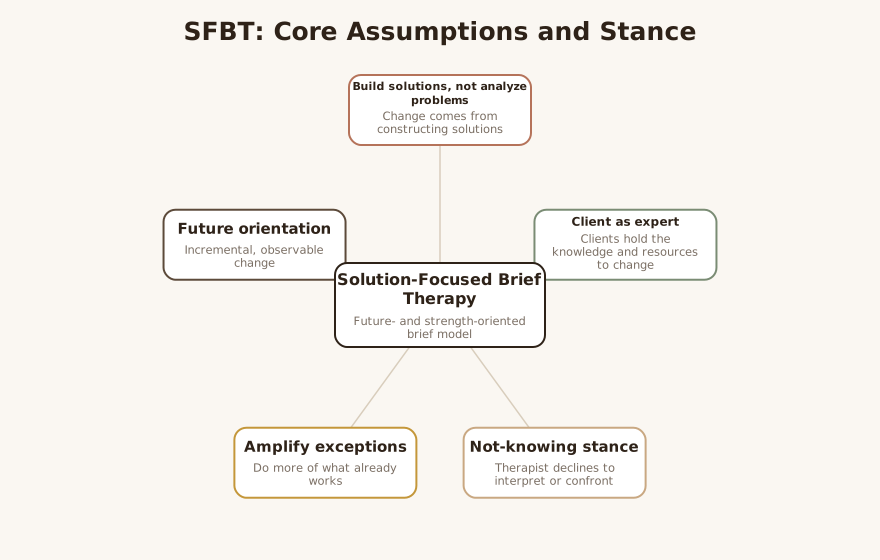
The model rests on a small set of assumptions that distinguish it sharply from problem-focused approaches. The first is that meaningful change emerges by building solutions rather than by analyzing problems. 5 The second is that the causes of a problem may be extremely complex while the solution need not be — so detailed etiological assessment is treated as optional rather than mandatory. 8 The third is a stance of client expertise: clients are presumed to hold the knowledge and resources needed to reach their goals, and the therapist’s job is to ask questions that evoke the change process rather than to interpret or instruct. 8
Operationally, this produces a recognizable posture. The therapist adopts a “not-knowing stance,” declining to impose interpretations or to confront, and instead cooperates within the client’s own language. 8 Attention is directed toward exceptions — moments when the problem is diminished or absent — and toward amplifying them by helping the client do more of what already works. 8 Sessions are oriented to the future and to incremental, observable change; a typical follow-up session may open with a question like “What’s been better since we last talked?” rather than a review of symptoms. 8 Underlying all of this is the principle that the client, not the diagnosis, sets the destination. LLM
Interventions & Techniques
SFBT’s techniques are often summarized with the MECSTAT acronym: Miracle questions, Exception questions, Coping questions, Scaling questions, Time-out, Accolades, and Tasks. 8
The miracle question is the model’s signature intervention: the client is invited to imagine that, overnight, the problem has been mysteriously resolved, and then to describe the first small signs by which they would notice the change. 8 Its purpose is to make a preferred future concrete and behavioral, generating goals the client can actually pursue. 5
Scaling questions ask the client to rate their situation, confidence, or progress on a 0-to-10 scale, which both measures movement and opens conversation about what one small step up the scale would look like. 8 Exception questions locate times the problem was less severe or absent and examine what was different then. 8 Coping questions are used when a client feels overwhelmed, drawing attention to how they have managed to keep going at all. 7 The therapist also uses compliments (accolades) and empathic support to highlight strengths the client may not have noticed. 7 A within-session break or time-out before delivering feedback and a between-session task round out the structure. 8
LLM-generated illustrative example (not a guideline): A client presenting with burnout rates their week at a 3 out of 10. Rather than cataloguing stressors, the therapist asks, “What tells you it’s a 3 and not a 1?” The client mentions still walking the dog each morning. The therapist explores this exception, then asks what a 4 would look like — perhaps protecting a single lunch break. The session ends with a small, self-chosen experiment rather than a problem inventory. LLM
Evidence Base
SFBT’s evidence base is best described as established, though clinicians should hold its claims with appropriate calibration. Early in its history the model was criticized for thin research support, but by around 2010 the evidence had become promising, and multiple meta-analyses now indicate effectiveness for internalizing problems with effect sizes broadly comparable to other evidence-based approaches such as CBT and IPT, achieved in fewer average sessions. 8 A 2024 meta-analysis of randomized controlled trials specifically in community-based services examined SFBT delivered in real-world service settings. 1 A separate 2024 meta-analysis synthesized psychosocial outcomes and tested moderating factors, reflecting the field’s maturation toward asking not just whether SFBT works but for whom and under what conditions. 2 A 2024 umbrella review aggregated existing systematic reviews and meta-analyses, the strongest available signal that the literature is now dense enough to review at a second order. 3
Honest caveats remain. Psychology Today’s clinical summary is explicit that SFBT is “not a cure” for psychiatric disorders such as depression or schizophrenia, though it may improve quality of life for people living with those conditions. 7 Much of the trial literature originates in Asian and non-Western settings, and study quality is uneven, so effect-size estimates should be read as orienting rather than definitive. 8 The most defensible reading is that SFBT produces meaningful, efficient gains on a range of behavioral and psychosocial outcomes, while not displacing disorder-specific treatments where those are indicated. LLM
Populations & Indications
SFBT has been applied across the lifespan and across settings — children, adolescents, couples, families, trauma survivors, and adults in medical, educational, correctional, and workplace contexts. 8 It is well suited to adults in brief or time-limited therapy, adolescents, couples, and families, and translates readily into coaching and Employee Assistance Program (EAP) work where the contract is short and goal-defined. 7 Its forward orientation makes it useful in crisis or single-session settings, where the coping question in particular gives a clinician a way to mobilize existing resources quickly. 7 Common indications include adjustment difficulties, relationship conflict, behavioral problems in children, low motivation, goal-setting difficulties, low self-efficacy, and stress and burnout, alongside adjunctive use for mood and anxiety presentations. 7 Because the model is agnostic about the content of the problem, it adapts flexibly to whatever the client brings, which is part of why it is described as suitable for a wide range of clients. 5
Problems-for-Work
The following are illustrative applications, not a prescriptive list.
- Major depressive disorder (adjunctive): scaling questions track small upticks in activity and mood between sessions, and exception-finding counters the cognitive negativity bias by surfacing better moments. 8
- Generalized anxiety disorder: the miracle question helps a client define what a non-anxious day looks like in behavioral terms, redirecting from worry content to desired functioning. 5
- Adjustment disorder: the future focus supports a client reorganizing life after a stressor by building a concrete picture of “what comes next.” 7
- Relationship conflict (couples/families): the team’s founding insight — asking what couples want to keep — reframes sessions away from blame toward shared preferred outcomes. 8
- Behavioral problems in children: parents and child identify exceptions when behavior is already going well and scale progress collaboratively. 7
- Low motivation and goal-setting difficulties: scaling confidence and defining one-step-up actions convert vague intentions into observable next steps. 8
- Stress and burnout (coaching/EAP): coping questions validate current functioning while compliments rebuild eroded self-efficacy. 7
LLM-generated illustrative example (not a guideline): A parent reports their child “never” completes homework. The clinician asks the exception question — “When did some of it get done recently?” — and the parent recalls a quiet evening without the TV on. That single exception becomes the kernel of an experiment, rather than a behavior plan imposed from outside. LLM
Contraindications, Cautions & Cultural Humility
SFBT is not positioned as a cure for serious psychiatric disorders, and a clinician should not let its optimistic frame substitute for risk assessment, diagnostic clarity, or disorder-specific treatment where indicated. 7 Psychology Tools cautions that the approach may not suit every individual and advises clinicians to consult disorder-specific guidelines. 5 In practice, the model’s reluctance to dwell on problems can become a liability if it leads a clinician to under-assess safety, trauma, or active psychosis; the future focus must never crowd out a competent evaluation of present danger. LLM
Cultural humility deserves explicit attention. SFBT has been adopted widely in Asian and non-Western settings, partly because its brevity and respect for client-defined goals travel well across contexts. 8 The not-knowing stance is itself a humility practice — the therapist treats the client as the expert on their own life and works within the client’s own language and meanings rather than importing the clinician’s framework. 8 Even so, “solutions” and “preferred futures” are culturally shaped; a clinician should remain alert to the risk of mistaking a culturally specific value (for instance, around family obligation or emotional expression) for a deficit, and should let the client define what improvement means. LLM
Treatment-Plan Suggestions & SMART Objectives
| Goal | SMART objective (example) | Mechanism |
|---|---|---|
| Increase behavioral activation in depression | Client will identify and complete one self-selected pleasant activity on 4 of 7 days, tracked on a 0-10 scale, within 3 weeks | Scaling + exception-finding amplify existing positive behavior 8 |
| Define a concrete recovery picture | Client will describe 3 observable signs of their “miracle day” by session 2 and select one to enact | Miracle question makes preferred future behavioral 8 |
| Reduce relationship conflict | Couple will name 2 shared “keep doing” behaviors and report 1 instance of each weekly for 4 weeks | Reframes from problem to shared preferred outcome 8 |
| Build coping during crisis | Client will articulate 2 strategies already used to “keep going” and apply one before next contact | Coping questions mobilize existing resources 7 |
| Improve homework completion (child) | Child completes homework on 3 of 5 school nights, rated jointly with parent on a 0-10 scale, within 2 weeks | Exception-finding + scaling extend what already works 7 |
| Raise self-efficacy / motivation | Client rates confidence to take one defined step and moves +1 on the 0-10 scale within 2 weeks | Scaling converts intention into observable next step 8 |
| Manage burnout | Client protects one daily restorative activity 5 of 7 days for 3 weeks, with weekly scaling review | Compliments + coping questions rebuild self-efficacy 7 |
Common Misconceptions
A frequent misconception is that SFBT is simply “positive thinking” or relentless cheerleading. In fact the model uses structured questions, scaling, and tasks to build concrete behavior change, and coping questions explicitly engage with difficulty rather than denying it. 7 A second is that brief necessarily means superficial; the meta-analytic record suggests effects comparable to longer treatments achieved in fewer sessions, not weaker outcomes. 8 A third is that SFBT forbids any discussion of problems — the stance is that problem analysis is optional, not prohibited, and that a clinician can help resolve a difficulty without exhaustively mapping its source. 8 Finally, some clinicians assume SFBT is a complete substitute for diagnostic or risk assessment; the appropriate reading is that it is a treatment approach, not a replacement for sound clinical evaluation. LLM
Training & Certification
The Solution Focused Brief Therapy Association (SFBTA) is the field’s professional home in the United States, fostering the exchange of practice and research and maintaining resources including an SFBT treatment manual. 4 SFBTA also supports the field’s growth through mechanisms such as research awards funding new studies. 4 Clinicians typically build SFBT competence through workshops, supervised practice, and study of the foundational texts, of which de Shazer’s Keys to Solution in Brief Therapy is a primary source. 6 Because the model’s skill is conversational and stance-based, deliberate practice with recorded or supervised sessions — rehearsing the miracle question, scaling, and the not-knowing posture — tends to matter more than didactic exposure alone. LLM
Key Terms
- Miracle question: an imaginal prompt inviting the client to describe the first small signs that their problem had resolved overnight. 8
- Scaling question: a 0-to-10 rating used to measure progress, confidence, or severity and to define the next step up. 8
- Exception: a time when the problem is less severe or absent, examined to learn what was different. 8
- Coping question: a question that highlights how the client has managed to keep going despite difficulty. 7
- Not-knowing stance: the therapist’s posture of curiosity and non-interpretation, treating the client as expert. 8
- Compliment / accolade: explicit recognition of client strengths and existing competencies. 7
- Preferred future: the client-defined description of how life would look once goals are met. 5
Resources & Further Reading
▶ Watch — a video introduction to this concept:
- Solution Focused Brief Therapy Association (SFBTA) — official site 4
- What Is Solution-Focused Brief Therapy (SFBT)? — Psychology Tools 5
- de Shazer, S. (1985). Keys to Solution in Brief Therapy (Norton) 6
- Solution-Focused Brief Therapy — Psychology Today 7
- Solution-focused brief therapy — Wikipedia 8
- Franklin, C. et al. (2024). SFBT in Community-Based Services: A Meta-Analysis of RCTs 1
- The current evidence of SFBT: A meta-analysis of psychosocial outcomes and moderating factors (2024) 2
- Effectiveness of SFBT: An umbrella review of systematic reviews and meta-analyses (2024) 3
Reflective / Supervision Questions
- When I move quickly toward solutions, am I genuinely following the client’s preferred future, or am I avoiding distressing material that warrants attention? LLM
- How do I recognize when a problem-focused assessment (risk, trauma, diagnosis) must take precedence over solution-building in a given session? LLM
- Where in my own practice does the not-knowing stance feel hardest to hold, and what does that reveal about my assumptions of expertise? LLM
- Am I treating “solution” and “preferred future” as universal, or am I letting each client define improvement in their own cultural and personal terms? 8
- When I deliver compliments and coping reflections, are they specific and evidence-based in the client’s own reported behavior, or generic reassurance? LLM
- How do I document SFBT interventions so that the active ingredients and measurable objectives are visible to a reviewer or supervisor? LLM