
Type & Discipline
Externalizing conversations are a core practice within narrative therapy, a postmodern approach developed inside the broader field of family therapy 7. The practice is a linguistic and conversational technique rather than a freestanding modality: it lives within the larger narrative project of helping people re-author their relationship to the problems that trouble them 7. The defining move is to use language that locates the problem outside the person’s identity, captured in Michael White’s now-canonical formulation that “the person is not the problem; the problem is the problem” 2.
Because it is a technique embedded in a wider therapeutic philosophy, externalizing should be understood as more than a verbal trick 3. White himself warned that “if externalization is approached purely as technique, it will probably not produce profound effects” 3. The discipline lineage runs from family therapy through narrative therapy, drawing philosophically on social constructionism and poststructuralist thought, which together hold that problems are constructed within cultural discourse rather than residing as fixed truths inside individuals 3.
Creators & Lineage
Externalizing conversations were pioneered by Australian social worker Michael White and New Zealand practitioner David Epston, who developed narrative therapy through the 1970s and 1980s 7. The practice of externalizing was articulated most comprehensively in their 1990 work, and White later systematized the conversational maps that guide it 3. White’s intellectual influences included Michel Foucault, Jerome Bruner, and Lev Vygotsky, whose ideas about power, narrative, and the social construction of meaning shaped the approach 7.
The work is institutionally anchored at the Dulwich Centre in Adelaide, Australia, which continues to publish, teach, and curate narrative practice 2. Within this lineage, externalizing is positioned as a “counter-practice” to therapies that objectify people’s identities; instead, narrative therapy objectifies the problem so the person can be released from a totalizing, problem-saturated description of themselves 2. Related narrative concepts in the same lineage include re-authoring conversations, the search for unique outcomes, and deconstruction of culturally imposed self-stories 7.
Core Principles
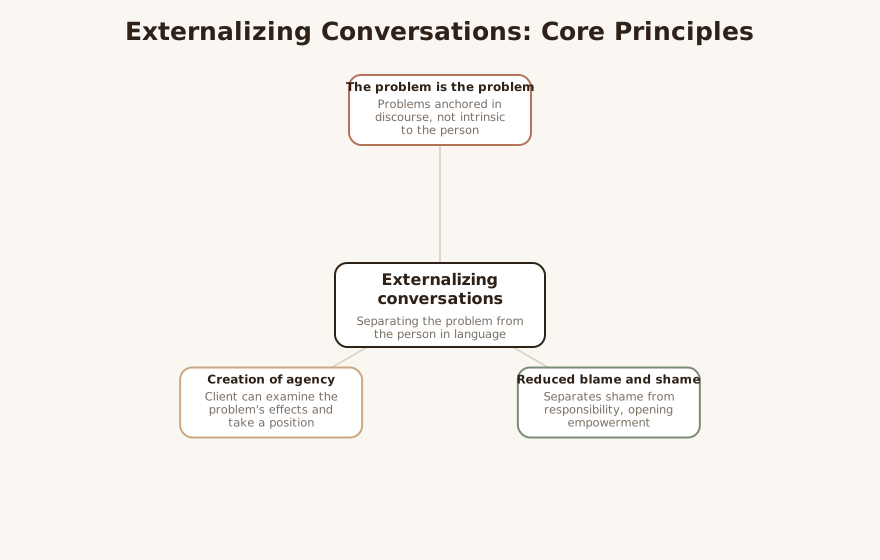
The foundational principle is the separation of problem from person, expressed as “the problem is the problem” rather than the person being inherently flawed 4. This separation rests on a social-constructionist premise: that problems are anchored in cultural discourses and language rather than intrinsic to the individual 3. From this premise follows the idea that a behavior a person does is more changeable than a core personality characteristic they are presumed to be 4.
A second principle is the reduction of blame and shame 3. By decoupling the problem from the person’s identity, externalizing aims to separate shame from responsibility, opening space for empowerment rather than defensiveness 3. A third principle is the creation of agency: once a problem is positioned outside the self, the client can examine its effects, evaluate them, and take a position on their preferred relationship to it 7. White described six effects of externalizing conversations, including decreasing unproductive conflict over responsibility, undermining narratives of failure, enabling cooperation against a shared problem, opening possibilities for effective action, permitting a lighter approach to serious matters, and facilitating dialogue rather than monologue 3.
Crucially, narrative practice holds that the person is the expert on their own life, and externalizing works best when it is led by the client’s own experience-near language rather than imposed by the clinician 6. This principle becomes a practical safeguard, as we will see in the cautions section 6.
Interventions & Techniques
The first technique is naming the problem 2. The clinician collaborates with the client to give the problem a distinct name or personified character, and then uses that name when discussing it 4. The “Sugar” story is a frequently cited example of how naming creates distance and enables fresh perspective 2. Naming may be literal and externalized further through small grammatical shifts: placing “the” before a problem word so that “worry” becomes “the worry,” or substituting “it” for “you” so that “How do you feel about that?” becomes “How does it have you feeling?” 5.
The second technique is relative influence questioning, which maps influence in two directions 2. The clinician asks both how the problem influences the person and how the person influences the problem 2. Mapping the problem’s effects might sound like, “This useless feeling, when does it visit? Are there times when it is more or less likely for the uselessness to come around?” 5. The clinician can also externalize the problem’s claims about identity by asking, “Am I right in thinking that the problem tries to tell you about the type of person you are?” 5.
The third structured technique is White’s Statement of Position Map, which guides the conversation through negotiating an experience-near name for the problem, mapping its effects across domains of the person’s life, inviting the client to evaluate those effects, and asking them to justify that evaluation 2. Adjunct creative methods such as letter-writing, drawing, and chair work can support externalization, though research suggests person-led, experience-near language often proves most effective 6.
LLM-generated illustrative example (not a guideline): A clinician working with an 11-year-old who has frequent meltdowns might ask the family to name the pattern. The child calls it “the Volcano.” The clinician then asks, “When does the Volcano sneak up on you?” and “Are there times you stopped the Volcano from taking over?” The conversation maps the Volcano’s tricks and the boy’s resistance to it, shifting the family away from “he is a difficult child” toward a shared project of outsmarting the Volcano LLM.
Evidence Base
Externalizing conversations are clinically established and widely taught, but it is important to be honest about the maturity of the dedicated empirical base 3. Research supporting externalizing’s specific claims remains limited and mixed: studies are modest in number compared with other approaches, often evaluate externalizing bundled within broader treatments, and some research suggests clients find it less central than other aspects of therapy 3. Narrative therapy more broadly has been criticized for lacking sufficient clinical and empirical studies to validate its many claims 7.
Part of this gap is methodological rather than simply a matter of missing trials 3. Narrative therapy’s constructionist values are in tension with positivist quantitative research that demands researcher objectivity, and few journals and training programs emphasize the qualitative methods aligned with narrative principles 3. In response, narrative practitioners developed “co-research,” a collaborative inquiry that positions clients as research partners and documents their accounts of what helped 3. Epston’s work on anorexia and bulimia exemplifies this tradition 3.
The strongest recent evidence is qualitative and nuanced. A reflexive thematic analysis of 13 UK adults in recovery from anorexia nervosa found that externalizing helped participants “see myself as a person and not the eating disorder” and built collaborative common ground with therapists 6. The same study, however, surfaced real risks when externalizing was applied rigidly, which informs the cautions below 6. In short, the clinical wisdom behind externalizing is mature and the practice is established, but the empirical validation within mainstream outcome research is still emerging 3.
Populations & Indications
Externalizing is applied across a wide range of populations 7. It is especially associated with work involving children and adolescents, families, and couples, where personifying a problem can give a shared, non-blaming target for collective effort 7. It is frequently used with people experiencing internalized shame or stigma, because separating the problem from identity directly counters self-blame 3.
Within narrative therapy, externalizing has notable traditions in eating disorders, developed by Epston, Stephen Madigan, and Catrina Brown, and in work with men who have used violence, developed by Alan Jenkins and Tod Augusta-Scott 7. The broader narrative approach has been applied to depression, anxiety, relationship satisfaction, ADHD, and trauma 4. Clinically, externalizing is well suited to presentations where a problem has colonized a person’s identity, such as obsessive-compulsive disorder and anxiety, where naming and resisting the problem voice is a coherent therapeutic stance 5.
Problems-for-Work
Internalized shame and self-blame. When a client says “I am useless,” externalizing reframes the statement by asking whether the problem is trying to tell them what kind of person they are, separating the verdict from the self 5.
Anxiety and obsessive-compulsive disorder. Naming “the Worry” and mapping when it visits gives the client an observer stance toward intrusive thoughts and compulsions rather than treating them as character 5.
Behavioral problems in children. Personifying a behavior pattern lets a family unite against the problem instead of against the child, decreasing unproductive conflict over responsibility 3.
Eating disorders. Externalizing the “anorexia voice” as distinct from the self can help clients build common ground with clinicians and resist the disorder, when done in the client’s own language 6.
Family conflict. Locating a recurring conflict as an external “it” that visits the family can shift members from blaming one another toward cooperation against a shared problem 3.
LLM-generated illustrative example (not a guideline): A couple caught in escalating arguments names their pattern “the Spiral.” Instead of asking who started the fight, the clinician asks, “What does the Spiral need from each of you to get going?” and “When did you two refuse to feed the Spiral this week?” Partners begin to describe themselves as allies against the Spiral rather than adversaries to each other LLM.
Contraindications, Cautions & Cultural Humility
The most important caution comes directly from people who have received the practice 6. In the anorexia nervosa study, participants reported that when staff overused externalizing language, they felt “belittled” and “overlooked,” and that treating the disorder as purely external could invalidate lived experience where it felt like “a part of them” 6. One participant recalled that when she disliked a food, nurses would say “that’s your eating disorder talking,” which dismissed her legitimate preference 6.
A second risk is one-way externalization 6. Exploring only the problem’s influence on the person, without exploring the person’s influence over the problem, can foster helplessness; as one participant observed, “you don’t have to be accountable for your actions when you have someone to blame” 6. Relative influence questioning is therefore not optional decoration but a safeguard against reduced agency 2. Combative metaphors such as “fighting” the problem increased distress for some clients, while a more compassionate distance helped others, so the clinician should fit the metaphor to the person 6.
There is also an ontological caution: some clients remained confused about what the externalized problem actually was, a “separate being or something in my brain,” even years later, so clinicians should hold the metaphor lightly and check its fit 6. For cultural humility, the social-constructionist roots of the practice are an asset: problems are understood as embedded in cultural discourse rather than personal deficiency, which invites attention to the social and political contexts shaping a person’s struggle 3. The overarching corrective is that externalization works best when individual-led and aligned with the principle that the person is the expert in their own life 6.
Treatment-Plan Suggestions & SMART Objectives
| Goal | SMART objective (example) | Mechanism |
|---|---|---|
| Separate identity from problem | Within 4 sessions, client will collaboratively name the problem and use the externalized name in at least 2 sessions when describing distress 2 | Naming creates distance between person and problem 4 |
| Reduce internalized shame | Over 6 weeks, client will identify 3 instances where “the problem” tried to define their identity and articulate a counter-claim 5 | Decoupling shame from responsibility 3 |
| Map relative influence | Within 5 sessions, client will describe both how the problem affects them and one way they affected the problem 2 | Two-directional influence questioning restores agency 6 |
| Identify unique outcomes | Across 4 sessions, client will name at least 2 occasions they resisted or escaped the problem’s influence 7 | Unique outcomes seed an alternative narrative 7 |
| Reduce family blame | Within 3 family sessions, members will describe the problem as an external “it” rather than attributing it to one member 3 | Cooperation against a shared problem 3 |
| Choose preferred relationship to problem | By session 8, client will state a personal position evaluating the problem’s effects and justify it 2 | Statement of Position Map structures evaluation 2 |
| Fit metaphor to person | Within 2 sessions, client will select language (e.g., compassionate vs. combative) for relating to the problem 6 | Person-led metaphor reduces distress 6 |
Common Misconceptions
A first misconception is that externalizing is merely a clever rephrasing trick 3. White explicitly cautioned that approached as pure technique it will probably not produce profound effects, because its power derives from a coherent set of assumptions about identity and discourse 3. A second misconception is that externalizing denies the reality or seriousness of the problem; in fact, it permits a lighter approach to serious issues precisely so the person can act effectively against them 3.
A third misconception is that externalizing means the problem is always entirely separate and the client bears no responsibility 6. The recovery research shows this one-way framing can backfire into helplessness, which is why mapping the person’s influence over the problem is essential 6. A fourth misconception is that more externalizing is always better; clients have reported feeling belittled when professionals overused externalizing language 6. Finally, externalizing is not synonymous with all of narrative therapy; it sits alongside re-authoring, unique outcomes, and deconstruction within the larger approach 7.
Training & Certification
Externalizing is taught within narrative therapy training rather than as a standalone credential 7. White’s Maps of Narrative Practice provides the canonical maps, including the Statement of Position Map that structures externalizing conversations 1. The Dulwich Centre in Adelaide is the principal institutional home for narrative training and offers structured courses, including a free introductory course with a dedicated lesson on externalizing 2.
There is no single universally mandated certification for narrative practice, and the Wikipedia overview does not specify formal certification requirements 7. In practice, clinicians develop competence through reading the foundational texts, attending workshops and intensives offered by narrative training centers, and supervised practice 1. Given the practice’s emphasis on experience-near, client-led language, ongoing supervision and feedback are especially valuable for avoiding the rigid over-application documented in the research 6.
Key Terms
Externalizing conversation — a conversational practice that locates the problem outside the person’s identity, often by naming or personifying it 2.
“The person is not the problem; the problem is the problem” — White’s formulation summarizing the externalizing stance 2.
Relative influence questioning — questions mapping both how the problem influences the person and how the person influences the problem 2.
Statement of Position Map — White’s map guiding negotiation of a problem name, mapping its effects, evaluating those effects, and justifying the evaluation 2.
Unique outcome — a moment that contradicts the problem-saturated story and seeds an alternative narrative 7.
Problem-saturated story — a totalizing account in which the problem has colonized the person’s identity 2.
Co-research — collaborative inquiry positioning the client as a research partner, developed as a narrative-aligned alternative to positivist methods 3.
Resources & Further Reading
▶ Watch — a video introduction to this concept:
- Maps of Narrative Practice (Michael White) — Dulwich Centre
- Externalising — The Dulwich Centre free narrative practice course
- Making Trouble for Problems: Assumptions and Research Behind Externalizing Conversations — Narrative Approaches
- Narrative Therapy: Definition, Techniques & Interventions — Simply Psychology
- Externalization Narrative Therapy: Separate Yourself from Your Problems — Thriveworks
- Experiences of externalisation in recovery from Anorexia Nervosa: a reflexive thematic analysis (PMC)
- Narrative therapy — Wikipedia
Reflective / Supervision Questions
- When I externalize a client’s problem, am I mapping both directions of influence, or am I inadvertently exploring only how the problem affects them and reducing their sense of agency? 6
- Whose language am I using to name the problem: the client’s experience-near words, or my own clinical framing imposed on them? 6
- Could my externalizing language ever leave this client feeling belittled, overlooked, or reduced to a diagnosis, and how would I know if it did? 6
- Am I treating externalizing as a coherent stance rooted in narrative assumptions, or as a detached technique I apply mechanically? 3
- Does the metaphor I am encouraging (e.g., fighting versus making peace with the problem) fit this particular person, or am I defaulting to combative framing? 6
- How am I attending to the cultural and social discourses that shaped this problem, rather than locating it solely within the individual? 3