
Type & Discipline
Collaborative / dialogic therapy is a postmodern psychotherapy modality grounded in social constructionism and rooted in the family therapy and clinical psychology traditions.1 It is sometimes described less as a technique-driven model and more as a philosophy of therapy — a “way of being” with clients rather than a “system of doing for, to, or about” them.3 Its developers frame human systems not as mechanical or cybernetic structures but as linguistic systems distinguished by their communicative and conversational markers, where meaning, problems, and solutions are generated in language and relationship.3
For practicing clinicians, the practical implication is that this is a stance-based approach. It can be expressed within individual, couples, or family work, and it overlaps conceptually with narrative therapy, the reflecting team tradition, and Open Dialogue, all of which share a postmodern lineage.3 LLM
Creators & Lineage
The approach was developed in the United States by Harlene Anderson and Harold A. Goolishian (1924–1991), originally within a family therapy context.1 Their 1988 article Human Systems as Linguistic Systems marked the shift away from cybernetic systems metaphors toward a language-systems view of human relationships, which then evolved over subsequent decades into the broader collaborative-dialogic practice Anderson continues to develop.3
The intellectual lineage is explicitly drawn from postmodern and social-constructionist thought, contemporary hermeneutics, and dialogue theory — Anderson cites thinkers including Bakhtin, Gergen, Shotter, Wittgenstein, Gadamer, Foucault, and Vygotsky among many others.3 Anderson situates collaborative-dialogic therapy within a wider family of postmodern practices that emerged from the same soil: conversational, dialogical, discursive, open-dialogue, reflecting, narrative, and solution-focused therapies.3 Her foundational text, Conversation, Language, and Possibilities: A Postmodern Approach to Therapy, articulates how language is generative in shaping and reshaping human life, and how therapy can dismantle the traditional expert/recipient hierarchy in favor of conversational partnership.6 Anderson is closely affiliated with the Taos Institute, an organization dedicated to social-constructionist theory and collaborative practice that maintains a global network of associates.25
Core Principles
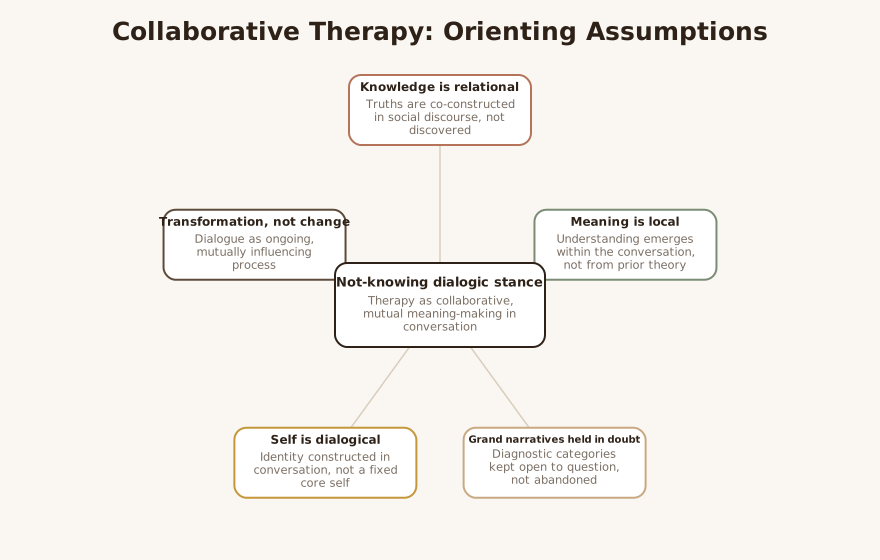
Anderson describes a set of interconnected, perspective-orienting assumptions that underpin the work.3 Several are especially load-bearing for clinicians.
Knowledge and language are relational, generative social processes. Theories, truths, and realities are not discovered but co-constructed in social discourse, produced in language, with all parties contributing.3 Meaning is local — it emerges from within the conversation rather than being imported from a pre-existing theory.3
Grand narratives and universal truths are seductive and risky. Dominant discourses and diagnostic categories can create “artificial” classes that obscure the uniqueness of a particular person and situation.3 Anderson does not call for abandoning inherited knowledge or psychological theory, but for holding it open to question and doubt.3
Self is a relational, dialogical concept. Identities are constructed in conversation rather than fixed within a bounded, autonomous “core self,” opening an emerging horizon of possibilities that cannot be known in advance.3
Transformation, not change. Because dialogue is an ongoing, mutually influencing process, Anderson prefers “transformation” to “change” — in living dialogic activity each participant, including the therapist, is influenced and cannot remain static.3
The central distinction underwriting practice is dialogue versus monologue. Monological talk is the domination of a single voice (or multiple non-connecting voices) — participants become “solo skyscrapers” side by side without doors or bridges between them.3 Dialogic engagement, by contrast, is a withness process: being spontaneously responsive to the other and to unfolding events, knowing and acting “from within the moment” rather than from the outside (“aboutness”).3
Interventions & Techniques
Collaborative-dialogic therapy resists being reduced to standardized procedures; Anderson explicitly frames it as non-formulaic and non-replicable across people or problems, with each therapist’s expression of the stance customized to each client.3 What follows are therefore characteristic ways of being and conversing, not a manualized protocol. LLM
The not-knowing stance. This is the best-known feature of the approach: the therapist avoids dogmatic postures and remains genuinely open to having their perspective altered by the client.1 In practice this means leading with curiosity, asking from a position of not-yet-understanding, and treating the client’s account as the primary source of expertise about their own life. LLM
Mutual inquiry / shared inquiry. The therapist orients so the client shares the engagement and “joint action,” with content, process, and outcome mutually determined as the conversation unfolds rather than dictated by a linear program.3
Withness and being “poised.” Rather than retreating to an internal theoretical schema and returning with an analyzed response, the therapist stays with the client — composed, calmed, and readied to respond spontaneously to whatever the present moment calls for.3
Privileging the client’s voice. The approach deliberately elevates the client’s experience and language, positioning therapist and client as conversational partners in transformation.6
The first conversation. Even the intake can be conducted from a collaborative-dialogic stance rather than as an expert-driven data-extraction exercise, reframing assessment as the beginning of a shared inquiry.4
LLM-generated illustrative example (not a guideline): A couple opens by demanding to know “who is right.” Rather than adjudicating, the therapist stays in a not-knowing posture — “Help me understand what each of you is hoping I’ll hear” — and lets the meaning of “right” be unpacked dialogically, so a new shared account of the conflict can emerge. LLM
Evidence Base
Honesty about maturity is important here. Collaborative-dialogic therapy is an established approach in the sense that it is long-recognized, widely taught internationally, and supported by a deep theoretical and clinical literature spanning several decades.3 It is not, however, supported by a robust base of randomized controlled outcome trials, and the provided sources contain no outcome data, effect sizes, or comparative trials. LLM
This reflects both the approach’s age-of-development and its own epistemology: a model that explicitly rejects standardized procedures and universal categories is intrinsically difficult to manualize and to study with conventional efficacy designs.3 LLM Indirect support can reasonably be inferred from the broader common-factors literature — the therapeutic alliance, collaboration, and client engagement are among the most consistent predictors of outcome across modalities — and collaborative-dialogic therapy places those relational factors at its center. LLM Clinicians should present the approach to clients and payers as a relationally grounded, theoretically rich practice, not as an empirically supported treatment with established efficacy for a specific disorder. LLM
Populations & Indications
The approach has been described as serving educated clients and those who distrust traditional, expert-driven psychotherapy, and as particularly suited to people whose lives sit outside dominant norms — including LGBTQ+ individuals, transgender, and gender-diverse clients and those living non-normative lifestyles.1 It is applied with families, couples, adults in individual psychotherapy, individuals from marginalized groups, people in conflict-laden relationships, and clients disillusioned with expert-driven care.1 LLM The literature also references work with adults carrying complex dual diagnoses, including substance use co-occurring with bipolar disorder, schizophrenia, psychosis, and body dysmorphic disorder — though, as noted below, such presentations call for considerable caution.1
The strongest indication is clinical situations where meaning, relationship, and being heard are central: identity questions, relational and family conflict, life transitions, and the experience of feeling disempowered or unheard. LLM
Problems-for-Work
- Relationship and family conflict. The dialogue-versus-monologue frame directly targets the “solo skyscraper” pattern in which family members talk past one another; the work creates connecting “bridges” between voices.3 LLM
- Communication difficulties. Mutual inquiry models a different quality of conversation that members can carry outside the room.3 LLM
- Identity concerns. The relational, dialogical view of self treats identity as an open, evolving horizon rather than a fixed deficit, which can be freeing for clients exploring who they are.3 LLM
- Life transitions and adjustment. A not-knowing, curiosity-led stance fits situations where there is no clear “right” path and meaning must be newly constructed.3 LLM
- Depression, anxiety, and meaning-making difficulties. The approach works with the client’s own language and dominant narratives rather than imposing a diagnostic script, which can loosen rigid, problem-saturated self-stories.1 LLM
- Feeling unheard or disempowered. Privileging the client’s voice and sharing ownership of the process directly addresses experiences of being “dismissed as numbers and categories.”3
Contraindications, Cautions & Cultural Humility
The collaborative-dialogic posture is a relational stance, not a clinical safety protocol. It does not replace risk assessment, crisis intervention, safety planning, or the use of evidence-based treatments where those are indicated. LLM In acute presentations — active suicidality, acute psychosis, ongoing abuse or violence, severe eating disorders, or medical instability — the clinician must shift into directive, structured, and protective modes; a not-knowing stance is contraindicated as the primary response in these moments. LLM Although the literature references work with psychosis and dual-diagnosis populations, such cases warrant integration with appropriate medical care, structured supports, and clear risk management rather than dialogue alone.1 LLM
The approach’s epistemological humility is itself a strong fit for cultural humility: it explicitly warns against generalizing dominant discourses and universal truths across peoples, cultures, and situations, and against creating artificial categories that depersonalize the other.3 At the same time, “not-knowing” should not become a passive license to withhold needed psychoeducation, clinical judgment, or mandated reporting. Anderson is clear that the stance does not require abandoning inherited knowledge or professional responsibility.3 LLM
Treatment-Plan Suggestions & SMART Objectives
| Goal | SMART objective (example) | Mechanism |
|---|---|---|
| Increase sense of being heard and engaged | Within 4 sessions, client reports (verbally or via brief check-in scale) feeling “understood” in at least 3 of 4 sessions | Withness stance; privileging the client’s voice 36 |
| Reduce monological conflict in a couple/family | Within 6 sessions, partners demonstrate, in session, at least 2 instances of reflecting the other’s meaning before responding | Dialogue replacing monologue; mutual inquiry 3 |
| Loosen a rigid, problem-saturated self-story | Within 8 sessions, client articulates at least 1 alternative, preferred account of the presenting concern | Self as relational/dialogical; meaning generated locally 3 |
| Build collaborative ownership of goals | By session 3, client co-authors a written list of their own therapy priorities in their own words | Shared ownership; content/process mutually determined 3 |
| Support meaning-making in a life transition | Over 6 weeks, client identifies and describes 2 new possibilities or perspectives not previously imagined | Generative language; transformation through dialogue 6 |
| Re-engage a client disillusioned with prior “expert” therapy | Within 2 sessions, client states therapy “feels different/collaborative” and agrees to continue | Not-knowing stance; dismantling expert hierarchy 16 |
| Reframe intake as shared inquiry | First session conducted as a dialogic conversation; client reports the intake felt collaborative rather than interrogative | Collaborative-dialogic first conversation 4 |
Common Misconceptions
“Not-knowing means the therapist has no knowledge or withholds expertise.” It does not. Anderson explicitly states the assumptions do not demand abandoning inherited psychological knowledge; not-knowing is a posture of humility and openness to revision, not ignorance or passivity.3 LLM
“It’s just being nice / unconditionally non-directive.” The stance is a disciplined relational practice — being “poised” and responsive in the present moment — not the absence of structure or clinical responsibility.3 LLM
“It rejects all diagnosis and theory.” The approach questions the generalizing and depersonalizing use of categories, not the existence of professional knowledge, which it explicitly retains.3 LLM
“There is a fixed technique to apply.” Anderson frames it as non-formulaic and uniquely expressed with each client, closer to a philosophy than a manualized method.3
“It’s an empirically supported treatment for specific disorders.” The provided literature supports it as a theoretically rich, established approach, not as an RCT-validated protocol. LLM
Training & Certification
There is no licensure pathway specific to collaborative-dialogic therapy; it is a stance learned and refined within existing mental health professions. LLM The principal hub for training and professional community is the Taos Institute, which is grounded in social-constructionist theory and collaborative practice and maintains a global network of associates with a structured “becoming an associate” pathway and educational offerings.5 Harlene Anderson’s own writings — including Conversation, Language, and Possibilities and her later Collaborative-Dialogic Practice texts — function as core training literature, alongside her work as a conference speaker, trainer, and consultant.26 Clinicians typically develop competence through reading, workshops, supervision, and reflective practice rather than a single credentialing exam.23 LLM
Key Terms
- Not-knowing — the therapist’s recommended stance of remaining flexible and open to having their perspective altered by the client, avoiding dogmatic postures.1
- Withness (vs. aboutness) — being spontaneously responsive from within the moment alongside the client, as opposed to analyzing them from an external theoretical distance.3
- Dialogue vs. monologue — connected, mutually responsive conversation versus the domination of single, non-connecting voices (“solo skyscrapers”).3
- Mutual / shared inquiry — joint action in which therapist and client co-determine content, process, and outcome.3
- Linguistic systems — the view of human systems as defined by language and communication rather than social or cybernetic structure.3
- Philosophical stance / way of being — the orientation that distinguishes the approach: a way of being with rather than a system of doing to or for.3
- Transformation — the preferred term for therapeutic movement, emphasizing an ongoing, mutually influencing dialogic process.3
- Relational/dialogical self — identity understood as constructed in conversation rather than as a fixed core self.3
Resources & Further Reading
▶ Watch — a video introduction to this concept:
- Collaborative therapy — Wikipedia
- Harlene Anderson — Official site (Books)
- Anderson, H. (2012). Collaborative Relationships and Dialogic Conversations (Family Process)
- First Conversations: Intakes From a Collaborative Dialogic Stance (Journal of Systemic Therapies, 2024)
- The Taos Institute
- Conversation, Language, and Possibilities (Harlene Anderson)
Reflective / Supervision Questions
- Where in my recent sessions did I slip from withness into aboutness — turning away to my theory and returning with an analyzed response? 3 LLM
- Whose voice is being privileged in this case formulation — the client’s, the referrer’s, the diagnostic category’s, or mine? 36 LLM
- When does my “not-knowing” serve the client, and when might it be a way of avoiding a clinical responsibility I should be exercising (risk, psychoeducation, structure)? 1 LLM
- Am I treating this client’s situation as “unfamiliar, exceptional, and extraordinary,” or am I navigating by pre-knowing and filling in the gaps? 3 LLM
- How would I document the medical necessity and observable goals of this dialogic work if a payer reviewed the chart? LLM
- In acute or high-risk presentations, do I have a clear plan for when to step out of the collaborative stance and into a directive, protective mode? LLM