
Type & Discipline
The not-knowing stance is a technique and therapeutic posture rather than a freestanding model of therapy. LLM It belongs to family therapy and, more precisely, to the collaborative and postmodern tradition that emerged from systemic and social-constructionist thinking. 2 Collaborative therapy, the approach in which the stance is embedded, conceives of the therapeutic relationship as a partnership in which client and therapist work together as conversational partners rather than as expert and recipient. 2 Within that frame, “not-knowing” names the specific attitude the therapist brings to the conversation: a deliberate willingness to be uncertain, curious, and informed by the client rather than to arrive armed with prior knowledge about what the client’s experience must mean. 1
For practicing clinicians the practical point is that not-knowing is method-portable. LLM Although it originates in the collaborative language-systems approach, it has been absorbed into narrative therapy, solution-focused brief therapy, and other postmodern practices, and it can inflect the stance a clinician takes in almost any modality that values curiosity over premature interpretation. LLM It is best understood not as a single move but as a way of being-in-conversation that shapes how questions are asked, how interpretations are held, and how authority is distributed in the room. 1
Creators & Lineage
The not-knowing stance was articulated by Harlene Anderson and Harold A. Goolishian, who together developed what they first called the “language-systems” or “collaborative language systems” approach to therapy. 1 Their influential 1988 paper, “Human systems as linguistic systems,” reframed the units that therapists work with: human systems are understood as language- and meaning-generating systems, and therapy is understood as a linguistic, conversational event in which new meaning can emerge. 1 From this premise it follows that the therapist cannot stand outside the client’s meaning system as a detached expert; problems are dissolved in language rather than fixed from above. 1
The lineage runs back through the systemic family therapy and the Galveston, Texas, group with which Anderson and Goolishian worked, and forward into the broader family of postmodern, social-constructionist therapies. LLM It is conceptually allied with narrative therapy and solution-focused brief therapy, which share a skepticism toward expert-imposed truth and a respect for the client’s own account, and it draws on social constructionism’s view that meaning is generated between people in dialogue rather than discovered in an objective world. 2 Anderson developed and consolidated these ideas in her 1997 book Conversation, Language, and Possibilities, which remains the fullest statement of the collaborative approach and of the not-knowing position within it. 5
A distinct but complementary line of development comes from Peter Rober, whose work on the therapist’s “inner conversation” examines the moment-to-moment interplay of knowing and not-knowing in the family therapy session. 3 Rober’s contribution is to resist a naive reading of not-knowing as pure emptiness, showing instead how the therapist constantly forms tentative, constructive hypotheses while holding them lightly. 3
Core Principles
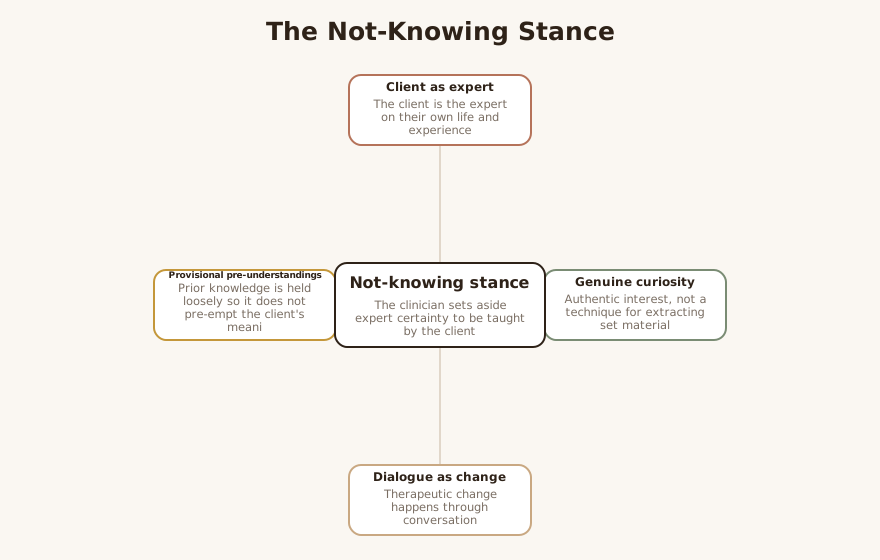
The first principle is that the client is the expert on their own life and experience, and the therapist is the expert on creating and sustaining the conversational space in which that expertise can be voiced. 2 Not-knowing does not mean the therapist knows nothing; it means the therapist refuses to let prior knowledge — diagnostic categories, theoretical schemas, assumptions about what a problem “really” is — pre-empt or close down the client’s own meanings. 1 The therapist’s pre-understandings are deliberately held as provisional and subordinate to what the client teaches them. 1
The second principle is genuine curiosity. 4 Anderson describes not-knowing as a way of being curious and being informed by the client, an orientation of authentic interest in what the other has to say rather than a technique for extracting predetermined material. 4 The stance carries an ethical and relational dimension: it treats the client as a knowledgeable partner, which redistributes power in a relationship that is otherwise structurally weighted toward the professional. 6
The third principle is dialogue as the engine of change. 1 In the language-systems view, therapeutic change is the emergence of new meaning and new narrative through conversation, not the application of an intervention to a passive system. 1 The therapist participates in, rather than directs, the generation of meaning, and the goal is to keep the conversation open and generative rather than to steer it toward a predetermined conclusion. 1 A fourth, values-based principle developed in later applications frames not-knowing as part of a relational, values-driven practice in which humility and respect for the other’s standpoint are themselves the point, not merely instruments. 6
Interventions & Techniques
The not-knowing stance is enacted less through discrete techniques than through a consistent quality of questioning and listening. LLM In practice the therapist asks questions from a position of genuine curiosity — questions whose answers the therapist does not already know — and lets each answer reshape the next question, so that the conversation is led by the client’s meanings rather than by the therapist’s hypothesis. 1 Anderson frames this as “being informed by the client,” with the therapist continually inviting elaboration and checking their understanding rather than asserting it. 4
Concrete enactments include withholding premature interpretation, asking the client to explain terms and meanings the therapist might otherwise assume they understand, and treating apparent “resistance” as feedback that the conversation has moved away from the client’s meaning. LLM Rober’s account adds nuance for the clinician: the therapist does form hypotheses — he calls this “constructive hypothesizing” — but these are inner, tentative, and dialogic, offered into the conversation provisionally rather than imposed as conclusions. 3 The therapist’s own inner conversation (the private stream of reactions, ideas, and hunches) becomes a resource to be used reflectively and disclosed selectively, rather than a hidden expert assessment running underneath the dialogue. 3
LLM-generated illustrative example (not a guideline): A father says his teenage son is “just lazy.” Rather than assessing for depression or correcting the label, the therapist asks from genuine not-knowing: “When you say lazy, what does that look like in a typical day — and what do you make of it?” The answer (“he stays up all night talking to friends overseas because that’s the only time they’re awake”) reshapes the next question and opens a meaning the therapist could not have supplied LLM.
Evidence Base
Honesty about maturity matters here. LLM The not-knowing stance is established in the sense that it is an influential, well-developed, and widely taught approach within family and collaborative-postmodern therapy, with a substantial conceptual literature anchored by Anderson and Goolishian’s foundational work. 15 It is not “established” in the sense of being validated by randomized controlled outcome trials. LLM Collaborative and postmodern therapies as a class have comparatively thin controlled-efficacy evidence, partly by design: their epistemology is skeptical of the standardized-manual, expert-measured paradigm that efficacy trials assume. LLM
The support for the stance is therefore primarily theoretical, clinical, and process-oriented rather than trial-based. LLM Its conceptual rigor is documented in peer-reviewed family-therapy scholarship — the original Family Process paper and Rober’s Journal of Marital and Family Therapy analysis of knowing and not-knowing in session — and in detailed clinical-practice accounts. 13 More recent work situates not-knowing within values-based, relational practice, extending it beyond therapy into wider helping contexts. 6 Clinicians should present it to themselves and to clients as a well-grounded, influential way of practicing whose value rests on relational and process evidence and theoretical coherence, not as an empirically supported treatment with a demonstrated effect size. LLM
Populations & Indications
Because the stance targets the relationship and the conversation rather than a specific disorder, it generalizes broadly. LLM It was developed primarily in work with families and couples, where competing accounts of “the problem” make any single expert framing contestable, and where a not-knowing posture lets each member’s meaning enter the room without the therapist adjudicating whose version is correct. 1 It is especially indicated with culturally diverse clients, where the therapist is unlikely to share the client’s frame of reference and where assuming expert knowledge of the client’s world risks misattunement; not-knowing operationalizes cultural humility by making the client the authority on their own context. 6
The stance is well suited to adolescents and to clients who feel disempowered or misunderstood by previous professionals, because it explicitly redistributes authority toward the client. LLM It is also foundational for clients engaged in narrative therapy, where the work of re-authoring depends on the therapist not pre-defining the meaning of the client’s story. 2 Finally, it has a distinctive indication for clinicians and trainees themselves, who are taught not-knowing as a corrective to the habitual pull toward premature expertise and as a discipline of reflective, dialogic practice. 3
Problems-for-Work
- Feeling misunderstood. When a client arrives convinced that no professional has grasped their experience, the therapist’s explicit not-knowing — asking to be taught rather than asserting understanding — directly counters the felt experience of being categorized and missed. 4
- Therapeutic rupture. Ruptures often follow the therapist imposing a meaning the client cannot accept; returning to a not-knowing posture, and inviting the client to correct the therapist’s understanding, is a repair move. 3
- Resistance in therapy. In the language-systems view, “resistance” is reframed as a signal that the conversation has drifted from the client’s meaning; the response is renewed curiosity, not increased pressure. 1
- Problem-saturated narratives. By refusing to ratify the problem as the fixed truth of the client and asking instead how the client understands and lives it, the therapist opens space for new meaning and alternative narrative to emerge in dialogue. 12
- Disempowerment. Treating the client as the expert on their own life rebalances the structural power asymmetry of the professional relationship. 6
- Family and relationship conflict. Holding multiple accounts as valid, without the therapist deciding who is right, lowers defensiveness and lets each member contribute to a shared, evolving understanding. LLM1
LLM-generated illustrative example (not a guideline): A couple is locked in “who started it.” Instead of forming a private verdict, the therapist stays in not-knowing — “I don’t yet understand what this fight means to each of you; can you each help me see it from inside your experience?” — which shifts the task from winning an adjudication to co-describing a pattern LLM.
Contraindications, Cautions & Cultural Humility
There is no hard contraindication to curiosity, but there are real cautions. LLM The most important is that not-knowing must never override the clinician’s safety and ethical responsibilities: in situations involving risk of harm, abuse, or acute crisis, the therapist’s duty to assess and act does not dissolve into open-ended curiosity, and a naive application of not-knowing that abdicates clinical judgment would be unsafe. LLM Not-knowing is a stance toward meaning, not a license to ignore mandated assessment or to withhold knowledge the client genuinely needs. LLM
A second caution is conceptual: not-knowing is easily caricatured as the therapist pretending to know nothing or being passive and content-free. 3 Rober’s work is the corrective — the skilled therapist is always forming tentative hypotheses and using their inner conversation, but holding these provisionally and dialogically rather than imposing them. 3 Performed insincerely, as a technique rather than a genuine attitude, the stance becomes a hollow performance the client can detect. LLM
On cultural humility the stance is, if anything, a natural ally. 6 By positioning the client as the expert on their own context and refusing to assume the therapist already understands the client’s world, not-knowing operationalizes the humility that cross-cultural work requires. 6 The caution here is to ensure that not-knowing does not become an excuse for the therapist to avoid doing their own learning about systemic and cultural context; curiosity in the room should complement, not replace, the clinician’s responsibility to be informed. LLM
Treatment-Plan Suggestions & SMART Objectives
| Goal | SMART objective (example) | Mechanism |
|---|---|---|
| Help client feel genuinely understood | Across 4 consecutive sessions, therapist checks understanding (“Have I got that right?”) at each major topic shift and client confirms accuracy in 3 of 4 sessions | Being informed by the client and verifying meaning counters the experience of being misunderstood 4 |
| Redistribute authority toward the client | By session 6, client sets the agenda at the start of 3 of 4 sessions, with the therapist following rather than directing | Treating the client as expert on their own life rebalances relational power 6 |
| Reduce defensiveness in family conflict | Within 8 sessions, therapist elicits and holds each member’s account without adjudicating, and family reports lower in-session escalation on a 1-5 rating | Holding multiple meanings as valid lowers threat and invites shared understanding 1 |
| Loosen a problem-saturated narrative | Over 5 sessions, therapist asks at least one “how do you understand/live this?” question per session, and client articulates one alternative meaning by session 5 | New meaning and narrative emerge through dialogue rather than expert correction 12 |
| Repair therapeutic rupture | Within 2 sessions of a rupture, therapist explicitly invites correction of their understanding, and client reports restored alliance on a session-rating item | Returning to a not-knowing posture and inviting correction is a repair move 3 |
| Strengthen culturally humble practice | For the next 6 sessions with a culturally different client, therapist asks the client to explain context-specific meanings rather than assuming them, logged each session | Positioning the client as authority on their own context operationalizes cultural humility 6 |
| Build trainee’s reflective stance | Over a 10-week supervision block, trainee records and reviews 4 sessions, identifying moments of premature certainty and re-posing them as not-knowing questions | Reflective use of the inner conversation curbs the pull toward premature expertise 3 |
Common Misconceptions
- “Not-knowing means the therapist knows nothing.” It does not; it means prior knowledge is held provisionally and is not allowed to pre-empt the client’s meanings, while the therapist remains the expert on facilitating the conversation. 12
- “It’s passive listening with no hypotheses.” Rober shows the skilled therapist continually forms tentative, constructive hypotheses and uses an active inner conversation — these are held lightly and offered dialogically, not abandoned. 3
- “It’s a technique you switch on.” Anderson frames it as a genuine attitude of curiosity and being informed by the client; performed as a mere technique without authentic interest, it rings false. 4
- “The client being the expert means the therapist has no role.” The therapist has a distinct and demanding expertise — creating and sustaining the dialogic space and keeping the conversation generative. 2
- “It abandons clinical judgment and safety responsibilities.” Not-knowing is a stance toward meaning and does not suspend the clinician’s duties to assess risk and act in crises. LLM
Training & Certification
There is no single licensing credential in the not-knowing stance itself; it is taught as part of training in collaborative, dialogic, and postmodern family therapy. LLM The primary text for self-directed study is Anderson’s Conversation, Language, and Possibilities, supplemented by the foundational Anderson and Goolishian paper and Rober’s analysis of knowing and not-knowing in session. 513 Skill development is best pursued experientially — through supervision that reviews recorded sessions for moments of premature certainty, and through deliberate practice of curiosity-led questioning. 3
International collaborative-therapy training communities, associated with the Houston Galveston Institute and related institutes that Anderson helped found, offer workshops and certificate programs in collaborative and dialogic practice in which not-knowing is a central teaching. LLM For clinicians grounded in another model, the most realistic pathway is to adopt the stance reflectively within existing practice, using supervision to track how holding interpretations more provisionally changes the conversation. LLM
Key Terms
- Not-knowing — a stance of genuine curiosity in which the therapist sets aside expert certainty so as to be informed and taught by the client. 14
- Client as expert — the principle that the client is the authority on their own life and experience, with the therapist expert in facilitating the conversation. 2
- Language-systems / collaborative language systems — Anderson and Goolishian’s reframing of human systems as meaning-generating linguistic systems. 1
- Dialogic understanding — understanding generated between participants in conversation rather than extracted by one party. 3
- Constructive hypothesizing — Rober’s term for the therapist’s tentative, provisional hypotheses, held lightly and offered dialogically. 3
- Inner conversation — the therapist’s private stream of reactions and hunches, used reflectively rather than as hidden expert assessment. 3
- Social constructionism — the view that meaning is generated between people in dialogue rather than discovered in an objective world. 2
Resources & Further Reading
▶ Watch — a video introduction to this concept:
- Anderson, H., & Goolishian, H. A. (1988). Human systems as linguistic systems. Family Process (Semantic Scholar record)
- Collaborative therapy — Wikipedia overview
- Rober, P. (2002). Constructive hypothesizing, dialogic understanding and the therapist’s inner conversation (PubMed)
- Interview: The Wisdom of Not Knowing — A Conversation With Harlene Anderson (ResearchGate)
- Anderson, H. (1997). Conversation, Language, and Possibilities: A Postmodern Approach to Therapy (PDF)
- A not-knowing, values-based and relational approach (White Rose / University of Leeds eprint, PDF)
Reflective / Supervision Questions
- In your last session, where did you assume you knew what the client meant before they had finished telling you? What might you have missed? 1
- When you notice “resistance,” do you increase pressure or return to curiosity? What would treating it as feedback about the conversation change? 1
- How do you hold your hypotheses — as conclusions you are confirming, or as tentative ideas offered into the dialogue and open to correction? 3
- With clients whose cultural context differs from yours, how do you ask to be taught rather than assuming you already understand? 6
- Where is the line, for you, between a genuine not-knowing stance and your non-negotiable responsibilities for safety and risk assessment? LLM
- Does your not-knowing feel like an authentic attitude, or does it ever become a performed technique the client might sense as hollow? 4