
Type & Discipline
Re-membering conversations are a structured therapeutic practice drawn from narrative therapy, a tradition situated within family therapy and the broader field of social-constructionist counseling 1. The practice is a technique — a defined conversational map with a recognizable shape — rather than a stand-alone modality; it is deployed inside the larger narrative therapy framework alongside externalizing conversations, re-authoring conversations, and definitional ceremonies 2. The word “re-membering” is a deliberate double meaning: it points both to recollection and to the re-organizing of “membership” in a person’s life, the way one might add or remove members of a club 1. The discipline that houses it treats identity not as a fixed inner essence but as something produced and sustained in relationship with others 4.
The technique rests on a particular metaphor: that a person’s identity is shaped by an “association of life” or “membership,” a kind of club whose members are the significant figures, past and present, who have contributed to who that person is 4. In a re-membering conversation, the therapist treats this membership as something that can be revised — the standing, voice, and influence of any given figure can be raised or lowered 3. This reframes identity work as something relational and editable rather than introspective and static 4.
Creators & Lineage
The practice was developed by Michael White, the Australian social worker and family therapist who, with David Epston, co-founded narrative therapy and the Dulwich Centre in Adelaide 1. White first articulated re-membering conversations in his collection Narratives of Therapists’ Lives (1997) and later gave the practice its most complete map in Maps of Narrative Practice (2007) 12. The Dulwich Centre remains the primary custodian of White’s work, including a substantial video archive of his teaching and demonstration interviews 5.
The term “re-membering” White borrowed directly from the cultural anthropologist Barbara Myerhoff, who used it to describe a special kind of recollection that re-aggregates the figures of a life into a meaningful membership 4. Myerhoff’s ethnographic studies of an elderly Jewish community in Venice, California — particularly her concept of “definitional ceremony,” in which a community gathers to witness and authenticate one another’s identities — became a central source for White’s later narrative practices 4. The lineage thus runs from cultural anthropology and social constructionism into family-systems-informed therapy, where it converges with a relational understanding of self 4. The practice also sits comfortably alongside the continuing-bonds theory of grief, which holds that ongoing connection to the deceased can be healthy rather than pathological — a stance re-membering conversations enact in practice LLM.
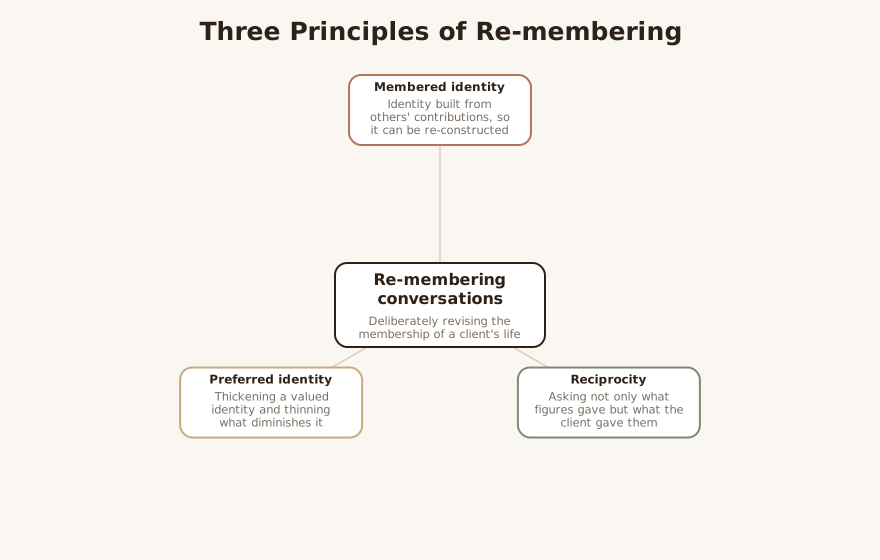
Core Principles
The first principle is that identity is a membered association rather than a solitary, encapsulated self 4. Who we understand ourselves to be is built from the contributions of others across our lives, and those contributions can be deliberately revisited 3. Because the membership is constructed, it can be re-constructed — figures can be upgraded, downgraded, honored, recruited, suspended, or revoked 3.
The second principle is reciprocity, and it is the engine of the practice 2. Re-membering conversations do not simply ask what a significant figure gave to the client; they also ask what the client contributed to the life of that figure, and how the client’s existence shaped how that person came to see themselves and the world 2. This two-way movement is what distinguishes the practice from ordinary reminiscence — it positions the client not as a passive recipient of others’ influence but as an active contributor to others’ lives 4.
The third principle is preferred identity 2. The point of revising the membership is to thicken a version of the client’s identity that they value and to thin the influence of figures and accounts that diminish it 3. A figure whose voice supports the client’s preferred values is given a louder seat; a figure whose voice has fueled self-criticism or shame may be moved to the margins, have their membership questioned, or be revoked from the club altogether 3. The conversation is therefore evaluative and intentional, guided by the client’s own assessment of which contributions they want amplified 2.
Interventions & Techniques
White’s map of re-membering conversations is organized around two inquiries, each with two stages, giving four broad categories of question 2. The first inquiry concerns the figure’s contribution to the client’s life: the therapist invites the client to recount what a particular member gave them, then asks what this contribution reveals about what the client gives value to or holds as important in life 2. The second inquiry reverses the direction: the therapist asks what the client contributed to the life of the figure, then asks how this contribution may have shaped that figure’s identity and sense of themselves 2.
In practice the therapist begins by helping the client identify a member of significance — often someone who saw something valuable in the client, who may be living or dead, known personally or known only through reputation, and who may even be a fictional character, a childhood pet, or a public figure 3. The conversation then moves through richly descriptive questions that develop the figure’s contribution, the client’s reciprocal contribution, and the implications of both for the client’s preferred identity 2. Where the work is about a difficult or harmful figure, the therapist can support the client in downgrading or revoking that figure’s membership, dislodging the authority of a voice that has sustained a problem-saturated account 3.
Re-membering conversations are frequently paired with outsider-witness practices and definitional ceremonies, in which invited witnesses retell what they have heard, further authenticating the client’s preferred story 4. White’s recorded demonstrations of these linked practices are preserved in the Dulwich Centre’s video archive and are a useful study resource for clinicians learning the rhythm of the questions 5.
LLM-generated illustrative example (not a guideline): A client grieving a grandmother who died years earlier is asked not only what the grandmother taught her about patience, but what she — as a small, watchful child — brought to her grandmother’s later years. Recognizing that she gave her grandmother “someone to be gentle for” lets the client hold the relationship as a living, two-way bond rather than a closed loss LLM.
Evidence Base
The maturity of re-membering conversations is best described as established practice rather than empirically validated treatment LLM. The technique has a clear theoretical foundation, a detailed published practice map, and decades of clinical use and teaching disseminated through the Dulwich Centre and allied training bodies 125. It is widely taught and applied across grief, trauma, and identity work 34.
However, the evidence base consists largely of theory, detailed case description, and practitioner consensus rather than randomized controlled trials of the specific technique LLM. Clinicians should be honest with clients and referrers that narrative practices in general, and re-membering conversations in particular, rest on a constructionist and qualitative tradition of evidence rather than on the controlled-trial literature that supports protocols such as prolonged exposure or cognitive processing therapy LLM. This does not make the practice unfounded — its premises about continuing bonds in grief align with contemporary bereavement theory — but the strength of recommendation is grounded in coherence and clinical utility more than in outcome trials LLM.
Populations & Indications
Re-membering conversations are applied with individuals, families, and groups, and are well suited to adults, older adults, and young people 3. They are most clearly indicated for bereaved clients, where the practice allows a relationship with a deceased person to be revised and continued rather than severed 4. They are also used with trauma survivors, with people facing identity concerns or major life transitions, and with clients carrying loss-related distress that has thinned their sense of who they are 14.
The practice is particularly resonant for older adults, given its roots in Myerhoff’s work with an aging community and its capacity to gather a long life’s worth of contributions into a coherent membership 4. It is equally applicable to clients struggling with loneliness or isolation, because it re-populates a life that may feel empty by recruiting and re-valuing absent or distant figures LLM. For people whose presenting identity is dominated by self-criticism, the practice offers a route to amplify supportive voices and demote denigrating ones 3.
Problems-for-Work
The clearest problem-for-work is grief and bereavement, including complicated grief 4. Re-membering conversations let a client “say hello again” to a lost figure by reincorporating that person’s contribution into ongoing life rather than treating grief as a problem of letting go 4.
LLM-generated illustrative example (not a guideline): For a client with prolonged grief after a parent’s death, the clinician develops not just memories but the parent’s living legacy — what the parent valued in the client, and what the client gave the parent — so the bond is reorganized into a sustaining presence rather than an open wound LLM.
A second domain is trauma, low self-esteem, and self-criticism 13. Where a client’s identity has been colonized by the voice of an abuser or a harshly critical figure, the practice supports downgrading or revoking that figure’s membership and elevating figures who saw the client’s worth 3.
LLM-generated illustrative example (not a guideline): A trauma survivor is helped to formally “revoke the membership” of a critical caregiver whose voice still narrates their failures, while recruiting a former teacher who believed in them into a more central, louder position in the club of life LLM.
A third domain is identity issues, loneliness, depression, and loss-related distress 14. Here the practice re-thickens a preferred identity by drawing on the full membership of a life rather than the impoverished story the problem has been telling 4.
Contraindications, Cautions & Cultural Humility
Re-membering conversations have no formal medical contraindications, but several cautions apply LLM. When a significant figure is also a perpetrator of harm, the therapist must take care that re-membering does not become an implicit pressure to honor or forgive that figure — the client’s right to downgrade or revoke a membership should be foregrounded, not softened 3. The practice should follow the client’s own evaluation of which contributions they value, never the therapist’s assumptions about which relationships ought to matter 2.
Cultural humility is intrinsic to the tradition rather than an add-on, since the metaphor itself came from ethnographic attention to a specific cultural community 4. Conceptions of who counts as a member of one’s life, how the dead remain present, and whether ongoing bonds with ancestors are normative vary widely across cultures, and the therapist should let the client define the terms of their own membership rather than imposing a particular frame of continuing bonds LLM. With clients in acute crisis, severe dissociation, or active suicidality, stabilization should precede this reflective and identity-focused work LLM.
Treatment-Plan Suggestions & SMART Objectives
| Goal | SMART objective (example) | Mechanism |
|---|---|---|
| Reorganize a grief relationship | Within 6 sessions, client will identify and describe in detail the two-way contributions of one deceased significant figure, articulating one way that bond can continue to support daily life | Reciprocity inquiry that reframes loss as a continuing bond 4 |
| Reduce influence of a critical voice | Within 4 sessions, client will name one denigrating figure and describe two ways its influence will be downgraded in their “club of life” | Downgrading membership to thin a self-critical account 3 |
| Recruit supportive members | By session 5, client will identify three figures who recognized their worth and articulate what each contributed to their preferred identity | Upgrading membership to thicken preferred identity 2 |
| Strengthen sense of agency | Within 8 sessions, client will describe, for two members, what they contributed to those figures’ lives | Reverse-direction questioning that positions client as a contributor 2 |
| Counter loneliness/isolation | By session 6, client will map a membership of at least five figures (living, deceased, or fictional) and rate the felt presence of each | Re-populating an impoverished life narrative 3 |
| Authenticate preferred identity | Within treatment, client will participate in one outsider-witness retelling and report which witness reflection most affirmed their values | Definitional-ceremony witnessing that authenticates identity 4 |
| Consolidate gains | By discharge, client will produce a personal account of their revised “club of life,” naming who was upgraded, downgraded, or revoked and why | Integration of re-membered identity into a durable narrative 1 |
Common Misconceptions
A first misconception is that re-membering is simply reminiscing or recollection 4. The practice deliberately moves beyond recall toward a reciprocal, evaluative re-organizing of a membership, and the second-direction questions — what the client gave the figure — are precisely what mark the difference 24. A conversation that only catalogs memories has not yet become a re-membering conversation 4.
A second misconception is that grief work must aim at “letting go” or “closure” 4. Re-membering conversations explicitly resist this; they help clients say hello again and keep a relationship membered, aligning with the view that continuing bonds can be healthy 4. A third misconception is that members must be living people the client knew well, when in fact a member can be deceased, a public figure, a fictional character, or even an animal — anyone whose contribution matters to the client’s preferred identity 3.
A fourth misconception is that the technique requires honoring every significant figure 3. On the contrary, a core move is the capacity to downgrade, suspend, or revoke a membership, giving clients a structured way to demote harmful voices rather than enshrine them 3.
Training & Certification
There is no single licensing body that certifies “re-membering conversation” practitioners; competence is developed within narrative therapy training LLM. The foundational texts for self-directed study are White’s chapter on the practice in Narratives of Therapists’ Lives and the dedicated chapter in Maps of Narrative Practice 12. The Dulwich Centre in Adelaide is the principal training institution for narrative therapy and offers courses, publications, and a video archive of White demonstrating the practice in live interviews 5.
Practical, applied introductions also exist for allied practitioners, such as the YouthAOD Toolbox module on re-membering, which orients youth alcohol-and-other-drug workers to the technique 3. Academic programs that teach narrative and constructionist practice — for example, university wikis documenting re-membering and outsider-witness retelling — provide additional study material 4. Clinicians are best served by combining text study with supervised practice and review of recorded demonstrations 5.
Key Terms
Membership / “club of life.” The metaphor that identity is composed of the significant figures who have contributed to a person’s life, whose standing can be revised 4.
Re-membering. The deliberate re-aggregation and re-ranking of a life’s significant figures, a term White adopted from Barbara Myerhoff 4.
Reciprocity / two-way contribution. The inquiry into both what a figure gave the client and what the client gave the figure, central to the practice 2.
Upgrading and downgrading membership. Raising or lowering the voice, status, and influence of a given figure within the client’s identity 3.
Definitional ceremony. A Myerhoff-derived practice in which witnesses gather to acknowledge and authenticate a person’s identity claims 4.
Outsider-witness retelling. The structured retelling by invited witnesses that thickens and validates the client’s preferred story 4.
Preferred identity. The valued version of self that the conversation seeks to thicken and sustain 2.
Resources & Further Reading
▶ Watch — a video introduction to this concept:
- Re-membering Conversations — Michael White (Dulwich Centre, from Narratives of Therapists’ Lives, 1997)
- Maps of Narrative Practice (Michael White, 2007, W.W. Norton)
- E9. Re-membering — YouthAOD Toolbox
- Re-membering Conversation and Outsider Witness Retelling — UMass Boston (CCT wiki)
- Michael White Video Archive — The Dulwich Centre
Reflective / Supervision Questions
- When I invite a client to develop a member of significance, am I asking the reverse-direction questions — what the client contributed to that figure — or am I stopping at recollection? 2
- Whose evaluation is steering which figures get upgraded or downgraded: the client’s or my own assumptions about which relationships should matter? 2
- With a client whose significant figure caused harm, how do I ensure that re-membering does not become a subtle pressure to honor or forgive rather than an invitation to downgrade or revoke? 3
- How does my own cultural frame about the dead, ancestors, and continuing bonds shape the memberships I find it easy or hard to take seriously? 4
- Am I treating this client’s grief as a problem requiring “closure,” or am I leaving room for a continued, re-membered bond? 4
- Where in this client’s work might an outsider-witness retelling further authenticate the preferred identity we have been developing? 4