
Type & Discipline
Exception-finding questions are a core clinical technique rather than a stand-alone modality; they belong to the question repertoire of solution-focused brief therapy and are most at home in family therapy and clinical psychology 1. An exception-finding question asks the client to locate and describe times when the presenting problem could have occurred but did not, or occurred with less intensity, so that the client’s own already-existing solutions become visible and repeatable 1. The technique is a conversational move, not a protocol — deployed flexibly alongside the miracle question, scaling questions, and coping questions, and defined by its target (the exception) rather than by a fixed wording 2.
The discipline is solution-focused brief therapy as practiced within counseling and clinical psychology, with strong roots in marriage and family therapy and the brief-therapy tradition of the Brief Family Therapy Center 5. Because exception-finding is a technique embedded in a larger modality, the clinician should treat it as one tool within a coherent solution-focused stance rather than an intervention that stands alone — its power depends on the surrounding posture of curiosity, client-as-expert collaboration, and a deliberate turn away from problem-saturated talk 1. It is brief by design, present- and future-oriented, and aimed at the smallest sufficient change rather than insight or characterological reconstruction 5.
Creators & Lineage
Exception-finding questions were developed and named within solution-focused brief therapy by Steve de Shazer and Insoo Kim Berg, the co-founders of the Brief Family Therapy Center in Milwaukee, who built the approach inductively through close observation of which therapist questions actually preceded client change 5. Berg in particular became the signature clinical teacher of the method, and recorded demonstrations of her interviewing — including her characteristic gentle, persistent pursuit of exceptions and competencies — remain a primary training resource for the technique 6. The exception question sits in the same family as the other de Shazer and Berg devices: the miracle question, scaling questions, and coping questions, all of which steer attention toward resources, goals, and times the problem is absent 1.
The lineage is integrative and brief-therapy-rooted LLM. The most proximate parent is solution-focused brief therapy itself, which supplies the future orientation, the non-pathologizing assumption that clients have resources, and the conviction that small differences seed larger change 1. Strategic family therapy and the broader brief-therapy tradition contribute the interest in interactional patterns and in interrupting the “more of the same” attempted solutions that maintain problems 5. Narrative therapy is a sibling rather than an ancestor, but it shares the premise that people are not identical to their problems and that overlooked non-problem moments — what narrative therapists call “unique outcomes” — can be thickened into a different story; exception-finding and unique-outcome work are close cousins LLM. The wider strengths-based movement provides the surrounding ethos that competence, not deficit, is the productive focus of clinical attention 5.
Core Principles
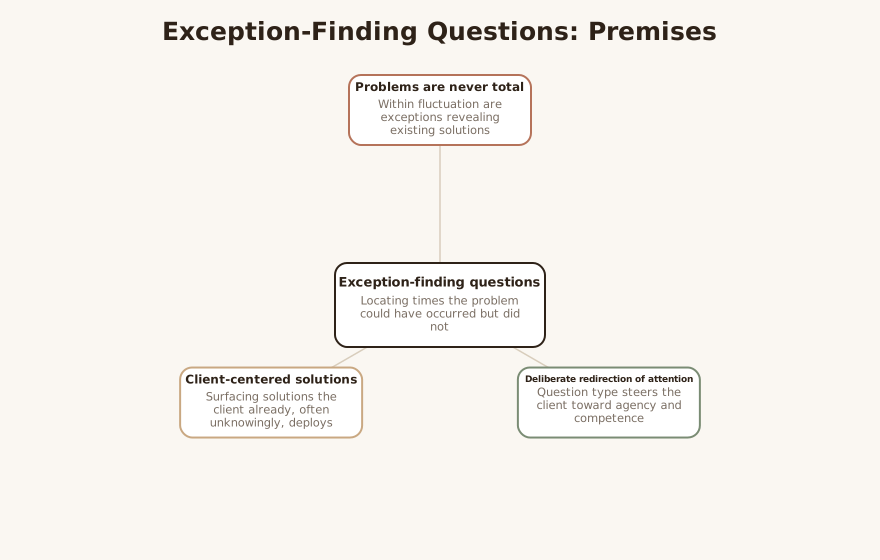
The organizing premise is that problems are never total — even the most entrenched complaint has fluctuation, and within that fluctuation are exceptions: occasions when the problem was milder, briefer, absent, or better handled 1. Solution-focused theory holds that these exceptions are not random noise but evidence of solutions the client is already, often unknowingly, deploying; the therapist’s job is to make them visible, deliberate, and repeatable rather than to manufacture new solutions from scratch 1.
A second principle is the deliberate redirection of attention. The questions a therapist asks shape what the client notices and reports; problem-focused questions tend to elicit more problem-talk and can deepen a sense of stuckness, whereas exception-oriented questions direct the conversation toward agency, competence, and times things went better 2. Research comparing solution-focused and problem-focused questioning supports the idea that the type of question carries differential effects on a client’s mood and self-perception, which is the empirical heart of why the exception question is more than a stylistic preference 2.
A third principle is the client-as-expert, non-pathologizing stance: the client holds the knowledge of what worked, and the therapist’s role is genuine curiosity about the detail of the exception rather than interpretation or instruction 1. A fourth is amplification through detail — an exception only becomes useful when unpacked concretely: what was different, who did what, what made it possible, and how the client might do more of it on purpose 1. A fifth is the smallest-sufficient-change logic: a single well-explored exception can seed a behavioral experiment, so the therapist looks for the minimum viable difference rather than wholesale transformation 5.
Interventions & Techniques
The exception question comes in several recognizable forms, all aimed at locating non-problem moments and then amplifying them 1. The direct exception inquiry asks, in effect, “Tell me about a time recently when the problem didn’t happen, or happened less” — followed immediately by the amplifying follow-ups that do the real work: “What was different? What did you do? How did you manage that?” 1. Because clients often answer with “I don’t know” or “it’s always there,” the skilled clinician persists gently, narrows the time frame (“even a slightly better hour this week?”), and treats any reported exception, however small, as significant 2.
Exception-finding is rarely used alone; it is interwoven with the rest of the solution-focused toolkit 1. Scaling questions (rating progress 0–10) are frequently paired with exceptions — asking what is already keeping the client at a 3 rather than a 1 is an exception inquiry in numeric clothing 1. The miracle question generates a preferred future, and the therapist then mines the present for fragments of that miracle already occurring, which are exceptions 1. Coping questions (“how have you managed to keep going given all this?”) locate exceptions inside apparent total distress, and are the safer entry point when a client is overwhelmed 1. Compliments and competence-spotting consolidate the exception by naming the strength it reveals 5.
Two further moves complete the technique. Eliciting the client’s theory of the exception — asking what they think made the better moment possible — anchors change in the client’s own causal account rather than the therapist’s 1. And task-setting: once an exception is understood, the therapist may invite the client to “do more of what works,” turning the remembered exception into a between-session experiment 5.
LLM-generated illustrative example (not a guideline): A client says, “My anxiety is constant, it never lets up.” The clinician narrows the frame: “Was there even a short stretch this week — an hour, twenty minutes — when it eased a little?” The client recalls a walk with the dog on Tuesday morning. The clinician slows down: “What was different about Tuesday morning? What were you doing, where were you, what was going through your mind?” Together they identify that movement, daylight, and being away from email lowered the dread — an exception that becomes a small, testable plan rather than a therapist’s prescription LLM.
Evidence Base
The honest label for this technique’s maturity is established within an established modality, with an important qualification LLM. Exception-finding does not have a large body of trials isolating it as a single ingredient; its evidence is largely inherited from solution-focused brief therapy as a whole, which now has a substantial and maturing outcome literature 3. A 2024 meta-analysis of solution-focused brief therapy reported meaningful benefits across common presentations, supporting its standing as an effective brief intervention 3. A 2024 umbrella review synthesizing prior meta-analyses likewise concluded that the modality is effective across a range of problems and populations, while noting variability in study quality that tempers the conclusion 4.
Where the exception question specifically has been studied, the most relevant evidence is the experimental work comparing solution-focused questions — miracle, exception, and scaling — against problem-focused questions, which found that the type of question produces differential effects on participants’ affect and self-efficacy 2. This matters because it isolates the questioning style, rather than the whole therapy package, as an active variable, lending specific support to the claim that exception-oriented inquiry does something distinct 2. The research summaries maintained by the solution-focused community further catalogue the accumulating controlled and quasi-experimental literature on the modality 7.
The fair summary for practice is that exception-finding is a well-theorized, widely taught technique whose direct, component-isolated evidence is modest but real, situated inside a modality whose overall outcome evidence is genuinely established though heterogeneous in quality 4. It is responsibly presented to clients and supervisees as a credible, evidence-supported technique rather than as a stand-alone, trial-proven cure for any specific diagnosis LLM.
Populations & Indications
Exception-finding was developed in general outpatient and family practice and is broad in its indications 5. Adults with depression, anxiety, low self-esteem, and demoralization are core, because the technique directly counters the totalizing “it’s always like this” appraisal 1. Adolescents and children often respond well to its concrete, non-pathologizing, jargon-light style, which avoids positioning the young person as the diagnosed problem and instead asks them, as competent informants, what was different on a better day 5. Couples and families are a natural fit given the family-therapy lineage, where exceptions to a recurring conflict cycle can be located and rehearsed 5.
Clients in brief therapy — in time-limited or single-session settings — are well matched, since a single well-explored exception can yield an actionable next step quickly 5. Mandated clients, who may arrive guarded, are a notable indication: because the technique presumes competence and does not require confessing pathology, it can sidestep the power struggle that problem-focused questioning often provokes, inviting collaboration around times things went acceptably 1. The general indication is any presentation marked by a “nothing ever works” story where evidence of intermittent competence can realistically be found and amplified 1.
Problems-for-Work
In depression and hopelessness, the work pairs validation of the low mood with patient exception-finding — locating the slightly better hours and unpacking what the client did to make them possible — on the principle that visible, owned evidence of agency erodes the global hopeless appraisal 3. In anxiety, exception inquiry converts “it’s constant” into specific, addressable contexts where dread eased, generating concrete behavioral experiments 2. In low self-esteem, the detailed exploration of an exception functions as competence-spotting: the client supplies the evidence of their own capability rather than receiving reassurance from the therapist 5.
LLM-generated illustrative example (not a guideline): With a parent and adolescent locked in nightly homework battles, a clinician asks, “Was there an evening this week, even one, when it went a bit smoother?” They recall a Thursday when the parent waited until after dinner and the teen started without being asked twice. The clinician unpacks exactly what each person did differently, and the family leaves with a small experiment — repeat the Thursday sequence — rather than a lecture on conflict LLM.
In relationship conflict and parent-child conflict, exceptions to the recurring fight are located and the behaviors that produced the better moment are made explicit and repeatable, interrupting the “more of the same” cycle 5. In behavioral problems with children, the focus shifts from cataloguing misbehavior to the times the child managed well, which the adults can then reinforce 5. In substance use problems, coping and exception questions surface the occasions a client declined or moderated use and what made that possible, building on existing self-control rather than starting from deficit — used cautiously and within a comprehensive plan 1. In goal-setting difficulties, exception-finding supplies raw material for goals by showing the client what “better” has already concretely looked like 1.
Contraindications, Cautions & Cultural Humility
The central caution is timing and validation: jumping to “tell me about a time it wasn’t a problem” before the client feels their suffering has been heard reads as dismissive or as toxic positivity, and is especially damaging with trauma survivors, the acutely grieving, and clients in crisis LLM. Coping questions are the safer first move in these situations, because they acknowledge the weight of the problem (“how have you even kept going?”) while still orienting toward strength 1. The technique is not a substitute for risk assessment: with active suicidality, psychosis, severe eating disorders, or acute safety concerns, exception-finding’s brief conversational frame is insufficient on its own and should at most be integrated within a more comprehensive, safety-prioritizing treatment plan LLM.
A further caution is that an exception can misfire when it depended on circumstances outside the client’s control — if the better day happened because a stressor was temporarily absent, implying the client should be able to reproduce it at will is both clinically wrong and quietly blaming LLM. The clinician must distinguish a replicable exception from a lucky one and pace expectations accordingly LLM. The technique can also slide into minimization when distress is driven by active abuse, poverty, or discrimination; “doing more of what works” cannot substitute for naming and addressing genuine external harm, and placing the burden of change on the individual in such cases is an ethical error LLM.
Cultural humility matters because the technique’s premises — that the individual has agency, that talking about personal strengths is comfortable, that a “better day” is self-authored — are not culturally neutral LLM. Clients from collectivist or hierarchical contexts may locate both problem and solution in family or community and may find direct competence-talk immodest; the questions should be adapted so the exception can be framed relationally (“when did your family handle this better?”) rather than purely individually LLM. The honest stance is to fit the technique to the client’s worldview, not the reverse LLM.
Treatment-Plan Suggestions & SMART Objectives
| Goal | SMART objective (example) | Mechanism |
|---|---|---|
| Counter the “it’s always like this” appraisal | Client identifies and describes one exception — a time the problem was absent or milder — each week for 4 consecutive weeks | Exception-finding makes existing competence visible and erodes a totalizing problem-story 1 |
| Convert global distress into addressable terms | Client names one specific context in which the problem eased and the behavior that helped, within 2 sessions | The type of question redirects attention from problem-talk to agency 2 |
| Make change measurable and exception-anchored | Client uses a 0–10 scaling rating each session and identifies what keeps them above a 1, for 6 weeks | Scaling reframed as exception inquiry defines the smallest sufficient next step 1 |
| Turn a remembered exception into a plan | Client repeats one identified “what works” behavior as a between-session experiment for 3 weeks | “Do more of what works” task-setting operationalizes the exception 5 |
| Increase self-efficacy through owned evidence | Client articulates, in their own words, what they did to produce one better moment each week for 4 weeks | Eliciting the client’s theory of the exception anchors agency in the client 1 |
| Enter strength-talk safely when overwhelmed | Clinician uses a coping question and the client names one way they have managed, each session for 4 weeks | Coping questions locate exceptions inside apparent total distress 1 |
| Interrupt a recurring relational cycle | In couples or family work, partners identify and rehearse one exception to the conflict over 3 weeks | Exception-finding surfaces the specific behaviors that produced a better outcome 5 |
Common Misconceptions
The first misconception is that exception-finding is “just positive thinking” or a refusal to discuss problems; in fact it is a disciplined search for real, observable evidence of competence the client has already shown, not an instruction to feel better 1. A second is that it requires ignoring the client’s pain; skilled use begins by acknowledging the difficulty — often via a coping question — before turning toward exceptions 1. A third is that exceptions must be large or dramatic; the method treats even a slightly better hour as significant, because small differences are the seeds of larger change 1. A fourth is that it is interchangeable with simply giving compliments; the active ingredient is the detailed, client-led unpacking of what made the exception possible, not the praise itself 1. A fifth is that, because it sits inside a brief therapy, it must be superficial; the brevity is a discipline of focus, and a single exception explored deeply can be more potent than a long problem history 5. A sixth is treating the technique as a fully trial-validated stand-alone intervention; its direct, component-isolated evidence is modest, and its strength is mostly inherited from the broader modality 4.
Training & Certification
There is no separate license for exception-finding; it is learned as part of training in solution-focused brief therapy, taught through the foundational texts of de Shazer and Berg, through workshops, and through observation of recorded master interviews 5. The recorded demonstrations of Insoo Kim Berg are an especially valued training resource, because the technique’s difficulty lies less in the wording of the question than in the patient, curious follow-up that amplifies a small exception into something usable 6. Practitioner-facing explainers from clinical and professional sources offer accessible introductions to the question repertoire for clinicians new to the approach 1.
Several organizations offer training and graduated recognition in solution-focused brief therapy, and the research and training resources maintained by the solution-focused community provide both the evidence summaries and the practice guidance that support competent use 7. The practical path for a licensed clinician is to study the source material, watch the technique performed, and then practice the validation-before-exception sequencing and the amplifying follow-up under supervision, integrating it within their existing scope of practice rather than treating it as a separate credential LLM.
Key Terms
Exception — a time when the problem was absent, milder, briefer, or better handled, treated as evidence of an already-existing solution to be unpacked and amplified 1. Exception-finding question — a question that locates and then elaborates such a time, including the amplifying follow-ups about what was different and how the client managed it 1. Coping question — an exception inquiry framed to first acknowledge distress (“how have you kept going?”), used when the client is overwhelmed 1. Scaling question — a 0–10 self-rating that doubles as exception inquiry when the therapist asks what keeps the client above the bottom of the scale 1. Miracle question — a structured invitation to describe a preferred future, from which present-day fragments are mined as exceptions 1. Client-as-expert — the stance that the client holds the knowledge of what works and the therapist’s role is genuine curiosity, not instruction 1. Do more of what works — the task-setting move that turns an identified exception into a between-session experiment 5. Unique outcome — the narrative-therapy cousin of the exception: an overlooked non-problem event that can be thickened into a different story LLM.
Resources & Further Reading
▶ Watch — a video introduction to this concept:
- Solution Focused Brief Therapy (SFBT) — Psychology Tools
- Neipp et al. — Solution-Focused versus Problem-Focused Questions: Differential Effects of Miracles, Exceptions and Scales
- The current evidence of solution-focused brief therapy: A meta-analysis (2024, J Behav Ther Exp Psychiatry)
- Effectiveness of solution-focused brief therapy: An umbrella review (2024, Psychotherapy Research)
- Solution-Focused Brief Therapy — Psychology Today
- Insoo Kim Berg: Solution-Focused Therapy demonstration (video)
- Research in Solution-Focused Therapy — Solution-Focused Therapy Institute
Reflective / Supervision Questions
- When a client answers your exception question with “it’s always like this,” how do you persist without pressuring, and what tells you to narrow the time frame versus switch to a coping question? LLM
- How do you confirm a client feels their distress was genuinely heard before you turn toward exceptions, especially with trauma survivors or the acutely grieving? LLM
- How do you distinguish a replicable exception the client produced from a lucky one that depended on circumstances outside their control, and how does that change the task you set? LLM
- When a client’s distress is rooted in active harm or structural constraint, how do you use exception-finding without implying the burden of change rests on them rather than the situation? LLM
- Where does your own use of strength-talk carry individualist cultural assumptions, and how might you reframe the exception question relationally for a client from a collectivist context? LLM
- Given that the component-specific evidence for exception-finding is modest while the modality’s overall evidence is more established, how do you describe the technique honestly to a client or supervisee? LLM
- How do you keep the amplifying follow-up — the detailed unpacking of what made the exception possible — from collapsing into mere compliments? LLM