
Type & Discipline
Possibility Therapy is a stand-alone, solution-oriented brief psychotherapy developed within clinical psychology and the family-therapy tradition 1. It is best classified as a collaborative, future-and-strengths–oriented modality rather than a pathology-focused one, and it positions itself within the broader family of solution-oriented and solution-focused brief therapies 3. What distinguishes it from a purely technical solution-focused stance is its explicit insistence on first acknowledging the client’s emotional and contextual reality — the felt weight of the problem — before pivoting toward unrealized possibilities and preferred futures 2. O’Hanlon frames the approach as occupying a deliberate middle ground: it refuses both the deficit-and-diagnosis lens of traditional pathology-oriented therapy and the relentlessly upbeat, problem-skipping tone that some brief therapies fall into 4. For the practicing clinician, the practical claim is that change is reliably faster when the therapist validates experience, declines to treat the client as broken, and methodically opens space for difference, exception, and a more workable future 2.
The discipline is clinical and counseling psychology, with strong roots in marriage and family therapy 5. It is a brief therapy by design — oriented to efficiency, present and future focus, and the smallest sufficient change rather than exhaustive insight or characterological overhaul 3. Because it is a full modality and not merely a set of techniques, it carries its own philosophy of language, its own theory of how problems are maintained, and its own intervention repertoire, even as it borrows freely from its lineage 4.
Creators & Lineage
Possibility Therapy was originated and named by William Hudson “Bill” O’Hanlon, a clinical psychologist, author, and workshop teacher, who developed it as an evolution of his earlier “solution-oriented therapy” 1. O’Hanlon was a direct student of Milton H. Erickson, and the Ericksonian inheritance is central: a respect for the client’s existing resources, an artful use of language and suggestion, and a conviction that the therapist’s framing of a problem materially shapes what becomes possible 5. O’Hanlon has articulated the model across many trade and professional books and, in scholarly form, in his 2011 piece on “possibilities and solutions” and in interviews and commentaries on his clinical thinking 45.
The lineage is explicitly integrative LLM. The most proximate root is solution-focused brief therapy as developed by Steve de Shazer and Insoo Kim Berg, from which Possibility Therapy takes the future orientation, the search for exceptions, and signature devices such as the miracle question and scaling 3. With Michele Weiner-Davis, O’Hanlon co-authored In Search of Solutions: A New Direction in Psychotherapy, an early and influential statement of the solution-oriented turn that helped define the field for clinicians 6. The second major root is Ericksonian hypnotherapy, which supplies the strengths-based, utilization stance and the close attention to language 5. Narrative therapy contributes the assumption that problem-saturated stories can be re-authored and that people are not identical to their problems 3. Strategic family therapy contributes the focus on how interactional patterns and attempted solutions maintain problems, and the interest in changing the “doing” of the problem 3. O’Hanlon’s distinctive contribution is to fuse these with an insistence on acknowledgment and validation, so that the solution-orientation does not slide into invalidation 2.
Core Principles
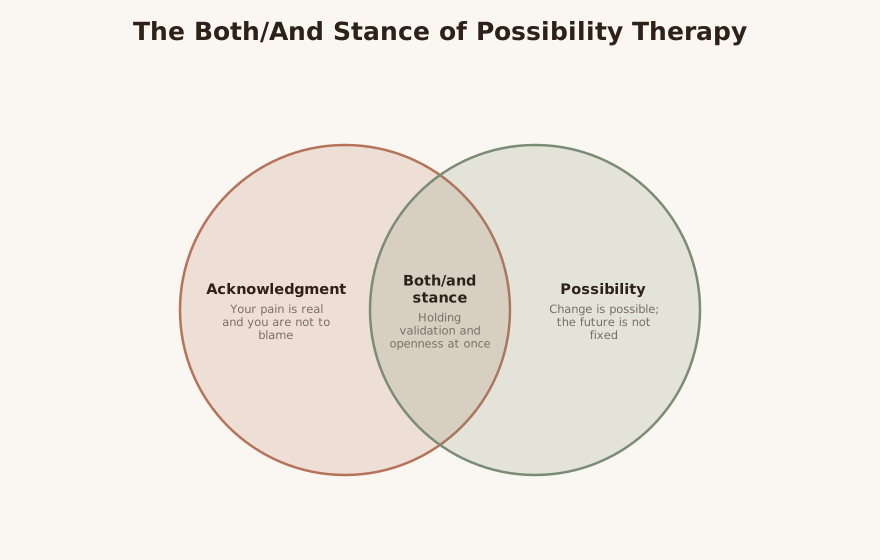
The organizing principle is a dual stance the model calls acknowledgment and possibility — validating the client’s experience as real and understandable while simultaneously holding open that change is possible and the future is not determined by the past 2. O’Hanlon frames this as the “both/and” of therapy: both your pain is real and you are not to blame for feeling it, and you have more influence over what comes next than the problem-story suggests 4. Skipping the acknowledgment half is, in this model, the characteristic failure mode of naïve solution-focused work; skipping the possibility half is the failure mode of traditional problem-focused therapy 2.
A second principle is the non-pathologizing, competence assumption: clients are viewed as having resources, strengths, and exceptions to the problem already present in their lives, and the therapist’s job is to evoke and amplify these rather than to catalogue deficits 3. A third is the primacy of language and framing: how a problem is described — as a permanent trait versus a changeable behavior, as “I am depressed” versus “depression is visiting more often this week” — shapes what interventions feel available, so the therapist deliberately reshapes problem-talk toward “action talk” that specifies observable, changeable behavior 4. A fourth is future and solution orientation: attention is steered toward preferred futures, goals stated in concrete behavioral terms, and times when the problem was absent or less intense, on the premise that exceptions are seeds of solution 3. A fifth is the smallest-change, brief-therapy logic: small differences can initiate larger shifts, so the therapist looks for the minimum viable change rather than total transformation 3.
Underlying all of this is a stance O’Hanlon describes as treating the person as fundamentally capable and the problem as something that can be influenced, while never implying the suffering is trivial or “just” a matter of thinking positively 4. The acknowledgment is what makes the possibility credible to the client rather than dismissive 2.
Interventions & Techniques
The intervention repertoire blends validation moves with classic solution-oriented devices 3. The foundational move is acknowledgment and validation — reflecting the client’s emotional reality accurately and explicitly before any pivot, often in language that conveys the feeling is legitimate without locking it in as permanent identity 2. Paired with this is Rogerian empathy reframed for change: O’Hanlon’s reflections often use past-tense or partial language (“so up to now things have felt stuck”) that validates while quietly implying the situation can move 4.
From the solution-focused toolkit, the model uses the miracle question (inviting the client to describe, in concrete detail, how life would look if the problem were resolved overnight), exception-finding (locating times the problem was absent, milder, or handled better, then unpacking what was different), and scaling questions (rating the problem or progress 0–10 to make change visible and to define the next small step) 3. Goal-setting in action terms translates vague complaints (“I want to be happy”) into observable, achievable behavioral markers 4. Normalizing and de-pathologizing reframes a client’s experience as an understandable response rather than a disorder of the self 3.
From the Ericksonian and narrative strands come utilization (using whatever the client brings — including resistance, beliefs, and idiosyncrasies — as a resource rather than an obstacle), externalizing language (separating the person from the problem), and presuppositional and “future-pull” questions that embed the assumption of change in the grammar of the question itself (“when you notice the first small sign that things are turning, what will it be?”) 35. Compliments and competence-spotting are used deliberately to amplify what is already working 3. The therapist also attends to the client’s attempted solutions, in strategic-therapy fashion, to interrupt patterns that are maintaining the problem 3.
LLM-generated illustrative example (not a guideline): A clinician sees a client who opens with “I’m a failure, I’ve ruined everything.” Rather than immediately challenging the cognition or jumping to a goal, the clinician first acknowledges — “It sounds like this week has felt genuinely crushing, and you’re carrying a lot of blame.” Only after the client feels heard does the clinician open possibility: “I notice you said you ‘managed to get the kids to school every day anyway’ — how did you pull that off on a week this heavy?” The exception (getting the kids to school) becomes the thread of competence to amplify LLM.
Evidence Base
The honest label for this modality’s maturity is emerging 4. Possibility Therapy is primarily articulated through O’Hanlon’s clinical and trade literature, professional commentary, and textbook chapters rather than through a large body of randomized controlled trials carried out under its own name 34. The conceptual and practitioner literature is real and citable — the 2011 “possibilities and solutions” paper, the influential In Search of Solutions, the published interview-portrait of O’Hanlon’s clinical thinking, and standard textbook treatments of solution-oriented and possibility therapy — but this is a literature of theory, method, and expert description more than of outcome trials 4563.
Its strongest empirical claim is borrowed rather than owned LLM. Possibility Therapy shares most of its active machinery — the future orientation, exception-finding, the miracle question, scaling, goal-setting — with solution-focused brief therapy, which does have a more developed outcome literature; to the extent those shared mechanisms are effective, Possibility Therapy inherits that support 3. But a clinician should be careful: inheriting a sibling modality’s evidence is a reasonable plausibility argument, not a substitute for direct trials of Possibility Therapy as a distinct package LLM. There is, at present, limited head-to-head research isolating O’Hanlon’s specific addition — the acknowledgment-plus-possibility dual stance — as an independent active ingredient LLM.
The fair summary for practice is that Possibility Therapy is a coherent, well-theorized, widely taught brief approach with strong roots in better-studied modalities, but whose own outcome evidence is thin and largely indirect 4. It is responsibly presented to clients and supervisees as a credible, lineage-supported method rather than a first-line, trial-proven protocol for any specific diagnosis LLM.
Populations & Indications
The approach was developed in general outpatient and family-therapy practice and is broad in its indications 5. Adults presenting with situational distress, demoralization, and stuckness are the core population, since the model’s pivot from acknowledgment to possibility is well suited to people who feel hopeless or defined by their problem 4. Couples and families are a natural fit given the strategic-family lineage and the focus on changing interactional patterns and attempted solutions 3. Adolescents often respond to its non-pathologizing, collaborative, jargon-light stance, which avoids positioning the young person as the diagnosed problem 3. Survivors of trauma are an indicated but caution-laden population: the explicit acknowledgment-first principle is precisely what makes a solution-orientation safe rather than invalidating for trauma survivors, though pacing matters 2. Brief-therapy clients — those seeking time-limited, focused work, whether by preference or setting constraint — are well matched to the model’s smallest-sufficient-change logic 3.
The general indication is a presentation where the client is stuck in a problem-saturated story, where hope and self-efficacy are low, and where concrete, future-oriented movement is both desired and realistic 4. The approach is especially well indicated when prior pathology-focused work has left the client feeling broken or blamed, because the competence assumption directly counters that 3.
Problems-for-Work
In major depressive disorder and hopelessness, the work pairs genuine acknowledgment of the depth of the low mood with exception-finding and scaling to locate and amplify the moments of even slightly better functioning, on the principle that small visible differences seed momentum 3. In anxiety disorders, action-talk reframing and future-pull questions help convert global dread into specific, addressable behaviors and a described preferred future 4. In trauma and its aftermath, the acknowledgment-first stance validates the reality and legitimacy of the survivor’s experience before any move toward possibility, which is what keeps the solution-orientation from reading as denial of what happened 2.
LLM-generated illustrative example (not a guideline): With a client whose relationship conflict has hardened into “we just don’t work,” a clinician using Possibility Therapy first validates each partner’s hurt as real, then asks the exception question: “Tell me about a recent moment, even a small one, when you felt briefly like a team.” The couple recalls a five-minute exchange over a shared joke; the clinician slows down and unpacks exactly what each did differently in those five minutes, turning a remembered exception into a repeatable behavior LLM.
In adjustment disorder and grief, the model treats the distress as an understandable response to real circumstances rather than a disorder of the self, normalizing while gently orienting toward what a workable next chapter could contain 3. In relationship conflict, the focus on attempted solutions interrupts the cycles each partner uses that inadvertently maintain the fight 3. In low self-efficacy and demoralization, deliberate competence-spotting and compliments rebuild the client’s sense of agency by making existing successes visible 3. In stuckness, the externalizing and reframing language separates the person from the problem so that the problem becomes something to be influenced rather than an identity to inhabit 4.
Contraindications, Cautions & Cultural Humility
The central caution is timing and pacing: pivoting to “possibility” before the client feels genuinely acknowledged is the model’s signature failure mode, experienced by clients as invalidation or toxic positivity, and it is especially damaging with trauma survivors and the acutely grieving 2. O’Hanlon’s own emphasis on acknowledgment exists precisely to guard against this, but the discipline of staying with the pain long enough is easy to shortcut under brief-therapy time pressure LLM. The approach is not a substitute for risk assessment: with active suicidality, psychosis, severe eating disorders, or conditions requiring structured, protocol-driven or medical care, Possibility Therapy’s brief, conversational frame is insufficient on its own and should at most be integrated within a more comprehensive, safety-prioritizing treatment plan LLM.
A further caution is that the optimistic, change-is-possible framing must not minimize real, ongoing harm or structural constraint LLM. When a client’s distress is driven by active abuse, poverty, discrimination, or unsafe circumstances, “opening possibilities” without naming and addressing the external reality risks placing the burden of change on the person rather than the situation, which is both clinically wrong and ethically problematic LLM. The exception-finding move can also misfire if a clinician implies a client “should” be able to reproduce a good moment at will, when the exception depended on circumstances outside their control LLM.
Cultural humility matters because the model’s premises — that the individual has agency, that a “preferred future” can be self-authored, that talking about strengths is comfortable — are not culturally neutral LLM. Clients from collectivist or hierarchical contexts may locate the problem and its solution in family and community rather than in individual goals, and may find effusive competence-spotting or direct goal-talk strange or presumptuous; the dual stance should be adapted so that acknowledgment includes the client’s cultural framing of suffering and possibility LLM. The honest position is to use the approach’s flexibility to fit the client’s worldview, not to fit the client to the approach LLM.
Treatment-Plan Suggestions & SMART Objectives
| Goal | SMART objective (example) | Mechanism |
|---|---|---|
| Restore hope and counter demoralization | Client identifies and describes one weekly “exception” — a time the problem was absent or milder — for 4 consecutive weeks | Exception-finding makes existing competence visible and seeds momentum 3 |
| Translate global distress into workable terms | Client restates one presenting complaint in concrete, observable action-talk within 2 sessions | Action-talk reframing reveals changeable behavior rather than fixed identity 4 |
| Make change measurable | Client uses a 0–10 scaling rating each session and names one step toward the next number for 6 weeks | Scaling externalizes progress and defines the smallest sufficient next step 3 |
| Build a credible preferred future | Client articulates, in concrete detail, a “preferred future” via the miracle question within the first 3 sessions | Future orientation supplies direction and concrete behavioral goals 3 |
| Ensure validation precedes change-work | Clinician reflects and the client confirms feeling accurately acknowledged before any solution-talk each session | The acknowledgment half of the dual stance prevents invalidation 2 |
| Increase self-efficacy | Client logs and shares one instance of personal competence or coping each week for 4 weeks | Competence-spotting rebuilds agency and counters a deficit self-story 3 |
| Interrupt a problem-maintaining pattern | In couples work, partners replace one identified attempted solution with a different response over 3 weeks | Targeting attempted solutions disrupts cycles maintaining the conflict 3 |
| Separate person from problem | Client uses externalizing language for the problem in session and at home for 2 weeks | Externalizing reframes the problem as influenceable rather than identity 4 |
Common Misconceptions
The first misconception is that Possibility Therapy is “just positive thinking” or a brand of forced optimism; in fact its defining commitment is acknowledgment of real pain first, and the possibility-orientation is what follows validation rather than what replaces it 2. A second is that it is identical to solution-focused brief therapy; while it shares most techniques and lineage, O’Hanlon’s distinctive addition is the explicit acknowledgment-plus-possibility dual stance that guards solution-talk against invalidation 4. A third is that it denies or ignores the past; the model does not require excavating the past, but it does insist the past and present pain be honored before orienting to the future 2. A fourth is that “brief” means superficial; the brevity is a discipline of focus and smallest-sufficient-change, not a refusal to engage difficult material 3. A fifth is that the strengths focus implies the problem is the client’s fault or easily fixed; the non-pathologizing stance is the opposite — it explicitly frames the person as not broken and not to blame 4. A sixth is treating it as a fully trial-validated protocol; it is an emerging, lineage-supported approach whose direct outcome evidence is limited LLM.
Training & Certification
There is no single licensing board or mandatory certification that governs Possibility Therapy; it is taught primarily through O’Hanlon’s own books, workshops, and training materials rather than through a credentialing gatekeeper 1. Clinicians typically learn it by reading the foundational texts — In Search of Solutions and O’Hanlon’s later writings — and by attending workshops and trainings on solution-oriented and possibility methods 61. Because the approach sits within the solution-focused and brief-therapy world, training in solution-focused brief therapy and familiarity with Ericksonian and narrative methods provide a strong foundation, and much of the technique repertoire overlaps 3. The practical path for a licensed clinician is to study the source material closely enough to deliver the dual stance faithfully, to practice the validation-before-possibility sequencing under supervision, and to integrate the techniques within their existing scope of practice rather than treating the approach as a separate license LLM. O’Hanlon’s official site remains a primary point of access for his current trainings and publications 1.
Key Terms
Acknowledgment and possibility (dual stance) — the model’s organizing both/and: validating the client’s real experience while holding open that change is possible 2. Solution orientation — the future- and strengths-focused stance inherited from solution-focused brief therapy, attending to goals and exceptions rather than deficits 3. Exception — a time when the problem was absent, milder, or better managed, treated as a seed of solution to be unpacked and amplified 3. Miracle question — a structured invitation to describe in concrete detail how life would look if the problem were resolved, used to generate a preferred future 3. Scaling question — a 0–10 self-rating that makes change visible and defines the next small step 3. Action talk — reframing vague, trait-like complaints into observable, changeable behaviors 4. Non-pathologizing / competence assumption — the stance that clients have resources and are not defined by or to blame for their problems 4. Utilization — the Ericksonian move of using whatever the client brings, including resistance, as a resource 5. Externalizing — separating the person from the problem in language so the problem becomes something to influence 3.
Resources & Further Reading
▶ Watch — a video introduction to this concept:
- Bill O’Hanlon, MS — Possibility Land (official site)
- Possibility Therapy: Benefits, Techniques & How It Works — GoodTherapy
- Solution-Oriented and Possibility Therapy — textbook chapter (ebrary)
- O’Hanlon, B. (2011). Possibilities and Solutions: The Differences That Make a Difference — ResearchGate
- Bubenzer, D. L., & West, J. D. (1993). William Hudson O’Hanlon: On Seeking Possibilities and Solutions in Therapy — Sage
- O’Hanlon, W. H. & Weiner-Davis, M. — In Search of Solutions: A New Direction in Psychotherapy — Amazon
Reflective / Supervision Questions
- When you pivot a client from acknowledgment toward possibility, how do you confirm the client actually felt validated rather than rushed past their pain? LLM
- With a trauma survivor or an acutely grieving client, what tells you the timing is right to introduce exception-finding, and what tells you to wait? LLM
- How do you distinguish a genuine, replicable exception from a good moment that depended on circumstances the client could not control, and how does that change what you do with it? LLM
- When a client’s distress is rooted in active harm or structural constraint, how do you open possibility without implying the burden of change rests on them rather than the situation? LLM
- Where does your own use of strengths-talk and goal-setting carry cultural assumptions that may not fit a given client’s worldview, and how do you adapt the dual stance accordingly? LLM
- Given the limited direct outcome evidence, how do you decide when Possibility Therapy is sufficient on its own versus when it should be integrated within a more comprehensive or protocol-driven treatment plan? LLM
- How do you guard against brief-therapy time pressure pushing you to shortcut the acknowledgment half of the model? LLM