
Type & Discipline
Social constructionism is a theoretical position in sociology and the philosophy of knowledge, not a model of psychotherapy 4. Its core claim is that knowledge and reality are created through social interaction rather than existing independently of the people who know them, so that a great many phenomena treated as objective “facts” are in fact produced and sustained by shared social practices, language, and discourse 46. Where a positivist asks what is true about an objective world, the constructionist asks how a given “truth” came to count as true, and for whom 4.
The title of this entry pairs social constructionism with constructivism, and the two terms are in fact often used interchangeably in the literature, with many sources drawing no distinction between them 4. A clinically useful rough distinction, not drawn cleanly by any single provided source, is that constructivism tends to locate construction in the individual mind — how a person actively builds their own knowledge and meaning structures — while social constructionism locates it in shared social and linguistic process, between people rather than inside one head LLM. Because every key figure and every source for this entry sits on the social-constructionist side, this article centers there and flags constructivism only where the difference matters LLM.
For the clinician the categorical point comes first: this is a theory of how categories and reality are made, and any therapeutic use is borrowed and adapted, not delivered as the theory itself LLM. It enters the consulting room almost entirely through one channel — the narrative and postmodern therapy traditions, and solution-focused brief therapy, which translated “meaning and identity are socially constructed and therefore revisable” into clinical practice LLM.
Creators & Lineage
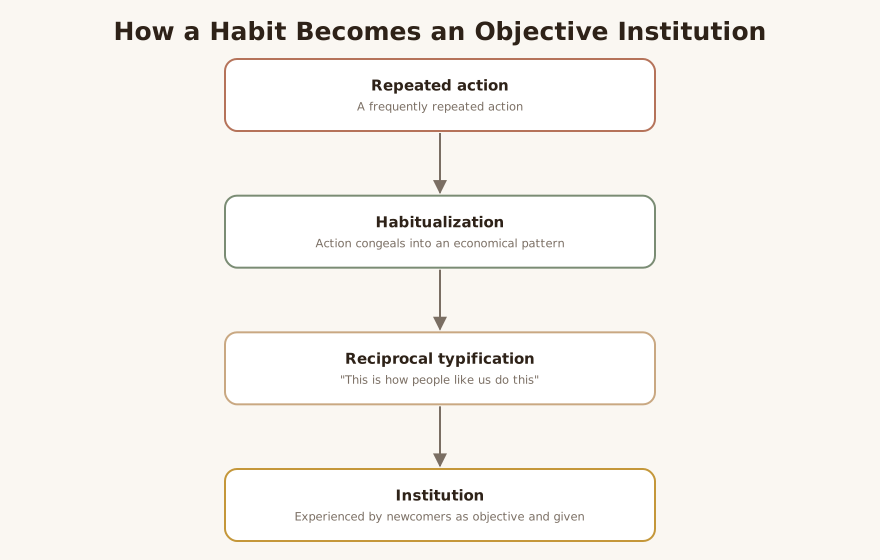
The foundational text is Peter Berger and Thomas Luckmann’s The Social Construction of Reality (1966), a watershed in sociology that argued reality is socially constructed and that the sociology of knowledge must analyze the processes through which this occurs 6. Berger and Luckmann proposed that humans create and sustain all social phenomena through their social practices 4. They described a three-stage cycle by which knowledge hardens into apparently objective reality: externalization, in which people act into the social world; objectivation through habituation and institutionalization, in which repeated, reciprocated actions become institutions “experienced as an objective reality”; and internalization, in which new members absorb those shared meanings through socialization 6. The crucial move is that what began as human activity comes to be experienced as a fixed, external given 6.
Kenneth Gergen extended the tradition into psychology, arguing as early as 1973 that social theories do not merely describe what is — they “describe what is perceived to be and prescribe what is seen as desirable,” so that psychological knowledge is itself a social and historical product rather than a neutral mirror of nature 4. The lineage reaches back further to George Herbert Mead’s symbolic interactionism, which held that the self is created through social interaction and that explanations are to be found in the interactive processes that take place routinely between people 46. Ian Hacking later sharpened the field philosophically, insisting that blanket talk of “social construction” is nearly empty until one specifies what is being constructed and submits the claim to disciplined scrutiny 5.
The clinical lineage is a separate, later development that the sociological sources do not document LLM. Narrative therapy (Michael White and David Epston) is the principal bridge, importing the idea that identity is constituted in language and that dominant social narratives can be examined and revised; solution-focused brief therapy and the broader postmodern and symbolic-interactionist traditions form the surrounding ecology through which these ideas reached practice LLM.
Core Principles
The first principle is the social production of knowledge: reality and knowledge are created through social interaction rather than discovered, meaning is fluid and shaped by cultural, historical, and social context, and even taken-for-granted knowledge should be approached with a critical, questioning stance 46. This carries a built-in critique of naive positivism — of the assumption that mainstream observation and laboratory method simply read off an objective world — because what counts as knowledge is, on this view, sustained by social processes rather than guaranteed by detached observation 4.
The second principle is that something can be socially constructed and still be entirely real. Mallon stresses that a thing can be both: a cocktail party requires “being thought to be a cocktail party” as part of its nature and yet genuinely exists, and race is the standard example of a category that is socially constructed yet real — grounded in social and cultural factors rather than biological difference, but no less consequential for that 1. To say a phenomenon is constructed is to make a claim about its grounds, not to declare it an illusion 1.
The third principle is the distinction between constructing representations and constructing objects. Much construction talk is about our categories, theories, and concepts — the representations — rather than the things themselves; Mallon warns against sliding from “the concept of X is socially produced” to the much stronger and harder claim that “the social practices produced X itself” 1. He separates causal construction (social activity causes Y to exist or shapes its typical properties) from constitutive construction (social activity regarding an individual is metaphysically necessary for it to count as a Y) 1.
The fourth principle, central for clinicians, is the looping effect of human kinds. Hacking’s account, as Mallon presents it, holds that classifications like “multiple personality disorder” or “child abuse” create “new ways to be a person”: a label shapes both social responses and the labeled person’s own self-understanding and conduct, so the classification helps produce the very phenomenon it describes 1. Because “the targets of the social sciences are on the move,” human kinds differ fundamentally from indifferent natural kinds, which do not react to being classified 1.
Interventions & Techniques
Social constructionism supplies no protocol, manual, or technique set of its own LLM. What it offers the clinician is an interpretive stance and a set of questions, which become “interventions” only once they are folded into an established modality — chiefly narrative therapy and solution-focused brief therapy LLM. The framing below is constructionist; the delivery is recognized psychotherapy LLM.
Externalizing the problem operationalizes the refusal to treat a category as the truth of a person: rather than the client being “a borderline” or “an anxious person,” the problem is separated out as an object that acts on the client, which directly undercuts the looping effect by which a diagnostic label becomes a way to be LLM. Deconstructing dominant narratives asks where a “truth about me” came from, whose interests it serves, and what it had to leave out — surfacing the social production of a story the client treats as simply given LLM. Mapping discourse and power helps a client notice which cultural standards of normality they are being measured against and that those standards are historically and culturally variable rather than natural law LLM. Solution-focused and re-authoring moves use the fluidity of meaning constructively: exception-finding and preferred-future questions build an alternative, client-endorsed account, leaning on the constructionist premise that meaning is revisable LLM.
LLM-generated illustrative example (not a guideline): A client says, “I’m bipolar, so I’ll always be unstable — that’s just a fact.” A clinician working from a constructionist stance might respond, “The diagnosis names a pattern and points to care that helps — and I’m curious where the ‘always unstable’ verdict comes from, and what it leaves out about the steadier stretches you’ve described.” The aim is to honor the real condition while loosening the totalizing identity story wrapped around it. LLM
Evidence Base
Honesty requires separating two very different claims LLM. As social theory and epistemology, social constructionism is established and canonical: Berger and Luckmann’s 1966 work is a foundational text of twentieth-century sociology, Gergen’s program reshaped social psychology, and the position is taught across the social sciences and humanities 46. Its maturity as an intellectual framework, and the seriousness of the philosophical work refining it, are not in question 15.
As a clinical intervention, however, it has no evidence base of its own LLM. There are no randomized controlled trials of “social-constructionist therapy” and no manualized protocol, because constructionism was never a treatment LLM. Whatever clinical credibility the stance can claim is borrowed from the therapies it informs — chiefly narrative therapy and solution-focused brief therapy — whose own evidence base is comparatively modest, more practice-based and qualitative than randomized, and generally weaker than that for cognitive-behavioral treatments LLM. The defensible position is therefore to use constructionist ideas as an interpretive lens within an established modality, and never to represent “social constructionism” to clients or in documentation as an evidence-based therapy in its own right LLM.
Populations & Indications
A constructionist lens is most apt where the presenting distress is bound up with categories, labels, and the weight of inherited “truths” about who a person is or must be LLM. Clients in narrative therapy are the natural fit, because the modality is built on exactly this premise and supplies the techniques that carry it LLM. People with internalized stigma are a strong indication: a frame that treats a stigmatizing category as socially produced rather than as the truth of the person gives clinical language for loosening its grip LLM.
LGBTQ+ individuals individuals and cultural and minority groups are a particularly strong indication, because the constructionist analysis of how social norms define normality and pathology — and the historical fact that categories such as homosexuality were reclassified from “disorder” to normal as cultural values shifted — gives clients a way to see a devaluing label as contingent rather than natural 43. Couples and families can use the lens to surface and renegotiate the dominant relational stories and shared “realities” that organize conflict, treating them as jointly constructed and therefore jointly revisable LLM.
Problems-for-Work
Internalized stigma. When a client has absorbed a demeaning category as the truth about themselves, the constructionist move is to relocate that category in the social processes that produced it, and the work becomes recognizing it as imposed rather than discovered 4LLM.
Identity disturbance. For clients whose sense of self feels unstable or rigidly negative, treating identity as constituted in social interaction — and therefore revisable — rather than as a fixed defect can reduce the felt permanence of the disturbance LLM.
Self-criticism and shame. Externalizing the critical voice and asking whose standards of normality it enforces deconstructs the apparent objectivity of the self-judgment, loosening its authority LLM.
Meaning-making difficulties and demoralization. Where distress tracks a collapse of taken-for-granted meaning, a stance that treats meaning as constructed — and so reconstructable — can be generative, provided it is paired with support rather than delivered as bare relativism LLM.
Relationship conflict. Couples often fight inside a dominant, taken-as-real story about the relationship; mapping and renegotiating that jointly held construction can open alternatives the conflict had foreclosed LLM.
Adjustment disorder and existential distress. When a life transition has overturned a client’s settled “reality,” naming the prior account as one construction among possible others supports building a new, workable account rather than mourning a lost certainty LLM.
Contraindications, Cautions & Cultural Humility
The central caution is the relativism trap: a careless application can imply that because categories are constructed, the client’s diagnosis, suffering, or oppression “isn’t really real.” This is a misreading and a clinical harm LLM. The sources are explicit that something can be socially constructed and fully real at once, and the psychiatry literature insists that constructionism about a disorder’s classification is compatible with the disorder being real and biologically grounded — purely physiological, behavioral, or experiential features that are not themselves constructed may still be required 12. The aim is to contest disempowering interpretations and labels, never to deny the reality of trauma, distress, or material constraint LLM.
A second caution concerns acutely vulnerable clients: with a client who is disorganized, psychotic, or in active trauma activation, telling them their reality is “constructed” can deepen destabilization, so the lens should wait until the client is grounded and resourced, and the therapeutic relationship must remain a stable anchor LLM. Constructionist exploration must never displace risk assessment, safety planning, or concrete intervention when a client is in crisis LLM.
Cultural humility is intrinsic to the stance rather than added on, because the clinician’s own diagnostic and theoretical vocabulary is itself a social construction that can, through looping effects, constitute the very people it describes 14. At the same time, social constructionism is a Western intellectual tradition, and its impulse to question and destabilize settled meanings may not fit clients for whom communal, religious, or ancestral meanings are sources of coherence and resilience rather than constructions to be unpacked LLM. The humble move is to deconstruct with the client toward their preferred direction, never to perform critique on them LLM.
Treatment-Plan Suggestions & SMART Objectives
| Goal | SMART objective (example) | Mechanism |
|---|---|---|
| Reduce internalized stigma | Within 6 weeks, client will trace 3 self-devaluing labels to their social/cultural source and name each as imposed rather than true | Relocating a category in the social processes that produced it externalizes it 4 |
| Loosen a totalizing diagnostic identity | Over 8 sessions, client will distinguish the named condition from the “always/never” story attached to it and record 3 counter-examples | Separating a real condition from the looping label reduces its identity grip 1 |
| Decrease shame and self-criticism | By week 6, client will externalize the self-critical voice and identify whose standards of “normal” it enforces in 3+ sessions | Deconstructing the judgment’s apparent objectivity loosens its authority LLM |
| Reduce identity disturbance | Over 6 sessions, client will articulate 2 self-descriptions held as fixed and reframe each as a revisable construction | Treating identity as socially constituted reduces its felt permanence LLM |
| Rebuild meaning after disruption | Within 8 weeks, client will articulate 2 self-chosen sources of meaning and one weekly practice expressing them | Treating meaning as constructable supports active reconstruction LLM |
| Renegotiate a dominant relationship story (couples) | Within 10 sessions, partners will name the shared story organizing their conflict and propose one alternative account | Mapping and displacing a jointly held construction opens new options LLM |
| Re-author a preferred self-narrative | Across treatment, client will co-construct and rehearse one alternative, value-aligned story of self | Re-authoring builds a narrative the client endorses LLM |
Common Misconceptions
“Social constructionism says nothing is real — it’s all just made up.” This is the most damaging misreading LLM. The sources are explicit that a phenomenon can be socially constructed and still genuinely exist; construction is a claim about a thing’s social grounds, not a denial of its reality 1.
“If a diagnosis is socially constructed, the client isn’t really ill.” Constructionism about how a disorder is classified is compatible with the disorder being real and biologically grounded; the social element typically concerns the second-order question of what counts as “a mental disorder,” not the first-order suffering or physiology itself 2.
“Social constructionism and constructivism are completely different things.” In practice the terms are frequently used interchangeably, with many sources drawing no distinction; the useful contrast — individual cognition versus shared social process — is a matter of emphasis rather than a hard boundary 4LLM.
“Labeling is harmless description.” Hacking’s looping effect shows that classifying people can create “new ways to be a person,” changing the behavior and self-understanding of those classified — which is exactly why careless diagnostic labeling has real downstream effects 1.
“Constructionism is a therapy you can deliver.” It is a social theory; any therapeutic use is an adaptation delivered through narrative therapy, solution-focused brief therapy, or related approaches, not a validated standalone treatment LLM.
Training & Certification
There is no certification in social constructionism, because it is a body of social theory rather than a clinical credential LLM. Clinicians who want to work competently with the concerns it raises should pursue formal training in the empirically practiced modalities that carry it — chiefly narrative therapy and solution-focused brief therapy — through recognized supervision, coursework, and the primary clinical literature LLM. Direct reading of the source theory — Berger and Luckmann on how reality is socially produced, Gergen on the social nature of psychological knowledge, and especially Hacking’s insistence on specifying what is constructed — gives a more accurate stance than secondhand slogans and guards against the “nothing is real” misreading 645. Ongoing supervision matters because this work intersects with diagnosis, identity, and stigma, where mistimed or heavy-handed application can destabilize vulnerable clients LLM.
Key Terms
Social constructionism — the view that knowledge and reality are produced and sustained through social interaction, language, and discourse rather than discovered as objective, mind-independent facts 46.
Constructivism — the closely related, often interchangeably used term that, where distinguished, emphasizes construction within the individual’s own cognition rather than in shared social process 4LLM.
Externalization, objectivation, internalization — Berger and Luckmann’s three-stage cycle by which human activity becomes institutionalized and is then experienced as an objective, external reality 6.
Causal vs. constitutive construction — Mallon’s distinction between social factors causing a phenomenon to exist or shaping its properties, and social activity being metaphysically necessary for something to count as a kind of thing 1.
Representation vs. object — the difference between socially constructing our concepts and theories of X and the far stronger claim of constructing X itself; conflating the two is a common error 1.
Looping effect / interactive kind — Hacking’s idea that classifying people creates “new ways to be a person,” so the classification feeds back into and reshapes the behavior it names, unlike indifferent natural kinds 1.
Normality and pathology as constructed — the position that what counts as normal or pathological depends in part on social and cultural context and shifts historically, as with the reclassification of homosexuality 34.
Resources & Further Reading
▶ Watch — a video introduction to this concept:
- Naturalistic Approaches to Social Construction — Stanford Encyclopedia of Philosophy (Mallon) — the rigorous account of construction, the representation/object and causal/constitutive distinctions, and Hacking’s looping effects 1
- What Is Constructionism in Psychiatry? — Frontiers in Psychiatry (PMC) — why constructionism about classification is compatible with a disorder being real and biologically grounded 2
- The Social Construction of Normality and Pathology — Palgrave Macmillan (introduction) — how concepts of normal and pathological are socially defined and culturally variable 3
- Social Constructionism Theory: Definition and Examples — Simply Psychology — accessible overview of Berger, Luckmann, Gergen, core assumptions, and the constructionism/constructivism overlap 4
- The Social Construction of What? — Harvard University Press (Hacking) — the disciplined, skeptical treatment insisting that construction claims specify what is constructed 5
- Sociological Theory: Social Constructionism — EBSCO Research Starters — Berger and Luckmann’s three-stage process and the symbolic-interactionist roots 6
Reflective / Supervision Questions
- When a client states a diagnosis or category as “just a fact” about themselves, do I treat it as a fixed truth to manage or as a socially produced construction to explore alongside its real referent LLM?
- Where might my own diagnostic and theoretical vocabulary be constituting the client through looping effects rather than neutrally describing them, and how would I hold those categories more lightly 1?
- How do I distinguish contesting a disempowering label from implying that the client’s suffering, diagnosis, or oppression is “merely” constructed and therefore unreal 2LLM?
- Have I assessed grounding, stability, and risk before introducing destabilizing meaning-work with a vulnerable client LLM?
- Does a Western, questioning, constructionist stance fit this client’s cultural and spiritual sources of meaning, or am I imposing it where communal meaning is a strength LLM?
- Am I working with the client toward their preferred direction, or performing critique on them in a way that overrides their lived experience LLM?