
Type & Discipline
Social prescribing is not a psychotherapy in the conventional sense; it is a service-delivery model and referral pathway that sits at the interface of primary care, public health, and the voluntary and community sector 1. Rather than treating distress with a clinical intervention delivered by a clinician, it routes a patient to non-medical resources in their community — group activities, exercise, the arts, nature-based programs, volunteering, and practical help with the social problems that erode health 1. Its disciplinary home is public health and primary care, and its family is the broad category of community-based interventions for psychosocial and social determinants of health LLM.
For a practicing therapist, the most useful framing is that social prescribing is a structured way of acting on the part of a person’s suffering that lives outside the consulting room: the loneliness, the empty calendar, the disconnection from meaningful activity, the unaddressed housing or financial stressor LLM. NHS England describes it as “an approach that connects people to activities, groups, and services in their community to meet the practical, social and emotional needs that affect their health and wellbeing” 1. It is positioned within the NHS as “a key component of Universal Personalised Care” and as “an all-age, whole population approach” rather than a niche service for one diagnosis 1.
Creators & Lineage
Social prescribing did not emerge from a single founder or a manualized protocol; it grew out of a long-standing recognition in UK general practice that a substantial share of presentations in primary care are driven by social rather than strictly biomedical problems LLM. It has been championed and formalized over the past two decades by figures associated with UK primary care and the social prescribing movement, including Michael Dixon, a general practitioner and advocate for community-oriented and integrative primary care, and Marie Polley, an academic who co-founded the Social Prescribing Network and helped build the research and evidence agenda for the field LLM.
The model was scaled dramatically when it was embedded in NHS policy as part of the personalised care agenda, with the social prescribing link worker becoming a funded role within primary care networks 1. The King’s Fund, an influential UK health-policy charity, has been a central voice in defining the concept, mapping the variety of schemes in practice, and offering measured commentary on what the evidence does and does not yet support 2. This lineage matters clinically because it explains the model’s strengths and weaknesses: it is pragmatic, locally adaptive, and relationship-centered, but it was scaled by policy faster than it was validated by trials 3.
Core Principles
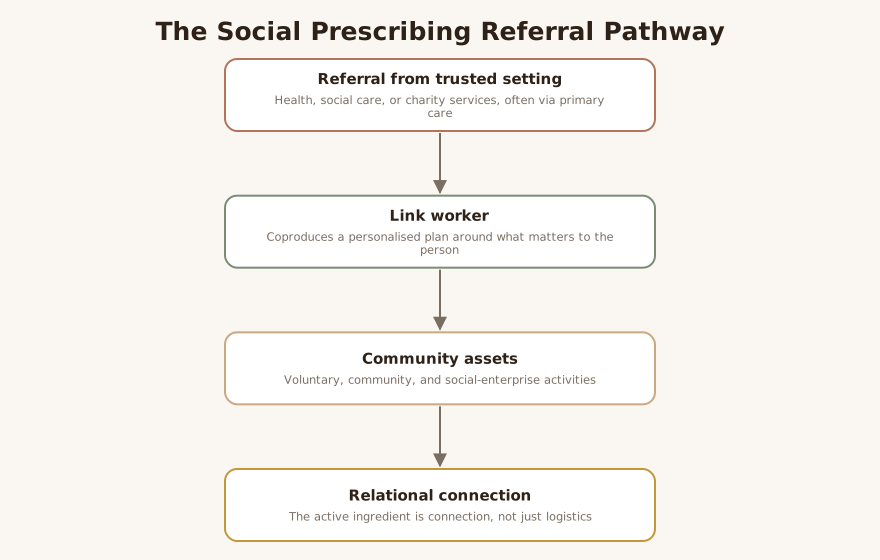
At the heart of the model is the link worker (sometimes called a community connector or social prescribing coordinator). NHS England frames the link worker’s task as giving people time and “focusing on ‘what matters to me?’ to coproduce a simple personalised care and support plan” 1. This is a deliberately non-prescriptive, person-centered stance: the link worker does not diagnose and does not assign an activity from a fixed menu, but works alongside the person to identify what would be meaningful and feasible for them 1.
A second principle is referral from a trusted setting. NHS England notes that local agencies — “charities, social care and health services” — refer people to a social prescribing link worker, with primary care as a common entry point 1. A third principle is connection to community assets: the destination is the voluntary, community, and social-enterprise sector rather than a clinical service, and the link worker also supports those community groups “to become accessible and sustainable” 1. A fourth, often underappreciated principle surfaced by realist work is that the active ingredient is relational, not merely logistical: connection works through “sustained, unhurried, and non-judgemental relationships,” trust development, and persistent practical follow-up — the link worker who contacts the person directly after referral and makes regular follow-up calls — rather than a one-off signpost 5.
Interventions & Techniques
Because social prescribing is heterogeneous by design, its “techniques” are better understood as a set of intervention components that vary widely across schemes. A scoping review by Sandhu and colleagues examined 32 articles describing 22 distinct UK schemes and found substantial variation in target populations, in “activities and procedures performed by primary care staff and link workers,” and in organizational, staffing, and financing arrangements 4. To impose order, the authors used the Template for Intervention Description and Replication (TIDieR) framework to identify and categorize components into a taxonomy intended “to guide future research, policy and practice efforts in addition to supporting standardized intervention reporting” 4.
In practice, the components typically include: a referral or identification step; a holistic, “what matters to you” conversation with the link worker; co-production of a support plan; an active connection to one or more community resources; and structured follow-up 14. The community destinations span the social-determinant and wellbeing spectrum — exercise and physical-activity groups, arts and creative programs, volunteering, befriending, debt and housing advice, and nature-based or “green” activities 1. NHS England runs a dedicated green social prescribing program, reflecting the inclusion of outdoor and environmental activity as a recognized pathway 1.
LLM-generated illustrative example (not a guideline): A 58-year-old man with type 2 diabetes and low mood attends his GP frequently but his HbA1c and his isolation are both worsening. The link worker meets him for an unhurried conversation, learns he used to fish and feels useless since retiring, and connects him to a riverside conservation volunteering group and a peer walking group. Over three months the link worker checks in by phone, problem-solves a transport barrier, and the man re-engages socially and physically. LLM
Evidence Base
Honesty about the evidence is essential here, because adoption has outpaced validation. A systematic review of social prescribing link workers identified only eight studies (n=6,500): five randomized controlled trials at low risk of bias and three controlled before-after studies at high risk of bias, drawn from the UK and US 3. The findings were sobering. Of four studies reporting health-related quality of life, all four reported no impact; of four reporting mental health outcomes, three reported no impact, with only one study showing a significant improvement in anxiety 3. The authors concluded that “the certainty of the evidence was low or very low” and, more bluntly, that “there is an absence of evidence for social prescribing link workers,” recommending that policymakers “support evaluation of current programmes before mainstreaming” 3.
The economic picture is equally thin: the same review found no cost-utility or cost-effectiveness analyses, and the limited cost data were mixed — one study found intervention costs exceeded savings, while a single return-on-investment estimate suggested “$2.47 for every $1 spent” 3. This does not mean social prescribing is ineffective; it means it is under-evidenced, and that absence of evidence is not evidence of effect in either direction LLM. The realist literature adds an important nuance: social prescribing “is not inherently advantageous” and can, without the right conditions, fail to help or even “risk exacerbating health inequalities when access is contingent on certain social or economic conditions” 5. The maturity of this field is best labeled emerging, and clinicians should hold its promise and its unproven status simultaneously LLM.
Populations & Indications
NHS England positions social prescribing as an all-age, whole-population approach but notes it “works particularly well” for people with long-term conditions, those needing low-level mental health support, people experiencing loneliness or isolation, and those with “complex social needs which affect their wellbeing” 1. These indications map cleanly onto presentations therapists see daily: the client whose anxiety is inseparable from social withdrawal, the client whose depression is reinforced by an empty and meaningless week, the client whose distress is substantially generated by debt, housing precarity, or unemployment LLM.
For therapists, the natural candidates are clients whose treatment plan would benefit from behavioral activation and social re-engagement that the therapy hour alone cannot supply, and clients whose social determinants are doing real work in maintaining their symptoms LLM. It is not a substitute for indicated psychotherapy or psychiatric care; it is best conceived as an adjunct that addresses the social and activity-based scaffolding of recovery while clinical treatment proceeds LLM.
Problems-for-Work
Loneliness and social isolation. This is perhaps the clearest indication. A link worker connection to befriending, group, or volunteering activities directly targets the social disconnection that both causes and sustains distress, and NHS England names loneliness explicitly as a population for whom the approach fits 1.
Distress driven by social determinants. Where a client’s anxiety or low mood is fueled by housing, debt, or employment problems, social prescribing’s connection to practical advice services addresses a driver that talk therapy cannot resolve on its own 1LLM.
Behavioral disengagement and inactivity. For clients whose depression is maintained by a contracted, unrewarding routine, connection to exercise, arts, or green activities supplies real-world behavioral activation opportunities 1LLM.
Low activation in long-term-condition self-management. For clients whose physical health and mood are entangled, the “what matters to you” conversation and community re-engagement can rebuild a sense of agency and routine 15LLM.
Contraindications, Cautions & Cultural Humility
Social prescribing is low-risk relative to most clinical interventions, but it is not risk-free, and several cautions deserve emphasis. First, it should never be used to deflect or substitute for needed clinical care; routing a person with significant depression or active risk solely to a community group, rather than to indicated treatment, would be a misuse LLM. Second, the realist review warns that benefit is conditional, not automatic: where the relational and organizational conditions are absent, the model can fail, and where access depends on social or economic resources the client lacks (transport, money, confidence, time), it “risk[s] exacerbating health inequalities” 5.
There is also a fragmentation caution. The same review notes that in poorly integrated, transactional models, clinicians can become “less aware of their patients’ wider social and community context,” and rigid, pre-set service limits can produce a “lack of dynamism and flexibility that may hinder the co-production” the model depends on 5. Cultural humility is essential at the connection step: an activity that is meaningful and accessible for one person may be alienating, financially out of reach, or culturally incongruent for another, and the “what matters to me” conversation must genuinely center the client’s own values and constraints rather than the link worker’s assumptions 15LLM.
Treatment-Plan Suggestions & SMART Objectives
| Goal | SMART objective (example) | Mechanism |
|---|---|---|
| Reduce social isolation | Within 6 weeks, client attends at least 2 community group sessions per month via a link-worker connection | Social re-engagement and relational support 15 |
| Increase meaningful activity | Within 8 weeks, client engages in one valued community activity (arts, volunteering, or exercise) weekly | Behavioral activation through real-world structure 1 |
| Address a social-determinant stressor | Within 4 weeks, client completes a link-worker referral to housing/debt advice and reports one concrete step taken | Reduction of distress-maintaining social stressor 1 |
| Improve physical activity and mood | Within 6 weeks, client participates in a green or exercise prescription twice weekly | Activity- and nature-based mood and physical benefit 1 |
| Build self-management agency | Within 8 weeks, client co-produces a personalised support plan and identifies 3 personally meaningful goals | Person-centered “what matters to me” planning 1 |
| Strengthen follow-through | Over 8 weeks, client maintains scheduled link-worker check-ins and reports on barriers encountered | Sustained, non-judgemental relational support and problem-solving 5 |
| Reduce non-medical primary-care reliance | Within 12 weeks, client identifies community supports for 2 needs previously brought to the GP | Redirection of social needs to appropriate community resources 1 |
Common Misconceptions
A first misconception is that social prescribing is “just signposting” — handing a patient a leaflet of local groups. The realist evidence directly contradicts this: the working ingredient is a “sustained, unhurried, and non-judgemental” relationship with active, persistent follow-up, not a one-time referral 5. A second misconception is that it is a proven, evidence-based treatment; in reality the best current synthesis describes “low or very low” certainty evidence and “an absence of evidence” for clear health-outcome benefit, even as the model is broadly implemented 3. A third misconception is that it replaces therapy or medical care, when it is more accurately an adjunct that addresses social and activity-based drivers of distress alongside clinical treatment LLM. A fourth is that it is a single standardized intervention; the scoping review documents marked heterogeneity across schemes and had to construct a taxonomy precisely because programs differ so widely 4.
Training & Certification
There is no single regulated credential or licensure pathway for social prescribing in the way there is for established psychotherapies, reflecting its status as a service model rather than a manualized treatment LLM. In the UK system, the central trained role is the social prescribing link worker, whose competencies emphasize person-centered “what matters to me” conversations, co-production of support plans, and knowledge of local community assets — supported, the realist review argues, by training, supervision, leadership endorsement, and integrated information governance at the organizational level 15. For therapists outside that system, the practical “training” is largely orientation: learning the local landscape of community resources, understanding how to make and track a referral, and adopting the relational, non-prescriptive stance the model depends on 15LLM.
Key Terms
Link worker — the person who connects an individual to community resources through an unhurried, person-centered conversation and ongoing follow-up 15. Personalised care — the broader NHS framework within which social prescribing sits as “a key component,” emphasizing what matters to the individual 1. Co-production — the collaborative creation of a support plan with, rather than for, the person 15. Community assets — the voluntary, community, and social-enterprise activities and services to which people are connected 1. Green social prescribing — nature-based activities (gardening, conservation, walking) as a recognized pathway 1. TIDieR — the Template for Intervention Description and Replication, used to taxonomize social prescribing components 4.
Resources & Further Reading
▶ Watch — a video introduction to this concept:
- Social prescribing — NHS England 1
- What is social prescribing? — The King’s Fund 2
- Effect of social prescribing link workers on health outcomes and costs: a systematic review 3
- Intervention components of link worker social prescribing programmes: a scoping review (Sandhu et al., 2022) 4
- Tensions and opportunities in social prescribing: a realist review 5
- Let’s talk about social prescribing — The King’s Fund podcast 6
Reflective / Supervision Questions
- For which of my current clients is a meaningful share of their distress generated outside the consulting room — by loneliness, an empty schedule, or an unaddressed social stressor — and would a community connection address what therapy alone cannot? LLM
- Do I actually know my local community-resource landscape well enough to make a credible connection, or would I be “just signposting” in the way the evidence warns against? 5
- How do I hold the honest tension between social prescribing’s intuitive appeal and its low-certainty evidence base when recommending it to a client? 3LLM
- When I suggest a community activity, am I genuinely starting from “what matters to this person” and their real constraints, or from my own assumptions about what would be good for them? 15
- How will I track follow-through and barriers, given that the relational, sustained component — not the referral itself — appears to be the active ingredient? 5