
Type & Discipline
Humanistic psychology is a broad theoretical and clinical framework within psychology rather than a single manualized treatment LLM. It emerged in the mid-twentieth century as a self-described “third force” positioned against the two dominant schools of the era, behaviorism and psychoanalysis 4. Where behaviorism reduced the person to conditioned responses and psychoanalysis emphasized unconscious drives and pathology, the humanistic movement centered the whole person, subjective experience, free will, and the human capacity for growth 4. Its clinical home in organized psychology is the Society for Humanistic Psychology, Division 32 of the American Psychological Association, which describes the field as honoring human freedom, dignity, and the potential to actualize 2. As a framework it gives rise to specific therapies, most prominently person-centered (client-centered) therapy, but the framework itself is best understood as a philosophy of persons and an orienting stance toward the therapeutic relationship rather than a discrete billable modality LLM.
Creators & Lineage
The movement’s two principal architects are Abraham Maslow and Carl Rogers, with Rollo May contributing its existential dimension 7. Abraham Maslow articulated the motivational backbone of the framework in his 1943 paper “A Theory of Human Motivation,” which proposed that human needs are organized hierarchically and that, once lower needs are met, the person is drawn toward self-actualization, the desire to become everything one is capable of becoming 1. Carl Rogers developed the clinical translation of these ideas into client-centered therapy, grounding practice in the therapist’s genuineness, acceptance, and empathic understanding 3. Rogers’s biography reflects the field’s optimism: a clinician who came to trust the client’s own capacity to find direction when given the right relational conditions 6.
Humanistic psychology coalesced as an organized movement in the late 1950s and early 1960s, with the founding of its journal and association giving the “third force” institutional form 7. It is woven from several adjacent threads: Maslow’s hierarchy of needs supplies the motivational theory, Rogers’s person-centered therapy supplies the clinical method, and existential therapy and Gestalt therapy supply complementary emphases on meaning, freedom, responsibility, and present-moment awareness 7. These traditions share a common rejection of deterministic, reductive accounts of the person and a common commitment to phenomenology, the study of experience as the person actually lives it 5.
Core Principles
The framework rests on a set of interlocking commitments. The first is holism: the person is understood as an integrated whole and as more than the sum of conditioned reflexes or competing drives 4. The second is the assumption of an innate tendency toward growth, often called the actualizing tendency, the organism’s directional movement toward fulfilling its potential under favorable conditions 3. The third is the primacy of subjective experience and personal agency; humanistic psychology insists that people exercise free will and are not merely shaped by environment or biology 4.
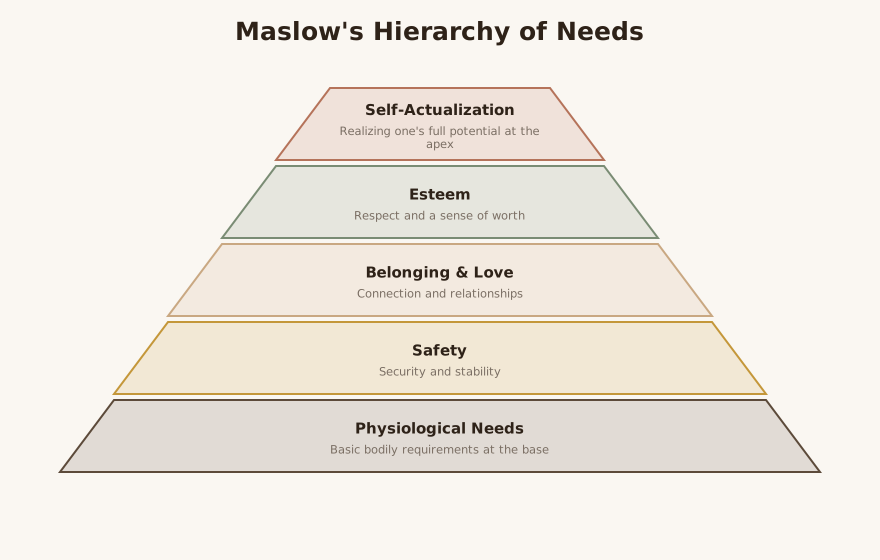
Maslow’s hierarchy of needs orders human motivation from physiological needs through safety, belonging and love, and esteem, culminating in self-actualization at the apex 1. Self-actualization is the realization of one’s full potential and was, for Maslow, both a motive and a description of psychologically healthy functioning 1. Rogers complemented this with the concept of the self-concept, the organized picture a person holds of who they are, and with congruence, the alignment between the ideal self, the perceived self, and lived experience 3. When experience is denied or distorted to protect the self-concept, the person becomes incongruent, and this gap is a central source of distress in the model 3. Rogers also distinguished conditional from unconditional positive regard, arguing that conditions of worth imposed in childhood drive incongruence and that an accepting relationship can reverse the process 3. The good-life endpoint Rogers described is the fully functioning person, open to experience and living in the present rather than defending a fixed self-image 3.
Interventions & Techniques
In its clinical expression, the framework is delivered chiefly through person-centered therapy, which is defined less by techniques than by the quality of the relationship 3. Rogers proposed three core therapist conditions held to be necessary and, in his account, sufficient for change: congruence or genuineness, unconditional positive regard, and empathic understanding 3. The clinician aims to enter the client’s frame of reference and reflect it accurately, communicating that the client is prized as a person regardless of the content disclosed 3. The therapy is deliberately non-directive; the clinician does not interpret, diagnose, or steer toward predetermined goals, trusting instead the client’s actualizing tendency to find a constructive direction 3.
Beyond person-centered method, the broader humanistic family draws on adjacent techniques LLM. Gestalt-derived practice emphasizes present-moment awareness and direct contact with experience, while existentially oriented work foregrounds dialogue about freedom, responsibility, meaning, and finitude 7. Across these, the common thread is phenomenological attention: helping the client articulate and own their lived experience rather than fitting it to an external schema 5.
LLM-generated illustrative example (not a guideline): A client says, haltingly, that they feel like a failure for leaving a prestigious job. Rather than reassuring or problem-solving, the clinician reflects the felt experience – “It sounds like part of you is grieving the version of yourself that career was supposed to make you” – and stays with the affect, conveying acceptance so the client can explore the disowned feeling without defending against it LLM.
Evidence Base
The honest position is that humanistic psychology is an established and historically influential framework, not a tightly manualized, trial-validated protocol LLM. It is institutionalized through APA Division 32, a dedicated journal, decades of continuous practice, and a substantial theoretical literature 2. Its descriptive sources present the framework’s concepts and history rather than controlled outcome data, so the framework as a whole should not be presented to clients as a first-line evidence-based treatment for a specific disorder 5. The strongest empirical footing within the family belongs to person-centered and broader humanistic-experiential therapies, which have an outcome literature, though it is generally regarded as less extensive than that supporting cognitive-behavioral approaches LLM. Rogers himself was an early advocate of researching psychotherapy process and outcome, and his conditions of change generated decades of study on the therapeutic relationship and what is now called the working alliance 3.
Two recurring scientific criticisms should be named plainly LLM. First, central constructs such as self-actualization and the actualizing tendency are difficult to operationalize and falsify, which limits rigorous testing 7. Second, the framework’s reliance on subjective, qualitative methods and its optimistic view of human nature have been criticized as insufficiently scientific and as potentially overlooking the constraints of biology and environment 7. The defensible clinical stance is to use the relational stance and growth orientation as a foundation, while delivering disorder-specific care through approaches with stronger trial support where indicated LLM.
Populations & Indications
The framework is well suited to adults engaged in personal growth work, where the goal is not symptom suppression but a fuller, more congruent way of living 2. It is a natural fit for clients with low self-esteem, because the experience of unconditional positive regard directly counters the conditions of worth Rogers held responsible for diminished self-regard 3. Young adults and others navigating identity questions benefit from a space that prizes their own emerging sense of self rather than imposing an external template 3. People in life transitions – career change, relationship endings, relocation, role shifts – are served by the framework’s attention to self-concept and meaning as circumstances reorganize LLM. Clients facing existential concerns about purpose, freedom, and mortality are addressed by the movement’s existential strand, which treats these as ordinary human questions rather than pathology 7.
Problems-for-Work
The framework speaks most directly to incongruence, the gap between lived experience and the self-concept, which Rogers placed at the heart of psychological distress 3. It is well matched to low self-esteem and self-concept disturbance, where the therapeutic relationship offers the acceptance needed to revise a harshly conditioned self-image 3. It is frequently used for identity confusion, lack of meaning or purpose, and existential crisis, reframing these as growth-relevant rather than purely symptomatic 7.
LLM-generated illustrative example (not a guideline): A young adult two years out of school reports a vague, persistent sense that “nothing matters.” Within a humanistic frame, the clinician explores the felt emptiness without rushing to fix it, helping the client name which inherited “shoulds” they are living by and what, in their own experience, actually feels alive and worth moving toward LLM.
Demoralization and the diffuse distress of difficult life transitions are addressed by restoring the client’s sense of agency and self-direction, which the actualizing-tendency model treats as recoverable under accepting conditions 3. Adjustment difficulties and the anxiety that accompanies them are worked through present-moment awareness and the reduction of incongruence rather than through symptom-targeting protocols 5. Across these applications, the unifying move is to relocate the client as the agent of their own change LLM.
Contraindications, Cautions & Cultural Humility
A non-directive, growth-oriented, insight-emphasizing stance is poorly matched to acute crisis, active psychosis, acute suicidality, or significant instability, where structure, containment, safety planning, and evidence-based stabilization must take priority LLM. Clients with severe disorders that have established first-line treatments – for example, exposure-based care for certain anxiety disorders – may be underserved if a purely non-directive approach displaces those interventions, so the relational stance should complement rather than replace indicated care LLM. Clients who want brief, structured, skills-focused help may find the open-ended pace and absence of direction frustrating, which makes informed consent about the method important LLM.
Cultural humility is essential because the framework’s core values – individual self-actualization, autonomy, and personal authenticity – carry strong assumptions from mid-twentieth-century Western individualism 7. Maslow’s apex of self-actualization and Rogers’s emphasis on the individual self may not map cleanly onto collectivist value systems in which relational duty, family, and community can be the locus of meaning LLM. The clinician should hold “self-actualization” as one cultural articulation of flourishing rather than a universal endpoint, and should calibrate the work to each client’s own values, neither imposing autonomy as an ideal nor dismissing communal sources of meaning LLM.
Treatment-Plan Suggestions & SMART Objectives
| Goal | SMART objective (example) | Mechanism |
|---|---|---|
| Reduce incongruence between self-concept and experience | Within 10 sessions, client will identify and articulate 3 experiences they have been minimizing and describe each in their own words without self-judgment | Reducing distortion/denial of experience 3 |
| Strengthen self-esteem and self-acceptance | Over 8 weeks, client will record 2 instances per week of meeting a personal standard rather than an externally imposed one | Loosening conditions of worth 3 |
| Clarify identity and values | Within 12 sessions, client will draft a written statement distinguishing inherited “shoulds” from personally endorsed values | Self-concept clarification 3 |
| Increase sense of agency and self-direction | Over 6 weeks, client will choose and follow through on 1 self-initiated value-aligned action per week | Engaging the actualizing tendency 3 |
| Address lack of meaning or purpose | Within 10 sessions, client will name 2 activities or relationships that feel intrinsically meaningful and increase engagement with one | Existential meaning-making 7 |
| Improve present-moment awareness | For 6 weeks, client will practice describing in-session feelings as they arise and report shifts in affect | Phenomenological awareness 5 |
| Stabilize lower-order needs before growth work | Within 4 weeks, client will establish 1 concrete plan addressing an unmet safety or basic need | Hierarchy-of-needs sequencing 1 |
Common Misconceptions
A common error is treating Maslow’s hierarchy as a rigid staircase in which no higher need can be felt until every lower need is fully satisfied; the original motivation theory describes relative prepotency, not strict lockstep, and people pursue higher and lower needs in overlapping ways 1. Another is equating self-actualization with selfishness or mere self-improvement, when in the humanistic tradition it denotes realizing one’s authentic potential, often expressed through values, relationships, and contribution 1. A third is assuming person-centered therapy means the therapist is passive or simply agrees with everything; genuine congruence and accurate empathy are demanding, active conditions, and unconditional positive regard prizes the person without endorsing every behavior 3. Some clinicians also conflate “non-directive” with “no structure,” when the stance is a disciplined refusal to impose direction, not an absence of clinical intentionality LLM. Finally, the framework’s optimism is sometimes misread as a claim that human nature is uniformly good; the more defensible reading is that people have a constructive directional tendency that favorable conditions release, a claim that remains hard to test 7.
Training & Certification
There is no single license called “humanistic psychologist”; the framework is practiced by licensed mental health professionals – psychologists, counselors, social workers, and others – who incorporate its principles into their scope of practice LLM. The field’s professional and continuing-education home in the United States is APA Division 32, the Society for Humanistic Psychology, which supports scholarship, dialogue, and professional development in the tradition 2. Person-centered and broader humanistic-experiential therapies are taught through graduate clinical programs and post-graduate training, and clinicians can pursue focused training in specific modalities within the family, such as person-centered, Gestalt, or existential therapy LLM. Many generalist therapists integrate humanistic principles – the core conditions, a growth orientation, attention to self-concept – into otherwise integrative practice, which is legitimate provided competence and scope are represented honestly LLM.
Key Terms
Self-actualization – the realization of one’s full potential, both the apex of Maslow’s hierarchy and a description of healthy functioning 1. Hierarchy of needs – Maslow’s ordering of motivation from physiological and safety needs through belonging and esteem to self-actualization 1. Actualizing tendency – the organism’s innate directional movement toward growth and fulfillment under favorable conditions 3. Self-concept – the organized picture a person holds of who they are 3. Congruence / incongruence – the alignment, or mismatch, between experience and the self-concept; in the therapist, genuineness 3. Unconditional positive regard – non-judgmental acceptance and prizing of the person regardless of disclosed content 3. Conditions of worth – internalized contingencies, often from childhood, under which one feels acceptable only when meeting certain standards 3. Fully functioning person – Rogers’s portrait of psychological health: open to experience, present-centered, and self-trusting 3. Third force – the movement’s self-designation as an alternative to behaviorism and psychoanalysis 4. Phenomenology – the study of subjective experience as the person actually lives it 5.
Resources & Further Reading
▶ Watch — a video introduction to this concept:
- A Theory of Human Motivation (Maslow, 1943, Psychological Review) – Classics in the History of Psychology, York University
- Society for Humanistic Psychology – APA Division 32
- Carl Rogers: Theory & Contribution to Psychology – Simply Psychology
- Humanistic Psychology – Simply Psychology
- Humanistic Psychology – ScienceDirect Topics (overview)
- Carl Rogers, Abraham Maslow, and Henry Murray – Multicultural Personality Theory (open textbook)
- Humanistic psychology – Wikipedia
Reflective / Supervision Questions
- When a client’s vision of the good life is grounded in family or community duty rather than individual self-actualization, am I honoring their frame or quietly imposing an autonomy ideal LLM?
- How do I distinguish a client who is ready for open-ended, non-directive growth work from one who first needs structure, safety, and stabilization LLM?
- Am I offering the core conditions authentically, or am I performing acceptance while privately steering the client toward my preferred outcome LLM?
- Where does a non-directive stance risk withholding an indicated evidence-based intervention, and how do I integrate the two responsibly LLM?
- Am I representing the evidence status of this framework honestly to clients – as an established, relationship-centered approach rather than a trial-validated protocol for their specific condition LLM?