
Type & Discipline
Active imagination is a clinical technique within analytical psychology, the depth-psychological tradition founded by C.G. Jung 4. It belongs to a family of imaginal and dialogue methods that work directly with spontaneous inner imagery rather than analyzing it from the outside 2. The core move is to open oneself to the unconscious and give free rein to fantasy while simultaneously maintaining an active, attentive, conscious point of view 2. In Jung’s own framing it is a method of “dreaming with open eyes,” in which conscious doubt is set aside and images are allowed to develop according to their own logic 4. LLM
For practicing therapists, it is useful to locate active imagination precisely: it is a technique used within a depth-oriented frame, not a standalone treatment model and not an empirically packaged protocol LLM. Jungian analysts themselves disagree about how central it is — some treat it as peripheral, while others regard it as the very essence and goal of analysis 2. That internal debate matters clinically, because it signals that active imagination is best understood as a flexible, attitude-driven practice rather than a fixed sequence of steps LLM.
Creators & Lineage
Jung developed active imagination out of personal necessity during the intense psychological period of roughly 1912–1920, as an alternative to Freud’s exclusive reliance on dream analysis 1. He discovered that as long as he could translate his emotions into symbolic images, he was inwardly calmed and reassured 2, and he documented this inner journey in what later became known as the Red Book 1. His foundational theoretical statement was The Transcendent Function, written in 1916 — described as Jung’s first paper about the method he later came to call active imagination 4. The technique can be read as a direct extension of Freud’s free association, redirected toward visual and dramatic engagement rather than verbal chains alone 2. LLM
The lineage was carried forward by later analysts. Marie-Louise von Franz, Jung’s close collaborator, elaborated the method in relation to dreams and individuation, and the Jungian analyst Robert A. Johnson popularized it for a general clinical and lay audience LLM. Johnson’s Inner Work presents a structured, four-step approach to engaging the unconscious through dreams and active imagination, framing imagination as a “transformer” that converts invisible material into images the conscious mind can perceive 3. The post-Jungian Michael Fordham introduced an important developmental caution, noting that the method can promote psychological disturbance where early childhood developmental disruptions exist 5. LLM
Core Principles
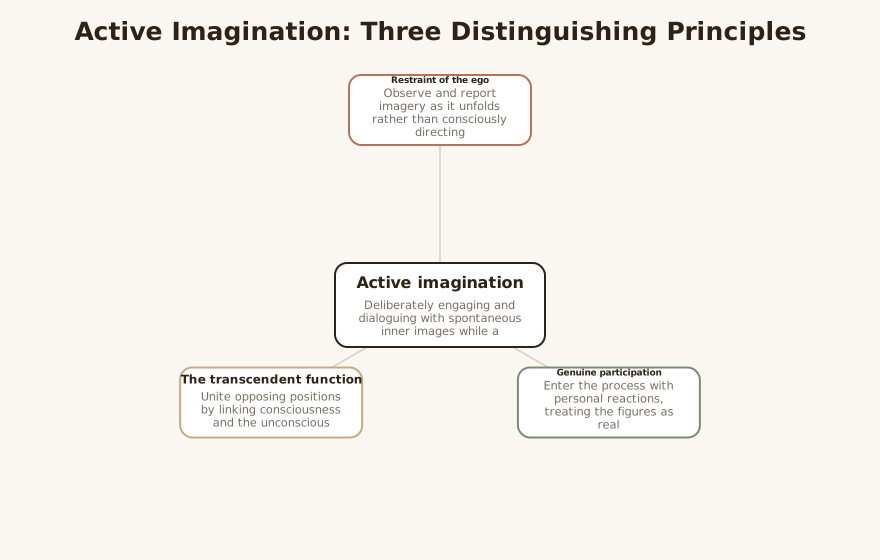
Several principles distinguish active imagination from ordinary daydreaming or guided visualization LLM.
First, restraint of the ego. The practitioner does not consciously direct the imagery; instead they observe and report changes as they unfold naturally, holding a passive-receptive stance while actively focusing attention on what is about to happen 51. The posture is often compared to watching an internal movie 1. LLM
Second, genuine participation. Paradoxically, the observer is not merely a spectator. Jung insisted, “You yourself must enter into the process with your personal reactions … as if the drama being enacted before your eyes were real” 5. The figures are treated as having their own autonomy and point of view, and the conscious self responds with real feeling LLM.
Third, the transcendent function. The term names both the method and its aim — to unite opposing psychological positions by establishing communication between consciousness and the unconscious 24. Material typically begins from a mood, an image, or a bodily sensation 2, and the work gives voice to normally unheard aspects of the psyche, particularly the shadow and the anima or animus 4. LLM
Fourth, symbolic thinking and ethical obligation. A foundational prerequisite is the capacity for symbolic thinking — the ability to hold double meanings 1. And the work does not end at insight: Jung stressed that understanding gained through the process must be converted into an ethical obligation, extending its benefit beyond self-knowledge into how one acts in the world 1. LLM
Interventions & Techniques
In practice, active imagination unfolds across two broad stages drawn from The Transcendent Function: first allowing unconscious material to emerge, and then integrating it 2. LLM
The first stage is lowering the threshold of consciousness enough for spontaneous imagery to appear, while resisting the urge to censor or steer it 5. The clinician helps the client find a starting point — a charged mood, a fragment of a recent dream, a recurring image, or a felt sense in the body 2. LLM
The second stage is engagement and integration. Here the client enters into dialogue or interaction with the figures that appear, responding with their own reactions as if the encounter were real 5. Crucially, the products of the imagination are given an external, durable form. Jung described this as giving shape to oneself — “by painting himself he gives shape to himself” 5. The expressive medium is deliberately diverse and can include painting, sculpting, drawing, writing, dancing, weaving, dramatic enactment, inner visions, and inner dialogues 2. LLM
Robert Johnson’s contribution was to render this into a teachable, four-step structure for both therapeutic and self-directed use, anchored in the idea that imagination is the transformer that makes unconscious “parts” — each holding distinct needs and perspectives — perceptible and addressable 3. The specific naming and ordering of those steps belongs to Johnson’s text itself and is not reproduced here LLM.
LLM-generated illustrative example (not a guideline): A client who keeps “freezing” before deadlines is invited to let an image arise for the freeze. A heavy, grey figure appears who “sits on my chest.” Rather than interpreting it for her, the clinician encourages her to ask the figure what it wants. Over several sessions she writes out the dialogue; the figure turns out to be a protective part terrified of public failure. The integration is not the insight alone but a small concrete commitment she makes in waking life LLM.
Evidence Base
Honest appraisal of maturity is essential. Active imagination is established as a clinical tradition — it is a foundational method with more than a century of practice and an extensive theoretical literature across Jung’s Collected Works 4. That is a different claim from being empirically validated by controlled trials LLM. The provided source base does not contain randomized or controlled efficacy studies, and that absence is itself the honest answer: the technique’s standing rests on clinical lineage and case literature rather than a modern evidence pyramid LLM.
Two cautions belong in any honest evidence summary. Jungian analysts disagree about the technique’s importance, ranging from peripheral to central 2, which means there is no consensus dose or indication even within its home tradition LLM. And the method carries recognized risk: Jung warned it “may carry the patient too far away from reality,” and Fordham specifically cautioned that it can promote psychological disturbance where early developmental disruption exists 5. Clinicians should therefore present it to clients as a practice with strong theoretical grounding and meaningful risks, not as an evidence-based protocol LLM.
Populations & Indications
Active imagination is best suited to clients with intact reality-testing, sufficient ego strength to step back into ordinary consciousness, and a baseline capacity for symbolic thinking 1. LLM Good candidates include adults in longer-term depth or psychodynamic work; reflective, psychologically minded clients; and those drawn to creative or expressive-arts modalities, since the method naturally extends into painting, writing, movement, and enactment 2. LLM
It is frequently indicated in midlife and meaning-related work, where symptom relief has been achieved but flatness, stuckness, or loss of direction remains LLM. Because the technique gives voice to the shadow and to contrasexual figures (anima/animus), it is apt where projection, disowned affect, or an internal critical figure dominates the clinical picture 4. LLM Bereaved clients working with continuing bonds may also find an imaginal frame useful for structured inner dialogue, provided reality-testing is firm LLM.
Problems-for-Work
The following are clinically apt targets, each with a brief application note LLM.
- Persistent inner conflict between opposing parts of the self. The transcendent function is designed precisely to hold and bridge opposites 2, so the technique is well matched to “two minds” stalemates LLM.
- Disowned or projected shadow material. Giving the shadow a voice and a form lets the client meet, rather than enact, what they have been projecting 4. LLM
- Stuckness or loss of meaning despite symptom relief. Re-engaging the imaginal can restore aliveness where standard symptom work has plateaued LLM.
- Recurrent or unresolved dream material. Active imagination extends dreamwork into waking dialogue, continuing a dream’s narrative under conscious participation 4. LLM
- Differentiating from a persecutory inner figure. Treating the critic as an autonomous figure to be questioned, rather than an identity, supports separation 5. LLM
- Identity and individuation work. Establishing communication between consciousness and the unconscious is the core aim of individuation 4. LLM
Contraindications, Cautions & Cultural Humility
The most important contraindications follow directly from the risk literature. The method should be avoided or used only with great caution where reality-testing is fragile, where there is active psychosis or a history of psychotic decompensation, or where there is significant dissociative pathology, because the practice deliberately lowers the threshold to unconscious material and can carry a vulnerable client too far from reality 5. LLM Fordham’s caution about early developmental disruption is a specific flag for clients with severe early relational trauma 5. LLM
Procedurally, active imagination requires specialized training; analysts are expected to be specially trained, even though clients learn primarily through cultivating the proper attitude rather than memorizing steps 1. LLM Clinicians without depth training should not improvise it, and should secure consultation or refer LLM. The ethical-obligation principle — that insight must be translated into responsible action 1 — is also a safeguard against the work becoming self-absorbed rumination LLM.
Cultural humility is essential. The figures, archetypes, and symbolic vocabulary a client produces are shaped by their culture, spirituality, and lived context; the clinician’s task is to follow the client’s own meanings rather than impose a Western Jungian template LLM. For clients whose traditions already hold rich frameworks for inner figures, ancestors, or spirit, the clinician should hold those as the client’s, not pathologize them and not appropriate them LLM.
Treatment-Plan Suggestions & SMART Objectives
| Goal | SMART objective (example) | Mechanism |
|---|---|---|
| Increase tolerance of inner conflict | Within 8 sessions, client will complete and journal 3 imaginal dialogues with an opposing inner figure | Transcendent function bridges opposites 2 |
| Re-own projected shadow material | Within 6 weeks, client will identify and dialogue with 1 shadow figure and name 2 disowned traits | Giving voice to the shadow 4 |
| Restore meaning and aliveness | Over 10 sessions, client will produce 4 expressive artifacts (writing, drawing, or movement) from inner images | Externalizing unconscious content 5 |
| Reduce fusion with an inner critic | Within 4 sessions, client will hold 2 structured dialogues treating the critic as a separate figure | Personifying autonomous contents 5 |
| Extend dreamwork into waking engagement | Within 5 sessions, client will continue 1 recurring dream image in waking active imagination | Dreaming with open eyes 4 |
| Translate insight into action | By session 12, client will convert 2 imaginal insights into specific real-world commitments | Insight as ethical obligation 1 |
| Strengthen symbolic-reflective capacity | Over 6 sessions, client will articulate the double meaning of 3 personal symbols | Building symbolic thinking 1 |
Common Misconceptions
“It’s just guided visualization.” No — in guided imagery the facilitator directs content, whereas active imagination requires the ego to restrain its steering and let images develop on their own logic 5. LLM
“It’s daydreaming.” Daydreaming is passive drift; active imagination demands genuine, affect-laden participation, entering the drama as if it were real 5. LLM
“Insight is the goal.” Jung was explicit that understanding must be converted into ethical obligation and action; insight alone is incomplete 1. LLM
“It’s a low-risk relaxation tool.” It deliberately opens access to the unconscious and was flagged by Jung and Fordham as potentially destabilizing for vulnerable clients 5. LLM
“It only means visualizing.” The method spans automatic writing, painting, dance, music, and sculpture; the modality is whatever lets the material take form 5. LLM
Training & Certification
There is no single certification specific to active imagination; competence is acquired within broader analytical-psychology training, where analysts are expected to be specially trained in the method before guiding clients 1. LLM Formal pathways run through institutes affiliated with the International Association of Analytical Psychology, which curates clinical guidance on the technique 1. LLM For self-study and as an adjunct to supervised practice, Johnson’s Inner Work offers an accessible, structured introduction to the method 3, and Pacifica’s library guide maps where Jung treats the technique across the Collected Works for clinicians who want primary-source grounding 4. LLM Therapists without depth training should pursue consultation, supervision, or referral rather than self-teaching the method into practice LLM.
Key Terms
- Active imagination — engaging unconscious imagery while awake through participatory dialogue 2. LLM
- Transcendent function — the psyche’s capacity, and the method’s aim, to unite opposing positions 24. LLM
- Shadow — disowned or unconscious aspects of the self given voice in the work 4. LLM
- Anima / animus — contrasexual inner figures addressed through the method 4. LLM
- Symbolic thinking — the capacity to hold double meanings, a prerequisite for the work 1. LLM
- Dreaming with open eyes — Jung’s phrase for letting images develop under conscious witness 4. LLM
- Individuation — the developmental aim of integrating conscious and unconscious into a fuller self 4. LLM
Resources & Further Reading
▶ Watch — a video introduction to this concept:
- Active Imagination — International Association of Analytical Psychology (IAAP)
- Active Imagination (Analytical Psychology) — Encyclopedia.com
- Active Imagination — A Library Guide to Jung’s Collected Works (Pacifica Graduate Institute)
- Inner Work: Using Dreams and Active Imagination for Personal Growth — Robert A. Johnson
- Active imagination — Wikipedia
Reflective / Supervision Questions
- How do I assess a given client’s reality-testing and ego strength before introducing an imaginal method that deliberately lowers the threshold to the unconscious 5? LLM
- Where is my own training adequate to guide this method, and where should I seek consultation or refer 1? LLM
- Am I helping the client follow their own symbolic meanings, or am I importing a Jungian template onto culturally distinct material LLM?
- When insight emerges, how do I support the client in translating it into responsible action rather than rumination 1? LLM
- How do I hold the genuine clinical uncertainty here — a deep tradition with thin controlled-trial evidence — honestly with the client 2? LLM