
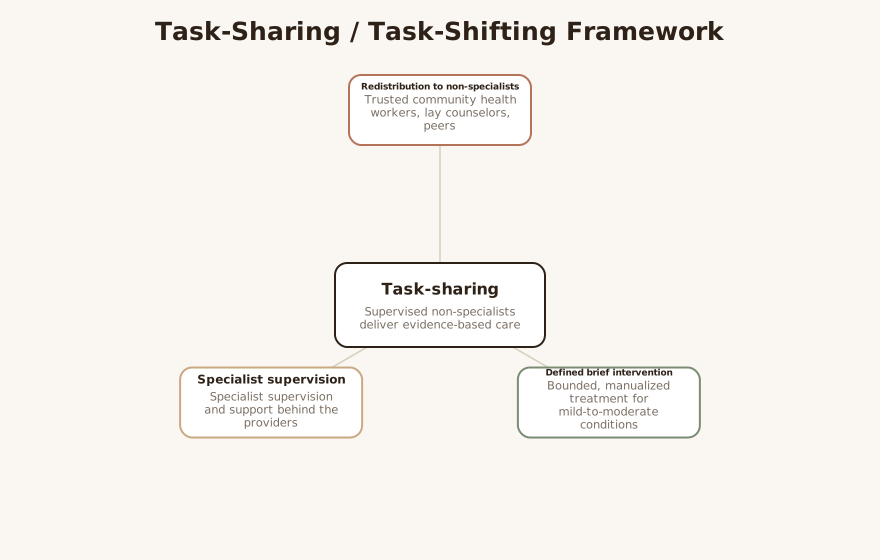
Task-sharing — historically called task-shifting — is the delivery strategy of training non-specialist providers to deliver brief, evidence-based mental health care that has traditionally been the province of licensed professionals 12. It is not a therapy; it is a way of redistributing who delivers therapy, codified for mental health most influentially in the World Health Organization’s mhGAP Intervention Guide and now tested in dozens of trials from Harare to high-income European clinics 12. For the practicing therapist it matters for two reasons. First, it is one of the few service-delivery frameworks with a deep enough trial base to be called established, including landmark studies like Zimbabwe’s Friendship Bench 5. Second, the specialist’s role inside a task-sharing system shifts from doing all the clinical work to training, supervising, and supporting a frontline workforce — a role many clinicians will increasingly be asked to play 23.
Type & Discipline
Task-sharing is a framework for organizing mental health delivery, not a discrete psychotherapy 1LLM. Its disciplinary home is global mental health, the field concerned with closing the treatment gap between the number of people who need mental health care and the number who can access it 1LLM. The defining move is structural: rather than concentrating all care in the hands of psychiatrists, psychologists, and licensed therapists who are scarce almost everywhere and acutely scarce in low- and middle-income countries, the framework trains “non-specialist providers” to deliver defined, manualized interventions under specialist supervision 12.
The term itself carries a history worth knowing. The older phrase “task-shifting” implied work being handed down from specialists to lay workers; “task-sharing” deliberately reframes this as a collaboration in which specialists and non-specialists hold complementary roles rather than one simply offloading onto the other 2LLM. The unit of intervention, as in any service-delivery framework, is the care system — the workforce, the training pipeline, the supervision structure — not a single clinical hour 1LLM. What makes it a coherent framework rather than improvised stopgap care is that the same elements recur across implementations: a defined evidence-based intervention, a trained non-specialist workforce, and a specialist supervision and support layer 2LLM.
Creators & Lineage
Task-sharing for mental health has no single inventor; it emerged from the broader global health movement that had already applied the principle to HIV, tuberculosis, and maternal health before extending it to psychiatry 1LLM. The World Health Organization is the institutional anchor: WHO articulated task-shifting as formal policy and, through the mental health Gap Action Programme (mhGAP) and its Intervention Guide, produced the structured guidelines that let non-specialists assess and manage priority mental, neurological, and substance-use conditions 13. The mhGAP framework is the reference point that recurs across the implementation literature, including the decision-support systems built to guide community health workers and primary care doctors 3.
Two figures are routinely associated with the movement’s intellectual leadership: Vikram Patel, whose trials of lay-delivered psychological treatments helped establish that non-specialists can produce real clinical effects, and Shekhar Saxena, who led WHO’s mental health work during the period when mhGAP and task-sharing became codified global policy LLM. A defining empirical landmark is the Friendship Bench programme developed by Dixon Chibanda in Zimbabwe, in which trained lay health workers — many of them older women, the “grandmothers” who anchor the model — deliver structured problem-solving therapy on a bench outside primary care clinics 5. The Friendship Bench cluster randomized controlled trial is one of the clearest demonstrations that a non-specialist, low-cost, culturally embedded model can move symptom scores in a rigorous trial 5.
Core Principles
The first principle is the redistribution of clinical tasks to non-specialist providers 12. A non-specialist provider, in this literature, is “individuals who provide mental health care but have not previously received specialized mental health or clinical training” — community health workers, lay counselors, lay health workers, or peer volunteers, who are “often trusted figures within the community” 2. Their trustedness is not incidental; it is part of the mechanism, because care delivered by a familiar community member can reach people who would never approach a specialty clinic 2LLM.
The second principle is defined, brief, evidence-based intervention. Task-sharing does not ask lay workers to improvise; it asks them to deliver a specific, manualized treatment for “people experiencing mild to moderate mental health conditions” — problem-solving therapy, behavioral activation, motivational interviewing, psychoeducation, or supportive counseling 2. The intervention is deliberately bounded so that a non-specialist can be trained to fidelity in a manageable time 2LLM.
The third principle is specialist supervision and support, which is what separates task-sharing from simply abandoning patients to untrained help 3LLM. Specialists train the workforce, supervise ongoing cases, and provide guidance for difficult or high-risk presentations; increasingly this is delivered remotely, through “voice calls and text messaging to provide supervision to the lay health workers as well as guidance and support for responding to challenging cases” 3. The fourth principle is integration into existing systems and stepped escalation: non-specialists handle the common, milder presentations, freeing scarce specialists for complex cases and creating a pathway to step up care when a patient does not improve or presents with risk 23LLM.
Interventions & Techniques
The “interventions” of task-sharing are partly the clinical treatments delivered and partly the structural machinery that makes lay delivery possible LLM. On the clinical side, the workhorse treatments are brief, structured psychological interventions chosen because they can be manualized and taught: problem-solving therapy, behavioral activation, motivational interviewing, psychoeducation, and supportive counseling 2. The Friendship Bench, for example, delivers problem-solving therapy in roughly six structured sessions of thirty to forty-five minutes — problem listing and identification, problem exploration, developing an action plan, implementation, and follow-up — a sequence simple enough to teach to lay workers and concrete enough to deliver with fidelity 5.
On the structural side, the central technique is training and supervising the non-specialist workforce, and this is increasingly mediated by digital tools 3. Digital platforms support capacity-building through training apps (for example “an Android mobile app with videos for training about mental health”), remote supervision via calls and messaging, and electronic decision support — for instance a “decision support system based on guidelines outlined in the mhGAP program” that guides community health workers and primary care doctors through assessment and management 3. Digital tools can also reinforce treatment directly, using “text messages and phone calls to reinforce program content and to promote adherence among patients” 3.
Delivery channel is itself an intervention variable. Task-sharing programs increasingly test not only who delivers care but how — in person versus by telemedicine — with behavioral activation for perinatal depression an active example of a brief intervention being examined for delivery by non-specialists and across delivery channels to expand access 4. The recurring design logic is the same: take a bounded, evidence-based treatment, make it deliverable by a trained non-specialist, and wrap it in supervision and decision support so quality holds 23.
LLM-generated illustrative example (not a guideline): A district primary care clinic with no psychologist trains four community health workers to deliver a six-session problem-solving protocol. Each worker carries a tablet with a decision-support tool flagging danger signs, and they review every active case in a weekly call with a supervising clinician in the capital. A client whose low mood is complicated by active suicidal ideation is flagged by the tool and stepped up to the supervisor that same week, while milder presentations stay with the community workers LLM.
Evidence Base
The maturity of task-sharing’s evidence base is best described as established, with the important caveat that “established” describes the general strategy, not every intervention or setting 12LLM. The scoping review of scalable, task-shared mental health interventions identified studies spanning eight countries — seven in Sub-Saharan Africa, six in South and Southeast Asia, and two high-income European settings — treating depression, perinatal depression, PTSD, and common mental disorders 2. The breadth of this evidence, across diverse cultures and health systems, is what lifts task-sharing above a single-study idea 2LLM.
The Friendship Bench trial is the clearest anchor. A cluster randomized controlled trial across twenty-four clinics in Harare, with 576 adults who screened positive for common mental disorders, tested lay-health-worker-delivered problem-solving therapy against enhanced usual care, and the program’s effect on symptom reduction is one of the field’s most-cited demonstrations that non-specialist delivery produces real clinical benefit 5. Subsequent syntheses describe Friendship Bench participants showing “significant reductions in symptoms and depression compared to participants standard care control group” 3.
Honesty about scope matters in two directions. First, the strongest evidence is for common, mild-to-moderate conditions — depression, anxiety, perinatal depression, common mental disorders — delivered as brief structured interventions, not for severe or acute psychiatric presentations 2LLM. Second, the digital-capacity literature warns that “few studies reported clinically meaningful effectiveness outcomes,” meaning that the feasibility of training non-specialists with technology is better established than the downstream clinical impact of every such program 3. The strategy is proven; any specific program still needs its own evidence 3LLM.
Populations & Indications
Task-sharing was developed for, and is most validated in, low- and middle-income settings where the specialist mental health workforce is too small to meet need, but its logic — and a growing evidence base — extends to underserved populations in high-income countries as well 2. The scoping review’s inclusion of high-income European settings signals that the framework is not only a “global South” intervention but a response to access gaps wherever they occur 2LLM.
The core indication is common, mild-to-moderate mental health conditions amenable to brief structured treatment: depression, anxiety, and especially perinatal depression, where task-shared behavioral activation is being examined precisely because it could expand access for pregnant and postpartum people who face steep barriers to specialty care 24. Adults attending primary care who screen positive for common mental disorders — the Friendship Bench population — are a paradigmatic indication 5. The framework is best suited to populations large enough that a trained frontline workforce is the only realistic way to reach them, and to conditions where a bounded, manualized treatment is genuinely sufficient for most cases 2LLM.
Problems-for-Work
Task-sharing gives a system a structured way to attack a specific set of problems, and the honest framing is that it works on conditions amenable to brief, supervised, non-specialist delivery 2LLM.
- The mental health treatment gap is the foundational problem-for-work: in settings with almost no specialists, task-sharing is the mechanism by which any evidence-based care reaches the population at all 12.
- Common mental disorders in primary care — the mixed depression-and-anxiety presentations the Friendship Bench treats — are the flagship target, addressed with lay-delivered problem-solving therapy and measured symptom reduction 5.
- Perinatal depression is a high-value indication, where task-shared behavioral activation, including via telemedicine, is studied as a way to reach pregnant and postpartum people who would otherwise go untreated 4.
- Depression and PTSD in humanitarian and resource-poor settings appear across the trial base, treated by trained non-specialists with structured protocols 2.
- Workforce capacity itself is a problem-for-work the digital layer addresses: training, supervising, and quality-assuring a dispersed non-specialist workforce through apps, remote supervision, and decision support 3.
LLM-generated illustrative example (not a guideline): A perinatal program in an underserved region cannot staff enough therapists to meet demand, so it trains nurses and peer mothers to deliver a brief behavioral-activation protocol, some sessions in clinic and some by video. A supervising psychologist reviews cases weekly and takes direct referral of anyone with severe symptoms or safety concerns, so that the scarce specialist time is spent where it is most needed LLM.
Contraindications, Cautions & Cultural Humility
The principal limits of task-sharing concern fit and safeguards, not the strategy itself 2LLM. The framework is built for mild-to-moderate, common conditions; it is not designed to make non-specialists the sole managers of severe, acute, or high-risk presentations such as psychosis, mania, or active suicidality, which require specialist involvement and a working escalation pathway 23LLM. A task-sharing program without a real supervision-and-step-up layer is not the validated model and should not be assumed to carry its safety profile 3LLM.
A second caution, and an ethical one the field has had to confront, is the burden on non-specialist providers themselves. The provider-focused review documents that lay workers can experience “burnout and emotional exhaustion,” secondary trauma from client exposure, “gender-based harassment and safety concerns (especially for female NSPs),” inadequate compensation, and a lack of career progression and job stability 2. Task-sharing is not free care; it relocates labor and emotional load onto people who are often unpaid or underpaid and under-protected, and doing it ethically requires “competitive salaries and benefits,” “clear career pathways,” supervision, and “formal workplace safety protections” 2.
On cultural humility: the framework’s strength is that care is delivered by trusted community members, which embeds it in local meaning systems — the Friendship Bench works partly because a respected grandmother delivers it 25. That same strength carries an obligation. Screening tools and protocols must be culturally valid rather than imported wholesale; the Friendship Bench used the locally validated Shona Symptom Questionnaire, not a translated Western scale applied mechanically 5LLM. Task-sharing done well is an exercise in cultural adaptation; done carelessly, it risks exporting a manual without the context that makes it meaningful 2LLM.
Treatment-Plan Suggestions & SMART Objectives
| Goal | SMART objective (example) | Mechanism |
|---|---|---|
| Reduce common-mental-disorder symptoms | Over 6 sessions across 4–6 weeks, client’s symptom-screen score will fall by a clinically meaningful margin from baseline | Brief lay-delivered problem-solving therapy reduces symptoms 5 |
| Deliver a bounded evidence-based protocol | Within the episode, client will complete a structured behavioral-activation course delivered by a trained non-specialist | Manualized brief intervention deliverable to fidelity by non-specialists 24 |
| Build a problem-solving action plan | By session 3, client will identify a priority problem and complete one concrete action step | Problem-solving therapy structure: identify, explore, plan, implement, follow up 5 |
| Ensure specialist oversight | Every active case will be reviewed in weekly supervision, with high-risk cases escalated to a specialist within one week | Specialist supervision and stepped escalation maintain safety and quality 3 |
| Expand access for an underserved group | Client (e.g., perinatal) will receive treatment in clinic or by telemedicine, removing a known access barrier | Task-shared, multi-channel delivery expands reach 4 |
| Use decision support for safety | At each contact, the worker will screen for danger signs using a guideline-based decision-support tool | mhGAP-based electronic decision support guides assessment and flags risk 3 |
| Support treatment adherence | Between sessions, client will receive reminder/reinforcement contacts to sustain engagement | Digital reinforcement promotes adherence and program content recall 3 |
| Sustain and step down care | On meaningful improvement, client will complete a follow-up/maintenance contact before case closure | Structured follow-up consolidates gains within the protocol 5 |
Common Misconceptions
The most common misconception is that task-sharing is “cheap, lower-quality care for the poor.” The trial base shows trained non-specialists producing real, measurable symptom reduction; the strategy is about reaching people who would otherwise get nothing, not about offering a knockoff 25. A second misconception is that lay workers are left to improvise. They deliver defined, manualized protocols under specialist supervision, which is precisely what distinguishes the model from unsupervised informal help 23. A third is that task-sharing replaces specialists. It redistributes their role — toward training, supervision, decision support, and complex-case management — and depends on them rather than eliminating them 23LLM. A fourth is that it treats everything. The validated scope is common, mild-to-moderate conditions; severe and acute presentations need specialist care and escalation 2LLM. A fifth is that digital tools have proven the clinical payoff. The capacity-building literature is candid that “few studies reported clinically meaningful effectiveness outcomes,” so feasibility is better established than downstream impact for every digital program 3.
Training & Certification
There is no single license to “practice task-sharing”; it is a delivery framework implemented by training existing non-specialists — community health workers, lay counselors, peers — to deliver a specific intervention, supported by specialists 2LLM. The WHO mhGAP Intervention Guide is the canonical training reference, providing the structured guidelines around which non-specialist training and decision support are built 13. Training is deliberately bounded and protocol-specific: the Friendship Bench, for instance, trains lay health workers to deliver a defined six-session problem-solving sequence rather than a general clinical curriculum 5.
Increasingly the training and supervision pipeline is digital — app-based training packages, tablet-delivered sessions, and remote supervision by voice and text — which is itself a way of scaling capacity where in-person specialist trainers are scarce 3. For the licensed clinician, the relevant “certification” question is less about a credential and more about competence in a distinct skill set: training non-specialists, supervising them at a distance, maintaining fidelity, and running an escalation pathway — roles many clinicians were never trained for and must learn deliberately 23LLM.
Key Terms
- Task-sharing / task-shifting: redistributing health-care tasks to non-specialist providers; “working with non-specialist providers to deliver health care traditionally provided by people with professional degrees” 2.
- Non-specialist provider (NSP): “individuals who provide mental health care but have not previously received specialized mental health or clinical training,” such as community health workers, lay counselors, or peers, who are “often trusted figures within the community” 2.
- mhGAP Intervention Guide: WHO’s structured guidelines for non-specialist assessment and management of priority mental, neurological, and substance-use conditions, and the reference for related decision-support systems 13.
- Scalable intervention: a “brief and defined mental health intervention for people experiencing mild to moderate mental health conditions” suitable for non-specialist delivery 2.
- Problem-solving therapy: a brief structured treatment — problem identification, exploration, action planning, implementation, follow-up — central to lay-delivered programs like the Friendship Bench 5.
- Behavioral activation: a brief evidence-based intervention studied for task-shared delivery, including for perinatal depression and across delivery channels 4.
- Friendship Bench: a Zimbabwean program in which trained lay health workers deliver problem-solving therapy on a bench outside primary care clinics, validated in a cluster RCT 5.
- Decision support system: a guideline-based (e.g., mhGAP) electronic tool that guides non-specialists and primary care doctors through assessment and management 3.
- Treatment gap: the difference between the number of people needing mental health care and those who can access it, the central problem task-sharing exists to address 1LLM.
Resources & Further Reading
▶ Watch — a video introduction to this concept:
- The impact of task-sharing scalable mental health interventions on non-specialist providers: a scoping review (Global Mental Health, Cambridge)
- The impact of task-sharing scalable mental health interventions on non-specialist providers (open-access PMC version)
- Digital Technology for Building Capacity of Non-specialist Health Workers for Task-Sharing and Scaling Up Mental Health Care (PMC)
- Task-Sharing: A Behavioral Activation Intervention for Perinatal Depression Could Expand Access to Care (MGH Center for Women’s Mental Health)
- The Friendship Bench programme: a cluster randomised controlled trial in Zimbabwe (Chibanda et al., PMC)
Reflective / Supervision Questions
- In the underserved populations I serve, where would a trained non-specialist delivering a bounded protocol reach people that my current model never touches? 2
- If I supervise non-specialists, is my escalation pathway real — can a flagged high-risk case actually reach me and be stepped up quickly — or does it exist only on paper? 3
- Am I attending to the burden I place on lay workers — burnout, secondary trauma, safety, fair compensation — or treating their labor as free? 2
- Are the screening tools and protocols I am exporting culturally valid for this community, or am I applying a translated Western instrument mechanically? 5
- Which of my would-be referrals genuinely need specialist care, and which are common, mild-to-moderate presentations a supervised non-specialist could treat at least as accessibly? 2
- If I lean on digital tools for training and supervision, have I confirmed the program produces clinical outcomes, given that feasibility is better established than effectiveness across this literature? 3