
Type & Discipline
Single-Session Therapy (SST) is best understood not as a discrete technique but as a service philosophy and delivery framework that treats each therapeutic contact as potentially complete and sufficient in itself 5. It sits within clinical psychology and the broader field of service design, and it is increasingly described by its proponents as a distinct, evidence-based approach in its own right rather than merely a shortened or compressed version of longer-term therapy 5. The defining move is a reframe of the unit of care: instead of designing services around a presumed course of weekly sessions, SST designs each session to stand alone, so that a single, well-structured meeting can deliver effective, goal-oriented support 3.
The discipline is simultaneously clinical and organizational LLM. On the clinical side, SST draws on collaborative, client-centered, goal-focused conversation; on the organizational side, it is a way of structuring access — through walk-in clinics, appointment-based “one-at-a-time” services, schools, and employee assistance programs — so that help is available at the moment of need rather than after a wait 31. Because it is a framework that reorganizes how an entire service operates, SST carries administrative, clinical, and supervisory implications that extend well beyond the individual therapy hour 1.
What makes it a framework rather than a single intervention is that it can host many therapeutic methods LLM. The same single-session container has been described as integrating methods from solution-focused brief therapy, cognitive behavioural therapy, and crisis intervention, depending on what the presenting problem requires 3. The framework specifies the stance and the structure; the clinician supplies the technique LLM.
Creators & Lineage
The modern articulation of SST is usually traced to work in the late 1980s and 1990, when clinicians began noticing that, across many services, the single most common number of sessions a client actually attended was one — and that this was frequently by the client’s choice rather than by drop-out or failure LLM. Moshe Talmon’s 1990 book popularized this observation and the deliberate, planned use of a single encounter, and Jeff Young is among the figures who carried the single-session and one-at-a-time movement forward into routine service design LLM. The collaborative volume Single-Session Therapy by Walk-In or Appointment, edited by Michael Hoyt, Monte Bobele, Arnold Slive, Jeff Young, and Moshe Talmon, brings these threads together and lays out the administrative, clinical, and supervisory aspects of one-at-a-time services 1.
The lineage is explicitly integrative and brief-therapy-rooted LLM. The most proximate influence is solution-focused brief therapy, from which SST inherits its future orientation, its search for client strengths and existing resources, and its insistence on defining concrete, workable goals quickly 3. Brief strategic therapy contributes the conviction that small, well-aimed change can be initiated rapidly and that the therapist need not resolve everything to be useful LLM. Motivational interviewing contributes a collaborative, client-led stance and an attention to readiness and ambivalence that fits a format where the client may attend only once LLM. Narrative therapy contributes the assumption that a single conversation can help a person re-author a problem-saturated story and leave with a different relationship to the difficulty LLM.
Talmon’s distinctive contribution — and the conceptual core of the whole framework — was to invert the default assumption LLM. Rather than treating a single attended session as a truncated or failed course of therapy, SST treats it as the natural and often sufficient unit of help, and then asks the clinician to plan accordingly: to make the most of every contact on the assumption that it may be the only one 5. The book-length, multi-author treatment of walk-in and appointment-based delivery represents the maturation of that idea from an individual clinical insight into a model for how services can be built 1.
Core Principles
The organizing principle is that each session is approached as if it could be the last and the only one — complete in itself, valuable in itself, and not merely a down-payment on future work 5. This is not a prediction that one session will be all the client ever needs; it is a design stance that maximizes the usefulness of whatever contact does occur 3. Paradoxically, treating each session as potentially complete tends to make each session more useful, whether or not the client returns LLM.
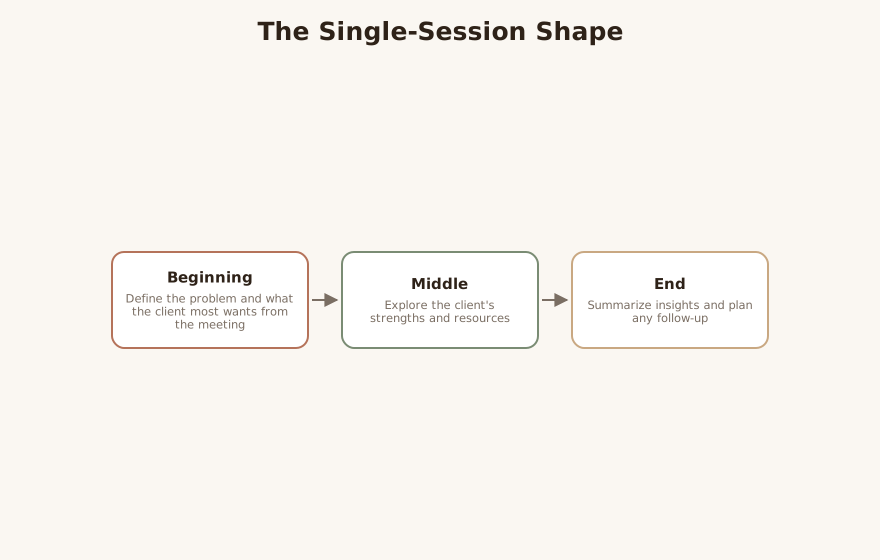
A second principle is rapid, collaborative goal-setting: because time is finite and the client may not come back, the work moves early to defining the problem and what the client most wants from the meeting, rather than gathering an exhaustive history 3. SST is typically organized around a clear three-part shape — a beginning that defines problems and goals, a middle that explores the client’s strengths and resources, and an end that summarizes insights and plans any follow-up 3. Sessions commonly run a single therapy hour, around 50 to 60 minutes 3.
A third principle is the competence and resource assumption inherited from its solution-focused lineage: the client is presumed to bring strengths and capacities that the session aims to identify, mobilize, and amplify rather than supplant 5. A fourth is access and barrier-removal: by eliminating the need for a lengthy commitment up front, SST lowers the threshold to getting help and is well suited to people who cannot or will not commit to an open-ended course of therapy 53. A fifth, easy to overlook, is that the door stays open: a single session does not foreclose further help, and the “one-at-a-time” framing means a client can return for another self-contained session if and when they choose 1.
Underlying all of these is a reframe of what counts as success LLM. In SST, a good session is one in which the client leaves with something genuinely useful — a renewed sense of confidence, a clearer view of the problem, or a practical plan — not one that successfully recruits the client into ongoing treatment 5.
Interventions & Techniques
SST is method-agnostic by design, so its “techniques” are partly the structuring of the session itself and partly the borrowed tools of its lineage LLM. The structural technique is the three-phase session map — define the problem and goal, explore strengths and resources, then consolidate and plan — which gives a single meeting enough shape to reach a useful endpoint within the hour 3. Within that map, clinicians draw on solution-focused devices such as eliciting exceptions, scaling, and concrete goal-definition, and on crisis-intervention moves when the presentation is acute 3.
A useful feature of at least one structured SST training model is that it makes explicit the range of clinician stances available within a single session, escalating from least to most directive 5. These run from a largely client-led conversation in which the person reaches their own conclusions, through the addition of structured questioning, to the clinician offering suggestions as options, to co-producing a written plan the client takes away, to co-producing a shared case formulation that can serve as an ongoing framework 5. The point is that the clinician chooses the lightest-touch style sufficient to leave the client with something useful, rather than defaulting to maximum directiveness because time is short LLM.
Practically, the framework rewards a handful of disciplines: front-loading the question “what would make this session worth your while?”, working from the client’s own strengths and resources rather than the clinician’s agenda, and ending with an explicit summary and a concrete next step or plan 53. Because the contact may be the only one, the clinician also attends to follow-up arrangements — making clear how the client can return — as part of the session itself 3.
LLM-generated illustrative example (not a guideline): A client comes to a walk-in clinic in acute distress after a sudden relationship breakup, unsure whether to “start therapy.” Rather than booking an intake and assigning homework toward a twelve-week course, the clinician asks what would make the next hour worthwhile. The client says they need to stop spiraling enough to get through the weekend. The session defines that as the goal, surfaces a coping resource the client has used before (calling a specific friend, a daily walk), rehearses a concrete plan for the next 72 hours, and ends with a written summary plus an explicit invitation to return for another single session if needed. The client leaves with a plan, not a treatment contract LLM.
Evidence Base
The honest label for SST’s maturity is established — meaning it is a recognized, widely implemented service model with a real and growing evidence and implementation literature, while still being honestly characterized about what that evidence does and does not show LLM. SST and one-at-a-time services have been reviewed in the scholarly literature, including dedicated review articles arguing that the accumulated single-session evidence warrants serious reconsideration of the default assumption that more sessions are always better 2. That a body of work exists substantial enough to review, and that services from walk-in clinics to appointment-based programs have been built around the model, is itself evidence of maturity rather than novelty 21.
Where clinicians should calibrate carefully is the kind of evidence LLM. Much of the supporting literature concerns client satisfaction, feasibility, access, and naturalistic outcomes — for example, the consistent finding that many clients report a single session sufficient to gain clarity and direction, and that satisfaction is high — rather than a deep base of disorder-specific randomized controlled trials comparing SST head-to-head against extended treatment 3LLM. Promotional and provider descriptions sometimes state that “the evidence is stronger than many clinicians expect,” and there is genuine substance behind the model’s effectiveness and durability claims; but a careful reader should treat strong vendor framing as a prompt to consult the primary review literature rather than as the evidence itself 5LLM.
The fair summary for practice is that SST is a well-established, well-implemented framework with credible support for satisfaction, access, and useful change from a single contact, whose strongest claim is that a single planned session is frequently far more useful than the field historically assumed 25. It is not a claim that one session is sufficient for every presentation, and the responsible position is to present SST as a robust first contact and a legitimate complete intervention for many problems, while remaining clear-eyed that some conditions need more LLM.
Populations & Indications
SST was developed for, and is well matched to, several populations LLM. People on therapy waitlists are a primary group: a single planned session can deliver real help during the wait, and for some it resolves the immediate need entirely 3. Crisis and walk-in clients are a core indication, since the framework is built to provide help at the moment of need without a commitment to ongoing care 31. Adolescents and youth, often seen in school and community settings, are well served by a low-barrier, single-contact format that does not require them to enroll in open-ended treatment 3.
Adults with circumscribed problems — a specific decision, a situational stressor, a discrete relationship difficulty — are well suited to a format designed to define and address a focused goal in one meeting 3LLM. Underserved or low-resource populations, for whom time, cost, and availability are real barriers, benefit from a model explicitly designed to remove the requirement of a lengthy commitment 3. And help-seekers who are ambivalent about ongoing therapy are perhaps the signature population: SST offers a way to get meaningful help without first having to commit to a course of treatment they are unsure about 53.
The general indication is a help-seeker with a reasonably focused concern, sufficient current resources to use a single conversation, and either a preference for or a constraint toward time-limited contact LLM. SST is delivered across adult, adolescent, substance misuse, and forensic services, among others, by a wide range of qualified practitioners 5.
Problems-for-Work
In crisis presentations and acute stress reactions, the framework’s crisis-intervention orientation and its design for help-at-the-moment-of-need allow a clinician to stabilize, mobilize coping resources, and leave the client with a concrete short-term plan within a single contact 3. In adjustment disorder and specific situational problems, the focused, goal-defining structure fits a presentation that is circumscribed and reactive to identifiable circumstances 3LLM.
LLM-generated illustrative example (not a guideline): A client facing a difficult, time-pressured decision — whether to accept a job that requires relocating away from an ailing parent — books a single session. The clinician does not pursue a long formulation; instead they help the client lay out the competing values, surface what the client already knows about their own priorities, and use a brief scaling exercise to clarify how each option sits with them. The client leaves with a clearer decision framework and a self-authored next step, having used one session to do focused work on a single, well-bounded problem LLM.
In anxiety disorders and mild to moderate depression of recent or situational onset, a single session can deliver psychoeducation, mobilize existing coping, and set a concrete plan, functioning either as a complete brief intervention or as a useful first contact that need not commit the client to more 3LLM. In relationship conflict, the strengths-and-resources phase helps a client identify what already works and define one workable change 3. In grief and demoralization, a single, validating, resource-focused conversation can restore a measure of agency and direction without pathologizing an understandable response 3LLM. And for help-seeking ambivalence itself, SST is almost custom-built: it lets the person experience useful help once, lowering the stakes of deciding whether to return 5.
Contraindications, Cautions & Cultural Humility
The central caution is matching the format to the problem LLM. SST is a first contact and often a complete intervention, but it is not a substitute for the structured, longer-term, or multidisciplinary care that some conditions require; severe or enduring mental illness, active and high-risk suicidality, psychosis, severe eating disorders, and complex trauma typically need more than a single conversation, and the single session should then function as a safe, well-planned point of access and triage rather than the whole treatment LLM. The framework’s own logic supports this: because the door stays open and follow-up is built into the session, recommending further or different care is a normal SST outcome, not a failure of it 1LLM.
A related caution is that the model’s optimism about what one session can achieve must not become pressure on the client to be “fixed” in an hour, nor pressure on the clinician to manufacture closure where none is warranted LLM. The goal is that the client leaves with something genuinely useful — which may be clarity, a plan, or a referral — not that the problem is declared resolved 5. Risk assessment is not optional in a single-session frame; it is more important, because there may be no second session in which to catch what was missed LLM.
Cultural humility matters because several of SST’s premises — that an individual can usefully self-author a goal in one meeting, that talking about personal strengths is comfortable, that brief and self-directed help is desirable — are not culturally neutral LLM. Clients from collectivist or hierarchical contexts may locate problems and solutions in family and community, may expect a more directive or relational stance, or may experience a single brisk goal-focused session as dismissive LLM. The framework’s flexibility — its range of clinician styles from client-led to formulation-led — is precisely what allows it to be adapted to the client’s expectations, and the honest stance is to fit the format to the person rather than the person to the format 5LLM.
Treatment-Plan Suggestions & SMART Objectives
| Goal | SMART objective (example) | Mechanism |
|---|---|---|
| Convert a vague request into focused work | Within the first 10 minutes, client states one concrete goal for the session in their own words | Rapid goal-definition is the entry phase of the single-session structure 3 |
| Mobilize existing coping in a crisis | Client identifies and rehearses at least two personal resources or supports usable in the next 72 hours, before session end | The strengths-and-resources phase amplifies what the client already brings 3 |
| Leave with a usable plan | Client departs with a written summary and one concrete next step they endorse, every single-session contact | A concrete take-away plan is the consolidation phase of the structure 5 |
| Lower the barrier for an ambivalent help-seeker | Client completes one self-contained session without committing to ongoing treatment | Barrier-removal makes help accessible to those unwilling to commit up front 5 |
| Match clinician directiveness to the client | Clinician selects the least directive style sufficient to produce a useful outcome, documented each session | Style-flexibility lets a single session fit the client rather than the reverse 5 |
| Keep the door open | Client can articulate how to return for another single session, by session end | One-at-a-time framing preserves access without requiring a course of care 1 |
| Make change visible within one contact | Client rates the problem on a 0–10 scale and names one step toward the next number before leaving | Borrowed solution-focused scaling externalizes progress in one meeting 3 |
| Ensure safe disposition | Clinician completes a risk check and, where indicated, arranges onward referral within the session | Single-session triage routes higher-acuity presentations to fuller care 1 |
Common Misconceptions
The first misconception is that SST means a client is allowed only one session; in fact the model keeps the door open, and “one-at-a-time” explicitly means a person may return for further self-contained sessions whenever they choose 1. A second is that SST is simply ordinary therapy rushed into a single hour; its proponents are emphatic that it is a distinct approach in its own right, with its own stance and structure, not a compressed course of treatment 5. A third is that one session is being claimed as sufficient for everyone; the actual claim is narrower and better evidenced — that a single planned session is frequently far more useful than the field assumed, and is often complete for focused problems, while some presentations still need more 2LLM.
A fourth misconception is that SST is only for crises or only for trivial problems; it is used across crisis, walk-in, scheduled, and routine contexts and across adult, adolescent, substance-misuse, and forensic services 35. A fifth is that a single session cannot produce lasting change; the framework is premised on, and the review literature engages, the finding that meaningful and durable change can follow a single well-structured contact 52. A sixth is that “brief” means superficial or evidence-free; SST integrates established methods within its structure and rests on a reviewable body of outcome and satisfaction evidence 32.
Training & Certification
There is no single licensing board that owns SST; it is delivered by a wide range of already-qualified mental health professionals — including nurses, social workers, occupational therapists, psychologists, psychiatrists, and probation officers — who add the single-session framework to their existing scope of practice 5. Dedicated SST training courses exist and are aimed at qualified practitioners working in one-to-one settings across adult, adolescent, substance-misuse, and forensic services 5.
Such training typically teaches the single-session structure and a graduated repertoire of clinician styles — from client-led conversation, through structured questioning and offering suggestions as options, to co-producing a written plan or a shared case formulation — so that the practitioner can deliver SST competently across a range of styles and help clients build on their own strengths 5. The foundational and field-defining literature, including the multi-author treatment of walk-in and appointment-based one-at-a-time services with its administrative, clinical, and supervisory guidance, supplies the implementation knowledge needed to build SST into a service rather than just practice it in a room 1. The practical path for a licensed clinician is to study the structure, practice the session map and the style range under supervision, and — crucially for this model — attend to the organizational design questions (intake, follow-up, supervision) that determine whether single sessions actually work at the service level 1LLM.
Key Terms
Single-Session Therapy (SST) — a service philosophy and framework that treats each therapeutic contact as potentially complete and sufficient in itself, structuring care around the single session rather than a presumed ongoing course 53. One-at-a-time (OAAT) service — a delivery model in which each session is self-contained and the client may return for further single sessions as needed, by walk-in or appointment 1. Walk-in clinic — an access model providing a single session of help at the moment of need without prior appointment or commitment 13. The single-session structure — the three-phase shape of a session: defining problem and goal, exploring strengths and resources, and consolidating insights with a plan and follow-up 3. Strengths-and-resources focus — the solution-focused inheritance of identifying and amplifying the client’s existing capacities rather than supplying solutions 53. Style range (client-led to formulation-led) — the graduated set of clinician stances, from least to most directive, available within a single session 5. Barrier-removal — the design principle of lowering the threshold to help by eliminating the up-front commitment to a course of treatment 5.
Resources & Further Reading
▶ Watch — a video introduction to this concept:
- Single-Session Therapy by Walk-In or Appointment (Hoyt, Bobele, Slive, Young, Talmon) — Routledge
- Campbell, A. (2012). Single-Session Approaches to Therapy: Time to Review — Australian and New Zealand Journal of Family Therapy
- What Is Single Session Therapy? | SST Explained — Compass
- ‘It forced me to think in different ways about single-session therapy’ — The Psychologist (BPS)
- Single-Session Therapy (SST) Training — APT
Reflective / Supervision Questions
- When you sit down with a client you may see only once, how does designing the hour as “potentially complete” change what you prioritize compared with a first session of an open-ended course? LLM
- How do you decide, within a single contact, whether the responsible outcome is a self-contained piece of useful work or a triage and referral toward fuller care? LLM
- Where on the style range — from client-led conversation to co-produced formulation — do you tend to default, and is that choice driven by the client’s needs or by your own comfort and the time pressure? LLM
- How do you conduct meaningful risk assessment knowing there may be no second session to catch what you missed? LLM
- With a client from a cultural context that expects a more directive or relationship-first stance, how do you adapt the single-session structure without abandoning it? LLM
- How do you distinguish the model’s legitimate optimism about one session from a subtle pressure on the client (or yourself) to manufacture closure that the problem does not yet warrant? LLM
- When you read that SST’s “evidence is stronger than clinicians expect,” what would you want to verify in the primary review literature before you presented that claim to a supervisee or a client? LLM