
Type & Discipline
Motivational Interviewing (MI) is a clinical communication style and counseling method rather than a single, manualized “school” of psychotherapy. LLM It is most precisely defined as “a collaborative, goal-oriented style of communication with particular attention to the language of change,” designed to strengthen a person’s own motivation and commitment to a specific goal. 1 MI sits within clinical and counseling psychology, but it has been adopted far more broadly than any single discipline, with applications across mental health, psychiatry, primary care, nursing, substance use treatment, supported employment, vocational rehabilitation, housing, and criminal justice settings. 5
A useful framing for practitioners is that MI is portable. LLM It can be a stand-alone brief intervention, a prelude that prepares an ambivalent client to engage in another treatment, or a relational style threaded through an entire course of care. LLM It functions as a core component within several recognized evidence-based practices, including Assertive Community Treatment, Integrated Dual Disorder Treatment, and Individual Placement and Support employment models. 5
Creators & Lineage
MI was developed by clinical psychologist William R. Miller, with Stephen Rollnick as the principal co-developer, and the two have authored the canonical text across multiple editions. 3 Theresa Moyers is a leading MI researcher and trainer closely associated with the development of fidelity coding and dissemination. 6 The method’s intellectual lineage is explicitly person-centered: it grows out of the Rogerian tradition of accurate empathy and unconditional positive regard, but departs from purely nondirective counseling by being intentionally goal-oriented toward a particular change. 7
Three other lineages inform contemporary MI practice. LLM The Transtheoretical (Stages of Change) model historically shaped how clinicians think about readiness and was tightly linked to MI in early substance use work, even though MI and the stages model are conceptually distinct. 4 Self-determination theory provides a motivational-science account of why supporting autonomy and competence increases durable, internalized change. 7 And while MI is not cognitive behavioral therapy, it is frequently sequenced with or embedded in CBT to address the ambivalence that otherwise stalls skills-based work. LLM The most recent edition of the core text reframes the goal as “helping people change and grow,” reflecting a broadening beyond problem behavior toward growth-oriented goals. 3
Core Principles
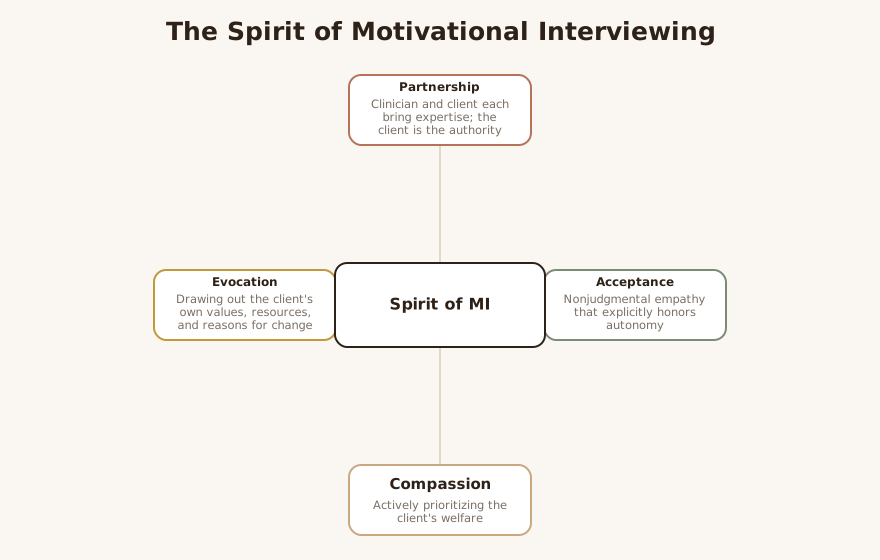
The foundation of MI is its underlying “spirit” — a way of being with clients that is more important than any technique. 1 The spirit comprises four interlocking elements: partnership (clinician and client each bring expertise; the client is the authority on their own life), acceptance (a nonjudgmental stance that expresses empathy and explicitly honors autonomy), compassion (actively prioritizing the client’s welfare), and evocation (drawing out the client’s own values, resources, and reasons for change rather than installing the clinician’s). 1
An earlier and still widely taught formulation expresses these commitments as four practice principles: express empathy, develop discrepancy, roll with resistance, and support self-efficacy. 5 Both formulations converge on the same clinical insight: motivation for change is elicited from the client, not imposed by the clinician. LLM A central concept is the righting reflex — the clinician’s instinctive urge to fix, correct, persuade, or argue the client toward the “right” answer. LLM MI treats that reflex as counterproductive, because direct persuasion tends to evoke the client’s defense of the status quo. LLM
The other organizing concept is ambivalence. SAMHSA’s TIP 35 frames motivation not as a fixed trait the client either has or lacks, but as a dynamic, changeable state that the clinician can actively influence within the relationship. 4 MI listens carefully for two opposing currents in the client’s speech: change talk (statements favoring movement toward change) and sustain talk (statements favoring the status quo). 1 The clinician’s job is to selectively attend to, evoke, and reinforce change talk while not amplifying sustain talk. 1
Interventions & Techniques
MI is operationalized through four processes that flow conversationally and recursively rather than as rigid stages: engaging (establishing a working relationship through listening and reflection), focusing (negotiating a shared agenda and a specific change target), evoking (eliciting the client’s own motivations and resolving ambivalence), and planning (consolidating commitment and developing concrete steps, only when readiness is present). 1
The micro-skills of MI are captured by the acronym OARS: Open questions that invite the client’s perspective, Affirmations that recognize strengths and effort, Reflections that demonstrate accurate understanding, and Summaries that gather and reinforce key statements. 1 Reflective listening is the workhorse skill, and attending to the language of change — distinguishing sustain talk from change talk — runs through all four processes. 1
LLM-generated illustrative example (not a guideline): A client mandated to treatment says, “I’m only here because the court made me, but I guess my drinking has cost me a lot.” Rather than correcting the resistance, the clinician reflects the change talk embedded in the second clause — “It’s cost you more than you’d like” — and follows with an evoking open question: “What are some of the things it’s cost you?” This selectively grows the change talk while rolling with the sustain talk. LLM
A practical rule of thumb is that the clinician resists the righting reflex, asks before informing (often using elicit-provide-elicit when offering information), and treats “resistance” as a signal to shift stance rather than a client deficit. LLM The 4th edition de-emphasizes adversarial language like “resistance” in favor of discord (a relational rupture) and sustain talk (normal ambivalence), a refinement worth knowing for current practice. 3
Evidence Base
MI has a mature, established evidence base. The most-cited meta-analytic foundation, Rubak and colleagues’ 2005 systematic review and meta-analysis, synthesized 72 randomized controlled trials and concluded that MI in a scientific setting outperforms traditional advice-giving across a range of behavioral problems and diseases. 2 MI showed a significant effect in approximately 74% of the trials, with comparable efficacy for psychological outcomes (75%) and physiological outcomes (72%). 2
Clinicians should be candid about effect magnitude and heterogeneity. LLM In Rubak’s pooled analyses, MI produced significant combined effects on body mass index, total blood cholesterol, systolic blood pressure, blood alcohol concentration, and standard ethanol content, but did not show significant pooled effects on cigarettes per day or HbA1c. 2 In other words, MI is reliably helpful but its effects are often modest and outcome-specific, not uniform across every target behavior. LLM
Dose and delivery matter. The same review found that brief 15-minute encounters showed an effect in 64% of studies while 60-minute encounters did so in 81%; a single session was effective in only about 40% of studies versus 87% when there were five or more sessions; and longer follow-up (12 months or more) was associated with higher effectiveness. 2 Provider type also mattered — psychologists and physicians achieved effects in roughly 80% of studies, while other providers did so in about 46%, underscoring that MI is a learnable but trainable skill rather than an automatic property of a friendly conversation. 2 MI is explicitly labeled evidence-based by implementation centers and is documented to reduce treatment dropout, a clinically valuable outcome in its own right. 5
Populations & Indications
MI was first developed and validated in the context of alcohol and other substance use treatment, and remains a frontline approach there. 4 It is well-supported for people with substance use disorders, including alcohol use disorder, where Rubak found effects in about 75% of relevant studies. 2 It is widely applied with adolescents, individuals with chronic illness, and people facing any health-behavior change need — weight management, smoking cessation, diabetes self-management, and medication or treatment adherence. 2 5
MI is particularly indicated whenever ambivalence or low motivation is the rate-limiting step. LLM It is a natural fit for justice-involved or mandated clients and adults ambivalent about treatment, populations in which traditional persuasion often backfires and where MI’s autonomy-honoring stance can lower defensiveness. 4 5 Because motivation is treated as a dynamic state the clinician can influence, MI is appropriate even when a client arrives with little stated interest in change. 4
Problems-for-Work
- Alcohol and substance use disorders. MI directly targets the ambivalence at the heart of addictive behavior and is the historical home of the method. 4 For example, a clinician helps a client voice their own reasons for cutting back rather than reciting the harms. LLM
- Medication and treatment nonadherence. MI explores the client’s mixed feelings about a regimen and elicits their own arguments for adherence. 5
- Smoking cessation, obesity, and diabetes self-management. MI is used to mobilize health-behavior change; effects are real but modest, and pooled data did not show a significant cigarettes-per-day or HbA1c effect, so set expectations accordingly. 2
- Low treatment motivation and ambivalence about change. This is MI’s purest indication — the work is resolving the ambivalence itself. 1
- Behavioral health risk reduction and gambling disorder. MI’s change-talk methodology generalizes to a range of risk behaviors where a person is “of two minds.” LLM
LLM-generated illustrative example (not a guideline): A primary-care patient with type 2 diabetes says she “knows she should test more but never gets around to it.” The clinician uses elicit-provide-elicit: asks what she already knows about glucose monitoring, offers one piece of information with permission, then evokes her own next step — “Given all that, what feels doable this week?” LLM
Contraindications, Cautions & Cultural Humility
MI has no formal contraindications in the way a medication does, but several cautions matter. LLM MI is a style, not a panacea: pooled effects are modest and outcome-specific, so presenting it as a guaranteed lever for change overstates the evidence. 2 When a client is in acute crisis, actively suicidal, psychotic, or otherwise needs directive safety intervention, the evocative, autonomy-first stance should yield to appropriate risk management. LLM Similarly, MI is about resolving ambivalence; if a client is already committed and simply lacks skills or resources, continued ambivalence-focused work can feel patronizing, and a shift to action-oriented or skills-based treatment is more appropriate. LLM
Fidelity is a genuine caution. LLM Because MI looks deceptively like ordinary supportive conversation, clinicians can believe they are “doing MI” while actually persuading, lecturing, or following the righting reflex — and the dose-response and provider-type findings suggest that under-trained delivery yields weaker results. 2 Training centers therefore require structured training plus between-session practice rather than a single workshop. 5
On cultural humility: MI’s central commitments — partnership, honoring autonomy, and evoking the client’s own values rather than imposing the clinician’s — are themselves a structural support for culturally responsive care. 1 In practice this means the clinician treats the client as the authority on their own life and context, and is alert that “change talk,” ambivalence, and even the appropriateness of certain goals are shaped by cultural, familial, and community frameworks the client knows better than the clinician does. LLM
Treatment-Plan Suggestions & SMART Objectives
| Goal | SMART objective (example) | Mechanism |
|---|---|---|
| Strengthen client’s own motivation for a target change | Within 4 sessions, client will verbalize at least 3 personal reasons for change (change talk) elicited via open questions, documented in session notes | Evocation; selectively reinforcing change talk 1 |
| Resolve ambivalence about substance use | Within 6 sessions, client will complete a decisional exploration of pros/cons of current use and articulate one self-chosen next step | Developing discrepancy; resolving ambivalence 4 |
| Improve treatment/medication adherence | Over 8 weeks, client will identify and implement one self-selected adherence strategy and report adherence ≥80% by self-monitoring | Autonomy support; eliciting client’s own change plan 5 |
| Increase engagement / reduce dropout | Client will attend ≥4 of next 5 scheduled sessions, with clinician using OARS-based engaging each visit | Engaging process; empathy reduces discord and dropout 5 |
| Move from contemplation toward action on a health behavior | Within 6 weeks, client will set one specific, measurable behavioral goal (e.g., walking 20 min x3/week) chosen by the client | Focusing / Focusing-Oriented Psychotherapy + planning; commitment language 1 |
| Reduce defensiveness in a mandated client | By session 3, frequency of sustain talk/discord decreases as clinician rolls with resistance, per clinician observation | Rolling with resistance; honoring autonomy 4 |
| Build self-efficacy for change | Client will identify ≥2 past successes and one strength applicable to current goal, affirmed by clinician | Supporting self-efficacy; affirmations 5 |
Common Misconceptions
- “MI is just being nice / Rogerian listening.” MI is person-centered in spirit but explicitly goal-oriented toward a particular change, which distinguishes it from purely nondirective counseling. 1 7
- “MI is a set of tricks to get clients to do what I want.” MI honors autonomy and the client’s right to not change; using OARS manipulatively violates the spirit and tends to fail. 1
- “If I learned the techniques, I’m doing MI.” The spirit (partnership, acceptance, compassion, evocation) is primary; technique without spirit is not MI, and provider-skill data suggest under-trained delivery yields weaker results. 1 2
- “MI works strongly for everything.” Effects are reliable but generally modest and outcome-specific; pooled analyses found no significant effect for cigarettes-per-day or HbA1c. 2
- “MI equals the Stages of Change model.” The two were historically linked but are conceptually distinct; MI does not require staging the client. 4 LLM
- “MI is only for addiction.” Although it originated in substance use treatment, it is applied across health, mental health, and many other settings. 4 5
Training & Certification
There is no single mandatory license to “practice MI,” but credible skill development follows a structured pathway. LLM The Motivational Interviewing Network of Trainers (MINT) is the international community of practice that defines and disseminates the method and maintains the authoritative description of MI. 1 Implementation centers typically deliver multi-part foundational training with required between-session practice before advancing, plus advanced workshops and coaching/supervision focused on fidelity. 5
Because MI is easy to approximate and hard to do well, ongoing coaching with feedback (often using fidelity coding of recorded sessions) is the accepted route to competence rather than a one-off workshop. LLM The current standard reference text is the 4th edition of Miller and Rollnick’s book, which any clinician adopting MI should treat as primary. 3 Brief orienting overviews directly from the developers are also available. 6
Key Terms
- Spirit of MI: the underlying stance of partnership, acceptance, compassion, and evocation. 1
- The four processes: engaging, focusing, evoking, planning. 1
- OARS: Open questions, Affirmations, Reflections, Summaries — the core micro-skills. 1
- Change talk / sustain talk: client language favoring change versus the status quo; the clinician selectively reinforces change talk. 1
- Righting reflex: the clinician’s urge to fix or persuade, which MI deliberately restrains. LLM
- Ambivalence: simultaneous wanting and not-wanting change; the central target of MI. 4
- Developing discrepancy / supporting self-efficacy / rolling with resistance / expressing empathy: the four classic practice principles. 5
Resources & Further Reading
▶ Watch — a video introduction to this concept:
- MINT — Understanding Motivational Interviewing 1
- Rubak et al. (2005), systematic review and meta-analysis, British Journal of General Practice 2
- Miller & Rollnick, Motivational Interviewing, 4th ed. (Guilford Press) 3
- SAMHSA TIP 35: Enhancing Motivation for Change in Substance Use Disorder Treatment 4
- Case Western Reserve University, Center for Evidence-Based Practices — Motivational Interviewing 5
- What is Motivational Interviewing? (Miller, Moyers & Rollnick) — video 6
- Motivational interviewing — Wikipedia 7
Reflective / Supervision Questions
- Where in my last session did I notice the righting reflex, and what did I do with it? LLM
- Can I distinguish, from a transcript, the moments of change talk versus sustain talk — and did I selectively reinforce the former? 1
- Am I doing MI in spirit (partnership, evocation) or merely deploying OARS techniques to steer the client toward my preferred outcome? 1
- Given that effects are modest and dose-dependent, is the dose and format of MI I’m offering this client adequate, or am I expecting too much from a single brief contact? 2
- With mandated or ambivalent clients, how am I honoring autonomy while still maintaining a clear focus? 4
- When am I confident a client has moved from ambivalence to commitment such that I should shift from evoking to planning — or to a different, action-oriented modality entirely? LLM
- How is this client’s cultural and relational context shaping what counts as a desirable change, and am I treating them as the authority on that? LLM