
Type & Discipline
Operant conditioning is a theory of learning, not a therapy in itself, and it sits at the foundation of behavioral and learning psychology 4. It describes how voluntary behavior is modified by its consequences: actions followed by reward tend to recur, while actions followed by aversive outcomes tend to diminish 6. The APA frames it as a process in which the probability of a response changes as a function of the consequences that follow it, distinguishing it from classical (respondent) conditioning, which concerns involuntary reflexive responses elicited by paired stimuli 1. For the practicing clinician, this distinction is load-bearing: classical conditioning explains how a cue comes to trigger a reaction (the fear that spikes at the sight of a needle), while operant conditioning explains how a behavior is maintained or extinguished by what it produces (the avoidance that keeps the phobia alive) 3.
Because it deals in observable behavior and measurable consequences rather than inferred mental states, operant conditioning gave behavior therapy its working vocabulary 2. It is the theoretical engine beneath applied behavior analysis, contingency management, token economies, parent management training, behavioral activation, and the behavioral half of cognitive behavioral therapy 3. Nearly every behaviorally oriented technique a therapist uses can be traced to an operant principle, which is why understanding the theory pays off across modalities rather than within a single one LLM.
Creators & Lineage
The lineage begins with Edward Thorndike, whose puzzle-box experiments with cats produced the Law of Effect around 1901: behavior followed by satisfying consequences is more likely to recur, and behavior followed by discomfort is less likely to recur 3. This was the first systematic statement that consequences strengthen or weaken behavior, and Thorndike’s paradigm was originally termed instrumental conditioning because the behavior was instrumental in producing the outcome 2.
B. F. Skinner (1904–1990) is regarded as the father of operant conditioning and built the systematic framework on Thorndike’s foundation 3. Skinner rejected Thorndike’s appeal to unobservable mental states such as “satisfaction” and grounded his analysis strictly in observable behavior and measurable consequences 3. His 1938 work, The Behavior of Organisms, launched the formal study of operant conditioning, and he invented the operant conditioning chamber (the “Skinner box”), which allowed precise measurement of response rates through lever-pressing or key-pecking 23. Skinner coined the term operant to denote behavior that “operates” on the environment to generate consequences, in contrast to the respondent behavior of classical conditioning 3.
The theory’s descendants are central to clinical practice 3. Applied behavior analysis extends operant principles to socially significant human behavior; social learning theory (Bandura) added observational learning that pure operant accounts could not explain; and cognitive behavioral therapy retained the behavioral contingency work while adding explicit cognitive mediation 23. Operant conditioning is therefore best read as a parent theory whose children populate much of the contemporary behavioral toolbox LLM.
Core Principles
The basic unit of analysis is the three-term contingency: a discriminative stimulus (the antecedent cue signaling that a consequence is available), the response (the behavior), and the consequence 3. A classic illustration is a rat trained to press a lever only when a light is on; the light is the discriminative stimulus that sets the occasion for reinforced responding 3. In clinical language, this is the antecedent–behavior–consequence (A-B-C) frame that behavior plans are built on 3.
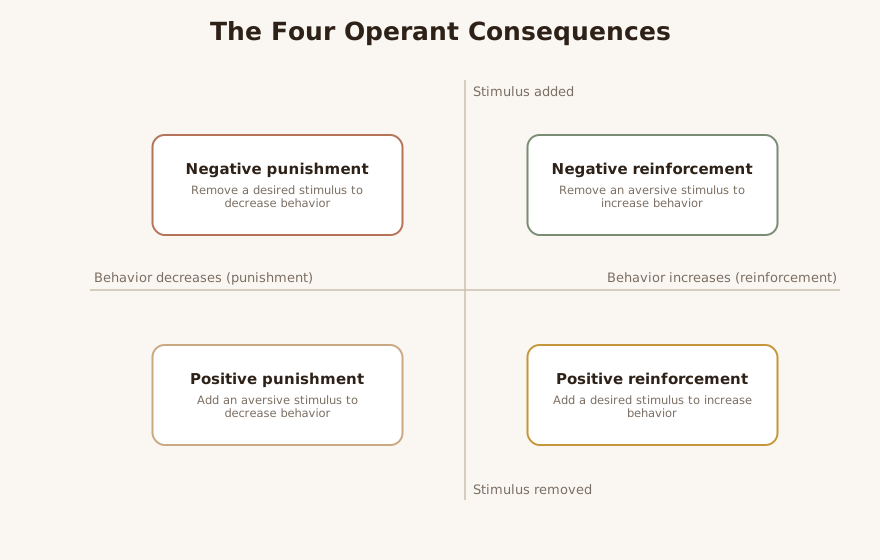
Consequences fall into four quadrants, defined by whether a stimulus is added or removed and whether behavior increases or decreases 5. Positive reinforcement adds a desired stimulus to increase behavior (praising a child for completing chores) 6. Negative reinforcement removes an aversive stimulus to increase behavior (getting out of bed to turn off an alarm) 6. Positive punishment adds an aversive stimulus to decrease behavior (extra chores for coming home late) 6. Negative punishment removes a desired stimulus to decrease behavior (confiscating a toy for lying) 6. Reinforcement always increases behavior and punishment always decreases it; the words “positive” and “negative” refer only to adding versus subtracting, not to good versus bad 5.
Reinforcers are further divided into primary reinforcers, which satisfy biological needs directly (food, water, warmth), and secondary (conditioned) reinforcers, which acquire their power through association (money, grades, praise, tokens) 2. Extinction occurs when the reinforcement that maintained a behavior is withheld, after which the behavior gradually declines 2. Reinforcement is most effective when it is immediate, contingent on the target behavior, and matched to the organism’s current state of deprivation or satiation 3.
Interventions & Techniques
Shaping (reinforcement of successive approximations) builds a complex target behavior by reinforcing progressively closer approximations to it, starting from a behavior the person already performs 2. Schedules of reinforcement govern persistence and are among Skinner’s most clinically consequential discoveries 2. Continuous reinforcement (rewarding every response) produces fast initial learning but rapid extinction once reward stops 2. Intermittent schedules produce more durable behavior, and the variable-ratio schedule (reinforcement after an unpredictable number of responses) yields the highest, most persistent rate of responding and the slowest extinction 23. This is why slot machines and other gambling devices, which run on variable-ratio schedules, sustain such tenacious behavior 3.
The clinical applications are direct 3. A token economy uses secondary reinforcers (tokens, points, stickers) that are exchanged for primary rewards, widely deployed in psychiatric hospitals and educational settings 2. Behavior modification systematically alters environmental consequences to strengthen desired and weaken undesired behaviors 2. Parent management training teaches caregivers to reward appropriate behavior with praise, smiles, and concrete rewards while using successive approximations toward larger goals 3. Contingency management for substance use applies the same logic, delivering tangible reinforcers for verified abstinence 3.
LLM-generated illustrative example (not a guideline): A clinician working with a withdrawn, depressed client uses behavioral activation, scheduling a single small, valued activity and arranging that its natural positive consequence (a brief pleasant exchange, a sense of accomplishment) follows reliably, then gradually expanding the activity menu as the behavior strengthens. The mood lift is treated as a reinforcer that the schedule is designed to deliver LLM.
Evidence Base
The maturity of operant conditioning is best labeled established. Its core principles, reinforcement strengthens behavior, punishment weakens it, schedules govern persistence, are among the most robustly replicated findings in psychology, reproduced across species and decades since Thorndike’s and Skinner’s original work 23. Unlike a packaged therapy with disputed efficacy, operant conditioning is a basic learning mechanism, and the question is not whether it “works” but where and how it applies LLM.
That said, the theory has well-documented limits that clinicians should hold in view 2. Garcia and Koelling’s 1966 work on biological preparedness showed that organisms are predisposed to form some associations far more readily than others, contradicting any claim that any behavior can be conditioned to any consequence with equal ease 2. The theory in its pure form underweights cognitive processes, insight learning, and observational learning, which is why Bandura’s social learning theory and later cognitive models were needed 2. Chomsky’s critique of behaviorist accounts of language acquisition exposed a further boundary 2. The overjustification effect demonstrates that excessive external reward can undermine intrinsic motivation for activities that are already enjoyable, a caution against reflexively reinforcing everything 2. Finally, extrapolating from animal laboratory findings to complex human cognition, language, and culture is not automatic 2. The fair summary is a theory whose mechanisms are solid and whose scope is bounded 2.
Populations & Indications
Operant methods are applied most heavily where behavior is observable and consequences can be arranged 3. Children with disruptive behavior are a primary population, addressed through parent management training, token systems, and contingency contracts 3. Autistic individuals and people with intellectual and developmental disabilities are the historic core of applied behavior analysis, where reinforcement, shaping, and prompting build adaptive skills 3. Individuals with substance use disorders are served by contingency management, which reinforces verified abstinence 3.
Patients in inpatient and institutional settings have long been managed with token economies that structure ward behavior around exchangeable conditioned reinforcers 2. People with habit disorders, including tic and habit problems, are treated with behavioral procedures that alter the contingencies maintaining the habit 3. Across these populations, the common thread is that a target behavior can be defined, measured, and brought under the control of arranged consequences LLM.
Problems-for-Work
- Oppositional defiant disorder and conduct disorder. Parent management training rewards prosocial compliance and places attention-maintained defiance on planned ignoring (extinction), shifting the contingencies that sustain the conflict 3.
- Attention-deficit/hyperactivity disorder. Token economies and immediate, frequent reinforcement compensate for the delayed-reward insensitivity common in ADHD, strengthening on-task behavior 3.
- Substance use disorder. Contingency management delivers tangible reinforcers for drug-negative tests, directly competing with the drug’s own reinforcing properties 3.
- Self-injurious behavior and noncompliance. Identifying the maintaining consequence (escape, attention, access) allows a functionally equivalent behavior to be reinforced while the problem behavior is no longer reinforced 3.
- Behavioral activation deficits in depression. Activity scheduling re-establishes contact with natural positive reinforcement that depression has eroded LLM.
LLM-generated illustrative example (not a guideline): For a child whose tantrums reliably end a demand (escape via negative reinforcement of the parent’s withdrawal), a clinician might coach the parent to keep the demand in place while reinforcing a brief, appropriate break request, so escape is delivered for the new behavior rather than the tantrum LLM.
Contraindications, Cautions & Cultural Humility
The principal cautions concern punishment. Punishment can suppress rather than eliminate behavior, tends to generate fear and aggression, provides no instruction in what to do instead, and carries potential for abuse 26. Contemporary behavioral practice therefore prioritizes reinforcement of desired alternatives over punishment, and the use of aversive procedures is heavily restricted 6. A second caution is generalization: behavior learned in one context may be absent or altered in another, so gains established in the clinic do not automatically transfer to home or school and must be deliberately programmed across settings 3.
A third is the overjustification effect: rewarding behavior that a client already finds intrinsically motivating can paradoxically reduce that motivation, so reinforcement should be reserved for behaviors that are not yet self-sustaining 2. Cultural humility requires recognizing that what functions as a reinforcer or a punisher is not universal but is shaped by the individual’s history, values, and context; a consequence that motivates one client may be neutral or aversive to another LLM. Goals should serve the client’s own quality of life and self-determination rather than enforcing compliance for its own sake, a critique raised forcefully within the autism and neurodiversity communities about behavioral programming LLM. Finally, the theory’s roots in animal laboratory work counsel caution against mechanistic over-application to the full complexity of human meaning-making 2.
Treatment-Plan Suggestions & SMART Objectives
| Goal | SMART objective (example) | Mechanism |
|---|---|---|
| Increase a child’s compliance | Within 8 weeks, child follows a first-time parental instruction in 80% of opportunities across 3 consecutive days | Positive reinforcement of compliance plus planned ignoring of attention-maintained refusal 3 |
| Reduce attention-maintained disruption | Within 6 weeks, classroom call-outs decrease 50% from baseline while hand-raising is praised | Differential reinforcement; extinction of the maintaining consequence 3 |
| Build on-task behavior (ADHD) | Within 10 weeks, sustain independent work for 10 minutes in 75% of trials using a token board | Immediate, frequent secondary reinforcement to offset delay insensitivity 3 |
| Support abstinence (SUD) | Over 12 weeks, earn escalating reinforcers for each drug-negative test, target 80% negative samples | Contingency management; reinforcement competing with drug reinforcement 3 |
| Replace self-injury | Within 12 weeks, reduce self-injury 50% while a functional communication request is reinforced | Function-based replacement; reinforcement of an equivalent behavior 3 |
| Re-engage activity (depression) | Within 4 weeks, complete 3 scheduled valued activities per week and rate post-activity mood | Behavioral activation; contact with natural positive reinforcement LLM |
| Reduce a habit/tic behavior | Within 8 weeks, decrease target habit frequency 40% using a competing-response plan | Altering contingencies maintaining the habit; reinforcement of the competing response 3 |
| Generalize a learned skill | Within 4 weeks of mastery, perform the skill with 2 new people and 1 new setting at criterion | Programmed generalization across people and settings 3 |
Common Misconceptions
- “Negative reinforcement means punishment.” Negative reinforcement removes an aversive stimulus to increase behavior; it is reinforcement, not punishment, and the most common student error in the field 5.
- “Reinforcement should be continuous to be effective.” Continuous reinforcement produces fast learning but fast extinction; intermittent, especially variable-ratio, schedules produce far more durable behavior 2.
- “Punishment is the efficient way to stop a behavior.” Punishment suppresses without teaching an alternative and risks fear and aggression; reinforcing a replacement behavior is the preferred strategy 26.
- “Operant conditioning is the same as classical conditioning.” Classical conditioning concerns involuntary reflexes elicited by cues; operant conditioning concerns voluntary behavior shaped by consequences 16.
- “Any behavior can be conditioned with the right consequences.” Biological preparedness shows organisms are predisposed toward some associations, bounding the theory’s reach 2.
Training & Certification
Operant conditioning is a theory rather than a credentialed treatment, so there is no certification in “operant conditioning” itself LLM. Clinicians acquire it as foundational coursework in behavioral and learning psychology, and it is examined as core content in standardized curricula such as the MCAT behavioral sciences sequence 5. Applied competence is credentialed through the modalities that operationalize the theory: board certification in applied behavior analysis, and training in contingency management, parent management training, and the behavioral components of cognitive behavioral therapy 3. Clinicians who wish to use operant methods responsibly should pursue supervised training within their own scope and the specific evidence-based protocol they intend to deliver, rather than improvising contingencies from first principles LLM.
Key Terms
- Three-term contingency (A-B-C) — antecedent/discriminative stimulus → behavior → consequence, the basic unit of analysis 3.
- Discriminative stimulus — an antecedent cue signaling that a consequence is available for a response 3.
- Reinforcement — any consequence that increases the future probability of a behavior; positive (adds a stimulus) or negative (removes one) 5.
- Punishment — any consequence that decreases behavior; positive (adds an aversive) or negative (removes a desirable) 5.
- Primary vs. secondary reinforcer — biologically satisfying reinforcers versus conditioned reinforcers that gain power through association 2.
- Extinction — decline of a behavior when its maintaining reinforcement is withheld 2.
- Shaping — reinforcing successive approximations toward a target behavior 2.
- Schedule of reinforcement — the rule governing when reinforcement is delivered; variable-ratio yields the most persistent responding 23.
- Token economy — a system of conditioned reinforcers exchangeable for primary rewards 2.
- Contingency management — delivering tangible reinforcers for a verified target behavior, used in substance use treatment 3.
Resources & Further Reading
▶ Watch — a video introduction to this concept:
- Operant conditioning — APA Dictionary of Psychology 1
- Operant Conditioning in Psychology: B.F. Skinner Theory — Simply Psychology 2
- Operant conditioning — Wikipedia 3
- Operant conditioning — EBSCO Research Starters 4
- Operant conditioning: Reinforcement and punishment — Khan Academy (MCAT) 5
- What Is Operant Conditioning and How Does It Work? — WebMD 6
Reflective / Supervision Questions
- For a behavior I want to change, have I identified the actual consequence that is maintaining it, or am I intervening on the behavior in isolation? 3
- Am I defaulting to punishment when reinforcing a functional replacement behavior would teach more and risk less? 26
- Is my reinforcement schedule designed for durability, and am I planning the thinning toward intermittent reinforcement before reward fades? 2
- Have I checked that what I am using as a reinforcer is actually reinforcing for this client given their history and values? LLM
- Have I deliberately programmed for generalization across people and settings, rather than assuming clinic gains will transfer? 3
- Am I at risk of the overjustification effect by rewarding a behavior the client already finds intrinsically motivating? 2
- Do my behavioral goals serve the client’s self-determination and quality of life, or compliance for its own sake? LLM