
Type & Discipline
Global Mental Health (GMH) is not a therapy modality; it is a field of research and practice and an associated social movement that sits at the intersection of public health, psychiatry, epidemiology, and human rights 14. Its unit of concern is the population rather than the individual session, and its central empirical claim is that an enormous gap exists between the number of people living with mental disorders and the number who receive even basic care 45. The World Health Organization frames mental health itself as “a state of mental well-being that enables people to cope with the stresses of life, realize their abilities, learn well and work well, and contribute to their community” — a definition that already pushes beyond the absence of diagnosable illness 5.
For a practicing therapist, the relevance is twofold LLM. First, GMH supplies the delivery science behind models — task-sharing, stepped care, brief structured protocols delivered by non-specialists — that increasingly shape how care is organized even in high-resource settings 4. Second, it supplies a disciplined ethic of cultural humility about how diagnostic categories and Western therapeutic assumptions travel across cultures 4. Treating GMH as merely “psychiatry for poor countries” misses that its conceptual contributions reshape the clinician’s stance everywhere LLM.
Creators & Lineage
The field crystallized around the 2007 Lancet series on global mental health, a coordinated set of papers that documented the treatment gap, mapped the scarcity of mental health resources worldwide, argued for scaling up evidence-based packages of care, and issued a call to action 12. The series is most associated with Vikram Patel and Martin Prince, with major contributions from Arthur Kleinman, whose cultural-psychiatry work anchors the field’s attention to validity across cultures, and Shekhar Saxena, who led mental health at the World Health Organization during the field’s institutional consolidation 124.
Out of the 2007 series grew the Movement for Global Mental Health, deliberately structured as a grassroots coalition rather than a formal institution — as its early description put it, “the movement is not an organisation,” with “no constitution, no office, no board of governors, and no budgets” 2. By the time of the field’s renewed agenda, this coalition spanned “95 institutions and over 1700 individuals from more than 100 countries” 4. The lineage reached a major inflection point with the 2018 Lancet Commission on global mental health and sustainable development, which broadened the agenda from closing the treatment gap to improving the mental health of whole populations and embedding mental health within the Sustainable Development Goals 3.
Core Principles
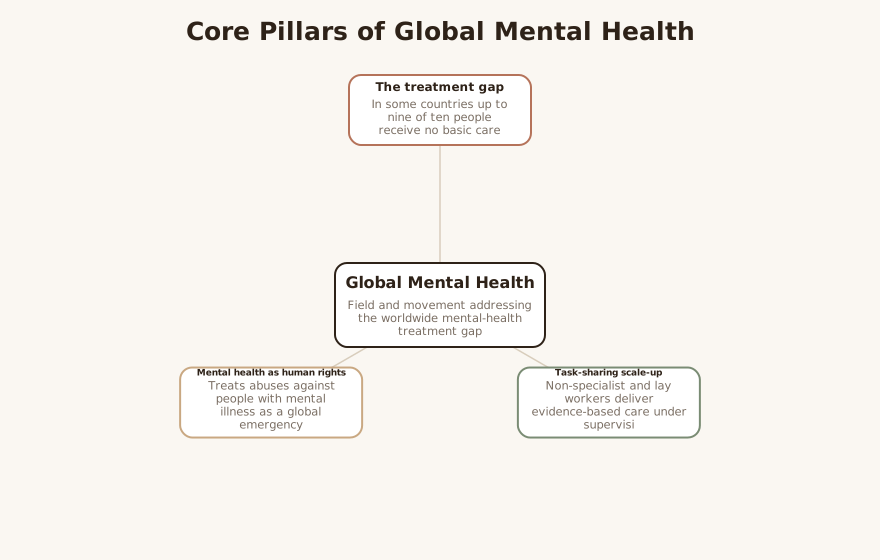
The treatment gap is the founding fact. In some countries, “up to nine of ten people with a mental health problem do not receive even basic care,” and this gap is most severe in low-income and middle-income regions 4. WHO data underscore the scale of need: in 2019 roughly 970 million people globally were living with a mental disorder, anxiety and depression being most prevalent, and mental disorders account for one in six years lived with disability worldwide 5.
Scale-up through task-sharing. Because the shortage of specialists is massive and will not be closed by training more psychiatrists, GMH centers “task sharing with non-specialist and lay health workers” — equipping community workers, nurses, and trained laypeople to deliver structured, evidence-based interventions under supervision 4. This is the field’s signature delivery principle and its most empirically supported one 4.
Mental health as a human-rights issue. The field treats human-rights abuses against people with mental illness as “a global emergency on a par with the worst human rights scandals,” and WHO’s QualityRights initiative operationalizes a rights-based, recovery-oriented standard of care 45.
Mental health and development are inseparable. Effective mental health interventions can contribute to reductions in poverty, and conversely poverty, violence, disability, and inequality raise the risk of mental disorder 45. The 2018 Commission made this structural, situating mental health across “virtually every major issue in development, from education and economic growth, to conflict and climate change,” and framing mental wellbeing on a continuum rather than as a binary of ill versus well 3.
Cultural validity over uncritical export. A recurring principle is that diagnostic categories and intervention models must be tested for validity in each cultural context rather than assumed to transfer intact — a stance rooted in Kleinman’s cultural-psychiatry tradition and threaded through the field’s self-critique 4.
Interventions & Techniques
GMH is a delivery framework, so its “techniques” are organizational and protocol-level rather than in-room maneuvers LLM. The flagship example is WHO’s Mental Health Gap Action Programme (mhGAP), which packages intervention guidelines for “priority mental, neurological, and substance misuse disorders for use by non-specialists,” covering conditions such as depression, psychosis, suicide/self-harm, epilepsy, dementia, and substance-use disorders 24.
Core delivery components include LLM: (1) task-sharing — non-specialist or lay providers deliver brief structured protocols under specialist supervision 4; (2) integrated packages of care — bundling evidence-based interventions for priority disorders into community and primary-care settings rather than relying on scarce psychiatric hospitals 2; (3) collaborative and stepped care — matching intensity of intervention to severity, escalating to specialists only when needed LLM; and (4) community-based service models consistent with WHO’s Comprehensive Mental Health Action Plan, which emphasizes community-based care, promotion, and prevention over institutional care 5.
LLM-generated illustrative example (not a guideline): A primary-care clinic adopts an mhGAP-aligned pathway in which a trained nurse screens for depression, delivers a brief structured behavioral-activation protocol over several visits, and refers to the visiting psychiatrist only the clients who do not improve or who screen positive for suicide risk — a stepped, task-shared design that extends the reach of a single specialist across an entire catchment population LLM.
For the office-based therapist in a high-resource setting, the transferable techniques are the same ones LLM: supervising brief structured protocols, building stepped-care referral logic, and screening systematically rather than relying on presentation alone 4.
Evidence Base
The maturity label “established” requires a precise reading LLM. What is established is not “GMH” as a single modality with one randomized trial base, but a body of evidence supporting specific delivery strategies — above all, that task-shared, non-specialist-delivered psychological interventions for common disorders such as depression and anxiety are effective and feasible in low-resource settings 4. The field explicitly identifies task-sharing as evidence-based 4.
Several lines of evidence anchor this status LLM. The treatment-gap epidemiology is robust and replicated across WHO surveillance 45. The economic case is well quantified: the 2018 Commission projected that mental health conditions would cost the global economy roughly US$16 trillion in lost output between 2011 and 2030 — more than cancer, diabetes, and chronic respiratory diseases combined — while every US$1 invested in scaling up treatment for common conditions such as depression yields an estimated US$3–5 return 3.
Be honest about the maturity boundary LLM. The 2018 Commission itself acknowledged that the field had to expand beyond reducing the treatment gap toward improving population mental health and closing gaps in prevention and quality of care — implicitly conceding that prevention evidence and real-world quality of delivery remain less mature than the access-and-efficacy evidence 3. The renewed agenda likewise flagged that real-world delivery models still require development and that the evidence-to-practice gap is itself a research frontier 4. So: established as a delivery framework with strong efficacy and economic evidence for specific interventions; still maturing on prevention, on quality at scale, and on cross-cultural validity 34.
Populations & Indications
GMH’s primary population is people in low- and middle-income countries (LMICs), where the treatment gap is most severe and specialists are scarcest 4. Within that, the field gives particular attention to children and adolescents — “more than a third of the global population” — whose mental health needs are systematically under-served 4.
The framework is also indicated for populations shaped by structural adversity: people experiencing poverty, violence, disability, and inequality, all of which elevate risk for mental disorder 45, and people with severe mental illness who are especially vulnerable to human-rights violations and to premature mortality — WHO notes that people with severe conditions die 10–20 years earlier than the general population 5. By indication, the priority conditions mirror the mhGAP set: depression, psychosis, suicide and self-harm, substance-use disorders, and the common anxiety disorders 245.
Problems-for-Work
GMH reframes familiar clinical problems-for-work at the level of access and delivery rather than only symptom reduction LLM:
- Untreated depression and anxiety. The problem-for-work is not only the mood or worry symptoms but the access barrier; the GMH answer is a task-shared brief protocol delivered close to where the person lives 4.
- Psychosis with no specialist within reach. Application: an mhGAP-aligned pathway lets a trained non-specialist initiate and monitor care while reserving the psychiatrist for diagnostic uncertainty or treatment resistance 24.
- Suicide and self-harm risk in under-resourced settings. Application: systematic screening built into primary-care contacts, with clear escalation criteria, so that risk is detected rather than missed 2.
- Substance-use disorder. Application: inclusion in the integrated package of community-based care rather than siloed into separate, often absent, addiction services 2.
- Mental ill-health entangled with poverty. Application: pairing clinical intervention with attention to social determinants, given the bidirectional link between poverty and mental disorder 45.
Contraindications, Cautions & Cultural Humility
The chief caution is intrinsic to the field’s own self-critique LLM. Exporting diagnostic categories and intervention manuals without testing their validity in the local cultural context risks imposing frameworks that do not fit the idioms of distress people actually use — the field’s emphasis on cultural validity exists precisely to guard against this 4. A second caution is that scale-up must not become a thin, under-supervised substitute for adequate care; task-sharing is evidence-based with supervision and quality systems, not as unsupported delegation 4.
A third caution is structural humility LLM. The field warns that budgetary allocations for mental health remain “grotesquely out of proportion” to need, so individual clinical effort cannot compensate for systemic under-investment, and clinicians should be honest with clients about what a strained system can and cannot provide 4. Finally, the human-rights frame is itself a standard of care: any model that scales access while tolerating coercion or rights violations fails on the field’s own terms 45.
LLM-generated illustrative example (not a guideline): A team adapting a manualized depression protocol for a new community first works with local health workers and community members to learn how distress is named and expressed locally, revises screening language accordingly, and confirms the construct is recognizable before deploying the protocol — rather than translating the manual verbatim and assuming it transfers LLM.
Treatment-Plan Suggestions & SMART Objectives
| Goal | SMART objective (example) | Mechanism |
|---|---|---|
| Reduce access barriers to evidence-based care | Within 8 weeks, client completes 6 sessions of a brief structured protocol delivered through a stepped-care pathway | Task-shared delivery extends reach of scarce specialists 4 |
| Detect and manage suicide/self-harm risk | At every contact for 12 weeks, clinician administers a standardized risk screen with documented escalation criteria | Systematic screening within an integrated care package 2 |
| Address social determinants alongside symptoms | Within 4 weeks, client and clinician identify 2 poverty- or adversity-linked stressors and link to 1 community resource | Bidirectional poverty–mental-health link 45 |
| Improve cultural fit of the intervention | By session 2, clinician elicits and documents the client’s own idiom of distress and adapts psychoeducation accordingly | Cultural validity / category-fallacy guardrail 4 |
| Strengthen continuity via community-based care | Within 6 weeks, client is connected to one ongoing community-based support consistent with a recovery orientation | WHO community-based, recovery-oriented model 5 |
| Protect rights and dignity in care | Throughout treatment, clinician documents informed consent and absence of coercive measures at each decision point | Human-rights / QualityRights standard 45 |
| Build measurement-based monitoring | Over 12 weeks, client completes a validated symptom measure at baseline, midpoint, and endpoint | Quality-of-care gap targeted by the 2018 Commission 3 |
Common Misconceptions
“GMH is just psychiatry for poor countries.” The framework’s conceptual contributions — task-sharing, the social-determinants lens, cultural validity — reshape practice in every setting, and the 2018 Commission explicitly broadened the agenda to the mental health of whole populations 34LLM.
“It means exporting Western therapy worldwide.” The field’s core caution is the opposite: that uncritical export risks invalid categories, which is why cultural validity is a founding principle 4.
“Task-sharing lowers quality.” The evidence is that non-specialist-delivered, supervised protocols are effective; quality depends on supervision and structure, not on specialist credentials per se 4LLM.
“It’s only about closing the treatment gap.” The 2018 Commission deliberately expanded the agenda beyond access to also encompass prevention and quality of care across a continuum of mental wellbeing 3.
“It’s a single, fully proven intervention.” It is a delivery framework; the evidence is strongest for specific task-shared interventions, with prevention and quality-at-scale still maturing 34LLM.
Training & Certification
There is no single credential that certifies one as a “global mental health clinician” LLM. The field’s practical entry points are the WHO mhGAP intervention guidelines and training materials, which are designed to equip non-specialists to deliver care for priority disorders, and WHO’s QualityRights training on rights-based, recovery-oriented care 245. Engagement has historically run through the Movement for Global Mental Health as an open coalition rather than a certifying body 2. Clinicians seeking structured grounding typically pursue graduate coursework in global or public mental health and supervised experience with task-shared, community-based delivery models LLM.
Key Terms
- Treatment gap — the proportion of people with a mental disorder who do not receive care, reaching as high as nine in ten in some settings 4.
- Task-sharing (task-shifting) — delivering structured interventions through trained non-specialist and lay health workers under specialist supervision 4.
- mhGAP — WHO’s Mental Health Gap Action Programme; intervention guidelines for priority disorders for use by non-specialists 24.
- Packages of care — bundled, evidence-based interventions for priority disorders delivered in community and primary-care settings 2.
- Cultural validity — the requirement that diagnostic categories and interventions be tested for meaning and fit in each cultural context 4.
- Social determinants of mental health — the structural conditions (poverty, violence, inequality) that shape mental-health risk 45.
- Mental wellbeing continuum — the 2018 Commission’s reframing of mental health beyond a well/ill binary toward a dimensional view embedded in development 3.
Resources & Further Reading
▶ Watch — a video introduction to this concept:
- The Lancet — Global Mental Health 2007 Series (landing page)
- The Lancet’s Series on Global Mental Health: 1 year on (PMC, open access)
- The Lancet Commission on global mental health and sustainable development (2018)
- A renewed agenda for global mental health (PMC, open access)
- World Health Organization — Mental Health (programme hub)
Reflective / Supervision Questions
- Where in my own practice do I rely on specialist scarcity as an excuse rather than designing stepped, task-shared pathways that extend reach? LLM
- When I apply a manualized protocol, do I test whether its categories and idioms fit the client’s cultural context, or do I assume they transfer? 4LLM
- How systematically do I screen for the priority problems — depression, suicide risk, substance use — versus relying on what a client volunteers? 2LLM
- Am I attending to the social determinants (poverty, violence, inequality) that shape my client’s distress, or treating symptoms in isolation? 45LLM
- In what concrete ways does my care uphold — or quietly compromise — the human-rights and dignity standard the field treats as non-negotiable? 45LLM
- The 2018 Commission pushed beyond access toward prevention and quality; what would shifting even one objective in that direction look like in my caseload? 3LLM