
Most evidence-based treatments were developed, tested, and refined with samples that do not look like the full population a working clinician actually sees LLM. Cultural adaptation is the disciplined response to that gap: rather than abandon a treatment that works or apply it unchanged across every group, it provides frameworks for deciding what to modify, why, and how, while protecting the active ingredients 1. This article orients practicing therapists to the major frameworks, the honest state of the evidence, and how to use adaptation in routine care LLM.
Type & Discipline
Cultural adaptation of evidence-based treatments is a framework — or, more accurately, a family of frameworks — rather than a standalone therapy modality LLM. It sits at the intersection of clinical psychology and implementation science, the field concerned with how research-supported practices actually get delivered in real-world settings 1. Implementation science contributes ecological, multi-level thinking about systems and providers, while cultural adaptation contributes granular attention to the cultural factors operating between a specific client and clinician 1. The two were historically separate literatures, and a recurring argument in the field is that they should inform each other directly 1. In practice, cultural adaptation is something you do to an existing intervention, not a treatment you deliver on its own LLM.
Creators & Lineage
The foundational framework is the Ecological Validity Model (EVM), introduced by Guillermo Bernal, Bonilla, and Bellido in 1995 2. The EVM specifies eight dimensions along which a treatment can be culturally adapted: language, persons, metaphors, content, concepts, goals, methods, and context 2. A second lineage comes from Resnicow and colleagues, who distinguished surface structure adaptations — matching materials, language, and imagery to a population’s observable characteristics — from deep structure adaptations, which incorporate culture-specific illness conceptualizations, social norms, and beliefs into the intervention’s mechanisms 1. Melanie Domenech Rodríguez and Bernal further contributed decision-making guidelines for adaptation, and the EVM remains the dominant coding scheme in adaptation reviews 2. Felipe González Castro and Manuel Barrera are central figures in this literature, associated with the heuristic that adaptation proceeds through staged phases of information-gathering, preliminary design, testing, and refinement LLM. More recent contributions include Anna Lau’s selective and directed adaptation framework — which holds that adaptation is warranted when distinct sociocultural contexts demand new treatment elements or when poor social validity threatens engagement — and the Dynamic Adaptation Process, in which an implementation resource team makes iterative adaptation decisions while preserving core ingredients 1.
Core Principles
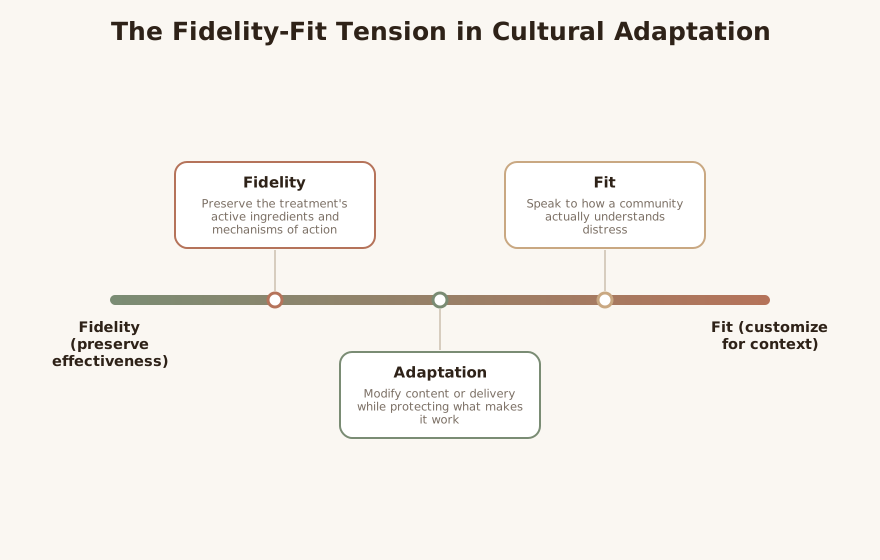
The organizing principle is the tension between fidelity and fit: preserving the treatment’s effectiveness while customizing it for a local context and population 1. Adaptation can target the content of an intervention or its delivery, and deciding which requires careful specification so that active ingredients are not diluted 1. A second principle is mechanism preservation — the first analytic step in rigorous procedures is to identify the treatment’s key mechanisms of action so that everything downstream protects them 3. A third is the primacy of deep over merely surface change: translating materials and swapping in local imagery is necessary but rarely sufficient, because engagement and outcomes are driven by whether the intervention speaks to how a community actually understands distress 1. Finally, the field increasingly insists on transparency — explicit documentation of what was adapted, why, and how — because ad-hoc, undocumented modification cannot be evaluated or replicated 2.
Interventions & Techniques
Concrete techniques map onto the EVM dimensions 2. At the surface level, clinicians translate materials into the client’s language, replace clinical examples with locally relevant stressors such as financial burden, grief, or migration, and develop case stories and visual cards featuring relatable characters 3. At the deep level, the most consequential move is reworking the explanatory model of distress itself 1. A widely cited example comes from adapting Group Problem Management Plus, a five-session World Health Organization intervention, for earthquake-affected communities in Nepal, where the team built a “tension” ethnopsychology model that linked symptoms to practical problems and resonated far better than clinical depression terminology 3. Delivery-level techniques include recruiting and training local lay health workers as facilitators, conducting community sensitization events with de-stigmatizing language, and building fidelity tools such as skill-application checklists 3. These same principles now extend to digital care, where internet- and mobile-based interventions for mental disorders are being systematically culturally adapted rather than deployed off the shelf 5.
LLM-generated illustrative example (not a guideline): A clinician delivering cognitive behavioral therapy for depression to a recently arrived client reframes “automatic negative thoughts” using a metaphor drawn from the client’s own faith tradition, and replaces worksheet vignettes about workplace stress with examples about family obligation and immigration uncertainty — a deep-structure adaptation of the EVM’s metaphors and content dimensions, with the cognitive-restructuring mechanism left intact LLM.
Evidence Base
The frameworks are established and widely adopted; the comparative-effectiveness evidence is genuine but modest and heterogeneous 1. Meta-analytic estimates place the added benefit of culturally adapted treatments over various controls at roughly d = 0.21 to d = 0.46, with effects described as highly heterogeneous across study designs, populations, and measures 1. The signal concentrates around specific moderators: adapting to clients’ explanatory illness models, targeting a single cultural group rather than a mixed sample, matching language, and using culturally congruent metaphors and goals 1. The implementation literature is weaker still — a systematic review of evidence-based parent training found that only 8 of 610 articles documented a rigorous cultural adaptation process, and just 2 tested implementation strategies with rigorous designs 2. Adapted programs in that review showed good family retention, high satisfaction, and outcomes broadly comparable to standard versions, but with great variability in effect sizes 2. In humanitarian and low-resource settings, the argument is framed as “no implementation without cultural adaptation,” reflecting a consensus that scaling cannot proceed responsibly without it 4. The honest summary is that adaptation reliably improves acceptability and engagement, and modestly improves outcomes under the right conditions, but does not uniformly outperform unadapted treatment LLM.
Populations & Indications
The literature is anchored in racial and ethnic minorities and immigrants in high-income countries, with particular depth on Hispanic and Latino communities 1. A frequently cited program, GenerationPMTO, was adapted for low-income Latino immigrant families and improved parenting behaviors, child outcomes, and immigration-related stress 6. The parent-training evidence spans Latino, Puerto Rican, Aboriginal Australian, and Somali and Pakistani communities, the latter studied in Norway 2. A second major arena is low- and middle-income countries and humanitarian contexts — refugees and conflict- and disaster-affected populations — where low-intensity, task-shifted interventions are the dominant delivery model 4. Digital mental health adds a further population: users of internet- and mobile-based interventions whose cultural context shapes uptake 5. Adaptation is most clearly indicated when there is a meaningful mismatch between the population the treatment was validated on and the population in front of you, especially when distress is conceptualized differently or when engagement is poor LLM.
Problems-for-Work
Adaptation has been applied across the common presenting problems clinicians treat daily LLM. For depression and anxiety, the WHO’s transdiagnostic low-intensity interventions and digital programs are the primary adapted platforms, with deep-structure reframing of the distress concept itself as the highest-yield move 35. For trauma-related distress in conflict-affected populations, adaptation addresses how trauma is narrated and which stressors are named as relevant 4. For disruptive behavior and parenting difficulties, the adapted parent-training programs — Parent-Child Interaction Therapy, The Incredible Years, the Parent Management Training-Oregon Model, and Triple P — make up the most thoroughly reviewed body of work 2. Cutting across all of these is the problem of engagement, retention, and dropout disparities, where surface and delivery-level adaptations such as language matching and trusted local facilitators do much of the work 13.
Contraindications, Cautions & Cultural Humility
The principal caution is over-adaptation that strips out active ingredients — the field’s repeated warning is that determining what to change requires careful specification precisely to avoid diluting the treatment’s mechanisms 1. A second is treating culture as a fixed, homogeneous attribute of a named group rather than attending to within-group variation; the EVM’s “persons” and “context” dimensions and Lau’s emphasis on social validity exist partly to keep clinicians from stereotyping 12. A third caution concerns process: rigorous procedures are built on community-based participatory principles — co-learning, shared decision-making, and mutual ownership with the people being served — which means adaptation done to a community rather than with it is a methodological and ethical failure 6. Cultural humility, then, is not a step in the procedure but the posture that makes the procedure honest, positioning the clinician as a learner about each client’s particular world rather than an expert on their culture LLM. Finally, adaptation is not a substitute for the structural and access barriers that drive disparities, and overstating its reach risks letting systems off the hook LLM.
Treatment-Plan Suggestions & SMART Objectives
| Goal | SMART objective (example) | Mechanism |
|---|---|---|
| Improve treatment engagement | Within 4 sessions, client attends ≥3 of 4 scheduled sessions after delivery-level adaptations (language match, trusted facilitator) are introduced | Reduced access and trust barriers improve retention 1 |
| Align treatment with client’s explanatory model | By session 3, client and clinician co-author a shared, culturally congruent formulation of the presenting distress | Deep-structure match to illness conceptualization improves relevance 1 |
| Increase comprehension of skills | Within 6 sessions, client correctly applies one core skill using a locally relevant example in 2 consecutive sessions | Content/metaphor adaptation aids encoding and transfer 2 |
| Reduce stigma-related avoidance | Within 8 weeks, client reports reduced shame about help-seeking on a brief self-report measure | De-stigmatizing, community-sensitive framing lowers avoidance 3 |
| Preserve core mechanism during adaptation | At intake and review, clinician documents the treatment’s key mechanism of action and confirms it is retained in each modification | Mechanism preservation protects effectiveness (fidelity) 3 |
| Strengthen family-level protective factors | Over 10 sessions, caregiver demonstrates 2 targeted positive-parenting behaviors in session | Adapted parent-training content reinforces protective factors 6 |
| Document the adaptation transparently | By case review, clinician records what was adapted, why, and how, in the treatment plan | Transparency enables evaluation and replication 2 |
Common Misconceptions
The most common misconception is that adaptation means translation: clinicians equate it with surface-level language and imagery changes, when the outcome-relevant work is usually deep-structure modification of how distress is understood 1. A second is that any adaptation improves outcomes — the data show modest, heterogeneous effects concentrated in specific conditions, not a guaranteed boost 1. A third is that adaptation and fidelity are opposites; well-specified adaptation explicitly preserves mechanisms, so the goal is fit with fidelity rather than one at the expense of the other 1. A fourth is that the field is mature and settled — in fact, rigorous, documented adaptation processes are rare even in well-studied areas like parent training 2. Finally, many assume adaptation is only relevant abroad or for “other” cultures, when culture operates in every dyad and every clinician brings one LLM.
Training & Certification
There is no single credential in cultural adaptation; competence is built through the frameworks themselves and through supervised practice LLM. The most directly trainable procedure is the mental health Cultural Adaptation and Contextualization for Implementation (mhCACI), a systematic 10-step framework organized into pre-conditions, pre-implementation, and implementation phases and built on the Replicating Effective Programs model 3. Its steps move from identifying mechanisms of action and reviewing the culture-and-context literature, through training-of-trainers, translation, and formative qualitative assessment, to practice rounds, a team adaptation workshop, piloting, and process evaluation 3. A streamlined version exists for severely resource-constrained settings, identifying practice rounds as the single most critical adaptation step 3. Clinicians can also train in the program-specific adapted protocols, such as the adapted parent-training models, which carry their own developer training 2. Underlying all of this, the field expects grounding in community-based participatory research principles as the ethical and methodological base 6.
Key Terms
Ecological Validity Model (EVM): Bernal and colleagues’ framework specifying eight dimensions for adaptation — language, persons, metaphors, content, concepts, goals, methods, context 2. Surface vs. deep structure: Resnicow’s distinction between matching observable characteristics versus embedding culture-specific beliefs into mechanisms 1. Fidelity vs. fit: the central tension between preserving effectiveness and customizing for context 1. Mechanism of action: the active ingredient a treatment must retain through any adaptation 3. Task-shifting: delivering interventions through trained lay or non-specialist providers, central to low-resource scaling 3. Selective and directed adaptation: Lau’s framework specifying when adaptation is warranted 1.
Resources & Further Reading
▶ Watch — a video introduction to this concept:
- A two-way street: bridging implementation science and cultural adaptations of mental health treatments (Cabassa & Baumann)
- Cultural Adaptation and Implementation of Evidence-Based Parent-Training: A Systematic Review and Critique
- Development of the mhCACI procedure: a systematic framework to prepare EBTs for scaling (Global Mental Health)
- No implementation without cultural adaptation: culturally adapting low-intensity psychological interventions (Conflict and Health)
- Cultural adaptation of internet- and mobile-based interventions for mental disorders: a systematic review (npj Digital Medicine)
- Cultural Adaptations to Evidence-Based Interventions (Texas Institute for Child & Family Wellbeing)
Reflective / Supervision Questions
- For a recent case, can you name the treatment’s core mechanism of action and state confidently that your adaptations left it intact? LLM
- Where on the surface-to-deep continuum do your adaptations actually fall, and are you mistaking translation for substantive change? LLM
- Have you adapted with the client’s understanding of their distress, or imposed a formulation drawn from the population the treatment was validated on? LLM
- When you assume something about a client’s culture, are you attending to within-group variation or applying a group-level stereotype? LLM
- Could you document what you adapted, why, and how clearly enough that a colleague could replicate or critique it? LLM
- Where does cultural adaptation reach its limit in your setting, and which barriers are actually structural rather than clinical? LLM