
Type & Discipline
The Friendship Bench is a structured, manualized psychological intervention delivered through a task-shifting model within the field of global mental health 1. It is best understood not as a novel theory of mind but as a delivery innovation: it packages an evidence-informed brief therapy — centered on problem-solving and behavioral activation principles — into a form that trained lay health workers, rather than specialist clinicians, can deliver in routine primary-care settings 1. Its founder situates it explicitly as a response to the global treatment gap, the vast mismatch between the burden of common mental disorders and the supply of trained mental health professionals 3.
Discipline-wise, the program sits at the intersection of public mental health, primary care, and community psychology 7. Its developer, the psychiatrist Dixon Chibanda, holds an academic appointment at the London School of Hygiene & Tropical Medicine, where the work is framed within global and public mental health rather than within a single school of psychotherapy 7. For a Western clinician, the most useful framing is this: the Friendship Bench is a demonstration that a circumscribed, well-specified intervention can retain clinical effect when the deliverer is a supervised non-specialist 1.
Creators & Lineage
The Friendship Bench was created by Dixon Chibanda, a Zimbabwean psychiatrist, beginning in 2006 in Harare, Zimbabwe 4. The widely told origin story is that Chibanda lost a patient to suicide after she was unable to find transport money to reach him, which crystallized the problem that mental health care confined to a handful of urban specialists is functionally inaccessible to most people who need it 3. At the time, the country had only a tiny number of psychiatrists for a population of millions, a scarcity that made conventional specialist delivery untenable at scale 3.
The lineage is therefore pragmatic rather than doctrinal 4. Chibanda’s key move was to enlist a workforce that was already present, trusted, and underused: community lay health workers, predominantly older women — affectionately and centrally described as “grandmothers” — embedded in primary-care clinics 3. These women possessed local knowledge, cultural fluency, and standing in the community that a parachuted specialist could not replicate 5. The benches themselves were a deliberately humble, low-cost piece of infrastructure: a wooden bench placed in the grounds of a clinic where a grandmother and a client could sit and talk privately 5. The original Shona name for the program translates as the “Friendship Bench,” reflecting the relational, non-stigmatizing framing of the encounter 6.
The intellectual lineage draws on cognitive-behavioral and problem-solving traditions, adapted to local idioms of distress 1. Rather than importing diagnostic language wholesale, the program works with culturally grounded concepts — most famously kufungisisa, a Shona expression meaning “thinking too much,” which maps closely onto what biomedicine labels depression and anxiety 6.
Core Principles
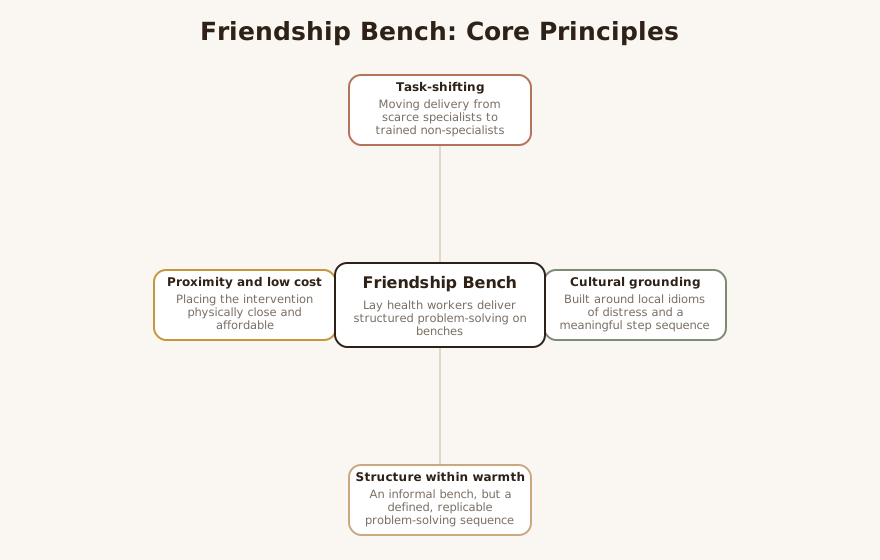
The first core principle is task-shifting: moving the delivery of a defined intervention from scarce specialists to a larger pool of trained and supervised non-specialists, thereby expanding access 1. The trial that established the program’s credibility deliberately tested whether lay health workers, not psychiatrists, could deliver effective care 1.
A second principle is cultural grounding 6. The intervention is built around local idioms of distress and a locally meaningful sequence of steps, so that the work feels like a familiar conversation rather than a foreign clinical procedure 6. The use of kufungisisa as an entry point allows clients to describe their suffering in their own terms before any biomedical reframing 6.
A third principle is structure within warmth 5. The bench is informal and relational, but the conversation that happens on it follows a defined, replicable problem-solving sequence, which is what allows non-specialists to deliver it with fidelity 5. The Shona names for the steps render an evidence-based therapeutic arc into accessible, memorable language 6.
A fourth principle is proximity and low cost 3. By placing the intervention physically at the primary-care clinic and removing the need for specialist referral, the model dissolves the practical barriers — distance, cost, stigma — that kept Chibanda’s original patient from care 3.
LLM-generated illustrative example (not a guideline): A clinic-based lay provider greets a woman who says she has been “thinking too much” since losing her market stall. Rather than opening with a symptom checklist, the provider sits beside her on the bench and invites her to name the problem that weighs heaviest, treating her own words as the starting material for the work LLM.
Interventions & Techniques
The clinical heart of the Friendship Bench is a brief, structured problem-solving therapy delivered across a small number of individual sessions on the bench 1. The arc is captured in three locally named stages: kuvhura pfungwa (opening the mind), kusimudzira (uplifting or lifting up), and kusimbisa (strengthening) 6. In practice this corresponds to engaging and identifying the client’s problems, working collaboratively toward solutions and small actionable steps, and then consolidating gains so they hold over time 6.
The technique sequence is recognizably problem-solving therapy: the provider helps the client articulate a specific problem, brainstorm possible responses, choose and plan a concrete action, and review how it went at the next contact 1. This is paired with behavioral-activation-style encouragement to re-engage in purposeful activity 1. The original program also linked clients onward — for example into peer-led income-generating or craft groups — so that the bench conversation connected to ongoing community support rather than ending in isolation 5.
Crucially, the deliverers are trained and then supervised lay health workers, not psychiatrists; ongoing supervision is part of the method, not an optional extra, because it is what sustains fidelity and safety when specialists are scarce 1. The program has also experimented with scaling through digital tools and wider networks as demand has grown beyond what physical benches alone can meet 2.
LLM-generated illustrative example (not a guideline): Over three short sessions, a provider and a young man move from naming his central problem — mounting debt and sleeplessness — to choosing one small, concrete step he can take before the next meeting, then reviewing whether it eased the pressure and what to try next LLM.
Evidence Base
The Friendship Bench has a genuinely landmark evidence base for a task-shifted psychological intervention, which is why it is fairly described as established rather than merely promising 1. The pivotal study was a cluster-randomized clinical trial conducted in Harare and published in JAMA in 2016, which compared lay-health-worker-delivered Friendship Bench problem-solving therapy against enhanced usual care for adults screening positive for common mental disorders in primary care 1. The trial reported that participants receiving the Friendship Bench intervention had significantly lower symptoms of common mental disorders, as well as lower depression scores, at six months than those receiving enhanced usual care 1.
The maturity of this evidence should be stated precisely 1. The 2016 trial is a rigorous, adequately powered randomized study with clinically meaningful effects, conducted in the real-world primary-care setting it was designed for — strong internal credibility for the original Zimbabwean context 1. That single high-quality trial, together with the program’s subsequent adoption and adaptation, is the backbone of its reputation 2. Honest appraisal also means acknowledging the limits of generalization: the strongest causal evidence is rooted in one setting and population, and the international adaptations — including the New York City implementation — represent expansion and feasibility work rather than a series of equivalently powered confirmatory trials in every new context 2. The program’s recognition and scale-up reflect both its trial evidence and its demonstrated implementability, which are related but distinct forms of support 2.
Populations & Indications
The primary indication is adults presenting with common mental disorders — chiefly depression and anxiety — in primary-care and community settings, particularly where specialist mental health care is scarce 1. This was the precise population enrolled in the foundational trial 1.
Beyond this core, the model has been described as reaching and being adapted for a range of groups, reflecting the broad community footprint of the original program 2. These include people living with HIV, perinatal and postpartum women, adolescents and young people, and communities affected by poverty and social adversity, where psychological distress is bound up with material hardship 2. The program’s defining setting is the low-resource environment, where the treatment gap is widest and where a task-shifted, clinic-based model has the most to offer 3. Its successful transplantation to a high-income city demonstrates that the indication is not limited to low-income countries but extends to underserved populations within wealthy ones 5.
Problems-for-Work
The Friendship Bench is built to address the everyday machinery of common mental distress through structured problem-solving 1. Depression is the prototypical target: the trial demonstrated reduced depressive symptoms, and the intervention’s problem-solving and activation steps are designed to interrupt the helplessness and withdrawal that characterize low mood 1. Anxiety and generalized psychological distress are addressed through the same sequence, often entering the conversation through the local idiom of “thinking too much” rather than a formal diagnostic label 6.
Stress rooted in poverty and social adversity is squarely in scope, because the model treats concrete life problems — debt, food insecurity, conflict, loss of livelihood — as legitimate material for the work rather than as background noise 5. Limited access to care and the treatment gap are, at a systems level, the problem the entire program was built to solve, and individual clients benefit from care that is local, low-cost, and non-stigmatizing 3.
LLM-generated illustrative example (not a guideline): A provider working with a recently widowed woman whose distress is inseparable from sudden financial precarity uses the problem-solving steps to help her identify one immediate, solvable sub-problem — securing this month’s rent through a community group — while validating the grief that sits underneath it LLM.
Contraindications, Cautions & Cultural Humility
The most important caution is scope of practice 1. The Friendship Bench is a brief intervention for common mental disorders delivered by supervised non-specialists; it is not designed to be a standalone treatment for severe mental illness, acute psychosis, or complex presentations that require specialist psychiatric care 1. A defining feature of safe task-shifting is a clear referral pathway and active supervision, so that providers escalate cases that exceed the model’s remit rather than managing them alone 1. Risk situations such as active suicidality require an escalation and safety protocol beyond the bench conversation itself LLM.
Cultural humility is not an add-on here but the program’s central design lesson 6. The Friendship Bench works in part because it was built from the inside out — using local idioms such as kufungisisa, locally named therapeutic steps, and trusted community members as deliverers — rather than importing a foreign clinical frame wholesale 6. The cautionary implication for clinicians elsewhere is the inverse: lifting the program’s surface features into a new culture without comparable local grounding risks losing the very thing that makes it effective 5. Adaptation, including the New York City implementation, succeeds to the extent that it re-grounds the model in the local community’s language, helpers, and concerns rather than copying the Zimbabwean specifics 5.
LLM-generated illustrative example (not a guideline): A team adapting the bench for a new immigrant community resists translating the Shona step-names literally and instead works with community elders to find local phrases that carry the same warmth and meaning, recognizing that the words must belong to the people using them LLM.
Treatment-Plan Suggestions & SMART Objectives
The following table offers illustrative goals, SMART-formatted objectives, and the mechanism each targets; all are examples to be individualized within a supervised, culturally grounded program rather than prescriptions LLM. The mechanisms reflect the program’s problem-solving and activation core 1.
| Goal | SMART objective (example) | Mechanism |
|---|---|---|
| Engage and name the problem | Within the first session, collaboratively identify and write down the single most pressing problem in the client’s own words | “Opening the mind” (kuvhura pfungwa) — externalizes distress as workable material 6 |
| Reduce depressive symptoms | Reduce screening-tool symptom score by a clinically meaningful margin over the planned course of bench sessions | Structured problem-solving and activation reduce common-mental-disorder symptoms 1 |
| Generate and act on solutions | Brainstorm at least 3 possible responses to the chosen problem and complete 1 concrete agreed action before the next session | “Uplifting” (kusimudzira) — solution generation plus behavioral activation 6 |
| Build problem-solving capacity | Independently apply the identify-brainstorm-act-review steps to a new problem by the final session | Skill internalization for durable self-management 1 |
| Consolidate and sustain gains | Develop and rehearse a brief plan for maintaining progress and recognizing setbacks before discharge | “Strengthening” (kusimbisa) — relapse-aware consolidation 6 |
| Reduce isolation | Connect to at least 1 ongoing peer or community support group during the episode of care | Onward linkage extends support beyond the bench 5 |
| Ensure safety and appropriate level of care | Apply the agreed escalation pathway for any risk or out-of-scope presentation identified during sessions | Supervision and referral keep task-shifting safe 1 |
Common Misconceptions
A common misconception is that the Friendship Bench is just informal chatting with a kindly elder 5. In reality the warmth sits atop a defined, replicable problem-solving sequence with named stages, which is precisely why supervised lay providers can deliver it with consistency 6. A second misconception is that “lay-delivered” means low-quality or unsupervised; the model depends on training and ongoing supervision, and its evidence comes from a rigorous randomized trial rather than anecdote 1.
A third misconception is that the program proves any therapy can be handed to anyone LLM. What the trial actually supports is that a circumscribed, well-specified intervention for common mental disorders can be task-shifted to trained, supervised non-specialists — not that specialist care is dispensable for severe illness 1. A fourth is that the model is a quaint solution only for poor countries; its adoption in a high-income city like New York indicates the underlying logic addresses underserved populations anywhere 5.
Training & Certification
The Friendship Bench is delivered by lay health workers who are specifically trained in the structured intervention and then supported through ongoing supervision, which together substitute for the scarcity of specialist clinicians 1. Training equips community members — historically including the older women central to the program’s identity — to run the problem-solving steps competently and to recognize when a presentation exceeds their remit and needs referral 3. There is no single universal license that defines the role; competence is built through program-specific training and sustained supervision rather than a generic credential LLM.
The organization behind the program operates as a structured initiative with a formal program identity, and its international scale-up has involved partnering with local organizations to train and supervise providers in each new setting 4. For a clinician outside Zimbabwe, the practical lesson is that fidelity depends less on adopting the brand and more on replicating its essentials: targeted training, a clear manualized sequence, embedded supervision, and genuine local grounding 5.
Key Terms
- Task-shifting — moving delivery of a defined intervention from scarce specialists to trained, supervised non-specialists to expand access 1.
- Common mental disorders — the cluster of depression and anxiety presentations that the program primarily targets in primary care 1.
- Treatment gap — the gap between the number of people who need mental health care and the number who can access it, the problem the program was built to close 3.
- Kufungisisa — a Shona idiom meaning “thinking too much,” used as a culturally grounded entry point that maps onto depression and anxiety 6.
- Kuvhura pfungwa / kusimudzira / kusimbisa — the locally named stages of the bench conversation: opening the mind, uplifting, and strengthening 6.
- Grandmothers — the older community women, central to the program’s identity, trained to deliver the intervention 3.
- Enhanced usual care — the comparison condition in the foundational randomized trial 1.
Resources & Further Reading
▶ Watch — a video introduction to this concept:
- Effect of a Primary Care–Based Psychological Intervention on Symptoms of Common Mental Disorders in Zimbabwe (Friendship Bench cluster RCT), JAMA 2016
- Dixon Chibanda: grandmothers help to scale up mental health care (PMC profile)
- Why I train grandmothers to treat depression — Dixon Chibanda (TED Talk)
- The Friendship Bench — official program site (The Founder)
- How Zimbabwean Grandmothers Are Stepping In to Fight Depression (TIME)
- Friendship bench (Wikipedia)
- Dixon Chibanda — London School of Hygiene & Tropical Medicine profile
Reflective / Supervision Questions
- For a client whose distress is inseparable from material hardship (debt, housing, food insecurity), how do you keep structured problem-solving honest about what is and is not solvable, without dismissing the real losses underneath? LLM
- The Friendship Bench works because it is grounded in local idioms and trusted local helpers; where in your own practice are you importing a clinical frame that may not fit your client’s language or community? 6
- What is the difference, in your setting, between effective task-shifting and simply under-resourcing care — and how would supervision and referral pathways tell the two apart? 1
- The program’s evidence rests heavily on one rigorous trial in one context; how do you weigh strong local evidence against uncertain generalization when deciding to adopt an adapted model? 1
- How would you build a clear escalation pathway so that a brief, problem-solving-focused contact does not become the ceiling of care for someone with severe or high-risk presentation? 1
- What can the “grandmother” model teach you about who, in your own community, already holds the trust and standing that formal services lack? 3