
Type & Discipline
Problem-Solving Therapy (PST) is a brief, structured, manualized intervention within the cognitive-behavioral family of psychotherapies 4. It belongs to clinical psychology and is best understood as a social-competence or coping-skills model: distress is framed not as a fixed trait or chemical imbalance but as the predictable result of stressful problems exceeding a person’s perceived and actual problem-solving resources 7. PST is typically delivered as time-limited individual psychotherapy, often in 6 to 12 sessions, though it has been adapted for group, telephone, primary-care, and home-based delivery 3. Because it teaches a transdiagnostic skill set rather than targeting a single disorder-specific mechanism, clinicians use it both as a stand-alone treatment and as a module embedded within broader CBT 5.
Creators & Lineage
PST was developed primarily by Thomas D’Zurilla and Arthur Nezu, building on D’Zurilla and Goldfried’s 1971 articulation of problem-solving as a clinical intervention 7. Christine Maguth Nezu later co-authored the major treatment manuals and contributed to the model’s refinement 4. The approach grew directly out of cognitive behavioral therapy and was shaped by social problem-solving theory, which distinguishes the orientation a person brings to problems from the skills used to solve them 7. Its lineage also draws on self-control and self-regulation models and overlaps conceptually with behavioral activation, since systematic problem-solving inherently re-engages avoidant or withdrawn clients with their environment 5. The current canonical references are the Springer treatment manual and the third edition of Problem-Solving Therapy: A Positive Approach to Clinical Intervention 45.
Core Principles
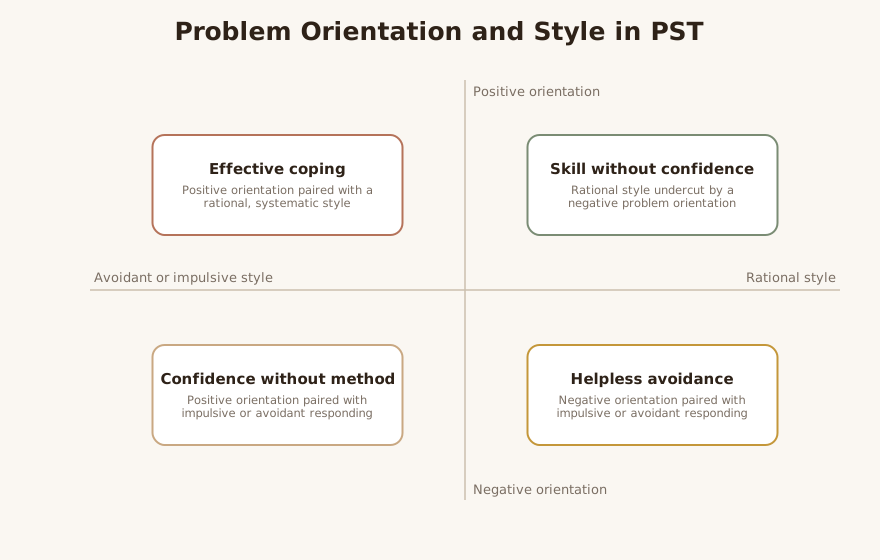
The central claim of PST is that the relationship between stressful life events and psychological symptoms is moderated by social problem-solving ability 7. The model separates two components. The first is problem orientation, the relatively stable cognitive-emotional set a person holds about problems and their own capacity to handle them; this can be positive (problems are normal, solvable challenges) or negative (problems are threats, evidence of personal deficiency, and sources of helplessness) 7. The second is problem-solving style, the actual behaviors used, which may be rational and systematic, impulsive/careless, or avoidant 7. Effective coping requires both a positive orientation and a rational style 5. PST therefore intervenes on both: it works to reduce negative orientation and avoidant or impulsive responding while building deliberate, planful problem-solving 4. The therapy is explicitly described as a positive approach because it emphasizes strengths, competence, and learnable skills rather than pathology 5.
Interventions & Techniques
Classic PST follows a defined sequence the clinician teaches and rehearses with the client 4. After psychoeducation linking stress, problems, and mood, work focuses on cultivating a positive problem orientation, often through reattribution, normalizing problems, and reversing the “problems mean I am inadequate” appraisal 7. The rational problem-solving process then proceeds in steps: (1) defining and formulating the problem in concrete, factual terms and setting realistic goals; (2) generating alternative solutions, frequently via brainstorming to defer judgment; (3) decision-making, weighing the likely consequences and feasibility of options; and (4) solution implementation and verification, trying the chosen plan and evaluating the outcome 4. Newer versions add toolkits for managing emotional arousal and overcoming cognitive overload, including simplification, visualization, and “stop-and-slow-down” techniques to counter impulsive responding 5. Homework, real-world practice, and the SSTA acronym for emotion regulation are common features 5.
LLM-generated illustrative example (not a guideline): A clinician helps a depressed client reframe “I can’t handle my finances, I’m a failure” (negative orientation) into “managing a tight budget is a solvable problem.” Together they define the problem narrowly (“I overspend on weekday takeout”), brainstorm eight options without censoring, weigh them, select meal-prepping two nights, and review the result the following week LLM.
Evidence Base
PST is a well-studied, established treatment, but its evidence is honestly described as moderate and heterogeneous rather than uniformly strong 3. The APA Society of Clinical Psychology (Division 12) lists PST as a research-supported treatment for depression 3. An early meta-analysis of 13 randomized studies (1,133 participants) found a mean effect size of 0.34 in the fixed-effects model and 0.83 in the random-effects model, with very high heterogeneity, and the authors concluded more research was needed to identify for whom PST works 1. An updated meta-analysis reported an overall effect versus control of g = 0.79 (95% CI 0.57-1.01) across 27 comparisons but with very high heterogeneity (I² = 84); among high-quality studies the effect shrank to g = 0.34, and after adjusting for publication bias to roughly g = 0.28 2. Crucially, PST did not differ significantly from other psychotherapies, suggesting comparable but not superior efficacy 2. The strongest signal is for depression—including older adults, primary care, and chronic illness—while direct evidence for generalized anxiety and other conditions is thinner 26.
Populations & Indications
PST has been studied and applied across a notably wide range of populations 3. It has a particularly strong fit with older adults, where its concrete, skills-based structure and adaptability to executive dysfunction (for example, Problem-Solving Therapy for primary care and adaptations for post-stroke or cognitively impaired patients) are clinical advantages 3. It is widely used with people experiencing major depression, primary care patients presenting with mixed distress, and individuals coping with chronic illness such as cancer or diabetes, where real, unsolved practical problems drive much of the emotional burden 6. Caregivers facing chronic strain and people with executive dysfunction are also common targets, since PST externalizes and structures a process that internal coping may no longer manage well 3. Its brevity and teachable structure make it attractive for integrated and stepped-care settings 6.
Problems-for-Work
PST maps onto presentations where unsolved or poorly managed life stressors maintain symptoms 7. For major depressive disorder, the model targets the avoidant coping and hopelessness that sustain low mood; the clinician helps convert global despair into discrete, workable problems 1. For stress and adjustment difficulties, PST directly addresses the stressor-symptom link that the theory was built to explain 7. With suicidal ideation and hopelessness, restoring a sense of agency and generating alternatives to an impasse is a plausible mechanism, and PST has been used adjunctively in such cases 3. Coping skills deficits and avoidant coping are squarely the model’s primary problem-solving-style targets 7. Distress related to chronic illness, emotion dysregulation, and features of generalized anxiety can be approached, though the evidence here is more limited and PST is often combined with other CBT components 2.
LLM-generated illustrative example (not a guideline): For a primary-care patient with adjustment difficulties after a job loss, the therapist treats “I’ll never recover” as a negative orientation to disrupt, then works the practical problem (“I need income within three months”) through brainstorming and decision-making, restoring a sense of agency LLM.
Contraindications, Cautions & Cultural Humility
PST has no absolute contraindications but several practical cautions 5. Its rational, stepwise format can feel mechanistic or invalidating if a clinician rushes to problem-solving before adequately attending to affect and the therapeutic relationship; the orientation work and emotion-management tools exist precisely to prevent this 5. With acute crisis, psychosis, or severe cognitive impairment, the standard protocol may need substantial adaptation, and severe executive dysfunction calls for simplified, externally scaffolded versions 3. Clients whose problems are genuinely uncontrollable—entrenched poverty, discrimination, abuse—require careful framing so the method targets coping and partial agency rather than implying the person is at fault for unsolvable circumstances 7. Cultural humility matters here: what counts as a “problem,” an acceptable “solution,” and an appropriate goal is culturally embedded, and the clinician should let the client define problems and weigh consequences against their own values rather than imposing the therapist’s LLM. The positive-orientation message must not slide into toxic positivity that dismisses structural realities LLM.
Treatment-Plan Suggestions & SMART Objectives
| Goal | SMART objective (example) | Mechanism |
|---|---|---|
| Build a positive problem orientation | Within 4 weeks, client will reframe at least 3 self-identified problems from “threats/proof of failure” to “solvable challenges,” logged in a worksheet, in 4 of 5 instances LLM | Reduces negative orientation; restores perceived control 7 |
| Replace avoidant coping with planful action | Over 6 sessions, client will complete and review one structured problem-solving plan per week with at least 80% homework adherence LLM | Targets avoidant problem-solving style via behavioral engagement 4 |
| Improve problem definition | By session 5, client will translate 2 vague complaints into concrete, observable problem statements with a realistic goal each LLM | Counters cognitive overload; enables effective solution generation 4 |
| Expand solution repertoire | Within 4 weeks, client will brainstorm at least 5 alternatives per target problem before deciding, in 3 consecutive problems LLM | Defers premature judgment; widens options 4 |
| Reduce hopelessness | Over 8 weeks, client will reduce a hopelessness or depression self-report score by a clinically meaningful margin LLM | Agency and mastery experiences reduce depressive cognition 1 |
| Manage emotional arousal during problem-solving | By session 6, client will apply a taught arousal-reduction technique before problem-solving in 4 of 5 high-stress instances LLM | Lowers impulsive responding; supports rational style 5 |
| Generalize skills | At termination, client will independently complete the full problem-solving sequence on a novel problem without therapist prompting LLM | Skill consolidation and relapse prevention 5 |
Common Misconceptions
A frequent misconception is that PST is merely “giving advice” or generic problem-solving coaching; in fact the active ingredient that distinguishes it is the systematic remediation of problem orientation, not just teaching steps 7. Another is that PST is superficial or only for “mild” cases—yet it is a Division 12 research-supported treatment for depression with effects comparable to other established psychotherapies 23. Some assume PST ignores emotion because it is structured; modern protocols explicitly include emotion-regulation and overload-management tools 5. A further error is reading the large random-effects effect sizes as the whole story, when high-quality and bias-adjusted estimates are considerably smaller, underscoring real heterogeneity 12. Finally, PST is not only for individuals: it has documented group, telephone, and primary-care formats 3.
Training & Certification
There is no single proprietary licensure or mandatory certification required to practice PST, which is openly published and learnable from its manuals 4. The primary self-study resources are the Nezu, Nezu, and D’Zurilla Treatment Manual and the third edition of Problem-Solving Therapy: A Positive Approach to Clinical Intervention, which lay out the model and protocol in detail 45. In practice, clinicians acquire competence through reading the manuals, supervised application, and—for specific programs such as PST for primary care or older adults—structured workshops and program-specific trainings 3. As with any CBT-family method, fidelity is best supported by consultation, session structure, and outcome monitoring rather than by a credential alone 5.
Key Terms
Social problem-solving: the self-directed cognitive-behavioral process by which a person identifies and copes with problems in everyday living 7. Problem orientation: the relatively stable set of beliefs and emotional reactions about problems and one’s ability to solve them, which can be positive or negative 7. Problem-solving style: the behavioral approach used—rational, impulsive/careless, or avoidant 7. Rational problem-solving: the systematic four-step process of problem definition, generation of alternatives, decision-making, and solution implementation/verification 4. Brainstorming: generating many alternative solutions while deferring evaluation 4. Positive approach: the model’s emphasis on competence and learnable skills over pathology 5.
Resources & Further Reading
▶ Watch — a video introduction to this concept:
- Problem solving therapies for depression: a meta-analysis (Cuijpers, van Straten & Warmerdam, 2007)
- Problem-solving therapy for adult depression: An updated meta-analysis (European Psychiatry)
- Problem-Solving Therapy for Depression — APA Society of Clinical Psychology (Division 12)
- Problem-Solving Therapy: A Treatment Manual (Nezu, Nezu & D’Zurilla)
- Problem-Solving Therapy: A Positive Approach to Clinical Intervention, 3rd ed. (Nezu & D’Zurilla)
- Problem solving therapy for depression (#ActiveIngredientsMH) — National Elf Service
- Introduction, Brief History, and Social Problem-Solving Constructs (Springer chapter)
Reflective / Supervision Questions
- When a client presents with distress, do I assess their problem orientation separately from their problem-solving skills, or do I collapse them? LLM
- Am I moving to solution-generation before the client feels their affect has been heard, risking an invalidating “fix-it” stance? LLM
- For this client’s circumstances, which problems are genuinely controllable, and how do I frame coping without implying blame for what is not? LLM
- How do culture, values, and resources shape what this client counts as a “problem” and an acceptable “solution”? LLM
- Given the heterogeneous evidence, how am I measuring whether PST is actually working for this person, and when would I switch approaches? LLM
- Where might PST function best as a module within broader CBT rather than as a stand-alone treatment for this presentation? LLM