
The Collaborative Care Model is not a therapy; it is a way of organizing care so that depression and anxiety get treated in primary care with the same measurement-based rigor a cardiologist brings to hypertension 4LLM. A patient with depression stays with their primary care provider, but a behavioral health care manager now tracks them on a registry, delivers brief evidence-based interventions, and reviews difficult cases each week with a psychiatric consultant who advises on the medication and treatment plan without ever necessarily meeting the patient 4. For the practicing therapist, the model is worth understanding because it is one of the few service-delivery frameworks with an unusually deep randomized-trial base, and because the care-manager role it defines is increasingly where behavioral health clinicians are being hired and embedded 5LLM.
Type & Discipline
The Collaborative Care Model (often abbreviated CoCM) is a framework for organizing care rather than a discrete psychotherapy, situated within integrated behavioral health and primary care 4LLM. It is “a specific type of integrated care, developed at the University of Washington, that treats common mental health conditions such as depression and anxiety that require systematic follow-up due to their persistent nature” 7. Its disciplinary home is the seam between primary care medicine, psychiatry, and behavioral health, and its unit of intervention is the care system — the team, the registry, the workflow — not a single clinical hour 4LLM.
Because it is a framework rather than a modality, Collaborative Care is defined by its structure rather than by a particular therapeutic technique LLM. The American Psychiatric Association describes it as a model in which “a primary care team works with a care manager and a psychiatric consultant” to deliver evidence-based care to a defined population of patients 7. What makes it a coherent model, rather than simply good teamwork, is that the same structural elements recur across every implementation and have been specified precisely enough to test in randomized trials 5LLM.
Creators & Lineage
Collaborative Care was developed at the University of Washington, where the AIMS Center now serves as its institutional home and disseminator 47. The intellectual lineage runs through Wayne Katon, a University of Washington psychiatrist whose work on the interface of depression and chronic medical illness laid the conceptual groundwork, and Jürgen Unützer, who led the landmark trial that established the model’s evidence base and who has been central to its national dissemination 1LLM. The model grew out of the broader chronic-care movement, applying to depression the same principles of systematic, measurement-based, population-level management that had transformed the care of conditions like diabetes 4LLM.
The defining empirical event in the model’s history is the IMPACT trial (Improving Mood — Promoting Access to Collaborative Treatment), reported by Unützer and colleagues in 2002, which tested collaborative care management of late-life depression in primary care against usual care 1. IMPACT was a large multi-site randomized controlled trial in older primary-care patients, and its results — together with their durability over the following years — converted Collaborative Care from a promising idea into one of the most rigorously validated service models in behavioral health 12. The psychiatrist’s specific role within the team was later articulated in detail by Lori Raney, whose 2015 American Journal of Psychiatry paper described how the consulting psychiatrist functions in the model — a population-focused, caseload-consultation role rather than a traditional one-to-one practice 3.
Core Principles
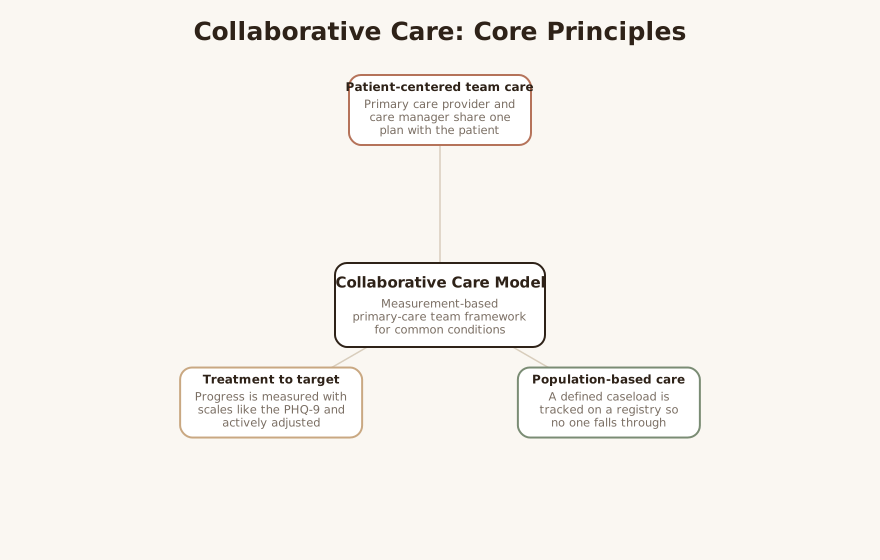
Collaborative Care is usually described through a small set of core principles, and the AIMS Center frames the model around them explicitly 4. The first is patient-centered team care: the patient’s primary care provider and a behavioral health care manager collaborate, with the patient, on a shared treatment plan, so that mental and physical health are managed together in one setting rather than fragmented across referrals 47.
The second principle is population-based care, in which a defined caseload of patients is tracked on a registry so that no one “falls through the cracks” 4. The registry is the operational heart of the model: it lets the care manager see, at a glance, who is improving, who is stalling, and who has not been contacted, and it shifts the team’s attention from whoever happens to walk in the door to the entire panel of patients in treatment 4LLM.
The third principle is measurement-based treatment to target. Each patient’s progress is tracked with validated symptom-rating scales — the PHQ-9 for depression is the canonical example — and treatment is actively adjusted if a patient is not improving as expected, rather than left unchanged 4LLM. The fourth principle is evidence-based care, meaning the treatments offered, whether brief psychotherapy or medication, are those with demonstrated efficacy for the condition 4. The fifth is accountable care, in which the team is held responsible, and reimbursed, for quality of care and clinical outcomes rather than simply for volume of contacts 4.
Interventions & Techniques
The model’s “interventions” are largely structural — the way roles and information flow are arranged — rather than novel clinical techniques LLM. The central new role is the behavioral health care manager, typically a nurse, social worker, or other behavioral health clinician embedded in the primary care clinic, who provides systematic follow-up, brief evidence-based interventions such as behavioral activation or problem-solving treatment, medication-adherence support, and ongoing symptom monitoring 47LLM. The care manager maintains the registry and is the relational thread that keeps patients engaged between primary-care visits 4.
The second defining role is the psychiatric consultant. Rather than seeing patients directly, the consultant reviews the care manager’s caseload — typically in a weekly systematic caseload review focused on patients who are not improving — and advises the primary care provider on diagnosis, medication, and next steps 34. Raney describes this as a shift from the psychiatrist treating one patient at a time to the psychiatrist supporting a whole population through the team, which is what allows a single consultant to extend specialty expertise across a far larger group of patients than direct practice could reach 3. The consultant also offers direct evaluation for the minority of complex or diagnostically unclear cases when needed 3LLM.
The third element is the stepped, treat-to-target workflow: patients begin with first-line treatment, are re-measured on a schedule, and have their treatment intensified or changed when the registry and rating scales show inadequate response 4LLM. Harvard Health summarizes the practical effect plainly — primary care doctors gain “the support of a care manager and a consulting psychiatrist,” so that patients can receive mental health treatment in the setting they already trust rather than being referred out and frequently lost 6.
LLM-generated illustrative example (not a guideline): A 70-year-old man screens positive on the PHQ-9 at his primary care visit. The care manager enrolls him on the registry, starts brief behavioral activation, and re-administers the PHQ-9 every few weeks. At week six his score has barely moved, so he is flagged in the weekly caseload review; the psychiatric consultant, without seeing him, recommends an antidepressant adjustment to the primary care provider, who makes the change. By week twelve his score has dropped below the response threshold, and the care manager shifts him to a relapse-prevention plan LLM.
Evidence Base
The maturity of Collaborative Care’s evidence base is best described as established, and it is unusually deep for a service-delivery model 5LLM. The AIMS Center notes that the model “is based on principles of effective chronic illness care” and is supported by “more than 90 randomized controlled trials,” with collaborative care consistently outperforming usual care for depression and anxiety 5. This breadth — dozens of independent trials across diverse settings and populations — is what distinguishes CoCM from frameworks supported by a single flagship study 5LLM.
The anchor trial remains IMPACT. Unützer and colleagues randomized older primary-care patients to collaborative care versus usual care and found substantially greater improvement in depression in the collaborative-care arm 1. Crucially, the benefits proved durable: long-term follow-up showed that patients who had received the collaborative-care intervention continued to have significantly lower depression severity than usual-care patients well after the active intervention period ended, indicating that the model produces lasting and not merely transient gains 2. That durability — improvement that persists once the structured program winds down — is one of the model’s most clinically important findings 2LLM.
Honesty about scope matters. The strongest and most replicated evidence is for depression, with robust extension to anxiety; the model is explicitly designed for “common mental health conditions” that benefit from systematic follow-up, not for the full range of severe or acute psychiatric presentations 57LLM. The model’s effect comes from organizing and intensifying delivery of already-evidence-based treatments, so its value is in access, follow-through, and outcomes at the population level rather than in a new therapeutic ingredient 45LLM.
Populations & Indications
Collaborative Care was first validated in older adults with depression in primary care, the population of the IMPACT trial, and that remains a paradigmatic indication 12. From there the evidence has extended across adult primary-care populations generally, including patients whose depression or anxiety co-occurs with chronic medical illness, where integrated management is especially valuable 45LLM.
The model’s core indication is common, persistent mental health conditions managed in primary care — most clearly depression and anxiety — that “require systematic follow-up due to their persistent nature” 7. Because the model is built around a defined caseload and registry, it is best suited to populations large enough to track at the panel level and to conditions for which measurement-based monitoring and stepwise adjustment make sense 4LLM. It is particularly indicated for patients who are unlikely to follow through on an external referral to specialty mental health — older adults, medically complex patients, and others for whom treatment in the familiar primary-care setting markedly improves the odds of actually receiving care 6LLM.
Problems-for-Work
Collaborative Care gives a team a structured way to attack a specific set of problems, and the honest framing is that it works on conditions amenable to measurement-based, population-level management 4LLM.
- Late-life depression is the flagship problem-for-work: in older primary-care patients, the model reduces depression severity and sustains that improvement well beyond the intervention period, as IMPACT and its long-term follow-up demonstrated 12.
- Major depression in adult primary care more broadly is the central indication, with the care manager delivering brief evidence-based treatment and the consultant guiding medication for patients who are not responding 47.
- Anxiety disorders are an established target, treated with the same registry-tracked, treat-to-target workflow that the model applies to depression 57.
- Depression or anxiety co-occurring with chronic medical illness fits the model especially well, since the patient’s mental and physical care can be coordinated in one setting rather than split across systems 4LLM.
- Poor engagement and lost referrals are themselves a problem the model addresses: by keeping treatment inside primary care with active follow-up, it captures patients who would otherwise never reach, or never return to, specialty care 6LLM.
LLM-generated illustrative example (not a guideline): A primary care clinic notices that a large share of patients referred out for depression never attend a single specialty appointment. Rather than referring, the clinic stands up a collaborative-care team: a care manager screens with the PHQ-9, enrolls positive cases on a registry, and reviews non-responders weekly with a consulting psychiatrist. Six months later, far more patients have measurable symptom improvement because treatment never left the building LLM.
Contraindications, Cautions & Cultural Humility
The principal limits of Collaborative Care concern fit, not harm: the model is built for common conditions requiring systematic follow-up, and it is not designed to be the sole vehicle for acute, severe, or high-risk psychiatric presentations that require direct specialty psychiatric care 7LLM. A patient in acute crisis, with active suicidality requiring direct intervention, or with a severe disorder outside the model’s tested scope, should not be managed only through caseload consultation; the consulting structure assumes the primary care provider remains the treating clinician and that escalation pathways exist 3LLM.
A second caution is that the model only works when its structural elements are actually present and used. The benefit depends on the registry being maintained, measurement being done on schedule, and the weekly caseload review actually happening; a “collaborative care” program missing these elements is collaborative in name only, and the trial-demonstrated outcomes should not be assumed 4LLM. The accountability principle — being answerable for outcomes, not just contacts — is part of what holds these elements in place 4.
On cultural humility: because the care manager often becomes the patient’s primary behavioral health relationship and the consultant never meets most patients, the model places real weight on the care manager’s ability to engage patients across differences of age, culture, and language, and on rating scales being valid and interpreted with cultural awareness rather than applied mechanically 4LLM. Measurement-based care is a strength, but a symptom score is a tool to inform clinical judgment within the patient’s context, not a substitute for it LLM.
Treatment-Plan Suggestions & SMART Objectives
| Goal | SMART objective (example) | Mechanism |
|---|---|---|
| Reduce depression severity to target | Over 16 weeks, client’s PHQ-9 will decrease by at least 50% from baseline, tracked at each contact | Measurement-based treatment to a defined target 4 |
| Ensure systematic follow-up | Client will be entered on the care-manager registry and contacted at scheduled intervals so no contact is missed | Population-based registry tracking prevents patients falling through the cracks 4 |
| Deliver evidence-based brief treatment | Within 12 weeks, client will complete a course of brief evidence-based intervention (e.g., behavioral activation) with the care manager | Care manager delivers evidence-based interventions in primary care 47 |
| Optimize medication for non-response | If PHQ-9 has not improved by week 6, the care plan will be reviewed in weekly psychiatric caseload consultation and adjusted | Systematic caseload review by the psychiatric consultant guides treatment change 3 |
| Treat co-occurring anxiety | Over 12 weeks, client’s anxiety symptoms will be tracked on a validated scale and treated to target alongside depression | Same registry-tracked, treat-to-target workflow applied to anxiety 57 |
| Improve engagement and follow-through | Client will attend at least 80% of scheduled care-manager contacts over the episode of care | Treatment delivered in the trusted primary-care setting improves engagement 6 |
| Sustain gains after acute treatment | On reaching response, client will complete a relapse-prevention plan with the care manager before discharge from active management | Durable benefit shown to persist beyond the active intervention period 2 |
| Coordinate mental and physical care | Throughout the episode, client’s behavioral health plan will be documented and shared with the primary care provider on the team | Patient-centered team care integrates mental and physical health 47 |
Common Misconceptions
The most common misconception is that Collaborative Care is just “having a therapist in the clinic.” It is not co-location; the defining features are the registry, measurement-based treatment to target, and weekly psychiatric caseload consultation, and a program lacking these is not the tested model 4LLM. A second misconception is that the psychiatrist sees every patient; in fact the consultant primarily reviews the care manager’s caseload and advises the team, seeing patients directly only when a case is complex or unclear, which is precisely what lets one consultant cover a large panel 3. A third is that the model is a new psychotherapy; it is a framework for organizing the delivery of already-evidence-based treatments, not a novel clinical technique 4LLM. A fourth is that the effects are modest or temporary; the long-term IMPACT follow-up shows benefits that persist well beyond the active intervention, and the model rests on more than 90 randomized trials 25. A fifth is that it treats everything; it is designed for common conditions such as depression and anxiety that benefit from systematic follow-up, not for the full range of severe or acute psychiatric presentations 7LLM.
Training & Certification
There is no single license to “practice Collaborative Care”; it is delivered by existing licensed and credentialed professionals — primary care providers, behavioral health care managers, and consulting psychiatrists — working in defined roles within the team 7LLM. The University of Washington’s AIMS Center is the principal source of implementation training, role-specific resources, and technical assistance for organizations adopting the model 47. The American Psychiatric Association likewise provides educational resources for psychiatrists and teams learning to deliver Collaborative Care, reflecting the consulting psychiatrist’s distinctive population-focused role 7.
The training emphasis is appropriate because, as with any structured model, fidelity drives outcomes: the registry, measurement schedule, and caseload-review cadence have to be implemented as designed for the trial-demonstrated results to follow 4LLM. Raney’s account of the psychiatrist’s role is, in effect, a description of a skill set that many psychiatrists trained in traditional one-to-one practice must deliberately learn — population-level consultation through a care manager rather than direct treatment of each patient 3.
Key Terms
- Collaborative Care Model (CoCM): a specific type of integrated care, developed at the University of Washington, that treats common mental health conditions requiring systematic follow-up by embedding a care manager and psychiatric consultant in primary care 7.
- Behavioral health care manager: the embedded clinician who provides systematic follow-up, brief evidence-based interventions, and symptom monitoring, and who maintains the patient registry 47.
- Psychiatric consultant: the psychiatrist who reviews the care manager’s caseload, typically weekly, and advises the primary care provider, seeing patients directly only when needed 34.
- Registry: the population-tracking tool that lets the team monitor an entire caseload so that no patient “falls through the cracks” 4.
- Measurement-based treatment to target: the practice of tracking each patient with validated rating scales and actively adjusting treatment when they are not improving as expected 4.
- Systematic caseload review: the regular (usually weekly) consultation in which the psychiatric consultant and care manager review patients, prioritizing those who are not improving 34.
- Population-based care: managing a defined panel of patients as a whole rather than only those who present in person 4.
- Accountable care: holding the team responsible, and reimbursed, for quality and outcomes rather than volume of contacts 4.
- IMPACT trial: the landmark randomized controlled trial of collaborative care management of late-life depression in primary care, reported by Unützer and colleagues in 2002 1.
Resources & Further Reading
▶ Watch — a video introduction to this concept:
- Unützer, J., et al. (2002). Collaborative Care Management of Late-Life Depression in the Primary Care Setting (IMPACT RCT)
- Long-term outcomes from the IMPACT trial for depressed elderly patients (PMC)
- Raney, L. (2015). The Role of the Psychiatrist in the Collaborative Care Model — American Journal of Psychiatry
- About Collaborative Care — AIMS Center, University of Washington
- Evidence Base for Collaborative Care (CoCM) — AIMS Center
- Collaborative care: Treating mental illnesses in primary care — Harvard Health
- Learn About the Collaborative Care Model — American Psychiatric Association
Reflective / Supervision Questions
- For the program I am part of, are the defining elements — a maintained registry, measurement on schedule, and weekly caseload review — actually in place, or am I calling co-location “collaborative care”? 4
- When a patient is not improving, do I have a real mechanism to surface them for psychiatric consultation and to change the treatment, or does the registry quietly hold non-responders I never act on? 3
- As a care manager, how am I building enough of a relationship to keep patients engaged between visits, across differences of age, culture, and language, given that I may be their only behavioral health contact? 4
- Am I treating the PHQ-9 score as information that informs clinical judgment within this patient’s context, or as a number that replaces it? 4LLM
- Which of my patients are well-served by this model’s common-conditions, systematic-follow-up design, and which need direct specialty or acute care that the consulting structure is not built to provide? 7
- Do I trust that improvement achieved here will last, and have I built a relapse-prevention step into discharge, given the evidence that benefits can persist beyond the active intervention? 2