
Type & Discipline
Psychotherapy integration is not a single therapy but a meta-framework within the discipline of psychotherapy—a field-wide movement to look beyond the confines of single-school approaches. 6 Rather than asking “which school am I?”, the integrative clinician asks “what works, for whom, under what conditions, and why?” LLM It belongs to the family of integrative and transtheoretical approaches and functions less like a protocol you deliver and more like a stance you bring to case formulation and treatment planning. LLM
A crucial early distinction separates integration from mere eclecticism. 2 Eclectic practitioners pragmatically select “what works” technique by technique, whereas integrative therapists seek a theoretical understanding of why an intervention succeeds and how disparate methods cohere. 2 In practice the boundary is porous, and most working clinicians blend pragmatic technique selection with some organizing rationale. LLM The point for the practitioner is intentionality: integration is a deliberate, defensible position about combining methods, not a default that follows from never having committed to one. LLM
Creators & Lineage
Modern psychotherapy integration grew out of the proliferation of competing schools that followed Freud—psychodynamic, behavioral, cognitive, humanistic, gestalt, existential, and systemic—each claiming primacy. 2 By the late twentieth century, clinicians and researchers grew dissatisfied with school-bound silos and began systematizing the ways therapies could be combined. LLM John Norcross and Marvin Goldfried are the figures most associated with organizing the field, mapping its routes and editing the canonical handbook literature that defined integration as a coherent area of inquiry. 4
Several named models anchor the lineage. Paul Wachtel’s cyclical psychodynamics integrated psychodynamic, behavioral, and family-systems thinking into a single account of how internal conflict and external behavior reinforce one another. 2 Arnold Lazarus’s multimodal therapy assessed clients across multiple modalities and selected techniques on empirical grounds without insisting on theoretical unity. 2 Anthony Ryle’s cognitive analytic therapy fused cognitive and psychodynamic concepts into a time-limited model. 2 James Prochaska’s transtheoretical model contributed the stages-of-change framework, drawing change processes from across the schools. LLM These developments converged in the Society for the Exploration of Psychotherapy Integration (SEPI) and its associated journal, which gave the movement an institutional home. LLM
Core Principles
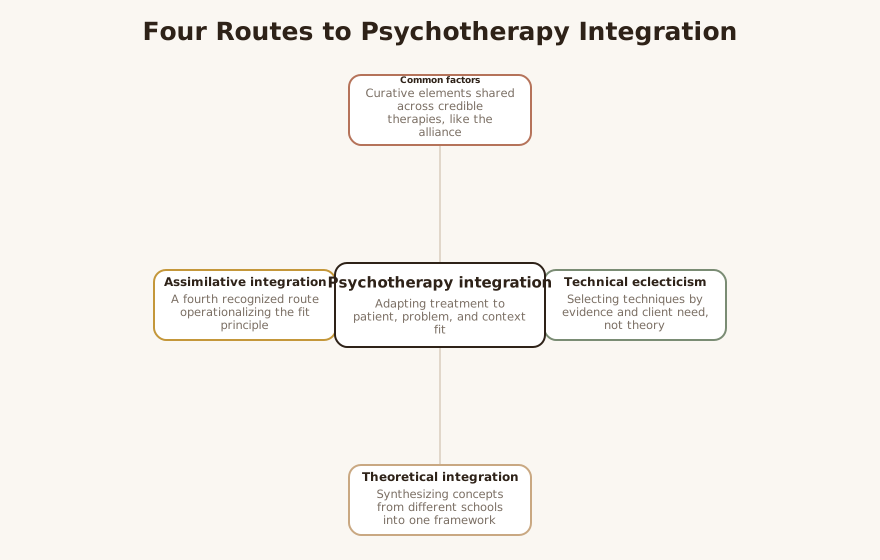
The organizing logic of integration is patient–problem–context fit: no single approach suits every patient, disorder, and situation, so treatment is adapted to the individual rather than the individual fitted to the treatment. 1 Four recognized routes operationalize this principle. 1
Common factors. This route emphasizes the curative elements shared across all credible therapies—the therapeutic alliance, client exposure to feared material, corrective emotional experiences, positive expectancy and hope, a credible rationale for the problem, and therapist qualities such as empathy. 6 Research underpins this emphasis: common factors account for roughly 20% of outcome variance, while specific techniques account for only about 7%. 1 That asymmetry is the empirical backbone of the integrative stance. LLM
Technical eclecticism. Here the clinician selects techniques based on evidence and client need, drawing on prior experience and the research literature without requiring theoretical consistency. 6 Lazarus’s multimodal therapy is the paradigm case. 2
Theoretical integration. The most ambitious route synthesizes concepts from different schools into a unified model; Wachtel’s cyclical psychodynamics and Ryle’s cognitive analytic therapy exemplify it. 2 Encyclopedia sources note the candid limit here—“neither psychotherapists nor physicists” have produced a grand unified theory. 6
Assimilative integration. The clinician retains a primary theoretical home while deliberately importing compatible techniques from other schools, gaining the coherence of a base model plus the flexibility of borrowed methods. 5 For many practitioners this is the most realistic route: it respects depth of training in one orientation while widening the toolkit. LLM
Interventions & Techniques
Integration does not supply a fixed technique list; it supplies a decision procedure for assembling one. LLM In practice this means beginning with a careful, multi-domain assessment of the client’s affect, cognition, behavior, physiology, and relationships, then matching methods to the formulation. 2 A clinician might use cognitive-behavioral exposure for a circumscribed phobia, shift to emotion-focused and relational work for the attachment wound underneath it, and draw on stages-of-change strategies to calibrate motivational interventions to the client’s readiness. LLM
Phased treatment frameworks—combining cognitive-behavioral and relational strategies in sequence—are a recurring integrative structure, often stabilizing symptoms before moving to deeper relational or trauma processing. 2 Throughout, the alliance is treated not as a precondition for technique but as an active ingredient to be monitored, repaired, and leveraged. 1
LLM-generated illustrative example (not a guideline): A client with panic and a history of emotional neglect responds partially to interoceptive exposure but stalls. The clinician, working assimilatively from a cognitive-behavioral base, imports a psychodynamic lens to name how the client’s fear of “losing control” mirrors childhood experiences of being dismissed when distressed. Naming the parallel reduces shame, restores collaboration, and the exposure work resumes with traction. LLM
Evidence Base
Honesty about evidence requires a distinction. What is established is not “integration as a whole” as a single validated protocol; it is, first, the common-factors and alliance research, and second, several specific manualized therapies that happen to be integrative. 1 Schema therapy, interpersonal psychotherapy, and cognitive analytic therapy are integrative treatments with empirical support across conditions including depression, postpartum depression, anxiety disorders, and personality disorders. 1
The umbrella movement itself is harder to evaluate because “integration” names a strategy, not one replicable intervention. LLM The strongest field-level evidence is indirect: the variance accounted for by common factors versus techniques, and the observation that the integrative way of working reflects how clinicians actually practice. 1 A survey of more than 1,000 practitioners found only about 15% used a single theoretical orientation, with a median of four approaches drawn upon. 1 In that sense integration is the modal reality of contemporary practice, even where it is not branded as such. LLM
The maturity rating—established—should therefore be read carefully. The mechanisms (alliance, expectancy, corrective experience) and the named manualized models are well supported; the claim that “any” idiosyncratic blend will outperform a coherent single-school treatment is not. LLM
Populations & Indications
Integration is most indicated where single-school protocols underperform. LLM Clients with complex or comorbid presentations—the rule rather than the exception in routine practice—benefit from the patient–problem fit logic, because their needs rarely map onto one diagnostic-specific protocol. 1 Treatment-resistant clients and those with prior treatment failures are natural candidates: a flexible approach can pivot when a first-line method has already failed. LLM The framework spans diagnostic categories rather than targeting one. 1
Culturally diverse clients are an important population, because individualizing treatment to client characteristics, preferences, and worldview is intrinsic to the integrative stance. 1 Finally, clinicians and trainees are themselves a target “population” of the integration literature, which exists in part to give practitioners a coherent way to organize the eclectic practice most already do. 1
Problems-for-Work
Integration is applied across a wide band of presenting problems rather than a narrow indication. LLM
- Comorbid disorders and heterogeneous symptom presentations. When a client presents with co-occurring depression, anxiety, and substance use, the integrative clinician sequences methods rather than forcing one protocol to cover all fronts. 1
- Treatment-resistant depression. After an adequate but unsuccessful cognitive-behavioral course, the clinician may assimilate interpersonal or emotion-focused methods to address the relational maintainers the first approach missed. LLM
- Complex trauma and personality disorders. Phased, relationally informed integration—stabilization before processing—suits presentations where a purely symptom-focused protocol destabilizes the client. 2
- Chronic anxiety and emotion dysregulation. Cognitive-behavioral skills can be paired with experiential and somatic work to address both the cognitive and the affective-physiological layers. LLM
- Poor therapeutic alliance and treatment dropout. Because the alliance is itself a primary mechanism, integration foregrounds rupture repair and motivational matching as direct interventions, not afterthoughts. 1
- Relationship difficulties. Systemic and psychodynamic-relational lenses can be integrated to address interpersonal patterns a strictly individual-cognitive frame would underweight. LLM
Contraindications, Cautions & Cultural Humility
The chief caution is incoherence. LLM Integration done well is intentional and theoretically grounded; integration done poorly is indistinguishable from drifting between methods without a formulation, which can confuse clients and dilute any single approach’s active ingredients. 2 Where a client clearly meets criteria for a condition with a strong, well-validated single-school protocol, defaulting to an improvised blend may withhold the most evidence-based option. LLM
A second caution is clinician competence: importing a technique from an unfamiliar school without adequate training risks delivering a caricature of it. LLM Assimilative integration partly mitigates this by keeping the clinician anchored in a base model they know well. 5
Cultural humility is not an add-on but a load-bearing part of the framework. LLM Because integration explicitly tailors treatment to client characteristics and preferences, it obliges the clinician to ask which methods fit a given client’s values, language, and explanatory model—and to treat the client’s own framework as data rather than resistance. 1 The flexibility that makes integration powerful can also smuggle in the clinician’s untested assumptions about what a client “needs,” so ongoing reflection and feedback are essential safeguards. LLM
Treatment-Plan Suggestions & SMART Objectives
| Goal | SMART objective (example) | Mechanism |
|---|---|---|
| Strengthen the therapeutic alliance | Within 4 sessions, client and clinician collaboratively agree on goals and rate alliance ≥4/5 on a brief session measure for 3 consecutive sessions | Alliance as a primary common factor 1 |
| Reduce comorbid symptom burden | Over 12 weeks, reduce combined depression and anxiety scores by 40% on standardized measures | Patient–problem fit across modalities 1 |
| Address relational maintainers of treatment-resistant depression | Within 8 sessions, client identifies and reframes 2 recurring interpersonal patterns sustaining low mood | Assimilation of interpersonal methods into a CBT base LLM |
| Build emotion-regulation capacity | Within 6 weeks, client applies one cognitive and one somatic regulation skill during 3 distress episodes per week | Layered cognitive and experiential techniques LLM |
| Match interventions to readiness for change | Within 3 sessions, clinician stages client motivation and tailors interventions accordingly | Stages-of-change process matching LLM |
| Repair alliance ruptures to prevent dropout | Across treatment, address each detected rupture within the same or next session and document resolution | Rupture-repair as active ingredient 1 |
| Stabilize before trauma processing | In phase one (sessions 1–6), establish grounding and safety skills before introducing trauma material | Phased integration of CBT and relational work 2 |
Common Misconceptions
“Integration is just doing whatever feels right.” It is the opposite: integration is the deliberate, theory-informed combination of methods, distinguished precisely from ad hoc selection. 2 The framework exists to make blending principled rather than arbitrary. 6
“Integration and eclecticism are the same thing.” They overlap but differ in emphasis—eclecticism asks what works, integration also asks why and how the pieces cohere. 2 Technical eclecticism is in fact one recognized route within integration, not its opposite. 6
“There is a single integrative therapy you can be certified in and deliver.” There is a movement and a set of routes, plus specific manualized integrative therapies, but no one master protocol called “integration.” LLM The umbrella is a strategy; the validated products are particular models such as schema therapy and cognitive analytic therapy. 1
“Integration means abandoning your home orientation.” Assimilative integration explicitly keeps a primary theoretical base, importing compatible techniques around it. 5
Training & Certification
There is no single licensing pathway unique to “integrative psychotherapy”; competence is built on top of standard clinical training. LLM The Society for the Exploration of Psychotherapy Integration (SEPI) functions as the field’s professional community, with a journal devoted to integration scholarship including foundational work on assimilative integration. 5 The canonical reference literature—edited handbooks systematizing the routes and models—serves as the de facto curriculum for clinicians developing an integrative practice. 4
Practically, training proceeds by first achieving competence in at least one well-defined orientation, then learning adjacent models well enough to import their methods responsibly, ideally under supervision that can catch incoherent or poorly executed borrowing. LLM Specific manualized integrative therapies—schema therapy, interpersonal psychotherapy, cognitive analytic therapy—have their own structured training and certification routes that an integrative clinician may pursue. 1
Key Terms
- Common factors. Curative elements shared across therapies—alliance, exposure, corrective emotional experience, expectancy, credible rationale, therapist empathy—that account for a substantial share of outcome variance. 6
- Technical eclecticism. Selecting techniques on empirical and pragmatic grounds without requiring a unifying theory. 6
- Theoretical integration. Synthesizing concepts from multiple schools into one coherent model. 2
- Assimilative integration. Working from one primary theoretical base while deliberately incorporating compatible techniques from other approaches. 5
- Patient–problem–context fit. The principle that treatment should be adapted to the individual client, disorder, and situation rather than the reverse. 1
- Cyclical psychodynamics. Wachtel’s theoretical-integration model linking internal conflict and external behavior across psychodynamic, behavioral, and systems thinking. 2
- Multimodal therapy. Lazarus’s technically eclectic model assessing and treating across multiple modalities. 2
Resources & Further Reading
▶ Watch — a video introduction to this concept:
- Zarbo et al., Integrative Psychotherapy Works (Frontiers in Psychology / PMC)
- Integrative psychotherapy — Wikipedia
- An Introduction to Psychotherapy Integration — Psychiatric Times
- Psychotherapy Integration (Norcross & Goldfried, APA Books)
- Introduction to the Special Issue on Assimilative Integration (Journal of Psychotherapy Integration)
- Psychotherapy Integration — Encyclopedia.com
Reflective / Supervision Questions
- When I describe my own practice as “integrative,” can I articulate which route—common factors, technical eclecticism, theoretical integration, or assimilative—I am actually using with this client, or am I drifting? LLM
- For my current treatment-resistant case, is my next move a principled importation of a method to address a specific formulated need, or am I switching techniques because I am anxious about lack of progress? LLM
- Where am I borrowing techniques from a school I have not been trained in, and how would I know if I am delivering a competent version of it? LLM
- How am I monitoring the alliance as an active ingredient, and what is my standing plan for detecting and repairing ruptures before they become dropouts? 1
- Whose framework is shaping this treatment plan—the client’s values and explanatory model, or my untested assumptions about what they need? LLM
- For a client who clearly fits a strong single-school protocol, can I justify why an integrative approach serves them better than the most validated option? LLM