
Interpersonal Psychotherapy (IPT) is a brief, structured, present-focused treatment that treats psychiatric symptoms — most robustly depression — by addressing the interpersonal context in which those symptoms arose and persist. Rather than targeting cognitions, behaviors, or unconscious conflict directly, IPT locates the patient’s current episode within one of four interpersonal problem areas and works to resolve that area, on the premise that improving the relational situation will relieve the symptoms.4 This article orients practicing clinicians to IPT’s structure, evidence, indications, and how to deploy it within everyday practice.
Type & Discipline
IPT is a manualized, time-limited individual psychotherapy developed within clinical psychology and psychiatry, typically delivered over 12-16 weekly sessions for an acute episode of major depression.4 It belongs to the family of empirically supported, diagnosis-targeted interpersonal therapies and was deliberately constructed as a research-ready treatment condition — it was first formalized so that a specific psychotherapy could be tested in randomized trials alongside medication.6 It is brief, focal, and symptom-oriented rather than open-ended or characterological in aim. LLM
Creators & Lineage
IPT was co-founded by Gerald L. Klerman, MD, and Myrna M. Weissman, PhD, who in 1969 designed an 8-month randomized controlled trial that added a psychotherapy arm — initially called “high contact” — to a study of pharmacotherapy for major depressive disorder; the first randomized trial was published in 1974.6 The treatment was codified in the foundational 1984 manual Interpersonal Psychotherapy of Depression by Klerman, Weissman, Rounsaville, and Chevron, which remains the canonical reference.5 John C. Markowitz later became a central figure in IPT’s expansion and dissemination.6
Theoretically, IPT draws on the interpersonal school of psychiatry. Harry Stack Sullivan’s view that interpersonal interactions are the most profound source of understanding one’s emotional life, Adolf Meyer’s biopsychosocial emphasis on the patient’s life situation, and Frieda Fromm-Reichmann’s work on the social roots of depression all inform the model.4 John Bowlby’s attachment theory contributes the premise that secure relationships and bonds are central to psychological well-being, which is why disruptions to attachments and roles become the therapeutic focus.6 Importantly, IPT shares with cognitive behavioral therapy a structured, time-limited, present-focused format, and shares with psychodynamic therapy an attention to relationships and loss — but it deliberately stays in the here-and-now interpersonal field rather than reconstructing childhood or restructuring cognitions. LLM
Core Principles
The organizing principle of IPT is that improving problematic interpersonal relationships or circumstances directly associated with the current mood episode will produce symptom reduction, and that as mood improves, interpersonal functioning improves further — a reinforcing cycle.4 Several commitments follow from this. LLM
First, IPT is diagnosis-anchored: the patient is given a formal diagnosis and, with it, the “sick role,” which frames symptoms as a treatable medical condition rather than a personal failing and licenses the time-limited work.4 Second, IPT is present-focused: it concentrates on current relationships and recent interpersonal events, not on transference or early development.6 Third, IPT is focal: after assessment, therapist and patient agree on one (occasionally two) of four problem areas as the organizing target. LLM Fourth, IPT is time-limited by design, which mobilizes both parties and is part of how the treatment works rather than a mere logistical constraint.4
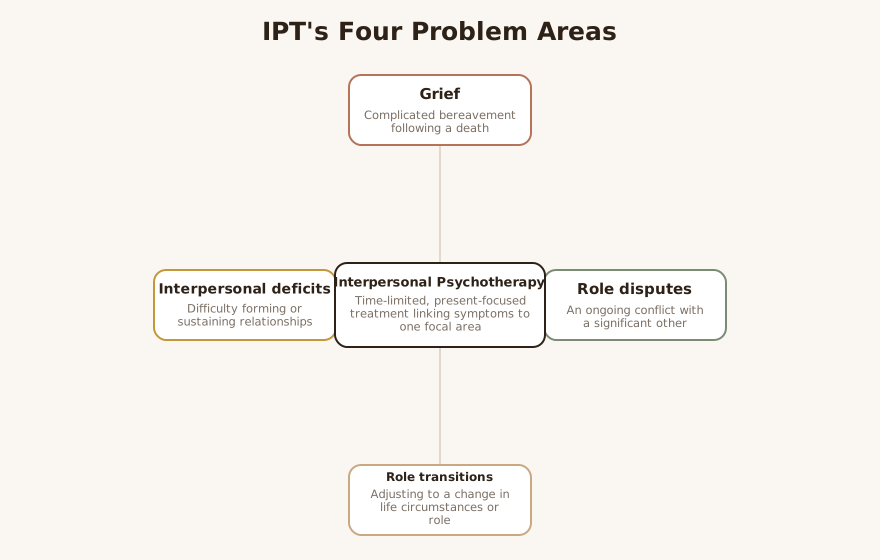
The four interpersonal problem areas are: grief (complicated bereavement following a death), interpersonal role disputes (a conflict with a significant other), role transitions (a change in life status such as divorce, job loss, illness, or new parenthood), and interpersonal deficits (longstanding social isolation or impoverished relationships).4 LLM
Interventions & Techniques
IPT is delivered in three phases.4 LLM
The initial phase (roughly sessions 1-3) involves a diagnostic evaluation, psychoeducation, assignment of the sick role, and construction of the interpersonal inventory — a systematic review of the patient’s significant relationships, their quality, and recent changes. The therapist links the symptom timeline to interpersonal events and, with the patient, selects the focal problem area and sets the time frame.4 LLM
The middle phase applies problem-area-specific strategies. For grief, the therapist facilitates mourning and helps the patient re-establish interests and relationships. For role disputes, the work clarifies the nature of the dispute, identifies the stage (renegotiation, impasse, or dissolution), and improves communication or expectations. For role transitions, the therapist helps the patient mourn the old role, appraise the new one more realistically, and develop the social skills and supports it demands. For interpersonal deficits, the focus is reducing isolation, examining recurrent relationship patterns, and building new connections.4 LLM
Across problem areas, IPT uses a recognizable technical repertoire: clarification, communication analysis (a detailed reconstruction of a specific interaction to find where it went awry), decision analysis, role-play, exploration of affect, and explicit attention to the link between mood and interpersonal events.6 The termination phase (final sessions) reviews gains, anticipates future interpersonal stressors, frames the ending itself as a role transition, and addresses relapse prevention.4 LLM
LLM-generated illustrative example (not a guideline): A 34-year-old patient develops a major depressive episode three months after relocating for a partner’s job. The interpersonal inventory reveals lost professional identity, no local friends, and rising friction at home. The dyad names the focus as a role transition. Communication analysis of a recent argument shows the patient withdrawing rather than voicing needs; role-play rehearses asking the partner for specific support, and between-session goals build one new local social contact. As connection and agency recover, mood lifts. LLM
Evidence Base
IPT’s evidence base is established and mature, particularly for depression. A comprehensive meta-analysis by Cuijpers and colleagues pooled 90 studies with 11,434 participants and found that for acute-phase depression IPT produced moderate-to-large effects compared with control conditions (g=0.60; 95% CI=0.45-0.75).1 An earlier depression-specific meta-analysis of 38 randomized trials (4,356 patients) found a comparable effect versus control (d=0.63), essential equivalence to other psychotherapies including CBT (d=0.04), modest superiority of pharmacotherapy over IPT for acute treatment (d=-0.19 after outlier removal), and — importantly — that maintenance IPT combined with medication significantly reduced relapse relative to medication alone (odds ratio=0.37).2 The authors concluded IPT “deserves its place in treatment guidelines as one of the most empirically validated treatments for depression.”2
Beyond depression, the comprehensive meta-analysis reported large effects for IPT in anxiety disorders with no evidence that it was less effective than CBT, and promising — though less mature — evidence in eating disorders and several other conditions.1 APA Division 12 (Society of Clinical Psychology) lists IPT for depression among its research-supported psychological treatments.3 By 2017, at least 133 clinical trials of IPT had been conducted worldwide.6 The honest summary: the depression evidence is strong and guideline-level; the anxiety and eating-disorder evidence is encouraging but thinner; bipolar and PTSD applications are adjunctive or developing. LLM
Populations & Indications
IPT has been validated and adapted across the lifespan and across formats — including group, telephone, and computer-assisted delivery — and for clinicians at varied training levels.6 It is used with adults for major depressive disorder and persistent depressive disorder, and has well-developed adaptations for adolescents (IPT-A).4 It has a strong tradition in perinatal and postpartum women, where the interpersonal stresses of a major role transition map naturally onto the model. LLM It is used with older adults, with bereaved individuals whose presentation centers on grief, and with people with eating disorders, particularly bulimia nervosa and binge-eating disorder.4 It serves as an adjunct to medication in bipolar disorder, and has been explored for PTSD and social anxiety disorder, with the strongest indication remaining unipolar depression.41
Problems-for-Work
IPT organizes the clinical work around the four problem areas, each of which becomes a concrete focus. LLM
- Grief / complicated bereavement — applied when symptom onset follows the death of a significant person; the work facilitates delayed or distorted mourning and rebuilds relationships and interests.4
- Interpersonal role disputes — applied when a current conflict with a partner, family member, or colleague maintains the episode; the work clarifies the dispute and improves communication and expectations.4
- Role transitions — applied to divorce, retirement, job loss, illness, migration, or new parenthood; the work mourns the old role and develops competence and supports for the new one.4
- Interpersonal deficits — applied when chronic isolation and a thin social network are central; the work reduces isolation and builds connection, and is generally regarded as the hardest problem area to treat. LLM
LLM-generated illustrative example (not a guideline): A recently widowed older adult presents with a depressive episode and reports she “can’t talk about” her late husband and has stopped seeing friends. The focus is named as grief. Sessions create space to narrate the loss and its ambivalences, and graded steps reconnect her with a bereavement group and a former friend; mood improves as mourning proceeds and relationships resume. LLM
Contraindications, Cautions & Cultural Humility
IPT has no absolute contraindications, but several cautions apply. LLM It is not designed as a standalone treatment for acute mania, active psychosis, or severe substance dependence requiring stabilization, and in bipolar disorder it is positioned as an adjunct to pharmacotherapy rather than a replacement.4 For severe major depression, pharmacotherapy showed a modest acute advantage over IPT in meta-analysis, so medication or combination treatment should be considered for more severe presentations.2 The “interpersonal deficits” focus, applied to patients with very entrenched, lifelong relational difficulties, may be too brief; a longer or different modality is sometimes more appropriate. LLM
Cultural humility is integral, not optional. What counts as a “role,” a normative life transition, an acceptable way to grieve, or a legitimate interpersonal dispute is profoundly shaped by culture, gender, family structure, and migration history. LLM The clinician should not import assumptions about, for example, autonomy-versus-interdependence into the role-dispute or transition work, and the interpersonal inventory must be conducted with curiosity about the patient’s own relational world rather than a default cultural template. LLM IPT’s adaptability across formats and settings is a strength here, but it places responsibility on the clinician to fit the focus to the patient’s context.6
Treatment-Plan Suggestions & SMART Objectives
| Goal | SMART objective (example) | Mechanism |
|---|---|---|
| Reduce depressive symptoms tied to a role transition | Patient’s PHQ-9 decreases by ≥5 points over 12 weekly sessions while addressing the identified transition | Resolving the focal problem area reduces symptoms as mood-interpersonal cycle reverses4 |
| Resolve an interpersonal role dispute | Within 8 sessions, patient identifies the dispute stage and rehearses two specific communication changes with the significant other | Communication analysis and renegotiation reduce conflict-driven symptom maintenance6 |
| Complete delayed mourning (grief focus) | Over 10 sessions, patient narrates the loss in session and resumes at least two previously valued activities or relationships | Facilitated mourning frees the patient to re-engage relationships, lifting mood4 |
| Decrease social isolation (interpersonal deficits) | Within 12 weeks, patient initiates and sustains one new social contact and attends one recurring social activity | Reducing isolation and revising relational patterns builds support and affect regulation4 |
| Strengthen postpartum support network | Within 12 weekly sessions, patient establishes a weekly support routine and reports reduced isolation on a standardized measure | Restructuring perinatal roles and supports addresses transition-linked depression41 |
| Prevent relapse after acute response | Patient transitions to monthly maintenance IPT and remains in remission at 6-month review | Maintenance IPT (esp. with medication) lowers relapse risk2 |
| Improve interpersonal functioning alongside symptoms | Patient reports measurable improvement on an interpersonal functioning scale by termination | Symptom and interpersonal gains reinforce one another in the IPT model4 |
Common Misconceptions
“IPT is just supportive counseling about relationships.” It is a structured, manualized, diagnosis-anchored treatment with defined phases, a focal problem area, and specific techniques, not unstructured relational support.45 LLM
“IPT is a form of CBT.” They share brevity and a present focus and perform comparably for depression, but IPT targets the interpersonal context rather than cognitions or behaviors directly.2 LLM
“IPT is psychodynamic therapy in disguise.” Although it descends from the interpersonal school and attends to relationships and loss, IPT stays in the present and avoids transference interpretation and developmental reconstruction.6 LLM
“IPT only works for depression.” Depression is its strongest indication, but meta-analytic evidence shows large effects in anxiety disorders and promising effects in eating disorders and other conditions.1 LLM
Training & Certification
Formal IPT training and certification are coordinated internationally through the International Society of Interpersonal Psychotherapy (ISIPT), which maintains foundational educational materials and a training pathway.4 The canonical clinical text remains the 1984 Klerman, Weissman, Rounsaville, and Chevron manual, supplemented by later guides.5 ISIPT also hosts a library of instructional videos useful for clinicians learning the method.7 Because IPT has been adapted for many populations, formats, and trainee levels, clinicians can pursue both general IPT competence and population-specific adaptations such as IPT for adolescents or perinatal IPT.6 LLM
Key Terms
- Interpersonal inventory — the systematic review of the patient’s significant relationships and recent relational changes, conducted in the initial phase to select the focus.4
- The four problem areas — grief, interpersonal role disputes, role transitions, and interpersonal deficits.4
- Sick role — the framing of the patient’s symptoms as a treatable medical condition, which reduces self-blame and structures the time-limited work.4
- Communication analysis — detailed reconstruction of a specific interpersonal exchange to identify where communication broke down.6
- Role transition — a change in life status (e.g., divorce, new parenthood, illness, retirement) that requires mourning an old role and adapting to a new one.4
- Maintenance IPT — continued, less frequent IPT after acute response to reduce relapse, especially alongside medication.2
Resources & Further Reading
▶ Watch — a video introduction to this concept:
- Interpersonal Psychotherapy for Mental Health Problems: A Comprehensive Meta-Analysis (Cuijpers et al., 2016, American Journal of Psychiatry)
- Interpersonal Psychotherapy for Depression: A Meta-Analysis (Cuijpers et al., 2011, PMC)
- Interpersonal Therapy for Depression — Society of Clinical Psychology (APA Division 12)
- Overview of IPT — International Society of Interpersonal Psychotherapy (ISIPT)
- Interpersonal Psychotherapy of Depression (Klerman, Weissman, Rounsaville & Chevron, 1984)
- Interpersonal Psychotherapy: History and Future (Markowitz & Weissman)
- Videos — International Society of Interpersonal Psychotherapy (ISIPT)
Reflective / Supervision Questions
- When I assess a depressed patient, do I routinely build an interpersonal inventory and connect the symptom timeline to a specific relational change — or do I default to a symptom checklist alone? LLM
- Of the four problem areas, which do I find hardest to work with (often interpersonal deficits), and how does my discomfort shape the focus I select with patients? LLM
- Am I selecting IPT for presentations where its evidence is strongest, and am I considering medication or combination treatment for more severe depression where pharmacotherapy showed an acute advantage?2 LLM
- How do my assumptions about “normal” roles, transitions, and grieving — shaped by my own culture — affect how I frame a patient’s problem area, and how can I hold those assumptions more lightly?6 LLM
- For patients who respond acutely, do I have a plan for maintenance or relapse prevention rather than simply ending at remission?2 LLM