
Type & Discipline
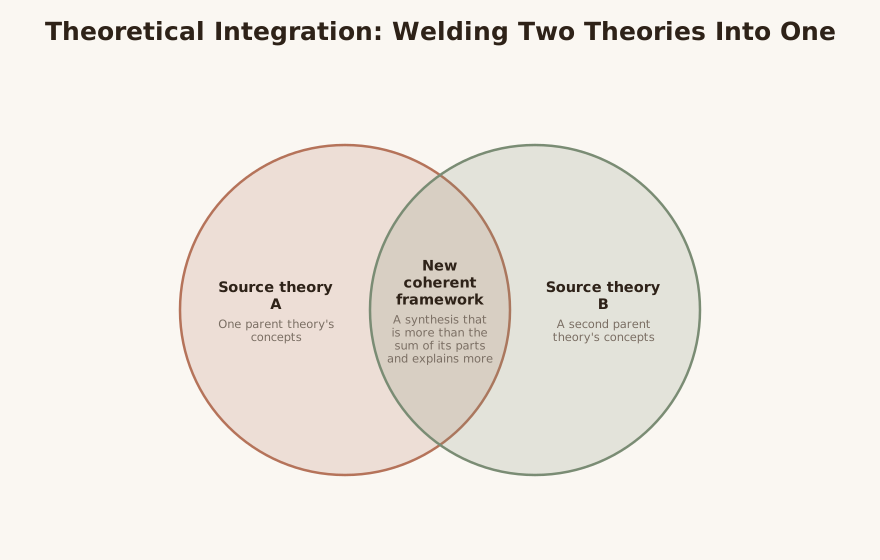
Theoretical (synthetic) integration is a framework within psychotherapy integration, a subdiscipline of clinical psychology devoted to combining elements of different therapeutic systems rather than practicing any single school in pure form 4. The field is conventionally described as having four main routes: technical eclecticism, theoretical integration, the common factors approach, and assimilative integration 4. Theoretical integration is the most ambitious of the four, because it does not merely borrow techniques or identify shared ingredients; it attempts to combine two or more theories into a new, conceptually unified framework 2. The “synthetic” qualifier captures the defining ambition: the product is meant to be more than the sum of its parts, a genuine synthesis rather than a juxtaposition 6.
What separates this route from its neighbors is the locus of integration. Technical eclecticism integrates at the level of technique and stays agnostic about theory, while the common factors approach integrates at the level of shared curative ingredients 4. Theoretical (synthetic) integration instead integrates at the level of explanatory theory itself, producing a superordinate model that reorganizes how change, pathology, and the therapeutic relationship are understood 2. It is therefore the route most likely to yield a named, free-standing therapy with its own vocabulary, rather than a meta-strategy applied to a host model LLM.
Creators & Lineage
The paradigm case and most-cited exemplar is Paul Wachtel’s cyclical psychodynamics, which fused psychoanalytic and behavioral theory into a single account in which inner dynamics and outer behavior continuously reinforce one another 6. Wachtel’s synthesis is the textbook illustration of theoretical integration precisely because it generated a new explanatory logic rather than a technique menu, showing how warded-off wishes and the interpersonal consequences they provoke form self-perpetuating vicious circles 6. His work is the historical anchor for the claim that two ostensibly incompatible theories can be welded into something coherent LLM.
The lineage runs through the broader psychotherapy-integration movement that arose to move past sterile turf wars between schools 4. Cognitive analytic therapy (CAT), developed by Anthony Ryle, is a second canonical product of this route, integrating cognitive and psychoanalytic ideas into a unified, time-limited model with its own reformulation tools 3. The field’s scholarly home and reference compendium is the Handbook of Psychotherapy Integration edited by John Norcross and Marvin Goldfried, which codifies theoretical integration as one of the recognized routes and catalogues its exemplars 1. Theoretical integration is best understood alongside its three sibling routes, from which it is repeatedly distinguished in the integration literature 24.
Core Principles
The first principle is conceptual synthesis over technical borrowing. The goal is a new theory that explains more, or more economically, than either parent theory alone, not a pragmatic mixing of methods 2. This is why theoretical integration is held to a higher coherence standard than eclecticism: incompatible assumptions must be reconciled, not merely coexist 2.
The second principle is that the synthesis should be more than the sum of its parts, generating predictions or formulations that neither source theory could produce in isolation 6. The third principle is reciprocal influence between domains; in cyclical psychodynamics, for example, intrapsychic conflict and interpersonal behavior are treated as mutually causal rather than as competing levels of explanation 6. The fourth principle is that genuine integration links theory, evidence, and technique systematically, which is the feature the literature uses to separate true integration from mere eclectic combination 3.
LLM-generated illustrative example (not a guideline): A clinician working from an integrated cognitive-psychodynamic model maps how a client’s core belief “if I need others I will be abandoned” both arises from early relational experience and is behaviorally enacted in ways that provoke the very rejection it fears. The single formulation holds the historical, cognitive, and interpersonal strands together rather than treating them as separate problems LLM.
Interventions & Techniques
Because theoretical integration produces whole therapies, its “techniques” are typically the procedures of the synthesized model rather than a portable toolkit LLM. In cognitive analytic therapy, the integrated theory generates distinctive tools such as collaborative written reformulation letters and sequential diagrams that map reciprocal roles, which embody the cognitive-psychodynamic synthesis in concrete clinical form 3. In cyclical psychodynamics, interventions target the self-perpetuating loop, combining insight into warded-off material with attention to the interpersonal behaviors that maintain it, so interpretation and active intervention serve one unified rationale 6.
The unifying mechanic across products of this route is that every technique is justified by the integrated theory, not by the school it descends from 2. A behavioral or experiential method, once placed inside a synthetic framework, is understood through that framework’s account of change rather than its original rationale 2. This is what allows an integrated therapy to deploy methods of diverse ancestry while remaining internally coherent LLM. The clinician’s task is to formulate within the synthesized model and let that formulation dictate which interventions are indicated and how their effects are read LLM.
Evidence Base
The maturity of theoretical (synthetic) integration is best described as established as a field rather than as a single empirically validated treatment LLM. Integrative practice has strong ecological validity: a survey of over 1,000 psychotherapists found that only about 15 percent used a single theoretical orientation, with practitioners drawing on an average of four approaches 3. The common-factors evidence that motivates integration is robust, with shared factors such as alliance, empathy, and expectancy accounting for roughly 20 percent of outcome variance against about 7 percent for specific techniques 3.
Honesty requires distinguishing the route from its products LLM. Direct randomized evidence does not attach to “theoretical integration” in the abstract, because the route is a way of building therapies, not a single manualized protocol LLM. Where strong outcome data exist, they belong to named integrative therapies that the literature identifies as evidence-based, notably interpersonal psychotherapy, schema therapy, and cognitive analytic therapy, with demonstrated effects across depression, anxiety, and personality disorders 3. Cognitive analytic therapy is the cleanest example for this route, since it is both a true theoretical synthesis and a treatment with an accumulating evidence base 3. The fair summary is that the route is conceptually mature and clinically widespread, while its empirical credibility is carried by its offspring rather than by the generic strategy 3LLM.
Populations & Indications
Theoretical integration was developed for adults in individual psychotherapy and is framed as broadly applicable rather than tied to one diagnostic niche 5. Its strongest indication is the client with complex comorbidity, where a synthesized model can hold symptom, character, and interpersonal pattern within one formulation instead of treating them as separate problems requiring separate therapies 3LLM. The integration literature emphasizes that diverse clinical presentations are precisely what motivated the movement, since no single school answers every case 4.
The route extends naturally to couples, children and adolescents, and treatment-resistant clients, all settings where rigid single-school practice often falters and a more comprehensive theory is attractive 5LLM. For treatment-resistant clients in particular, a synthesis that explains why change has stalled, by linking inner conflict to its behavioral and relational maintenance, can reframe nonresponse rather than simply adding more technique 6LLM. Across populations, the appeal is a single coherent account of the whole person 2LLM.
Problems-for-Work
Theoretical integration is well suited to presentations where symptom and underlying pattern are entangled LLM. In major depressive disorder, an integrated cognitive-psychodynamic formulation can connect self-critical cognition, early relational loss, and the withdrawal that perpetuates low mood, so one model addresses thought, history, and behavior together 6LLM. In generalized anxiety disorder, the synthesis can link worry as cognitive avoidance to the interpersonal reassurance-seeking that maintains it 3LLM.
For personality disorders and complex trauma, cognitive analytic therapy’s reciprocal-role mapping gives a worked example of a synthetic model built precisely for entangled relational and self-state problems 3LLM. In PTSD and emotional dysregulation, an integrated frame can hold trauma memory, meaning, and affect-regulation deficits within a single account rather than sequencing unrelated protocols 3LLM. For relationship conflict and comorbid disorders, the cyclical model is especially apt because it treats intrapsychic and interpersonal levels as one feedback loop 6LLM. For treatment nonresponse, the route offers a reformulation rather than a longer technique list 2LLM.
LLM-generated illustrative example (not a guideline): A client with co-occurring panic and longstanding relational instability has cycled through separate courses of skills training and supportive work without durable gain. Working within an integrated model, the clinician formulates how bodily fear and fear of abandonment are the same warded-off vulnerability expressed in two registers, and treats them through one coherent plan rather than two disconnected ones LLM.
Contraindications, Cautions & Cultural Humility
The principal caution is that genuine theoretical integration is demanding and presupposes real competence in the parent theories being synthesized 2. Combining theories one does not deeply understand risks producing incoherence dressed up as integration, which is exactly the failure the route is meant to avoid 2. Clinicians should also resist treating “integration” as a license to mix freely; the field draws a firm line between principled theoretical synthesis and unprincipled eclecticism 3.
A further caution is that the empirical support of a synthesized therapy cannot be assumed from the support of its parent theories, so ongoing outcome monitoring remains essential LLM. With respect to cultural humility, any synthesized theory carries the cultural assumptions of its sources; a model fusing psychoanalytic and cognitive traditions embeds particular views of self, autonomy, and distress LLM. Clinicians should hold the integrated model lightly enough to adapt formulation and intervention to the client’s cultural frame rather than imposing a Western theory of mind as if it were neutral LLM. Where a client’s presentation does not fit the synthesized account, that misfit is data, not a reason to force the case into the model LLM.
Treatment-Plan Suggestions & SMART Objectives
| Goal | SMART objective (example) | Mechanism |
|---|---|---|
| Build one coherent case formulation across symptom and character | Clinician and client will co-author a written reformulation linking presenting symptoms to relational patterns within 4 sessions | Conceptual synthesis of cognitive and psychodynamic theory into one formulation 3 |
| Interrupt a self-perpetuating depressive cycle | Client will identify, in 4 of 6 sessions, one instance where withdrawal both follows from and reinforces self-critical belief | Reciprocal-influence principle of cyclical integration 6 |
| Reduce generalized anxiety while addressing its maintenance | Client will log worry episodes and the reassurance-seeking they trigger twice weekly for 3 weeks | Linking cognitive avoidance to interpersonal maintenance in one model 3 |
| Improve treatment coherence for a comorbid presentation | Clinician will document one integrated formulation and justify each intervention by that model across 6 sessions | Theory-driven coherence distinguishing integration from eclecticism 2 |
| Map reciprocal roles in unstable relationships | Client will complete a sequential diagram of one recurring relational pattern by session 6 | Synthetic cognitive-analytic mapping of self-states 3 |
| Re-engage a treatment-resistant client | Within 3 sessions, reframe prior nonresponse using the integrated formulation and set one revised goal | Reformulation rather than additive technique for nonresponse 6 |
| Strengthen affect tolerance within a unified frame | Client will use one regulation strategy during 3 affectively intense sessions and link its meaning to the formulation | Technique justified by the integrated theory rather than its source school 2 |
Common Misconceptions
A frequent misconception is that theoretical integration is the same as technical eclecticism LLM. It is not: eclecticism combines techniques without requiring theoretical consistency, whereas theoretical integration insists on a unified superordinate theory 2. A second misconception is that “integration” means mixing a bit of everything; in this route it means a disciplined synthesis that links theory, evidence, and technique, which the literature explicitly contrasts with loose combination 3.
A third misconception is that integration lowers standards; doing it well demands deep competence in each parent theory and is harder, not easier, than single-school practice 2. A fourth is that the route is only a historical idea; in fact it has produced living, evidence-bearing therapies such as cognitive analytic therapy that remain in active clinical use 3. A fifth is that the synthesis is merely additive; the defining claim is that the product is more than the sum of its parts 6.
Training & Certification
There is no single license specific to theoretical (synthetic) integration; it is practiced by qualified psychotherapists within their existing scope rather than gated behind one proprietary credential LLM. Its scholarly home is the psychotherapy-integration community, whose codifying reference is the Handbook of Psychotherapy Integration 1. Clinicians typically build competence by first grounding themselves in the parent theories they intend to synthesize, since coherent integration is impossible without genuine fluency in each 2.
Where a specific synthesized therapy is the goal, training follows that therapy’s own pathway; cognitive analytic therapy, for instance, has its own structured training and accreditation routes maintained by its professional bodies 3LLM. The Society for the Exploration of Psychotherapy Integration and its associated journal literature serve as the field’s conventional reference points for clinicians seeking deeper study of the route as such 4LLM. Supervised practice in moving coherently between traditions, rather than merely accumulating techniques, is the core developmental task 2LLM.
Key Terms
- Theoretical (synthetic) integration: Combining two or more theories into a new, conceptually unified framework that is more than the sum of its parts 2.
- Cyclical psychodynamics: Paul Wachtel’s synthesis of psychoanalytic and behavioral theory in which inner dynamics and outer behavior reciprocally maintain one another 6.
- Cognitive analytic therapy: A time-limited integrative therapy synthesizing cognitive and psychodynamic ideas, with its own reformulation tools 3.
- Technical eclecticism: Selecting techniques empirically across schools without requiring theoretical consistency 4.
- Common factors: The curative elements shared across therapies, such as alliance, empathy, and expectancy 3.
- Assimilative integration: Working from one host theory while importing techniques from others, the fourth recognized route 2.
- Superordinate theory: The new, higher-order framework that a successful theoretical integration produces 2.
Resources & Further Reading
▶ Watch — a video introduction to this concept:
- Handbook of Psychotherapy Integration (Norcross & Goldfried, eds.) — Oxford University Press
- Bridging Technical Eclecticism and Theoretical Integration: Assimilative Integration — Journal of Psychotherapy Integration
- Integrative Psychotherapy Works — Frontiers in Psychology (PMC/NIH)
- An Introduction to Psychotherapy Integration — Psychiatric Times
- Integrative Therapy — Psychology Today
- Integrative psychotherapy — Wikipedia
Reflective / Supervision Questions
- Can I state the superordinate theory I am working from, or am I describing a pile of borrowed techniques? 2
- For this case, does my integrated formulation explain more than either parent theory would alone, or is it merely additive? 6
- Do I have genuine competence in each theory I claim to be synthesizing, or am I combining something I do not fully understand? 2
- Where is the actual outcome evidence for what I am doing, and am I relying on the support of a named integrative therapy or assuming it for the generic route? 3
- Could a critic fairly call my work eclecticism rather than theoretical integration, and what unifying theory would I point to? 4
- Does the cultural framing embedded in my synthesized model fit this client, or do I need to adapt the formulation? LLM
- When a case does not fit my integrated model, am I treating the misfit as data or forcing the client into the theory? LLM