
Type & Discipline
Multimodal Therapy (MMT) is a modality within clinical psychology, situated in the family of technical eclecticism and psychotherapy integration 4. It is best understood not as a single technique but as a comprehensive, biopsychosocial framework for assessment and individualized treatment planning 3. The defining feature is its commitment to technical eclecticism — the deliberate practice of borrowing effective strategies from across therapeutic schools without importing the theories that gave rise to them 3. This places MMT in a different category from theoretical integration, which attempts to merge underlying conceptual systems, and from doctrinaire single-school approaches that restrict the clinician to one set of techniques 3. For the practicing therapist, MMT functions as a meta-level organizing structure that can sit on top of, and direct the deployment of, the specific modalities a clinician is already trained in LLM.
Creators & Lineage
MMT was developed by the South African–born clinical psychologist Arnold Lazarus, who is also credited with introducing the term “behavior therapy” into the psychotherapy literature 6. Lazarus’s thinking grew directly out of the behavioral and cognitive-behavioral tradition, and MMT can be read as an attempt to extend beyond the limits of standard CBT by acknowledging the multidimensional nature of personality 6. He articulated the foundational version of the approach in his 1973 paper “Multimodal Behavior Therapy: Treating the ‘BASIC ID’,” published in the Journal of Nervous and Mental Disease 1. The lineage is therefore traceable through behavior therapy, social learning theory, and cognitive behavioral therapy, with MMT representing the integrative, technically eclectic endpoint of that line 6. Lazarus continued to develop and refine the model over subsequent decades, consolidating it in book-length treatments of the approach 5. He framed the central premise plainly: humans are biological beings who think, feel, act, sense, imagine, and interact, and effective treatment must attend to each of those domains 6.
Core Principles
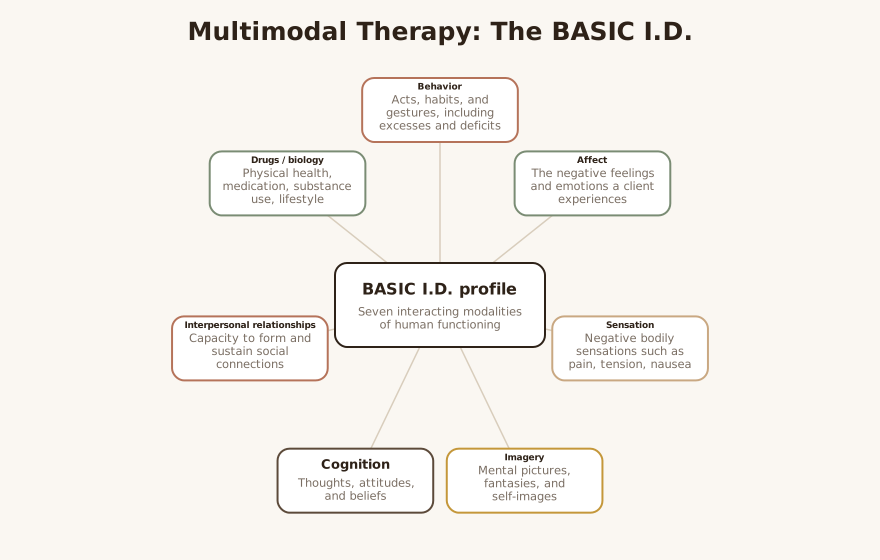
The organizing structure of MMT is the BASIC I.D., an acronym for seven interacting modalities of human functioning 6. Behavior covers acts, habits, and gestures, including both excesses and deficits 6. Affect refers to the negative feelings and emotions a client experiences 6. Sensation captures negative bodily sensations such as pain, tension, or nausea 6. Imagery includes the mental pictures, fantasies, and self-images a person carries 6. Cognition encompasses thoughts, attitudes, and beliefs 6. Interpersonal relationships concern the capacity to form and sustain social connections 6. Drugs stands more broadly for biology — physical health, medication, substance use, and lifestyle 6.
A core principle is that diagnostic labels are insufficient as a basis for treatment, because two clients carrying the same diagnosis may present with markedly different modality profiles 3. MMT therefore assesses the unique pattern of response excesses and deficits across the BASIC I.D. for each individual 3. A second principle is empirical pragmatism: techniques are selected preferentially because research supports them for the target problem, not because they belong to a favored theoretical camp 3. A third principle is that the modalities are interactive rather than independent, so change in one domain — for instance, sensation through relaxation — can cascade into others such as affect and cognition LLM.
Interventions & Techniques
MMT does not introduce a proprietary technique set; it imports interventions and assigns them to the modality they best address 3. Relaxation training, dietary and stress-management measures, and behavioral rehearsal are examples cited in descriptions of the approach 6. Practically, the clinician maps each modality to evidence-based methods: behavioral activation and exposure for Behavior, affect-labeling and emotion regulation for Affect, applied relaxation for Sensation, imagery rescripting and coping-imagery for Imagery, cognitive restructuring for Cognition, social-skills and communication work for Interpersonal, and medical or psychiatric referral and lifestyle change for Drugs/biology LLM.
Several signature procedures distinguish MMT in practice. Tracking examines the typical sequence, or “firing order,” in which a client’s modalities activate during a problematic episode, so that intervention can target the leading link in the chain 4. Bridging is the deliberate technique of first meeting a client in the modality they spontaneously favor before guiding them toward a less accessible but clinically relevant one 4. The second-order BASIC I.D. is a recursive assessment applied to a single stubborn problem, profiling that one issue across all seven modalities when initial interventions stall 4. Formal assessment is supported by structured instruments, including a Multimodal Life History Inventory and the Structural Profile Inventory, which yields a quantitative graph of a client’s relative weighting across the seven modalities 4. Sessions are sometimes recorded for later therapeutic review 6.
LLM-generated illustrative example (not a guideline): A client with panic describes the onset of an attack. Tracking reveals the firing order is Sensation (chest tightness) → Cognition (“I’m having a heart attack”) → Affect (terror) → Behavior (fleeing). Because the chain ignites in Sensation, the clinician front-loads interoceptive work and applied relaxation rather than starting with cognitive disputation LLM.
Evidence Base
The evidence base for MMT is best characterized as established as a framework but modest in modality-specific outcome trials LLM. Lazarus’s original rationale, advanced in 1973, was that comprehensive multimodal assessment and treatment would produce more durable gains than narrow single-target interventions by reducing untreated residual problems 1. The strongest empirical footing comes indirectly: MMT explicitly draws on empirically supported and evidence-based methods, so the individual techniques it deploys often carry their own research support within CBT and behavior therapy 3. What is far thinner is a body of randomized controlled trials testing the integrated MMT package itself head-to-head against established protocols LLM. Clinicians should therefore present MMT honestly as a well-developed, decades-refined organizing approach whose component interventions are evidence-based, rather than as a discrete therapy with its own large RCT literature LLM. The framework’s enduring presence in the integrative-psychotherapy and CBT literature reflects its conceptual maturity and clinical utility more than a dedicated outcome-trial program 5.
Populations & Indications
MMT was designed for broad applicability and is most often described for adults presenting with anxiety disorders and with depression 3. Its comprehensive assessment is particularly suited to individuals with complex or comorbid presentations, where a single-diagnosis protocol may leave important contributing modalities unaddressed 3. The approach is also applied with couples, where interpersonal and affective modalities are frequently central 6. More generally, it suits clients who want — or clinically require — an individualized treatment plan rather than a manualized one-size protocol, precisely because the BASIC I.D. profile differs from person to person 3. The biopsychosocial breadth of the model makes it a reasonable organizing lens for intake and case formulation across a wide adult outpatient caseload LLM.
Problems-for-Work
The problems MMT is commonly applied to span the common outpatient spectrum, and the value of the framework is that it routes each into the modality where it lives most strongly LLM. Major depressive disorder can be profiled across reduced activity (Behavior), anhedonia (Affect), fatigue (Sensation), and hopeless cognitions (Cognition) so that activation, sensation work, and cognitive restructuring are sequenced rather than applied indiscriminately LLM. Generalized anxiety disorder and panic disorder lend themselves to tracking the firing order, often anchored in Sensation and Imagery 4. Phobias route naturally into Behavior (avoidance) and Imagery (catastrophic mental pictures) LLM. Stress-related problems map onto Sensation and lifestyle factors under Drugs/biology, inviting relaxation and behavioral change 6. Sexual dysfunction, relationship conflict, and low self-esteem typically surface in the Interpersonal, Affect, and Cognition modalities, where bridging is especially useful 4. Comorbid presentations are arguably the clearest indication, because the BASIC I.D. prevents the clinician from over-focusing on one diagnosis while neglecting interacting modalities 3.
LLM-generated illustrative example (not a guideline): A client reports both low mood and chronic relationship strain. A second-order BASIC I.D. on the relationship problem alone surfaces an Imagery component — a recurring picture of being abandoned — that had been invisible when the case was framed only as “depression.” The clinician adds imagery work to the plan LLM.
Contraindications, Cautions & Cultural Humility
MMT has no absolute contraindications as an assessment framework, but several cautions apply LLM. Because the model is technically eclectic, the quality of care depends entirely on the clinician’s competence in the specific techniques they import; borrowing an intervention does not exempt the therapist from being trained in it 3. The comprehensiveness of the seven-modality assessment can be burdensome or overwhelming for clients in acute crisis or with significant cognitive impairment, and may need to be paced or deferred LLM. The breadth of the framework also creates a risk of unfocused, scattershot treatment if the clinician fails to use tracking and firing order to prioritize LLM. On cultural humility: the BASIC I.D. categories — particularly Affect, Imagery, Interpersonal, and the meaning of “Drugs/biology” — are expressed and weighted differently across cultures, so the clinician should hold the profile as a collaborative hypothesis rather than a fixed grid, and the Structural Profile Inventory should be interpreted in cultural context rather than as a culture-neutral measurement LLM. The Drugs/biology modality also obligates appropriate medical and psychiatric collaboration rather than informal opinion on medication LLM.
Treatment-Plan Suggestions & SMART Objectives
| Goal | SMART objective (example) | Mechanism |
|---|---|---|
| Reduce avoidance (Behavior) | Client completes 3 graded exposure tasks per week for 4 weeks, logging each | Behavioral exposure / extinction of avoidance 3 |
| Improve emotion regulation (Affect) | Client identifies and labels the primary emotion in 5 distressing episodes per week for 6 weeks | Affect-labeling and tolerance LLM |
| Lower physiological arousal (Sensation) | Client practices applied relaxation daily and reports a 2-point SUDS drop within sessions over 4 weeks | Down-regulation of sensory/autonomic arousal 6 |
| Revise catastrophic imagery (Imagery) | Client rescripts one recurring distressing image into a coping image in each of 4 sessions | Imagery rescripting / coping imagery 4 |
| Restructure maladaptive cognition (Cognition) | Client records and challenges 1 automatic thought daily for 3 weeks, rating belief change | Cognitive restructuring 3 |
| Strengthen relationships (Interpersonal) | Client initiates 2 assertive communications per week for 6 weeks and reviews outcomes | Social-skills / interpersonal rehearsal 6 |
| Address lifestyle/biology (Drugs) | Client attends a psychiatric medication review and adopts 1 sleep-hygiene change within 30 days | Biological/lifestyle optimization and referral 6 |
| Sequence the plan (firing order) | Therapist and client map the firing order for the index problem by session 3 and target the lead modality first | Tracking to prioritize intervention 4 |
Common Misconceptions
A frequent misconception is that MMT is theoretical integration — blending the theories of, say, psychoanalysis and behaviorism — when it is in fact technical eclecticism that borrows techniques while deliberately leaving their parent theories behind 3. A second is that MMT is simply CBT under another name; while it grew out of the cognitive-behavioral tradition, it explicitly extends beyond standard CBT to address sensation, imagery, interpersonal, and biological modalities that narrower protocols may underweight 6. A third misconception is that the BASIC I.D. is merely an intake checklist; in practice it drives dynamic procedures such as tracking, bridging, and second-order profiling throughout treatment 4. Finally, some assume “anything goes” under eclecticism, but MMT constrains technique selection to empirically supported and evidence-based methods 3.
Training & Certification
MMT does not have a single dominant credentialing body in the way some manualized therapies do, and competence rests primarily on grounding in the broader behavioral, cognitive, and integrative traditions from which it draws 6. The most authoritative training material remains Lazarus’s own writings, including his foundational 1973 paper and his book-length treatment of the approach, which together lay out the assessment instruments and procedures 1 5. Practitioner-oriented primers, such as the one Lazarus authored for continuing-education distribution, describe the assessment tools and signature techniques for clinicians adopting the model 4. Because the approach is technically eclectic, ongoing training in the specific imported interventions — exposure, cognitive restructuring, imagery work, relaxation, and interpersonal skills — is as important as familiarity with the MMT framework itself 3.
Key Terms
BASIC I.D. — the seven interacting modalities (Behavior, Affect, Sensation, Imagery, Cognition, Interpersonal, Drugs/biology) that structure assessment and treatment 6. Technical eclecticism — borrowing empirically supported techniques across schools without adopting their theories 3. Tracking — identifying the sequence, or firing order, in which modalities activate during a problem episode 4. Bridging — meeting the client first in their preferred modality before moving to a less accessible one 4. Second-order BASIC I.D. — re-profiling a single resistant problem across all seven modalities 4. Structural Profile Inventory — a structured instrument yielding a quantitative graph of a client’s relative weighting across the modalities 4. Multimodal Life History Inventory — a structured intake questionnaire supporting comprehensive BASIC I.D. assessment 4.
Resources & Further Reading
▶ Watch — a video introduction to this concept:
- Lazarus AA (1973). Multimodal behavior therapy: treating the ‘BASIC ID’. PubMed record
- Lazarus AA (1973). Journal of Nervous and Mental Disease abstract page
- Multimodal Therapy: A Unifying Approach to Psychotherapy (Psychology Today)
- Lazarus AA. Multimodal Therapy: A Primer (Zur Institute)
- Lazarus AA. Multimodal Therapy (book, Google Books)
- Multimodal therapy (Wikipedia)
Reflective / Supervision Questions
- When you formulate a case, which BASIC I.D. modalities do you habitually assess thoroughly, and which do you tend to skip — and what does that pattern reveal about your own training and biases? LLM
- For a recent stalled case, what would a second-order BASIC I.D. on the single resistant problem surface that your primary formulation missed? LLM
- Are the techniques you import for each modality genuinely ones you are trained and competent to deliver, or are you borrowing beyond your skill? 3
- How do you guard against the comprehensiveness of the BASIC I.D. becoming scattershot rather than sequenced by firing order? 4
- In what ways might your client’s cultural context change how Affect, Imagery, Interpersonal, or biology are expressed, and how does that affect your reading of the profile? LLM
- How honestly do you describe MMT’s evidence status to clients — as an evidence-informed organizing framework built from supported techniques, rather than a single therapy with its own large trial base? LLM