
Type & Discipline
Cognitive Analytic Therapy (CAT) is a brief, time-limited, integrative individual psychotherapy that sits within clinical psychology and psychiatry 3. It was developed in the United Kingdom and explicitly designed to provide effective and affordable psychological treatment within the resource-constrained context of the National Health Service 1. Its defining identity is integration: it combines the goal-setting and structured, Socratic working method of cognitive therapy with the depth and relational focus of psychoanalytic thought, and more recently a Vygotskian developmental and educational frame 16. The therapy is collaborative by design — therapist and patient work as cooperating partners who jointly construct shared written and diagrammatic tools, a stance that deliberately distinguishes CAT from the analyst–analysand asymmetry of classical psychoanalysis and from the more prescriptive posture of standard cognitive-behavioural approaches 3. For the practising clinician, the useful frame is that CAT is a focal, relational brief therapy: focal because it is organised around a small number of named target problems, and relational because its central unit of analysis is the patterned relationship between self and other rather than the isolated symptom 36.
Creators & Lineage
CAT was created by Anthony Ryle (1927–2016), an English medical doctor who trained at Oxford and University College London and qualified in medicine in 1949 2. Working first as a General Practitioner in North London after the founding of the NHS, Ryle observed that a large proportion of his patients presented with psychological distress, and he set out to develop a time-limited therapy that could realistically be offered within the health service 2. He went on to direct the University of Sussex Health Service and to serve as Consultant Psychotherapist at St Thomas’ Hospital, London, from 1983 to 1992; the approach is generally dated as formalised in 1984 26. His foundational texts include Cognitive Analytic Therapy: Active Participation in Change (1990) and Cognitive Analytic Therapy for Borderline Personality Disorder (1997) 2.
The model’s lineage is genuinely hybrid. From the cognitive tradition it draws structured goal-setting and the procedural analysis of action 1. From the psychoanalytic tradition — particularly object-relations theory — it inherits the conviction that early development shapes psychological structure, that current distress is connected to early relational patterns, and that the therapeutic relationship can itself modify those patterns 6. From George Kelly’s personal construct theory it took an early methodological and constructivist influence, including the repertory-grid method 1. From Vygotskian developmental theory it borrows the concepts of the zone of proximal development and scaffolding, used to calibrate the amount of therapeutic support the patient needs to do new psychological work 13. A later Bakhtinian influence adds an emphasis on the inherently dialogic, voiced nature of the self 1. The contemporary textbook of the approach is the second edition of Introducing Cognitive Analytic Therapy by Ryle and Ian Kerr, which presents CAT as a relational approach to mental health 7.
Core Principles
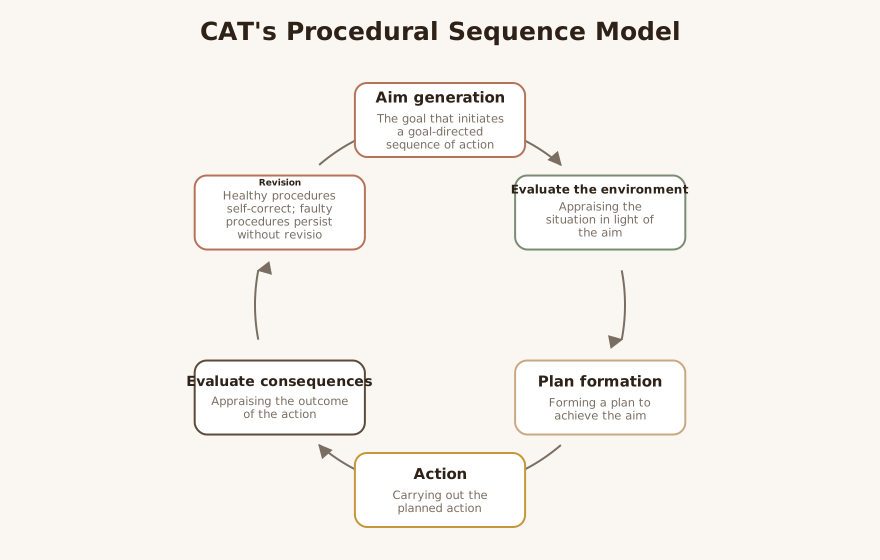
The theoretical spine of CAT is the Procedural Sequence Model (PSM), which describes goal-directed action as an ordered loop: aim generation, evaluation of the environment, plan formation, action, and evaluation of consequences, followed by revision 3. Healthy procedures self-correct — when a sequence does not achieve its aim, it is revised 3. Psychological difficulty arises when faulty procedures persist without being revised, becoming self-maintaining 3.
CAT classifies these maladaptive procedures into three recognisable forms, sometimes called target problem procedures 36:
- Traps — repetitive cycles in which the consequences of a behaviour perpetuate the very belief that drove it, as when depressive expectations generate genuinely discouraging outcomes that confirm the depression 3.
- Dilemmas — false either/or polarisations in which the person oscillates between two equally costly options, for example swinging between placation and aggression with no middle path 36.
- Snags — appropriate goals that are abandoned in anticipation of disaster, danger, or others’ disapproval, so the corrective step never occurs 36.
The second central construct is the reciprocal role (RR): an internalised template of a relationship that contains a role for the self, a role for the other, and a paradigm for how they relate 3. Reciprocal roles are learned early — a “critically demanding to guiltily striving” pattern, for instance — and are then replayed in adult relationships, including the therapeutic one 13. Crucially, problems are conceived as occurring between people rather than simply within the patient 1. When a patient unconsciously pressures the therapist into the complementary pole of a reciprocal role, CAT calls this reciprocal role induction, reframing what psychoanalysis terms countertransference as a piece of usable, observable data 3.
Interventions & Techniques
CAT delivers these concepts through a small set of concrete, jointly produced tools rather than through free-floating interpretation 36.
The Psychotherapy File is a structured questionnaire, usually completed as early homework, that helps the patient and therapist identify which common traps, dilemmas, and snags apply to them 3. The reformulation letter is a narrative account, written by the therapist and agreed collaboratively, that retells the patient’s life story, connects it to current difficulties, and names the maladaptive procedures and reciprocal roles at work 13. The Sequential Diagrammatic Reformulation (SDR) — often simply called the “map” — is a shared visual diagram of the patient’s reciprocal-role repertoire and the procedural loops that flow from it; it is particularly valuable in severe and complex presentations because it externalises a confusing inner world onto a single page that both parties can look at together 36. Weekly rating sheets and session summaries track movement on the agreed target problems, and the goodbye letter, exchanged near the end, reviews the trajectory of the work, what was and was not achieved, and the patient’s hopes for applying their new understanding 16.
A distinctive technical move is the search for exits — alternative, healthier procedures that allow the patient to step off a mapped loop — which the patient and therapist practise both in everyday life and inside the session itself 1. With more disturbed patients, the therapist models “involved non-collusion”: staying warmly engaged while declining to enact the reciprocal role the patient is inviting, and instead describing the pattern aloud as it happens 3. The Vygotskian scaffolding principle governs the dose of support: the therapist offers “just sufficient” help for the patient to reach the next increment of change, no more 3.
LLM-generated illustrative example (not a guideline): A patient repeatedly cancels sessions after sharing something vulnerable, then apologises profusely. On the SDR this might be mapped as a “trap”: expecting contempt for showing need (a contemptuous-to-shamed reciprocal role), the patient withdraws to pre-empt rejection, which then leaves them isolated and confirms that needs are dangerous. Naming the loop on paper — and noticing it live when the therapist “feels pushed away” (reciprocal role induction) — lets them rehearse an exit: staying in contact and tolerating the discomfort of being seen LLM.
Evidence Base
The maturity of CAT’s evidence base is best described as established in routine practice but modest and mixed in controlled-trial terms 34. On the encouraging side, a meta-analysis of 11 outcome studies involving 324 patients reported a large pooled effect size of 0.83, and comparative studies have suggested CAT is at least as effective as brief psychotherapy, person-centred therapy, and cognitive behavioural therapy 1. It has been applied with reported benefit across anorexia nervosa, borderline personality disorder in both adults and adolescents, deliberate self-harm, and even adjustment to chronic physical illness such as diabetes 1.
The honest caveat is that the rigorous evidence is thinner than the breadth of application implies. The Advances in Psychiatric Treatment review notes a relative lack of randomised controlled trials validating CAT; early findings rested on equivalence to Mann’s brief psychotherapy and on uncontrolled case series, and proponents and critics continue to disagree over how applicable RCT methodology is to this kind of therapy 3. A systematic scoping review of CAT in child and adolescent mental health services is similarly sobering: of 37 included articles, only 11 were quantitative and only 2 were robust RCTs, with the remaining 73% comprising service descriptions and author reflections 4. A 2008 trial found CAT produced slightly faster improvement in internalising and externalising pathology than good clinical care over 24 months, but a 2022 RCT found no clinically significant benefit of CAT over a high-quality holistic biopsychosocial intervention, and no study demonstrated effects beyond 24 months 4. The fair reading is that CAT is feasible, accessible, and acceptable, with promising but not yet decisive efficacy data 4.
Populations & Indications
CAT was designed for broad applicability, reflecting its NHS origins and its commitment to access and equity 15. It has been used with anxiety, depression, deliberate self-harm, abnormal illness behaviour, and the personality disorders 3. It has a particular reputation in the treatment of borderline personality disorder, for which Ryle developed a specific elaboration (described below), and it is applied to eating disorders including anorexia nervosa 1. The model is also used with adolescents: in CAMHS settings much of the research has concentrated on young people with borderline traits, notably within the HYPE early-intervention programme, alongside self-harm, non-suicidal self-injury, emotional dysregulation, and first-episode psychosis with comorbid BPD 4. Its relational lens makes it a natural fit for presentations dominated by maladaptive interpersonal patterns, repeated relationship conflict, and the relational residue of complex or developmental trauma 36.
Problems-for-Work
CAT organises treatment around a short list of named target problems and their underlying procedures, applying the same reformulate–recognise–revise sequence to each 3.
- Maladaptive interpersonal patterns and relationship conflict. The reciprocal-role framework treats recurring conflict as the playing-out of an internalised relational template; mapping it on the SDR and noticing its induction in the room makes the pattern available for change 3.
- Self-harm and deliberate self-harm. CAT targets the procedural chain leading to self-harm and, particularly in adolescents and personality-disordered patients, has reported reductions in self-harm in pre–post studies 14.
- Borderline personality disorder and dissociated self-states. Ryle’s Multiple Self States Model frames severe BPD as a three-level deformity — a restricted repertoire of reciprocal roles, abrupt “hair-trigger” switching between states, and impaired self-reflection rooted in developmental trauma 3.
- Depression and anxiety. Depressive “traps” and anxious “snags” are identified and exited; the procedural model gives a concrete account of how low mood and avoidance perpetuate themselves 36.
- Eating disorders. CAT has been applied to anorexia nervosa, where rigid control procedures and harsh self-to-self reciprocal roles can be mapped and revised 1.
LLM-generated illustrative example (not a guideline): For a patient with borderline personality disorder who flips from idealising to denouncing the therapist within a single session, the Multiple Self States Model offers language for the switch itself. The shared aim becomes building an “observing I” — a stance from which the patient can watch their state change without being wholly swept into it — by jointly tracking, on the diagram, the moment the switch occurs and what preceded it LLM.
Contraindications, Cautions & Cultural Humility
The cited sources name several practical cautions. Current drug or alcohol use to the point of active intoxication is a primary contraindication, and active psychosis and ongoing substance misuse are generally treated as exclusions for the brief format 36. Poor motivation that threatens reliable session attendance can undermine any time-limited therapy, although in practice the reformulation phase itself often engages otherwise reluctant patients by giving them a coherent and validating account of their difficulties 3. Because CAT is brief and focal, it depends on selecting a workable set of target problems; sprawling, undifferentiated presentations may overwhelm the frame 3.
A specific therapist caution concerns reciprocal role induction: the same mechanism that makes countertransference informative can pull the clinician into collusion, and the corrective discipline is “involved non-collusion” — remaining engaged while declining to enact the invited role 3.
LLM-generated illustrative example (not a guideline): Cultural humility is not elaborated in the cited primary sources, but the risk is visible in the method. Because CAT names patterns as “maladaptive procedures,” a clinician could mislabel a culturally adaptive stance — guardedness shaped by experiences of discrimination, or relational norms that differ from the therapist’s own — as a “trap” or “snag.” The collaborative ethic of CAT is the safeguard: the reformulation is agreed, not imposed, so the patient must recognise themselves in the map before it is treated as accurate LLM.
Treatment-Plan Suggestions & SMART Objectives
| Goal | SMART objective (example) | Mechanism |
|---|---|---|
| Agree a shared formulation | Within the first 4 sessions, patient and clinician co-author a reformulation letter the patient endorses as accurate | Collaborative reformulation builds the alliance and an explanatory frame 3 |
| Identify target problem procedures | Within 4 sessions, complete the Psychotherapy File and name 2–3 recurring traps, dilemmas, or snags | Structured self-assessment surfaces self-maintaining procedures 3 |
| Map reciprocal roles | By mid-therapy, produce a Sequential Diagrammatic Reformulation the patient can use to track patterns | Externalising the relational map increases recognition 36 |
| Recognise patterns in daily life | Over 6–8 weeks, log on diary/rating sheets at least 3 in-vivo instances of a mapped procedure per week | Self-monitoring converts insight into observed recognition 6 |
| Practise exits | By the revision phase, rehearse and report using at least one alternative (“exit”) procedure for the main target problem | Practising exits revises the faulty procedural loop 1 |
| Reduce self-harm frequency | Over the course of therapy, reduce self-harm episodes from baseline by an agreed, monitored margin | Interrupting the mapped procedural chain before enactment 14 |
| Strengthen self-observation (in BPD) | By ending, demonstrate an “observing I” by describing a state-switch as it occurs without being overwhelmed | Integration work in the Multiple Self States Model 3 |
| Consolidate and end well | In the penultimate session, exchange goodbye letters reviewing gains and remaining work | Structured ending reduces relapse and models non-abandonment 16 |
Common Misconceptions
- “CAT is just brief CBT.” It integrates cognitive and psychoanalytic ideas, treats problems as relational (between self and other) rather than as isolated cognitions, and uses tools — the reformulation letter, the SDR, the goodbye letter — that have no exact CBT equivalent 16.
- “It’s psychoanalysis on a timer.” CAT is collaborative and structured, with patient and therapist as cooperating partners jointly building written tools, which deliberately departs from the analyst–analysand asymmetry of classical psychoanalysis 3.
- “The strong evidence base settles it.” The breadth of application outstrips the controlled evidence: there is a relative lack of RCTs, and a recent adolescent trial found no significant benefit over good-quality alternative care 34.
- “The reformulation is the therapist’s interpretation handed down.” The reformulation letter and diagram are agreed with the patient and only treated as valid once the patient recognises themselves in them 3.
- “Countertransference is a distraction.” In CAT, the therapist’s pull toward a complementary role (reciprocal role induction) is treated as usable data about the patient’s relational pattern 3.
Training & Certification
In the UK, training and accreditation are organised through the Association for Cognitive Analytic Therapy (ACAT), the profession’s accrediting body and a UKCP member organisation 15. ACAT maintains standards and good practice and offers accredited training at multiple levels: introductory and foundation courses (including CAT Skills and Case Management training), Practitioner training, Psychotherapist training (the IRRAPT route), and Supervisor training for qualified practitioners 5. It maintains a professional register, lets clients verify therapist qualifications and find an accredited CAT therapist or supervisor, publishes the in-house journal Reformulation, and runs special interest groups and local networks for continuing professional development 5. The cited literature notes that experienced practitioners may reach competence through reading key texts and supervision, while less experienced therapists are directed to formal training programmes, with ACAT setting the standards 3. The principal contemporary text for self-study is Ryle and Kerr’s Introducing Cognitive Analytic Therapy 7.
Key Terms
- Procedural Sequence Model (PSM) — the account of goal-directed action as a self-correcting loop whose failure to revise produces persistent difficulty 3.
- Reciprocal role (RR) — an internalised relationship template comprising a role for self, a role for other, and the link between them 3.
- Reciprocal role induction — the patient’s unconscious pressure on the therapist to occupy the complementary pole of a reciprocal role; CAT’s reframing of countertransference 3.
- Traps, dilemmas, snags — the three classes of self-maintaining target problem procedures 36.
- Reformulation — the first phase and its written product (the reformulation letter), an agreed narrative of the patient’s patterns 13.
- Sequential Diagrammatic Reformulation (SDR) — the shared diagram (“map”) of reciprocal roles and procedural loops 36.
- Multiple Self States Model — Ryle’s elaboration of CAT for borderline personality disorder, describing a restricted repertoire, abrupt state-switching, and impaired self-reflection 3.
- Goodbye letter — the ending tool reviewing the work’s trajectory, gains, and unfinished business 16.
Resources & Further Reading
▶ Watch — a video introduction to this concept:
- Cognitive analytic therapy — Wikipedia 1
- Anthony Ryle — Wikipedia 2
- Cognitive–analytic therapy — Advances in Psychiatric Treatment (Cambridge Core) 3
- Cognitive analytic therapy in CAMHS: systematic scoping review of evidence — BJPsych Bulletin 4
- Association for Cognitive Analytic Therapy (ACAT) 5
- Cognitive Analytic Therapy (CAT) — Psychology Tools 6
- Ryle & Kerr — Introducing Cognitive Analytic Therapy, 2nd ed. (Wiley) 7
Reflective / Supervision Questions
- When I draft a reformulation letter, am I offering an account the patient can genuinely recognise and amend, or am I delivering my own interpretation for them to accept? 3
- Which reciprocal role am I being recruited into with this patient right now, and am I using that pull as data rather than enacting it? 3
- Am I holding to “involved non-collusion” — staying engaged while declining the invited role — or have I drifted into collusion or into cold detachment? 3
- Have I selected a workable, focal set of target problems, or has the formulation sprawled beyond what a brief therapy can hold? 3
- Could a pattern I have labelled a “trap” or “snag” actually be a culturally adaptive or trauma-protective stance I have not yet understood? LLM
- Given the modest and mixed trial evidence, am I clear with myself and the patient about what CAT can and cannot promise for this presentation? 34
- For my BPD patients, is the work genuinely building an “observing I,” or am I tracking symptoms without strengthening self-observation? 3