
Type & Discipline
Technical eclecticism is a framework for psychotherapy integration within clinical and counseling psychology, not a discrete treatment model with its own theory of personality or psychopathology LLM. It belongs to one of the four recognized routes to integration: technical eclecticism, theoretical integration, common factors, and assimilative integration 6. Its defining move is deceptively simple — borrow the techniques that work, leave the theories behind 7. As Lazarus put it, “it is techniques, not theories, that are actually used on people” 7.
Because technical eclecticism is a meta-strategy for organizing technique selection rather than a stand-alone modality, it is best understood as a clinical decision discipline layered on top of the empirically supported interventions a therapist already commands LLM. The two most developed clinical expressions of this stance are Arnold Lazarus’s multimodal therapy and Larry Beutler’s systematic treatment selection 6.
Creators & Lineage
Arnold Lazarus pioneered technical eclecticism, introducing the distinction in a 1967 paper and developing it across subsequent decades 7. He grounded the approach in social and cognitive learning principles so that borrowed techniques would remain anchored to empirically verifiable mechanisms rather than floating free of any framework 7. During the 1980s he formalized the approach as multimodal therapy — described as a comprehensive, biopsychosocial, “theoretically consistent, technically eclectic” psychotherapy 5.
The lineage runs directly through cognitive and behavioral therapy, from which Lazarus drew many of his preferred methods, and sits alongside the broader integration movement 76. A parallel line of development is Larry Beutler’s systematic treatment selection, which matches strategies to client variables such as coping style and emotional arousal — for example, externalizing copers tend to benefit from skill-building while internalizing copers benefit from insight-oriented work 6. The common-factors tradition, exemplified by Jerome and Julia Frank’s identification of universal healing elements (a helping relationship, a healing setting, an explanatory rationale, and a collaborative ritual), forms the relational backdrop against which technique selection occurs 6.
Core Principles
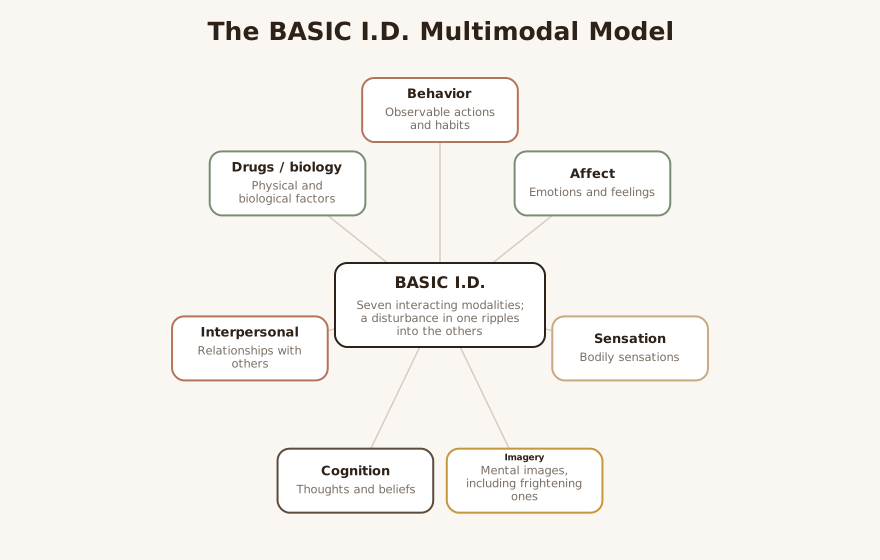
The foundational premise of multimodal assessment is that most psychological problems are multifaceted, multi-determined, and multilayered, and therefore require evaluation across several interacting dimensions 5. Lazarus operationalized this through the BASIC I.D.: Behavior, Affect, Sensation, Imagery, Cognition, Interpersonal relationships, and Drugs/biology 5. The seven modalities are treated as interactive rather than isolated, so a disturbance in one (for example, a frightening image) is expected to ripple into others (sensation, affect, behavior) 7.
The cardinal principle of technical eclecticism proper is that effective strategies are imported from diverse approaches without subscribing to the theories that spawned them 5. This is the line that separates it from theoretical integration, which attempts to blend the underlying theories themselves — an effort Lazarus explicitly rejected as combining frameworks that are often incompatible 57. A second principle is empirical primacy: multimodal therapists preferentially rely on empirically supported and evidence-based methods when addressing deficits across the BASIC I.D. 5.
A third principle is individualization over diagnosis. Because patients with identical diagnoses frequently present with very different symptom profiles, the framework aims to transcend diagnostic categories and tailor interventions to the person and the specific problem 56. The technical-eclectic clinician therefore asks not “what does my orientation prescribe?” but “what works best, for whom, under which conditions?” 6.
Interventions & Techniques
Multimodal therapy supplies several signature procedures that operationalize the framework 7. The Multimodal Life History Inventory (MLHI) is a structured instrument that surveys the client across the full BASIC I.D., reducing the session time otherwise spent gathering history and ensuring no modality is overlooked 7. Bridging is the practice of first meeting the client in their preferred modality before gradually shifting to others — for instance, allowing a cognitively oriented client to discuss thoughts before guiding them toward sensation and affect 7. Tracking the firing order identifies the characteristic sequence in which modalities activate during distress (e.g., sensation, then imagery, then behavior), so that interventions can be matched to that sequence 7. When treatment stalls, a second-order BASIC I.D. assessment applies the same analysis recursively to a single problem area, surfacing schemas or patterns missed on first pass 7.
Beyond these proprietary procedures, the actual techniques deployed are drawn from wherever the evidence points — clinicians prioritize empirically supported methods from cognitive-behavioral therapy and other evidence-based approaches, adapted to the individual’s needs and context 7. In systematic treatment selection, the matching itself is the intervention logic: the strategy is chosen to fit measured client characteristics rather than therapist allegiance 6.
LLM-generated illustrative example (not a guideline): A clinician completing a BASIC I.D. profile for a client with panic notes that episodes begin with a chest sensation, trigger a catastrophic image of collapse, then drive avoidance behavior. Recognizing this firing order, the clinician sequences interoceptive exposure (sensation), imagery rescripting (imagery), and graded behavioral exposure (behavior) — borrowing each technique on its empirical merits, not from a single school LLM.
Evidence Base
The maturity of technical eclecticism as an integration framework is best described as established: it is a long-standing, widely taught route to integration with decades of conceptual development and a recognized place in the integration literature 67. Its central methodological claim — preferring empirically supported methods and matching them to client and problem — is broadly consistent with the contemporary evidence-based-practice consensus 5.
Honesty about the evidence requires a distinction, however LLM. The framework is mature, but rigorous controlled outcome trials of multimodal therapy or technical eclecticism as a packaged whole are comparatively sparse relative to the manualized single-school treatments it borrows from LLM. Much of the support is conceptual, clinical-illustrative, or derived from the established efficacy of the imported component techniques rather than from head-to-head trials of the eclectic package itself 5LLM. Systematic treatment selection has accumulated more matching-focused research on dimensions such as coping style and reactance, but the practical effect sizes of prescriptive matching are modest and have been debated 6LLM. Clinicians should therefore present technical eclecticism to themselves as an evidence-informed organizing discipline, not as a separately validated brand-name therapy LLM.
Populations & Indications
Because it is technique-agnostic and individualizing, technical eclecticism is indicated wherever a single-school approach is a poor fit for the person in front of you LLM. It is applied across adults and, with developmental adaptation, children and adolescents 5LLM. It is particularly well suited to clients with comorbid conditions and heterogeneous presentations, where the multimodal premise — that problems are multilayered — most clearly applies 5. Couples work fits the framework naturally, since the Interpersonal modality and relational firing orders are explicit targets 7LLM.
It is frequently reached for with treatment-resistant or treatment-nonresponsive clients, where the second-order BASIC I.D. and a willingness to borrow from outside one’s home orientation give the clinician additional degrees of freedom 7LLM. Diagnostically, the approach has been used across mood, anxiety, and trauma presentations, and its diagnosis-transcending logic is meant precisely for cases where the label conceals wide variation in symptom profile 5.
Problems-for-Work
- Major depressive disorder. A BASIC I.D. profile may reveal that one client’s depression is driven chiefly by behavioral withdrawal and another’s by ruminative cognition, prompting behavioral activation for the first and cognitive restructuring for the second — same diagnosis, different technique selection 5LLM.
- Generalized anxiety disorder. Tracking the firing order can show whether worry begins in sensation, imagery, or cognition, allowing the clinician to lead with the matched technique rather than a fixed protocol 7LLM.
- PTSD. The imagery and sensation modalities make imagery rescripting and interoceptive/somatic work natural candidates to combine with cognitive and exposure methods 7LLM.
- Comorbid and personality-disordered presentations. The multilayered, multi-determined premise directly fits cases where several problems interact and no single manual covers the whole picture 5LLM.
- Relationship conflict. The Interpersonal modality and relational tracking guide couples interventions toward the specific interactional sequences maintaining distress 7LLM.
- Adjustment disorder and treatment nonresponse. Bridging and second-order assessment offer a structured way to re-engage clients who have stalled or who present with situationally driven, heterogeneous difficulties 7LLM.
Contraindications, Cautions & Cultural Humility
The chief professional caution is competence creep: technical eclecticism licenses borrowing techniques, but it does not license practicing them without training LLM. A technique imported “on its merits” still demands the same supervised competence, and ethical fidelity to the technique’s evidence-based delivery, that its home discipline requires LLM. Undisciplined eclecticism — grabbing techniques by intuition rather than by evidence and case formulation — is precisely the failure mode that systematic, empirically guided selection was designed to prevent 6LLM.
A second caution is theoretical coherence. Because the clinician sets aside the originating theories, the integrating logic must come from somewhere — for Lazarus, social-cognitive learning principles and the BASIC I.D. formulation supply that scaffolding, and abandoning it risks an incoherent grab-bag 7LLM. A third is that the modest effect sizes of prescriptive matching mean clinicians should hold their matching hypotheses lightly and revise them with data LLM.
On cultural humility: the BASIC I.D. is a structured lens, and its categories (especially Cognition, Imagery, and Interpersonal) carry culturally shaped content that the clinician must elicit rather than assume LLM. The framework’s individualizing, diagnosis-transcending stance is an asset here — it asks what is true for this person — but it places the burden on the clinician to surface the client’s own meanings, idioms of distress, and relational norms rather than reading them off a template 5LLM.
Treatment-Plan Suggestions & SMART Objectives
| Goal | SMART objective (example) | Mechanism |
|---|---|---|
| Complete a multimodal formulation | Within 2 sessions, complete a BASIC I.D. profile (and MLHI where appropriate) documenting at least one target in each of the 7 modalities | Structured cross-modal assessment surfaces multilayered, multi-determined problems 57 |
| Identify the firing order | Within 3 sessions, the client will name the modality sequence that initiates two recent distress episodes with 80% concordance across logs | Tracking matches intervention sequence to the client’s actual cascade 7 |
| Reduce depressive symptoms via matched technique | Over 8 weeks, reduce PHQ-9 by ≥5 points using the technique matched to the dominant modality (e.g., behavioral activation for behavioral withdrawal) | Empirically supported, individually matched method targets the driving modality 5 |
| Reduce anxiety with sequenced interventions | Within 6 weeks, the client will apply a matched coping skill at the first detected step of the worry firing order in ≥3 logged instances | Early-sequence intervention interrupts the modal cascade 7 |
| Engage via bridging | By session 4, the client will tolerate a shift from their preferred modality to one previously avoided in ≥2 sessions | Bridging builds alliance before cross-modal work 7 |
| Resolve a treatment impasse | Within 3 sessions of a plateau, complete a second-order BASIC I.D. on the stalled problem and revise the plan accordingly | Recursive assessment surfaces missed schemas/patterns 7 |
| Improve relational functioning | Over 8 weeks, the couple will reduce escalations by mapping and interrupting one interpersonal firing order, logged weekly | Interpersonal-modality tracking targets maintaining sequences 7 |
Common Misconceptions
- “Eclectic means undisciplined or anything-goes.” Technical eclecticism is the opposite: it is a systematic, empirically guided discipline for which technique to use, for whom, and when 67LLM.
- “It blends theories.” It does not — borrowing techniques without their parent theories is precisely what distinguishes technical eclecticism from theoretical integration 57.
- “It has no organizing framework.” Lazarus anchored it in social-cognitive principles and the BASIC I.D., so the technique selection is structured rather than ad hoc 7.
- “Multimodal therapy and technical eclecticism are the same thing.” Multimodal therapy is one (technically eclectic) clinical model; technical eclecticism is the broader selection stance that also includes approaches like systematic treatment selection 56LLM.
- “More techniques is better.” The aim is the right matched technique for the person and problem, not maximal breadth for its own sake 5LLM.
Training & Certification
Technical eclecticism is not a credentialed, certifying brand of therapy in the way some manualized models are; it is a stance taught within integration training and graduate clinical and counseling curricula 6LLM. Practically, developing it means first building solid competence in several evidence-based source modalities (cognitive-behavioral methods prominent among them) and then learning the selection discipline — formulation across modalities, matching to client variables, and outcome monitoring 76LLM.
Multimodal therapy specifically can be learned through Lazarus’s primers and inventories (notably the MLHI) and the associated literature, with supervised practice in bridging, tracking, and second-order assessment 17. Because borrowed techniques carry their own competence requirements, ongoing supervision and consultation are the realistic substitute for a single certifying pathway LLM.
Key Terms
- Technical eclecticism — selecting effective techniques from any orientation without adopting their underlying theories 57.
- Theoretical integration — by contrast, combining the theories themselves into a new framework 5.
- BASIC I.D. — the seven assessed modalities: Behavior, Affect, Sensation, Imagery, Cognition, Interpersonal relationships, Drugs/biology 5.
- Bridging — entering through the client’s preferred modality before moving to others 7.
- Firing order — the characteristic sequence in which modalities activate during distress 7.
- Second-order BASIC I.D. — recursive modal assessment of a stalled problem 7.
- Multimodal Life History Inventory (MLHI) — structured intake instrument covering the BASIC I.D. 7.
- Systematic treatment selection — Beutler’s prescriptive matching of strategies to client variables such as coping style and arousal 6.
- Common factors — shared healing elements across therapies (relationship, setting, rationale, ritual) 6.
Resources & Further Reading
▶ Watch — a video introduction to this concept:
- Lazarus, A. A. — Multimodal Therapy: A Primer (Zur Institute) 1
- Multimodal Therapy: A Unifying Approach to Psychotherapy — Psychology Today 5
- Integrative/Eclectic Therapy — Psychology iResearchNet 6
- Technical Eclecticism and Multimodal Therapy — Neupsy Key 7
Reflective / Supervision Questions
- When I selected my last “borrowed” technique, was the choice driven by evidence and case formulation, or by familiarity and orientation allegiance? LLM
- Can I articulate the firing order for my current client’s primary problem, and does my intervention sequence match it? LLM
- Where am I at risk of competence creep — using a technique I admire but have not been trained or supervised to deliver? LLM
- If I have set aside a technique’s parent theory, what coherent framework is actually organizing my case formulation? LLM
- For a client whose diagnosis I share with several others, what does the BASIC I.D. reveal that the diagnostic label conceals? 5LLM
- How am I checking whether my matching hypothesis is correct, given that prescriptive matching effects are modest? LLM
- Whose cultural meanings am I assuming when I fill in the Cognition, Imagery, and Interpersonal modalities — and how would I know if I were wrong? LLM