
Type & Discipline
Cyclical psychodynamics is a theory of personality and psychotherapy rather than a manualized treatment package 2. It sits within clinical psychology and psychoanalysis and is most precisely described as a relational-integrative psychodynamic framework 2. Its defining move is integrative: it melds psychodynamic, cognitive-behavioral, systemic, and experiential points of view, with its primary roots in the relational perspective within psychoanalysis 2. In the literature of psychotherapy integration it is treated as a worked example of an integrative relational psychotherapy rather than as a freestanding school 5. For the practicing clinician, the most useful framing is that cyclical psychodynamics is a formulation lens you bring to whatever individual or relational work you are already doing LLM.
Creators & Lineage
The theory is the work of Paul L. Wachtel, who holds an A.B. from Columbia University and a Ph.D. in clinical psychology from Yale University and is Distinguished Professor of Psychology in the doctoral clinical program at City College of New York 6. Wachtel’s 1977 book Psychoanalysis and Behavior Therapy: Toward an Integration challenged the traditional divisions among the schools and helped catalyze the broader psychotherapy-integration movement 6. He co-founded and served as past president of the Society for the Exploration of Psychotherapy Integration (SEPI), and his honors include the APA Distinguished Psychologist award 6. The full statement of the mature theory appears in his 2014 book Cyclical Psychodynamics and the Contextual Self and in the companion journal article “An integrative relational point of view” 42.
The intellectual lineage is explicit in the theory’s structure LLM. From psychoanalysis it takes unconscious conflict, defense, and the persistence of early-formed patterns 2. From the interpersonal tradition associated with Harry Stack Sullivan it takes the premise that anxiety and the self are constituted in relationship rather than in isolated drives LLM. From behavior therapy it takes a respect for observable behavior, environmental contingencies, and active techniques 6. From relational psychoanalysis and systemic thinking it takes the conviction that the therapeutic and extra-therapeutic fields are reciprocally implicated in both the maintenance and the change of patterns 2.
Core Principles
The central theoretical structure is a focus on the vicious and virtuous circles that perpetuate, or contribute to changing, personality patterns 2. Wachtel’s key claim is that such patterns may have originated in childhood but persist because they often generate the very feedback from others that is necessary to keep them going 2. In other words, the past is not preserved like a fossil to be excavated; it is continuously re-created in the present by ongoing interaction LLM.
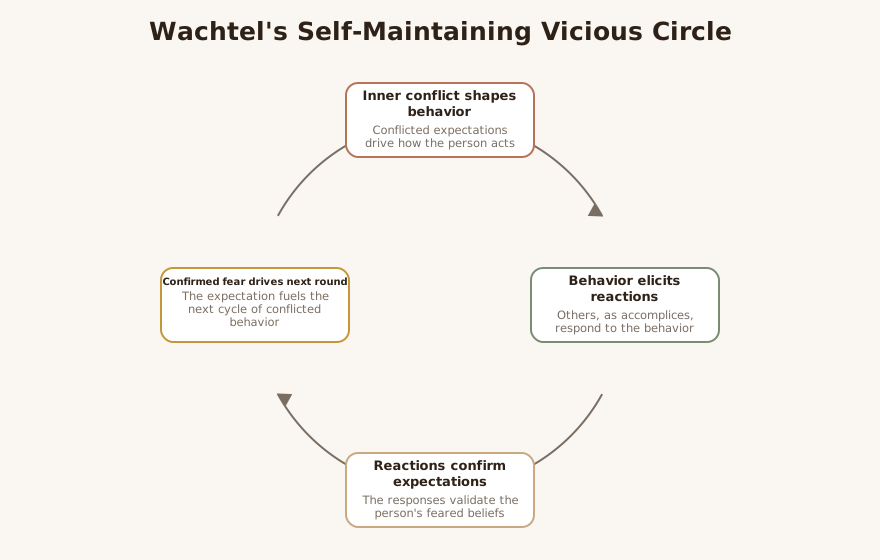
This reframes the relationship between inner and outer worlds LLM. Inner conflict shapes behavior; behavior elicits reactions from others; those reactions confirm the person’s feared expectations; and the confirmed expectation drives the next round of conflicted behavior LLM. The loop is closed and self-justifying, which is precisely why insight alone is often insufficient to break it LLM.
A distinctive corollary is the role of “accomplices” 1. The significant people in a client’s life are not neutral backdrops but active participants who, usually without intending to, keep the vicious circles running 1. APA’s account of the theory stresses that a client’s relationships both inside and outside the consulting room make a difference to treatment, and that therapy succeeds only when change occurs in relational contexts, because life is lived in relation to other people 1.
The “contextual self” is the second organizing idea: the self is understood across the inner world, the intimate world of close relationships, and the wider world of culture and society 4. The person is not a fixed entity with a buried true core but an emergent, relationally embedded process 4.
Interventions & Techniques
Because the theory locates pathology in self-maintaining loops, the therapeutic logic is to interrupt the loop at any accessible point rather than to insist on a single causal layer LLM. The relational approach therefore addresses, in equal and dynamically reciprocal fashion, both the therapeutic relationship in the consulting room and the key relationships outside it that maintain the problem 2.
Within sessions, the work retains a psychodynamic spine: attention to anxiety, conflict, defense, and what the relationship with the therapist reveals about the client’s characteristic patterns 2. Where cyclical psychodynamics departs from classical technique is its willingness to import active methods from behavior therapy, such as graded exposure to feared situations and assertiveness work, used not as separate “behavioral add-ons” but as ways of generating the new interpersonal experiences that disconfirm the feared expectation 6LLM. APA frames the aim as achieving corrective emotional experiences while fostering new patterns of interaction outside therapy 1.
A practical clinical task the theory prescribes is to map, with the client, who the accomplices are 1. Therapist and client analyze the client’s personality dynamics to identify the people in the client’s life who keep the vicious and virtuous circles going 1.
LLM-generated illustrative example (not a guideline): A client convinced that “people always pull away from me” speaks in a guarded, slightly accusatory tone when anxious. Colleagues, reading this as coldness, keep their distance, which the client experiences as proof of rejection. The cyclical-psychodynamic move is to surface the conflict driving the guarded tone, notice it live in the therapy relationship, and then rehearse and assign a more open relational behavior so that real-world responses begin to disconfirm the prophecy LLM.
Evidence Base
The honest label for the evidence base is established as a theory, not as a separately trialed brand of therapy LLM. Cyclical psychodynamics is established in the sense that it is a mature, widely cited, intellectually influential framework with a sustained literature, treated in major integration scholarship as a paradigmatic integrative relational model 52. Its standing rests on conceptual influence and clinical adoption rather than on a dedicated body of randomized controlled trials demonstrating efficacy under that name LLM.
This distinction matters for how clinicians represent the approach LLM. There is no “cyclical psychodynamics outcome literature” comparable to the RCT base for, say, CBT or IPT LLM. What does carry empirical support is the lineage it draws on: the active techniques it borrows from behavior therapy, such as exposure and assertiveness training, carry their own established behavior-therapy evidence, and the relational and psychodynamic processes it foregrounds overlap with mechanisms studied across the psychotherapies 6LLM. The theory is best understood as a well-developed organizing framework whose components are evidence-informed, not as a stand-alone empirically validated treatment LLM.
Populations & Indications
The theory was developed primarily for adults in individual psychotherapy and is explicitly relational, making it a natural fit for couples and for clients whose presenting difficulties are interpersonal 21. Because it foregrounds the relationships that maintain a pattern, it is especially indicated where the problem keeps reappearing across relationships, suggesting a self-perpetuating cycle rather than a discrete symptom 2.
Clinically, it suits clients with entrenched personality patterns, recurrent relationship problems, and self-defeating behavior, as well as anxiety, depression, and low self-esteem that are embedded in interpersonal context 2LLM. It can be a useful frame for adults with relational trauma and attachment difficulties, where early experience is understood as living on through current interactional loops rather than as a sealed historical event 2LLM. It is also well-suited to the insight-seeking psychotherapy patient who has gained understanding yet remains stuck, precisely the situation the theory predicts when accomplices keep the cycle going 1LLM.
Problems-for-Work
- Self-fulfilling prophecies / vicious cycles: the prototypical target; work names the loop, the feared expectation, and the behavior that recruits confirming feedback 2LLM.
- Interpersonal conflict and relationship problems: identify the partner or family members functioning as accomplices and the reciprocal behaviors each contributes 1.
- Self-defeating behavior patterns: treat the “self-defeat” as adaptive within the loop, then alter the behavior that elicits the defeating response LLM.
- Personality patterns / personality disorders: approach rigid character styles as continuously maintained rather than fixed, opening multiple points of intervention 2LLM.
- Anxiety and avoidance: combine dynamic exploration of the conflict with graded exposure so avoidance no longer protects the feared expectation 6LLM.
- Depression and low self-esteem: target the interpersonal feedback that confirms a depressive self-narrative 2LLM.
- Maladaptive relational schemas and attachment difficulties: use the therapy relationship and new outside experiences to generate disconfirming data 1LLM.
Contraindications, Cautions & Cultural Humility
There are no formal contraindications published for cyclical psychodynamics as such, because it is a formulation framework rather than a discrete procedure with its own risk profile LLM. The relevant cautions are inherited from its components LLM. Any active technique imported from behavior therapy, such as exposure, requires the standard safeguards: stabilization first where there is acute risk, and pacing that does not flood a dysregulated client LLM.
A specific ethical caution follows from the “accomplices” concept: framing partners or family members as maintainers of a cycle can slide into blame, including self-blame, if delivered without care LLM. The clinician should hold accomplices as part of a system, not as villains, and should be alert that some “vicious circles” are sustained by genuine external adversity rather than intrapsychic conflict LLM. Here Wachtel’s own broadening of the contextual self to include the world of culture and society is a corrective: relational patterns are situated within social and cultural conditions, which guards against locating all difficulty inside the individual 4. Cultural humility means asking whether a behavior that looks “self-defeating” is in fact an adaptive response to a hostile or unequal environment before treating it as an internal loop to be dismantled LLM.
Treatment-Plan Suggestions & SMART Objectives
| Goal | SMART objective (example) | Mechanism |
|---|---|---|
| Make the vicious cycle observable | Within 4 sessions, client will articulate one recurring interpersonal loop, naming the feared expectation, their behavior, and the typical reaction it elicits LLM | Builds metacognitive awareness so the pattern becomes a target rather than a fate 2 |
| Identify accomplices | By session 6, client will name 2-3 people who reinforce the pattern and describe each person’s reciprocal role 1 | Locates change leverage in the relational field, not only intrapsychically 1 |
| Generate a disconfirming experience | Over 8 weeks, client will complete a graded series of 3 assertive or approach behaviors and log others’ actual responses LLM | Exposure/assertiveness disconfirms the feared expectation through real new feedback 6 |
| Use the therapy relationship as data | Each session, therapist and client will notice and name one in-room enactment of the pattern LLM | Corrective emotional experience inside a safe relationship 1 |
| Reduce anxiety-driven avoidance | Within 6 weeks, client will reduce avoidance of one feared interpersonal situation by an agreed measure LLM | Interrupts the avoidance that protects the conflict from disconfirmation 6 |
| Revise the relational self-narrative | By week 12, client will state one updated belief about how others respond to them, supported by logged evidence LLM | Updates the maladaptive relational schema with lived data 2 |
| Generalize change outside therapy | Across treatment, client will report one new sustained interaction pattern with a key person 2 | Change endures only when it occurs in real relational contexts 1 |
Common Misconceptions
A first misconception is that cyclical psychodynamics is just psychoanalysis with behavioral techniques bolted on; in fact its integration is theoretical, treating the dynamic, behavioral, systemic, and experiential views as describing one reciprocal process rather than as separable toolkits 2LLM. A second is that it is a manualized, trial-validated therapy; it is more accurately an established theory and formulation framework 5LLM. A third is that it pursues a buried, timeless unconscious to be excavated; Wachtel’s emphasis is on how early patterns are kept alive by present feedback, shifting the clinical focus toward the current loop 2. A fourth is that “accomplices” means the client’s problems are someone else’s fault; the concept describes mutual maintenance within a system, not blame 1LLM. A fifth is that focusing on outside relationships neglects the transference; the theory insists on attending to in-room and out-of-room relationships in equal, reciprocal fashion 2.
Training & Certification
There is no proprietary certification or licensing body that credentials clinicians in cyclical psychodynamics, consistent with its status as a theory rather than a branded protocol LLM. The primary route to competence is the literature, beginning with Wachtel’s Cyclical Psychodynamics and the Contextual Self and the 2014 journal statement of the position 42. The natural professional home for this integrative tradition is the Society for the Exploration of Psychotherapy Integration (SEPI), which Wachtel co-founded and led 6. Clinicians already trained in psychodynamic, relational, or integrative psychotherapy, and competent in the borrowed behavioral techniques, are well positioned to apply the framework, ideally with supervision or consultation from an integrative-relational practitioner LLM.
Key Terms
- Vicious / virtuous circle: a self-reinforcing loop in which behavior generates the feedback that perpetuates (vicious) or transforms (virtuous) a personality pattern 2.
- Accomplices: the people in a client’s life who, usually unwittingly, keep the cycles going 1.
- Contextual self: the self understood across the inner world, the intimate world of relationships, and the world of culture and society 4.
- Integrative relational point of view: Wachtel’s melding of psychodynamic, cognitive-behavioral, systemic, and experiential perspectives on a relational foundation 2.
- Corrective emotional experience: a new relational experience, in or out of session, that disconfirms a feared expectation 1.
Resources & Further Reading
▶ Watch — a video introduction to this concept:
- Wachtel, P. L. (2014). An integrative relational point of view. Psychotherapy, 51(3), 342-349 (PubMed)
- Wachtel, P. L. (2014). An integrative relational point of view — full text PDF (Society for the Advancement of Psychotherapy)
- Wachtel, P. L. (2014). Cyclical Psychodynamics and the Contextual Self (Routledge)
- APA Spotlight: Cyclical Psychodynamics — A New Therapeutic Approach
- Cyclical Psychodynamics and Integrative Relational Psychotherapy — Handbook of Psychotherapy Integration (Oxford Academic)
- Paul L. Wachtel — Wikipedia
Reflective / Supervision Questions
- For a stuck case, what is the precise vicious circle, and where in the loop could a new experience be introduced? LLM
- Who are the accomplices in this client’s life, and can I describe their role without sliding into blame? LLM
- Where does this pattern show up between me and the client, and am I being recruited into the circle? LLM
- Am I treating an apparently self-defeating behavior as intrapsychic when it may be an adaptive response to real social or cultural adversity? 4LLM
- I have offered insight; what concrete new interaction would actually disconfirm the client’s feared expectation? LLM